Why Vocabulary Matters: The Research Case for Investing in Your Child's Words
Find your child’s vocabulary gaps
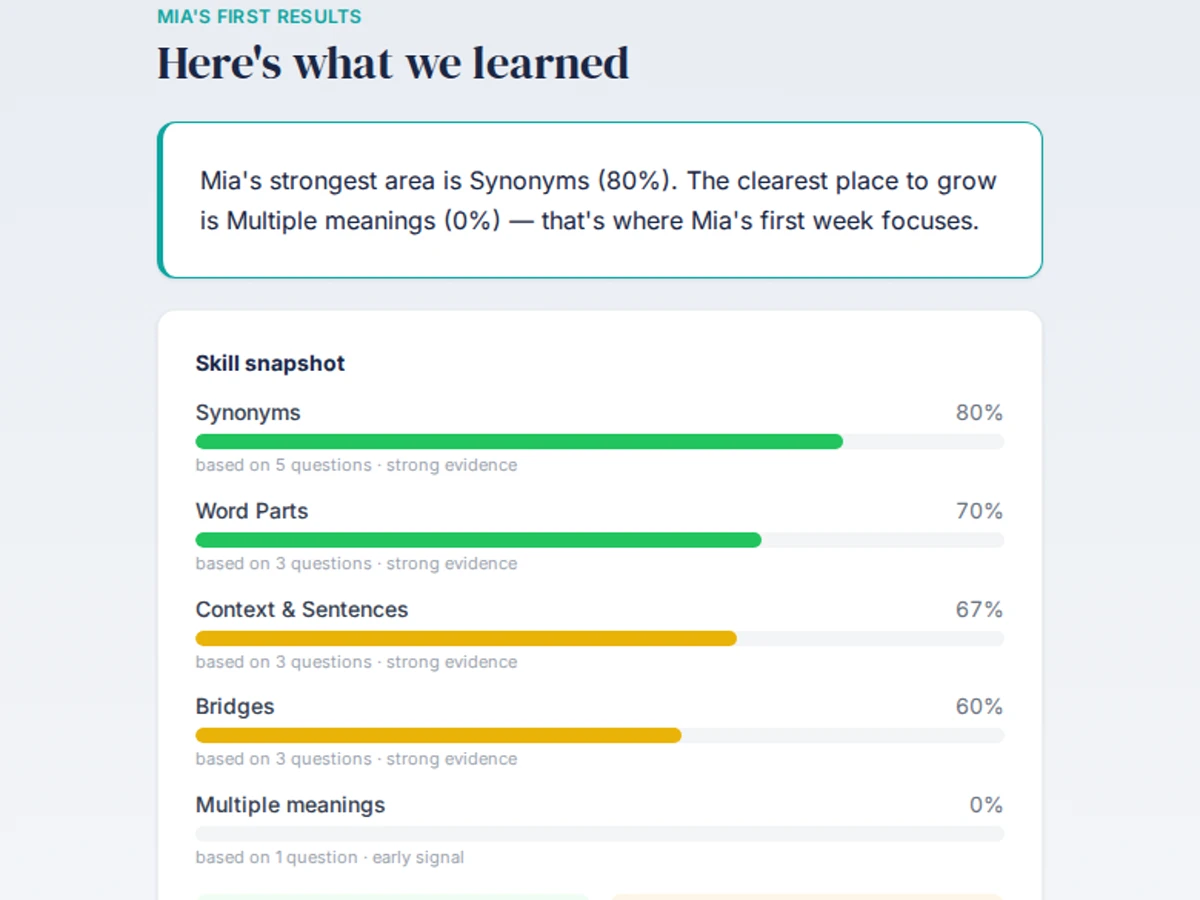
Start with a free, no-card vocabulary check-up and get a personalized parent report.
Find the vocabulary gaps — freeSee a sample parent report before starting
The check-up samples verbal skills and gives you an early strength, a growth area, and a first practice focus. It is not a full-length exam, an official SSAT or ISEE score, or an admissions prediction.
When a score report flags vocabulary as your child's weak spot, it is easy to file the problem under "test prep" — one more box to check before the SSAT or ISEE, then forget about once the scores are in.
That framing badly undersells what is happening. A growing body of research across economics, medicine, neuroscience, and education keeps arriving at the same conclusion: vocabulary is not merely a proxy for being a "good student." It is a causal mechanism — one of the levers through which people access opportunities, make better decisions, regulate their emotions, and accumulate advantage over a lifetime.
In other words, the words your child learns this year do not stop paying out when the test is over. They compound — across decades and across nearly every domain of adult life. This guide walks through what the evidence actually shows, and why building vocabulary early is one of the highest-return investments a parent can make.
Causation, Not Just Correlation
Everyone knows that strong students tend to have large vocabularies. The skeptical reply is that vocabulary is simply along for the ride — a side effect of being bright or well-schooled, not a cause of anything on its own.
The research tells a more interesting story. Using methods designed to separate cause from coincidence — instrumental-variable economics, longitudinal lifecycle models, randomized interventions, even fMRI — studies repeatedly find that vocabulary does work on its own:
- Financial literacy — the vocabulary of money — accounts for an estimated 30–40% of wealth inequality at retirement (Lusardi, Michaud & Mitchell, 2017).
- Low health literacy is associated with roughly 50% higher mortality (a hazard ratio near 1.50; Baker et al., 2007) — a larger effect than many of the risk factors doctors routinely warn us about.
- Metacognitive vocabulary — the words for how we think and learn — is linked to an average +7 to 8 months of additional academic progress, according to the Education Endowment Foundation's review of 355 studies.
These are not the fingerprints of a passive bystander. They are the fingerprints of a cause.
Three Ways Words Change Outcomes
If vocabulary is causal, how does it act? The research points to three broad mechanisms.
1. Access — words as the gate
Some words are the price of admission. If you do not know what an arbitration clause is, you can sign away your right to sue without ever realizing it. If you cannot navigate the language of a courtroom or a hospital, the system simply works less well for you. The starkest illustration: self-represented litigants secure favorable outcomes far less often than those who can speak the institution's language — in some studies 10% versus 40%. Vocabulary is the gatekeeper.
2. Decision — words as cognitive tools
Other words are tools for thinking. You cannot weigh compound interest if the idea has no name in your head. You cannot ask about a contraindication you have never heard of. Knowing the term base rate changes how you read a statistic. Each precise word your child owns is a concept they can reason with — and a category of mistakes they can avoid.
3. Regulation — words as a calming mechanism
The most surprising mechanism is neurological. Simply naming an emotion — "I feel resentful," rather than just "I feel bad" — measurably reduces activity in the amygdala, the brain's threat center (Lieberman et al., 2007). People with richer emotional vocabularies do not just describe their feelings better; their brains process those feelings differently. Here, the vocabulary is the intervention.
Eight Domains Where Vocabulary Pays Off
The reach is remarkably broad. A structured review of the literature identified eight distinct domains of adult life where vocabulary has measurable, independently documented effects:
- Professional & career — communication is the #1 employer-desired skill (73.4% of employers, NACE).
- Financial — financial literacy explains an estimated 30–40% of the retirement wealth gap.
- Health — low health literacy is tied to roughly 50% higher mortality and an estimated $236 billion a year in avoidable US costs.
- Legal & civic — self-represented litigants secure favorable outcomes far less often than the represented (in some studies, 10% versus 40%).
- Social — socially skilled jobs grew about 12 points of labor-market share between 1980 and 2012 (Deming, 2017).
- Emotional — naming feelings downregulates the amygdala (fMRI evidence).
- Academic — metacognition adds roughly 7–8 months of additional progress (355 studies).
- Digital — media-literacy training sharply reduced misinformation sharing (d ≈ 1.04).
No other single, teachable skill shows up this consistently across so many separate research traditions.
Vocabulary Is the Great Equalizer
There is an equity dimension worth naming plainly. Sociologists Basil Bernstein and Pierre Bourdieu described language as a form of capital — a resource that institutions quietly reward. Children who command the "elaborated code" (a wider, more precise, more explicit vocabulary) gain easier access to the schools, professions, and systems that run on it. Those who do not are held back by a barrier that is mostly invisible.
This cuts in a hopeful direction. Unlike many advantages, vocabulary is teachable. It is one of the few levers a family can actually pull to widen a child's access to opportunity — which is exactly why investing in it early matters so much.
From the SSAT to the Boardroom
Even viewed narrowly as "career readiness," the case is strong. Communication tops employer wish-lists year after year (73.4% of employers, NACE). English-language proficiency is associated with salary premiums of up to 80% in some global analyses. The Academic Word List — about 570 word families — covers roughly 10% of the words in academic and professional texts; a child who owns it reads the adult world more fluently.
The point is continuity. The same word-decoding muscle that helps your child reason through an unfamiliar SSAT analogy will, fifteen years later, help them parse a contract, a prospectus, or a diagnosis. Vocabulary is the rare test-prep investment that keeps paying long after the test.
What This Means for Your Child's Prep
If vocabulary matters this much — and compounds for this long — two things follow.
First, it deserves real, sustained attention, not a frantic week of flashcards before test day. Word knowledge is built through repeated, spaced encounters over months; it cannot be crammed. We unpack the timeline in when to start verbal test prep and the memory science in spaced repetition for kids.
Second, how you build it matters. Memorizing isolated word lists is slow; learning the roots and patterns beneath words turns vocabulary into a system your child can extend on their own — see the complete list of Latin and Greek roots and why root-based learning beats flashcards.
This is the conviction behind LexiMap: treat vocabulary as a high-return, lifelong investment, and build it the way the research says it actually sticks. Vocabulary Knowledge is Domain 1 of the five verbal domains LexiMap trains — and the full research advantage described above unfolds when your child pairs it with Relational Reasoning, Contextual Inference, Test Execution, and Metacognition.
Key Takeaways
- Vocabulary is causal, not just correlated — it shows up in instrumental-variable, longitudinal, and fMRI studies, not only in test scores.
- It acts through three mechanisms: access (gatekeeping), decision (cognitive tools), and regulation (calming the brain).
- The effects span eight domains of adult life, from wealth and health to careers and emotional wellbeing.
- Because vocabulary is teachable, it is one of the most powerful equalizers a family can invest in.
- The skill that lifts an SSAT score is the same one that pays off for decades — so build it early, and build it on roots.
Further reading:
- When to Start Verbal Test Prep
- Spaced Repetition for Kids
- The Complete List of Latin and Greek Roots
- Vocabulary Building for Entrance Exams
Get SSAT/ISEE vocabulary resources by email
Related Articles
Does Vocabulary Affect Test Scores? What the Research Actually Shows
A clear-eyed look at the evidence linking vocabulary to academic achievement, reading comprehension, and beyond — what's well-supported, what's overstated, and why it matters for test prep.
8 Ways a Strong Vocabulary Shapes Your Child's Future
Beyond test scores: the eight domains of adult life — from health and wealth to careers and emotional wellbeing — where research shows vocabulary makes a measurable difference.
How Words Shape Your Child's Brain: The Neuroscience of Vocabulary
Vocabulary isn't just labels for things your child already understands — naming a concept changes how the brain processes it. The research on how words drive access, decisions, and even emotional regulation.
The Vocabulary Gap: Why Words Are Your Child's Greatest Equalizer
Vocabulary quietly opens — or closes — doors to schools, professions, and institutions. Why the word gap is one of the few advantages families can actually close, and how to start.
Related Guides
SSAT Vocabulary: The Complete Guide to Root-Based Learning
Master SSAT vocabulary through Latin and Greek roots. Learn how root-based learning, spaced repetition, and interactive practice build lasting verbal skills for grades 4-12.
Root Words for SSAT & ISEE: The Complete Study Guide
The definitive guide to Latin and Greek root words for SSAT and ISEE preparation. Curated root set, study strategies, grade-level timelines, and practice exercises for grades 4-12.
SSAT® is a registered trademark of The Enrollment Management Association. ISEE® is a registered trademark of the Educational Records Bureau (ERB). LexiMap is not affiliated with or endorsed by these organizations.