8 Ways a Strong Vocabulary Shapes Your Child's Future
Find your child’s vocabulary gaps
Start with a free, no-card vocabulary check-up and get a personalized parent report.
Find the vocabulary gaps — freeSee a sample parent report before starting
The check-up samples verbal skills and gives you an early strength, a growth area, and a first practice focus. It is not a full-length exam, an official SSAT or ISEE score, or an admissions prediction.
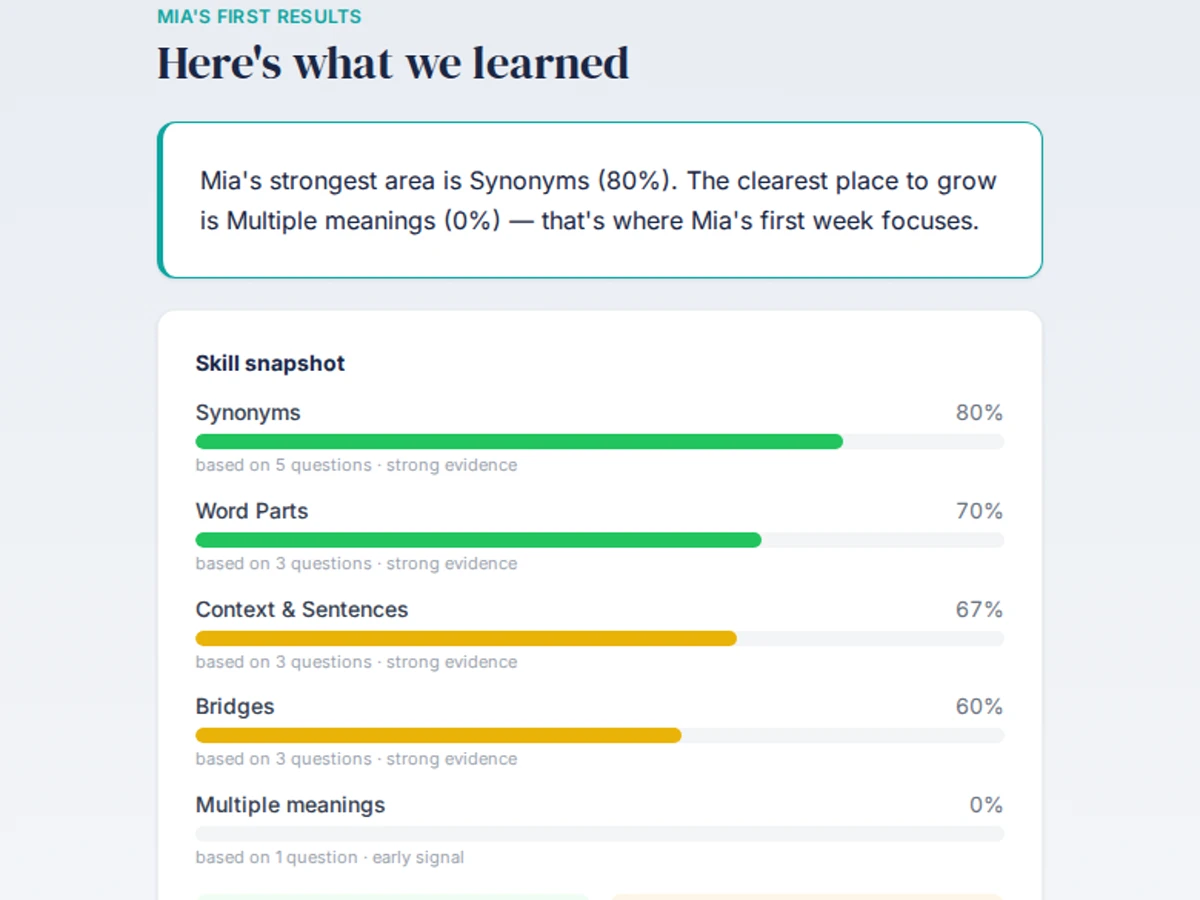
Most parents who arrive at vocabulary practice arrive via a test score. The SSAT flags "verbal reasoning." The ISEE shows a gap in sentence completions. The instinct is to patch the gap and move on.
That instinct underestimates what is actually at stake. As the research case for vocabulary investment shows, word knowledge is not just a test-prep variable — it is a causal mechanism that shows up, independently documented, across nearly every domain of adult life.
This page goes one level deeper than the overview. Below is a summary table of eight domains where vocabulary has measurable effects, followed by a short section on each: what the research found, how the mechanism works, and what it means for your child specifically.
The Eight Domains at a Glance
| Domain | Headline finding |
|---|---|
| Professional & career | #1 employer-desired skill (73.4% of employers, NACE) |
| Financial | 30–40% of the retirement wealth gap (Lusardi 2017) |
| Health | ~50% higher mortality with low literacy (Baker 2007); ~$236B/yr US cost |
| Legal & civic | 10% vs. 40% favorable outcomes when self-represented |
| Social | +12 points of labor-market share for social-skill jobs (Deming 2017) |
| Emotional | naming feelings downregulates the amygdala (Lieberman 2007) |
| Academic | +7–8 months of progress from metacognition (355 studies, EEF) |
| Digital | media-literacy training cut misinformation sharing (d ≈ 1.04, Huang 2024) |
1. Professional & Career
According to the National Association of Colleges and Employers (NACE), communication is the single most desired skill among employers — cited by 73.4% of hiring organizations, ahead of teamwork, problem-solving, or technical competence. Research by Pearson links English-language proficiency to salary premiums of up to 80% in global analyses, independent of educational attainment.
The mechanism is participation: specialized vocabulary is the price of admission to a profession's community of practice. You cannot negotiate effectively in terms you have never learned, advocate for a team, or write a proposal that moves people if you are reaching for words that aren't there.
What it means for your child: The vocabulary they build in grades 5–10 is not just preparation for a test question — it is the foundation of the professional register they will need to enter and advance in any field.
2. Financial
Economists Lusardi, Michaud, and Mitchell (2017) used a lifecycle simulation model to estimate that financial literacy — the vocabulary of money — accounts for roughly 30–40% of the wealth gap at retirement. PISA 2022 data makes the starting point concrete: only 13% of US 15-year-olds could correctly explain "diversification," and only 22% knew what "compound interest" meant.
The mechanism is decision-quality. You cannot weigh a risk you cannot name. Concepts like compound interest, amortization, or fiduciary duty are not jargon — they are cognitive tools that determine whether a person can evaluate a mortgage, a credit card offer, or a retirement plan on its actual terms.
What it means for your child: Financial literacy starts with financial vocabulary. A teenager who owns these terms enters adulthood with a decision-making advantage that compounds for decades.
3. Health
Baker and colleagues (2007) tracked a large cohort of Medicare enrollees and found that individuals with low health literacy had roughly 50% higher mortality — a hazard ratio near 1.50 (95% CI: 1.24–1.81) — than those with adequate literacy, after controlling for demographics and health status. The Milken Institute (2022) estimated the systemic cost of low health literacy at approximately $236 billion per year in the United States alone.
The mechanism is self-advocacy and comprehension. A patient who cannot parse a discharge summary, understand what a contraindication means, or ask an informed follow-up question is navigating a complex system with a significant handicap.
What it means for your child: Health literacy is built over years, not acquired in a waiting room. Children who develop precise language habits now will be better equipped to manage their own health — and advocate for family members — for the rest of their lives.
4. Legal & Civic
The consequences of legal vocabulary gaps are unusually stark because they show up in outcome data. Studies cited by the Department of Justice found that self-represented individuals in immigration proceedings secured favorable outcomes about 10% of the time; those with legal representation succeeded roughly 40% of the time. Research from Temple University found an even sharper disparity in protective-order proceedings: 32% versus 83%.
The mechanism is access. Contracts, waivers, regulatory filings, and court procedures are written in a specialized register. Those who can read that register can navigate — and challenge — institutions. Those who cannot are systematically disadvantaged, often without knowing what they are signing away.
What it means for your child: Civic and legal vocabulary is not just for lawyers. It is what allows any adult to be a full participant in the systems that govern their life — from leases to employment agreements to voting on ballot measures.
5. Social
Economist David Deming (2017), writing in the Quarterly Journal of Economics, tracked the composition of the US labor market from 1980 to 2012 and found that jobs requiring strong social and verbal skills grew by approximately 12 percentage points of total labor-market share — while purely cognitive jobs that do not require social interaction declined.
The mechanism is that verbal fluency enables coordination. Effective collaboration, persuasion, conflict resolution, and cross-cultural communication all run on language. As automation handles more routine cognitive tasks, the distinctly human work that remains is disproportionately verbal and relational.
What it means for your child: The economy your child will enter rewards articulate, socially fluent people more than the economy of a generation ago did. That is not soft — it is structural.
6. Emotional
In a landmark neuroimaging study, Lieberman and colleagues (2007) found that simply labeling an emotion — putting the precise word "anxious" or "resentful" to a feeling, rather than just registering distress — measurably reduced activity in the amygdala, the brain's threat-detection center. A richer emotional vocabulary is not just more expressive; it is neurologically regulatory. Research by Neff (2023) in the Annual Review of Psychology found that self-compassion — which depends on having language for one's own inner states — was associated with reduced depression at d = 0.64.
The mechanism is affect labeling: naming a feeling gives the prefrontal cortex a handle on the experience, reducing the intensity of the emotional response. Emotional vocabulary is not metaphorical — it is functional brain architecture.
What it means for your child: Children who develop a precise emotional vocabulary are better equipped to regulate under pressure — including during high-stakes tests, difficult conversations, and the inevitable setbacks of adolescence.
7. Academic
The Education Endowment Foundation's synthesis of 355 studies found that explicit metacognitive instruction — teaching children to monitor, plan, and reflect on their own learning using the vocabulary of cognition — produces an average of +7 to 8 months of additional academic progress. A separate meta-analysis across 47 studies found that critical-thinking ability was associated with academic achievement at d = 0.428.
The mechanism is self-regulation. Students who have words for what they are doing when they study — retrieval, elaboration, monitoring, interleaving — can apply those strategies intentionally. Vocabulary here is not the object of learning; it is the instrument of learning.
What it means for your child: Metacognitive vocabulary is one of the highest-leverage things to develop during the school years. A child who can accurately name what they understand and what they don't learns more efficiently from every hour they invest.
8. Digital
A 2024 meta-analysis by Huang and colleagues, covering 49 studies, found that media-literacy interventions — training people in the vocabulary and concepts needed to evaluate digital sources — reduced misinformation sharing with an effect size of d ≈ 1.04, among the largest effects in the behavioral science literature on this problem.
The mechanism is inoculation. People who have concepts like "source credibility," "confirmation bias," and "algorithmic amplification" can name the threat when they encounter it. Naming it creates the pause needed to evaluate rather than react.
What it means for your child: Digital literacy is not a technical skill — it is a vocabulary skill. Children who learn to interrogate information with precise language are better equipped to navigate an information environment designed to exploit fast, unconsidered reactions.
The Through-Line
These are not eight separate skills to teach in eight separate subjects. They are eight payoffs of the same underlying habit: building a large, precise, actively used vocabulary.
The same lexical depth that helps a child reason through an unfamiliar analogy on the SSAT is what will help them, fifteen years later, read a health-insurance summary, evaluate a financial product, or navigate a workplace negotiation. Word knowledge does not expire at test day — it compounds across every domain listed above.
That is the argument made in depth in Why Vocabulary Matters, and it is confirmed from a different angle in Does Vocabulary Affect Test Scores? — the short answer is yes, but the test is not the ceiling of the return.
LexiMap is built on this exact premise: vocabulary trained through roots, spaced repetition, and mastery-based practice is not a test-prep investment. It is a lifetime one. Vocabulary Knowledge is the on-ramp — Domain 1 of the five verbal domains LexiMap trains — but the full advantage across the eight domains above comes from pairing it with Relational Reasoning, Contextual Inference, Test Execution, and Metacognition.
Key Takeaways
- Vocabulary effects are documented across eight independent domains — professional, financial, health, legal, social, emotional, academic, and digital — each with its own research tradition and outcome measures.
- The mechanisms differ by domain — access, decision-quality, neurological regulation, system navigation — but the underlying lever is the same: precise word knowledge.
- The stakes are asymmetric: the costs of vocabulary gaps show up in mortality data, wealth gaps, and legal outcomes — not just test scores.
- Many of the effects compound over time, which means early investment returns more than late remediation.
- Vocabulary is teachable, making it one of the rare interventions where a parent's choices during the school years translate directly into measurable adult advantage.
Further reading:
Get SSAT/ISEE vocabulary resources by email
Related Articles
Does Vocabulary Affect Test Scores? What the Research Actually Shows
A clear-eyed look at the evidence linking vocabulary to academic achievement, reading comprehension, and beyond — what's well-supported, what's overstated, and why it matters for test prep.
From SSAT to SAT to Career: Why Vocabulary Is the Gift That Keeps Giving
The vocabulary your child builds for the SSAT doesn't expire after test day — it compounds through the SAT, college, and a career. The research on vocabulary as a lifelong return.
Why Vocabulary Matters: The Research Case for Investing in Your Child's Words
Vocabulary isn't just a test-score booster — research links it causally to health, wealth, careers, and emotional wellbeing. Why word knowledge is one of the highest-return investments a parent can make.
How Words Shape Your Child's Brain: The Neuroscience of Vocabulary
Vocabulary isn't just labels for things your child already understands — naming a concept changes how the brain processes it. The research on how words drive access, decisions, and even emotional regulation.
Related Guides
SSAT Vocabulary: The Complete Guide to Root-Based Learning
Master SSAT vocabulary through Latin and Greek roots. Learn how root-based learning, spaced repetition, and interactive practice build lasting verbal skills for grades 4-12.
Root Words for SSAT & ISEE: The Complete Study Guide
The definitive guide to Latin and Greek root words for SSAT and ISEE preparation. Curated root set, study strategies, grade-level timelines, and practice exercises for grades 4-12.
SSAT® is a registered trademark of The Enrollment Management Association. ISEE® is a registered trademark of the Educational Records Bureau (ERB). LexiMap is not affiliated with or endorsed by these organizations.