The Parent's Complete Guide to SSAT & ISEE Prep
Find your child’s vocabulary gaps
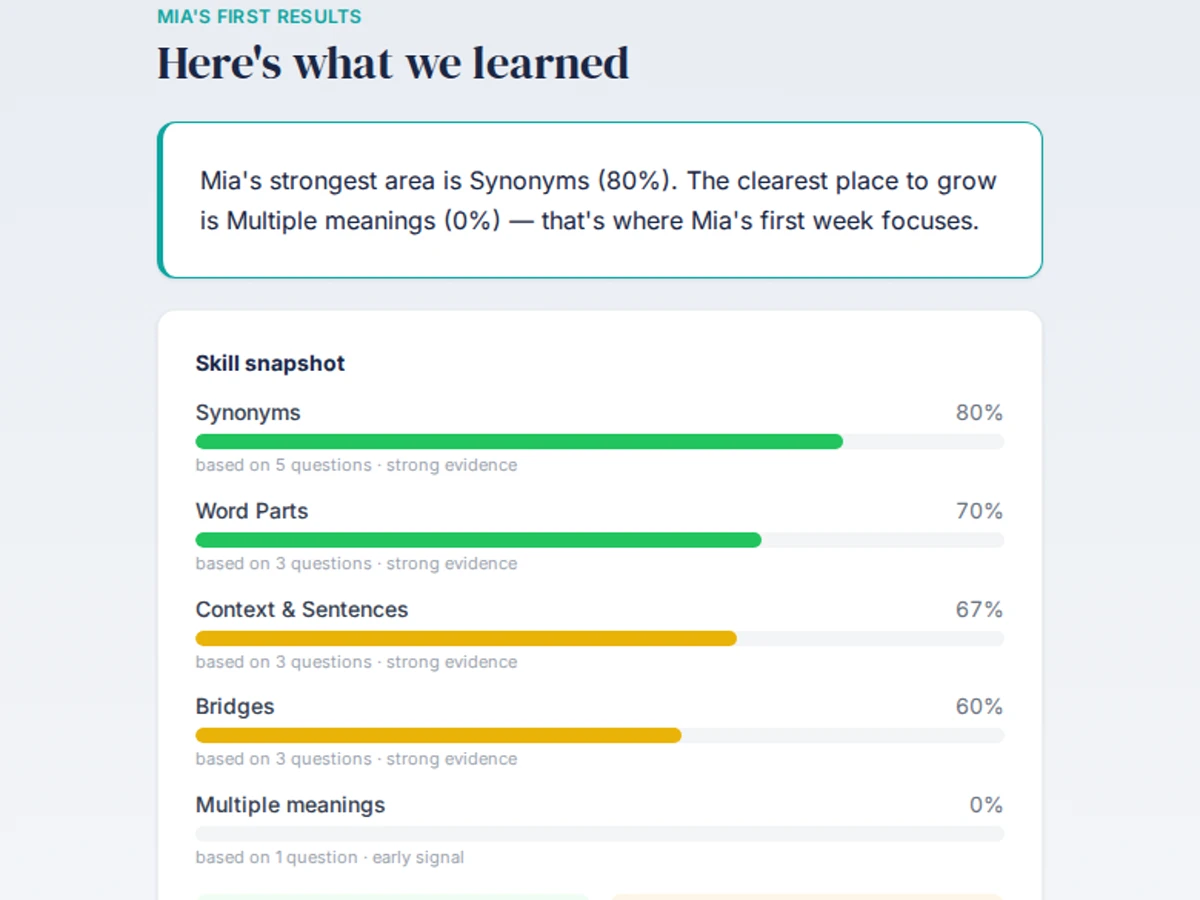
Start with a free, no-card vocabulary check-up and get a personalized parent report.
Find the vocabulary gaps — freeSee a sample parent report before starting
The check-up samples verbal skills and gives you an early strength, a growth area, and a first practice focus. It is not a full-length exam, an official SSAT or ISEE score, or an admissions prediction.
If you are reading this, you are probably not looking for another vocabulary worksheet. You are the parent managing your child's independent school admissions process, and you need a clear, honest overview of what SSAT and ISEE preparation actually involves — what the tests measure, when to start, which strategies work, and where your time and money are best spent.
This guide is written for you, not for your child. It assumes no prior familiarity with standardized testing terminology and covers both the SSAT and ISEE in a single resource because the preparation principles overlap almost entirely. By the end, you will have a concrete framework for making decisions about timing, tools, and daily routines — without needing to become a test prep expert yourself.
The verbal section is where most families focus their prep energy, and for good reason. Math and reading scores tend to cluster tightly among competitive applicants, but vocabulary scores vary widely. The difference often comes down to preparation method. This guide will help you choose the right one.
SSAT vs ISEE: Which Test Does Your Child Need?
The first decision is which test to take. Many independent schools accept both the SSAT and the ISEE, so check your target schools' admissions pages before committing to one. If a school accepts both, choose the format that plays to your child's strengths. Here is how the verbal sections compare:
| Feature | SSAT | ISEE |
|---|---|---|
| Question types | Synonyms + Analogies | Synonyms + Sentence completions |
| Wrong-answer penalty | Yes (quarter-point deduction) | No penalty |
| Guessing strategy | Eliminate 1+ choice, then guess | Always guess (no penalty) |
| Levels | Elementary, Middle, Upper | Primary, Lower, Middle, Upper |
| Can retake? | Yes (up to 8x per year) | Once per testing season |
| Vocabulary source | Latin/Greek root pool | Latin/Greek root pool |
The key takeaway: both tests draw vocabulary from the same Latin and Greek root pool. A child who learns roots well is prepared for either exam. The SSAT's analogy section rewards relational reasoning (understanding how word pairs connect), while the ISEE's sentence completion section rewards contextual inference (using surrounding words to determine meaning). Both skills improve with root-based study. For a detailed breakdown of the SSAT verbal section specifically, see our SSAT verbal section breakdown. For ISEE-specific preparation strategies and sentence completion techniques, see our ISEE vocabulary guide.
Understanding What the Verbal Section Tests
Many parents assume the verbal section is a memorization test — that students simply need to know more words. That is only partially true. The verbal section actually tests three distinct cognitive skills:
- Structural word knowledge: Can the student break a word into meaningful parts? A student who encounters "magnanimous" on the test and recognizes magn (great) and anim (spirit, mind) can infer "great-spirited" — generous, noble — even if they have never seen the word before.
- Relational reasoning: Can the student identify how two words relate to each other? Analogy questions on the SSAT test this directly. If bene means good and mal means bad, then benevolent relates to malevolent the same way benefit relates to malice.
- Contextual inference: Can the student use surrounding information to narrow down an unfamiliar word's meaning? Sentence completion questions on the ISEE test this skill, and even SSAT synonym questions involve eliminating answer choices through partial knowledge.
This is why root-based preparation outperforms word list memorization. Word lists only address the first skill, and even then only through rote association rather than structural understanding. Root-based learning builds all three skills simultaneously: students learn to decompose words (structural knowledge), connect word families (relational reasoning), and apply partial root knowledge to unfamiliar contexts (contextual inference). For a deeper look at this approach, see our complete SSAT vocabulary guide.
When to Start Preparing
Timing depends on your child's grade level and current vocabulary strength. Here are research-informed guidelines:
Elementary Level (Grades 3-4)
Start 3 to 6 months before test day. Focus on high-frequency roots and common prefixes. Daily sessions of 10 to 15 minutes.
Middle Level (Grades 5-7)
Start 4 to 8 months before test day. Build complete root families and practice analogy relationships. Daily sessions of 15 to 20 minutes.
Upper Level (Grades 8-11)
Start 6 to 12 months before test day. Master all 50+ core roots, advanced Greek forms, and context-based decoding. Daily sessions of 20 to 30 minutes.
One critical distinction: vocabulary preparation should start earlier than test-format practice. Root learning is cumulative and benefits from longer timelines with spaced repetition. Test-format practice (timed sections, bubble sheets, pacing strategies) is most productive in the final 4 to 6 weeks when vocabulary foundations are already in place. Starting format practice too early — before the vocabulary base is solid — leads to frustration and wasted time. For detailed grade-by-grade timelines, see our guide on when to start SSAT prep.
The 5 Most Effective Study Strategies
Not all study methods produce equal results. These five strategies, ranked by impact, form the foundation of effective verbal preparation for both the SSAT and ISEE.
1. Root-Based Vocabulary Learning
This is the single highest-leverage strategy. Over 60% of English words have Latin or Greek roots, and up to 90% of academic vocabulary is Latin/Greek-derived (Rasinski et al., 2008). The SSAT and ISEE draw heavily from this vocabulary. Each root unlocks 8 to 12 derived words. Mastering 50 core roots gives structural access to 400 to 600 words — not through memorization, but through understanding. A student who knows spec (look) can decode spectacle, inspect, retrospect, circumspect, and suspect. That is five words from one root, and the student can identify the root's contribution to meaning in each case. For a full root reference organized by test level, see our root words study guide.
2. Spaced Repetition (FSRS)
The brain forgets new information in a predictable decay curve. Spaced repetition counters this by scheduling reviews at increasing intervals, timed to arrive just before the memory would fade. Modern algorithms like FSRS (Free Spaced Repetition Scheduler) optimize intervals based on individual performance data, achieving higher retention with fewer total reviews than older methods. The practical implication: 10 minutes of spaced review daily produces dramatically better retention than 60 minutes of massed study weekly. Learn how this works in our methodology overview.
3. Multi-Format Practice
Recognizing a root on a flashcard is not the same skill as identifying it within an unfamiliar test word. Effective preparation practices root knowledge across multiple cognitive formats: recognition (match root to meaning), construction (build words from root parts), derivation (given one word, generate related words from the same root), context (identify word meaning within a sentence), and analogy (identify parallel relationships between word pairs). Each format strengthens a different aspect of root knowledge, and together they build the flexible word-analysis skill that both tests demand.
4. Daily Consistency Over Weekend Cramming
Memory consolidation happens during sleep and in the intervals between study sessions. A student who practices 15 minutes daily for six days (90 total minutes) will retain significantly more than one who studies 90 minutes on Saturday. This is not a preference — it is how human memory works. The spacing effect is one of the most replicated findings in cognitive science. The single most important thing you can do as a parent is help your child establish a daily practice routine, even when it is short.
5. Practice Tests for Format Familiarity
Practice tests serve a specific and limited purpose: they familiarize your child with the test format, pacing, and question types. They are not effective as a primary study tool for vocabulary building. A student who takes five practice tests without doing vocabulary work between them will score roughly the same each time. Use practice tests strategically — one at the start of prep to establish a baseline, one midway to check progress, and one to two in the final weeks for timing practice. The real vocabulary growth comes from daily root-based study between those tests.
Build your child's vocabulary foundation
LexiMap covers all five strategies in one app: Latin and Greek root-based learning, FSRS spaced repetition, 18 game modes, and daily practice in 10 to 20 minutes. Start with a free, no-card check-up.
Take a real timed section — freeCommon Mistakes Parents Make
Even well-intentioned families fall into preparation traps. Recognizing these patterns early can save months of wasted effort.
Starting Too Late
The most common mistake is beginning verbal preparation 4 to 6 weeks before the test. Vocabulary acquisition requires long-term memory formation, and long-term memory requires spaced repetition over months, not weeks. If your child's test date is less than 8 weeks away and they have not started verbal prep, focus narrowly on the 15 to 20 highest-frequency roots and common prefixes rather than trying to cover everything. Depth beats breadth when time is short.
Over-Relying on Practice Tests
Some families buy a stack of practice test books and treat test-taking as the primary study method. Practice tests measure current knowledge — they do not build new knowledge. A student who takes a practice test, reviews the answers, and then takes another practice test is mostly testing the same existing vocabulary pool. The growth comes from structured vocabulary study between tests. Use practice tests as checkpoints, not as curriculum.
Letting the Child Cram Instead of Practicing Daily
Children, especially older students, often prefer to defer studying until the weekend and then do a long session. This approach feels productive in the moment but produces weak retention. The cramming illusion — feeling confident right after a study session — disappears within days. Daily sessions of 10 to 20 minutes with spaced review intervals will outperform weekly 90-minute sessions every time. Your role as a parent is to help establish and protect that daily routine.
Using Word Lists Without Structural Framework
Word lists are everywhere: "500 SSAT words," "top 200 ISEE vocabulary words." These lists are not useless, but they are insufficient as a standalone strategy. A student who memorizes "magnanimous = generous" without understanding that magn means great and anim means spirit has learned one word. A student who learns the roots has learned a structural principle that applies to magnify, magnitude, animate, equanimity, and dozens of other words. For a deeper comparison of these approaches, see our post on roots versus flashcards.
Not Tracking Progress
Without a way to measure progress, families often drift. The child studies for a few weeks, feels uncertain whether it is working, loses motivation, and stops. Effective preparation includes some form of progress tracking — whether it is a practice test score comparison, a root mastery checklist, or an app dashboard that shows retention rates. Visibility into progress maintains motivation for both the child and the parent.
How to Interpret SSAT and ISEE Scores
Score reports can be confusing. Here is what each number means and what actually matters for admissions.
SSAT Scores
The SSAT produces three numbers per section: a raw score (total correct minus quarter-point penalty for wrong answers), a scaled score (ranging from 440 to 710 for Middle and Upper levels), and a percentile rank (how your child compares to other test-takers at the same grade level over the past three years). Admissions committees focus primarily on percentile rank. A score in the 75th percentile is generally competitive at selective schools. The most competitive programs look for 85th percentile and above. Scores at the 95th percentile and higher place students in the top tier.
ISEE Scores
The ISEE reports a scaled score (range varies by level), a percentile rank (1 to 9 stanine scale), and a stanine (a standardized nine-point scale where 5 is average). Schools typically want to see stanines of 7 or above for competitive admissions. The ISEE percentile compares your child to the norming group for their grade level.
What to Focus On
Do not panic about any single score. Look at trends across practice tests and, if your child takes the SSAT more than once, across administrations. A student who scores in the 60th percentile on a baseline practice test and reaches the 80th percentile after three months of root-based study has made excellent progress — even though 80th percentile is not "perfect." Schools value strong trajectories, and the verbal score is the section most responsive to targeted preparation.
Supporting Your Child Without Being a Tutor
You do not need to teach vocabulary yourself. In fact, parents who try to become the daily vocabulary tutor often create unnecessary stress for both themselves and their child. Your role is to create the conditions for consistent, low-friction practice. Here is what that looks like:
- Set a daily practice time. Anchor it to an existing routine — right after school, before dinner, or after breakfast on weekends. Consistency matters more than duration. Even 10 minutes daily is sufficient at younger levels.
- Use tools with built-in structure. Apps with spaced repetition, progress tracking, and adaptive difficulty remove the burden of designing study sessions. You should not need to decide what your child studies each day — the tool should handle sequencing.
- Check the dashboard, not the homework. Instead of quizzing your child on vocabulary, review their progress metrics weekly. Are they practicing daily? Is their retention rate improving? Are they advancing to new material? These metrics tell you more than any spot-check quiz.
- Celebrate consistency, not just scores. Praise the daily practice habit rather than fixating on test scores. A child who practices every day for 12 weeks builds a much stronger vocabulary foundation. A child who is anxious about scores will start avoiding practice.
- Do not over-schedule. If your child has school, sports, music lessons, and a tutor, adding 60 minutes of vocabulary homework will backfire. The sweet spot is 10 to 20 minutes of focused daily practice. Protect that time rather than trying to expand it.
Tools and Resources
There is no single tool that covers everything. Effective preparation typically combines a vocabulary-building tool with practice test materials:
- For vocabulary and root learning: LexiMap teaches Latin and Greek roots through interactive game modes with FSRS spaced repetition, designed specifically for SSAT and ISEE preparation. It handles daily sequencing, progress tracking, and adaptive review.
- For practice tests: Official SSAT practice tests from the Enrollment Management Association and official ISEE practice materials from ERB provide the most accurate simulation of test-day conditions.
- For supplementary reading: Regular reading of age-appropriate challenging texts (quality newspapers, literary fiction, nonfiction) exposes students to vocabulary in natural context, reinforcing root knowledge organically.
For a detailed comparison of vocabulary apps and study tools, see our best SSAT vocabulary apps review.
Frequently Asked Questions
How much should my child study per day?
For vocabulary specifically, 10 to 20 minutes of focused daily practice is the sweet spot for most students. This is enough time for a meaningful spaced repetition session without causing fatigue or resistance. Younger students (grades 3-5) should stay closer to 10 minutes. Older students preparing for Upper Level can extend to 20 to 30 minutes. The critical factor is daily consistency, not session length.
Can we prepare for both the SSAT and ISEE at the same time?
Yes. The vocabulary demands of both tests overlap almost completely — both draw from the same Latin and Greek root pool. Root-based study prepares your child for either exam simultaneously. The only divergence is in question format: the SSAT uses analogies, the ISEE uses sentence completions. Dedicate the final few weeks of prep to practicing the specific question format of whichever test your child will take.
Is a private tutor necessary?
Not necessarily. A tutor can be helpful for students who need accountability, test-taking strategy coaching, or help with math sections. But for vocabulary specifically, a well-designed app with spaced repetition and adaptive difficulty can be more effective than weekly tutor sessions because it provides daily practice with optimized review intervals — something a weekly tutor cannot replicate. Many families find that combining a vocabulary app for daily practice with a tutor for periodic strategy sessions and practice test review is the most efficient approach.
My child already reads a lot. Do they still need vocabulary prep?
Strong readers have an advantage, but reading alone does not fully prepare a student for SSAT or ISEE vocabulary questions. Reading builds incidental vocabulary knowledge — the student absorbs word meanings from context without explicitly studying them. This is valuable but incomplete. Test vocabulary includes words that rarely appear in age-appropriate fiction, and the test format (isolated synonym questions, decontextualized analogies) differs from how words are encountered while reading. Root-based study gives avid readers a structural framework to organize and extend the vocabulary they have already absorbed.
What if my child's test is less than a month away?
Focus narrowly. Learn the 15 highest-frequency roots (spec, duct, port, vis, cred, bene, mal, dict, rupt, struct, tract, mit, scrib, graph, ven) and the five most common prefixes (re-, in-/im-, con-/com-, pre-, dis-). Practice daily for 15 minutes and take one timed practice test to calibrate pacing. This is not a shortcut, but partial root knowledge can help students reason through unfamiliar vocabulary and eliminate wrong answers.
How do I know if the prep is working?
Look for three indicators: (1) your child can explain what roots mean when they encounter unfamiliar words in reading, (2) their retention rate in spaced repetition sessions trends upward over weeks, and (3) practice-test verbal trends improve compared to the initial baseline. The first indicator often appears within 2 to 3 weeks of consistent study. Practice-test trend checks are most meaningful after 8 to 12 weeks.
Key Takeaways
- Both the SSAT and ISEE draw vocabulary from the same Latin and Greek root pool — prepare for one and you are substantially prepared for both.
- Root-based learning is the most effective verbal preparation strategy because it builds structural understanding that transfers to unfamiliar words.
- Start vocabulary prep earlier than test-format practice: 3 to 12 months depending on grade level.
- Daily consistency (10 to 20 minutes) with spaced repetition beats weekend cramming by a wide margin.
- Your role as a parent is to set the routine, choose the tools, and track progress — not to become the tutor.
- Do not panic about individual scores. Look at trends over time and celebrate consistent practice habits.
Related Guides
SSAT Vocabulary: The Complete Guide to Root-Based Learning
Master SSAT vocabulary through Latin and Greek roots. Learn how root-based learning, spaced repetition, and interactive practice build lasting verbal skills for grades 4-12.
Root Words for SSAT & ISEE: The Complete Study Guide
The definitive guide to Latin and Greek root words for SSAT and ISEE preparation. Curated root set, study strategies, grade-level timelines, and practice exercises for grades 4-12.
SSAT Vocabulary List: 200+ Words Organized by Level and Root
Comprehensive SSAT vocabulary word lists organized by test level (Elementary, Middle, Upper) and root word family. Study the right words for your child's grade.
Related Articles
ISEE Verbal Section: The Parent's Complete Guide
Everything parents need to know about the ISEE verbal reasoning section — question types, scoring, levels, and what vocabulary prep actually works for your child.
SSAT Vocabulary Prep: The Complete Parent Guide
Everything parents need to know about SSAT vocabulary prep — what the verbal section tests, how scoring works, and the strategies that build lasting vocabulary mastery.
The Complete List of Latin and Greek Roots for SSAT Vocabulary
Learn 60+ Latin and Greek roots used in academic vocabulary for SSAT/ISEE preparation. Free root word tables, study strategies, and a test-question walkthrough for grades 4–12.
SSAT® is a registered trademark of The Enrollment Management Association. ISEE® is a registered trademark of the Educational Records Bureau (ERB). LexiMap is not affiliated with or endorsed by these organizations.