When to Start Verbal Test Prep: Month-by-Month Timelines by Exam
Find your child’s vocabulary gaps
Start with a free, no-card vocabulary check-up and get a personalized parent report.
Find the vocabulary gaps — freeSee a sample parent report before starting
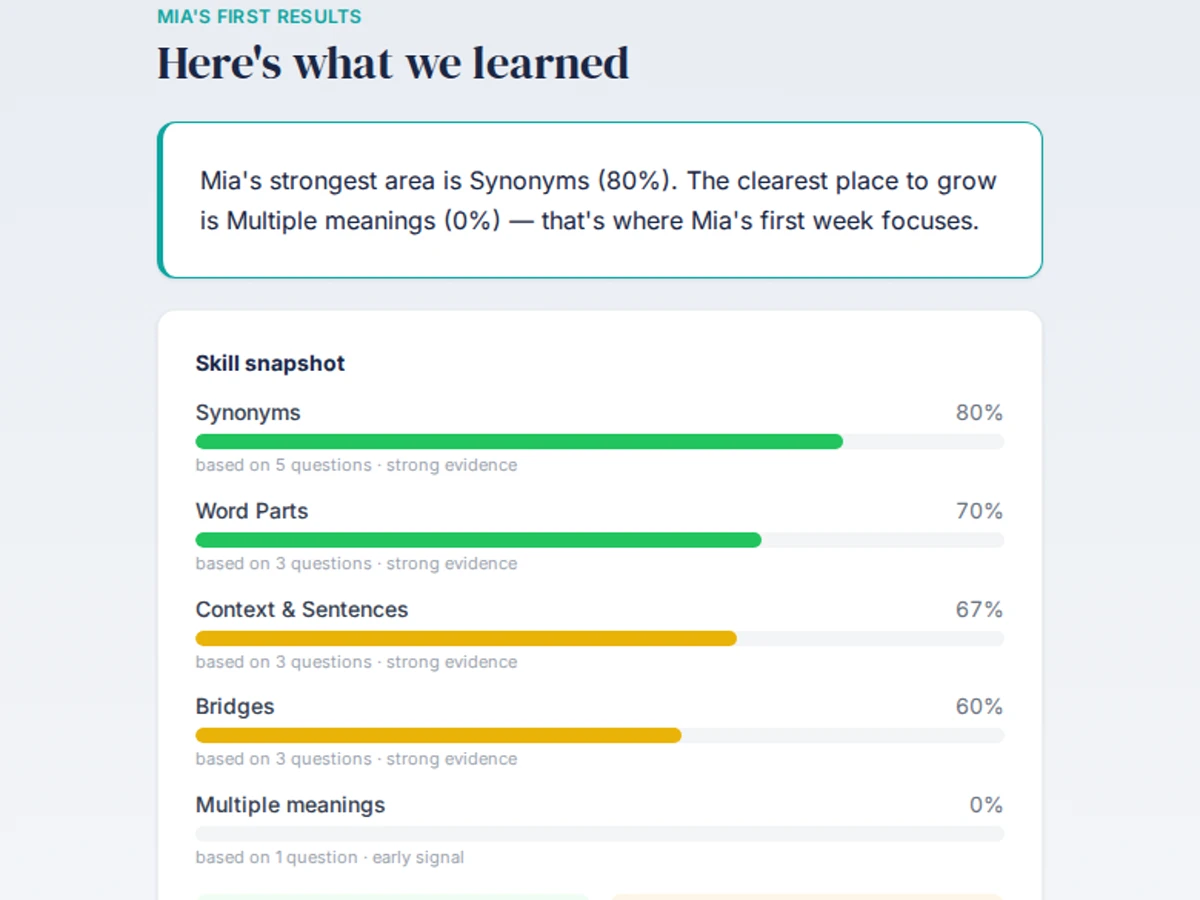
The check-up samples verbal skills and gives you an early strength, a growth area, and a first practice focus. It is not a full-length exam, an official SSAT or ISEE score, or an admissions prediction.
One of the most common regrets parents express after their child's entrance exam: "We started too late." The second most common: "We started too early and our child burned out." Both are avoidable.
The right start date for verbal test prep depends on three variables: which test, what grade level, and your child's current verbal baseline. This guide gives you month-by-month timelines for every major entrance exam — so you can calibrate your start date to your child's situation rather than guessing.
The Core Principle: Match Preparation Length to Skill Type
Before the timelines, one principle matters more than any specific date: verbal reasoning skills take longer to develop than subject knowledge.
When you study for a science test, you can acquire the necessary information in a few days. Vocabulary depth — owning hundreds of words precisely, with fast recall under pressure — does not work that way. It builds through repeated exposure and retrieval over weeks and months.
A student who starts SSAT verbal prep the week before the test is not under-prepared; they have not prepared at all. A student who starts 12 weeks out and practices consistently has a meaningfully different foundation.
This is why "when to start" matters more for verbal test prep than for almost any other academic preparation.
How Vocabulary Actually Develops
Research on vocabulary acquisition (Nation, 2001; Beck, McKeown & Kucan, 2013) establishes that durable word knowledge requires:
- Multiple encounters with the word in varied contexts (typically 10-15 exposures for robust acquisition)
- Spaced intervals between review sessions (the spacing effect shows 2-3× better retention than massed practice)
- Active retrieval rather than passive recognition (being tested on a word is more effective than re-reading it)
- Semantic depth — understanding a word's meaning, connotations, relationships to other words, and contextual uses
An optimal 10-week preparation schedule allows time for all four. A 3-week schedule only allows for exposure without consolidation.
Timeline by Exam
CogAT / OLSAT (Gifted and Talented Testing)
Testing window: Year-round, district-scheduled. Most fall cohort testing occurs September–November.
Recommended start for fall testing:
| Grade | Start Date | Duration | Daily Time |
|---|---|---|---|
| K-2 | No specific "start" — build ongoing | Ongoing | 15-20 min read-aloud + word games |
| 3-5 | July 1 (for September testing) | 8-10 weeks | 15 min/day |
| 3-5 | August 1 (for October-November testing) | 8-10 weeks | 15 min/day |
| 6-8 | June 15 (for September testing) | 12 weeks | 20 min/day |
| 6-8 | July 15 (for October testing) | 12 weeks | 20 min/day |
K-2 note: For kindergarten through second grade, the concept of "when to start" is less relevant than "how to sustain" language enrichment throughout early childhood. Read-aloud, word games, and rich conversation — maintained from birth — are the preparation. There is no meaningful advantage to starting an intensive test-prep program 8 weeks before a K-2 CogAT; an anxiety-raising program is actively counterproductive. Keep it playful.
3-5 note: Start root-word introduction at 8-10 weeks before the test. Cover 2-3 roots per week. Use spaced repetition for review. Include daily analogy and classification practice.
6-8 note: More systematic vocabulary study is warranted. 12 weeks allows coverage of 30+ root families with proper spaced review.
If the district has not yet announced testing dates: Ask your school's gifted coordinator when testing will occur and work backward. If you learn your child is being tested in 4 weeks, focus on format familiarity and root-word vocabulary exposure rather than systematic preparation.
SSAT (Secondary School Admission Test)
Testing window: October–June, with concentrated fall/winter dates (Oct–Jan) for most applicants.
Most families applying to independent schools for fall entry face SSAT deadlines in the October–January window. For January application deadlines, testing should complete by December at the latest (scores take ~2 weeks to arrive).
Recommended timelines:
Applying for fall entry, testing October-December:
| Situation | Start Prep | Duration |
|---|---|---|
| Starting from scratch, strong vocabulary | August 1 | 10-12 weeks |
| Starting from scratch, needs vocabulary work | July 1 | 14-16 weeks |
| Building on previous prep or strong reader | September 1 | 8-10 weeks |
| Less than 8 weeks to test | Immediately | Use remaining time efficiently |
Month-by-month for 12-week SSAT prep (starting September for December test):
September (weeks 1-4):
- Core Latin root families (15 roots)
- Daily synonym practice (10 questions)
- Analogy bridge type introduction
- Begin reading above grade level (30 min/day)
October (weeks 5-8):
- Greek roots + prefix/suffix patterns
- Near-synonym precision clusters
- Full analogy sets (30 questions, name the bridge)
- First full-length timed practice test (week 8)
November (weeks 9-12):
- Timed synonym drills (5-min sets, 10 questions)
- Mixed verbal practice (synonyms + analogies)
- Second full-length practice test (week 10)
- Final review (week 11-12): consolidate, do not introduce new material
December: Test. Sleep well. Done.
If you are reading this in October with a December test date: You have 8-10 weeks. This is enough for meaningful improvement — skip Phase 1 expansion (adding new roots) after week 6 and shift entirely to consolidation. You cannot learn all 30 root families in 8 weeks and consolidate them; better to own 15-20 families deeply than to rush through 30.
ISEE (Independent School Entrance Exam)
Testing windows: Fall (Sept–Nov), Winter (Dec–Feb), Spring (Mar–May).
The ISEE has stricter limits than the SSAT: only 3 tests per year (one per season). This makes the preparation window choice more consequential.
Recommended approach: Target the fall window (September–November)
For families applying to independent schools with January deadlines, testing in the fall window leaves time for a winter retake if needed before most deadlines.
Timelines (same as SSAT above — preparation is nearly identical)
Key ISEE-specific addition: budget extra time for sentence completion practice. The ISEE has sentence completion items that the SSAT lacks. From week 5 onward, include 2-3 sentence completion exercises per session in addition to synonym practice.
If your child is Primary Level (grades 2-4): The timelines compress. Primary Level vocabulary is not as deep as Upper Level, and young children's preparation capacity is more limited. 6-8 weeks of enriched vocabulary activities (not intensive drilling) is more appropriate than a 12-week structured program.
HSPT (Catholic High School Placement Test)
Testing window: November–December at individual Catholic high schools. Single administration per school.
For most families, the HSPT falls in November or December. Working backward:
Recommended start: Late August or early September
This gives 10-12 weeks before a November test, 12-14 weeks before a December test.
Why not start in summer? You can start earlier, but for the HSPT specifically, the 10-12 week window is well-calibrated to the vocabulary acquisition curve. Starting 20 weeks out requires maintaining motivation over a longer period, and material studied too early may fade without adequate ongoing review.
Month-by-month for 12-week HSPT prep (September for December test):
September (weeks 1-4):
- Core vocabulary roots (Latin families 1-15)
- Synonym and antonym pair study
- Analogy bridge introduction
- First diagnostic practice test (week 4)
October (weeks 5-8):
- Extend vocabulary (Greek roots + affixes)
- Add verbal logic (syllogism structure practice)
- Classification precision practice
- Timed verbal practice (16-second-per-question pace)
- Second diagnostic test (week 8)
November (weeks 9-12):
- Pure timed practice: 60 questions in 16 minutes
- Error analysis after each timed session
- Mixed review across all five verbal question types
- Final practice test (week 11)
- Week 12: light review, sleep priority, confidence framing
Critical HSPT timing note: Most Catholic high schools administer the HSPT on a single date in November or December, and many families do not learn the exact date until early fall. Contact your target schools in August to confirm HSPT dates and registration deadlines. Do not assume — dates vary by school and diocese.
TACHS (NYC Catholic High Schools)
Test date: First Friday of November (single date, no retake).
Because the TACHS is a single-date test, September 1 is the latest sensible preparation start date for a first-Friday-of-November test. This gives exactly 9 weeks.
Recommended start: August 15 – September 1
For 10-11 weeks of preparation:
August 15 – September 14 (weeks 1-4):
- Vocabulary root study
- Synonym practice (TACHS vocabulary is synonym-format)
- Begin reading comprehension practice
- TACHS-specific: introduce Ability section pattern practice
September 15 – October 10 (weeks 5-7):
- Timed synonym practice (TACHS pace is very fast)
- Mixed verbal + ability practice
- First full-length TACHS practice test (week 6)
October 11 – November 6 (weeks 8-11):
- Full timed practice (25-30 min per section)
- Second full TACHS practice test (week 9)
- Error analysis and targeted review
- Final 2 weeks: consolidate, light review, confidence
TACHS-critical note: There is no retake. The preparation period is the only window. Families who treat the TACHS like the SSAT (test multiple times, see what score emerges) will be disappointed — there is only one administration. Treat preparation accordingly.
COOP Program (NJ Catholic High Schools — now the HSPT)
Test date: Friday, November 6, 2026 (make-up November 14; registration opens September 1 at njcoopexam.org).
Recommended start: August 15 – September 1 (same rationale as the HSPT)
The COOP admissions program now administers the HSPT (the legacy COOP exam format was replaced), so prepare for the HSPT:
- Build HSPT Verbal Skills: synonyms, antonyms, analogies, and verbal classification (unlike the legacy COOP, the HSPT does include synonyms and antonyms).
- Practice timed analogy and relationship reasoning under the HSPT's pacing.
- See the HSPT verbal section guide for the full plan.
When to Reassess
Signs You Started Too Early
- Your child is burned out by week 8 of a 16-week program
- Daily practice has become a nightly struggle
- Your child was excited about test prep in September and is exhausted by October
What to do: Reduce daily session length (10 minutes, not 20-25). Shift to maintenance mode — review what has been learned rather than pushing through new material. Do not abandon preparation entirely; consolidate what has been built.
Signs You Started Too Late
- Your test is in 4 weeks and your child has not practiced at all
- Practice tests show significant vocabulary gaps with little time to address them
What to do: Triage. Focus preparation on:
- Format familiarity (making sure your child knows what the questions look like)
- Root-based decoding (teach the most common roots for emergency inference)
- Test-taking strategy (skip unknowns on SSAT; answer everything on ISEE)
- Sleep, nutrition, and anxiety management
Acknowledge honestly: 4 weeks is not enough to build vocabulary depth from scratch. It is enough to reduce surprises, build confidence, and implement useful test-taking strategies. That matters, even if it does not move scores dramatically.
The Absolute Minimum: What Matters Most in Any Timeframe
If you have any preparation time at all, prioritize these in order:
- Format familiarity: Your child should never encounter the analogy or sentence completion format for the first time on test day
- Root-based vocabulary exposure: Even 2-3 weeks of root study gives emergency decoding tools for unknown words
- Test-taking strategy for your specific exam: Guessing policy (SSAT vs. ISEE), time management, skip-and-return protocol
- Sleep and anxiety management: A well-rested, low-anxiety child with adequate preparation outperforms a tired, anxious child who over-prepared
- Confidence framing: Your child should walk into the test believing they have prepared and they are ready
Items 4 and 5 are always within reach, regardless of how much time you have. They are also among the highest-leverage factors in actual test performance.
Timing a start date well means planning for the full scope of what admissions tests reward, not only vocabulary. Roots are the on-ramp — they give your child a decoding system that compounds over weeks — but admissions tests measure five distinct verbal domains: vocabulary knowledge (where roots live), relational reasoning (analogies and word relationships), contextual inference (drawing meaning from surrounding text), test execution (pacing, elimination, guess discipline, and stamina), and metacognition (the self-monitoring that helps your child adapt under time pressure). LexiMap builds all five across its game modes and shows each domain on a parent dashboard, so the timeline question becomes not just "when to start vocabulary" but "when to introduce each domain so they peak together on test day."
Key Takeaways
- Verbal reasoning skills take longer to develop than subject knowledge — a student who starts a week before the SSAT has not prepared at all; 10–12 weeks is the minimum meaningful window.
- Each exam has its own optimal start date: work backward from the specific test date rather than picking an arbitrary number of weeks.
- If your child has less than 4 weeks, shift focus to format familiarity, the highest-frequency roots, and test-taking strategy — vocabulary depth cannot be built in that window, but surprises can still be reduced.
- For any time frame, prioritize sleep and anxiety management: a well-rested, low-anxiety child outperforms an over-prepared but exhausted one.
- Signs of starting too early (burnout by week 8) and too late (large vocabulary gaps with no time to close them) both have recoverable responses — reduce intensity or triage, respectively.
For detailed test dates and registration deadlines, see our entrance exam test dates calendar. For vocabulary preparation science, see our vocabulary building methods guide.
Get SSAT/ISEE vocabulary resources by email
Related Articles
Entrance Exam Test Dates 2026-2027: Complete Calendar
Complete 2026-2027 test date calendar for SSAT, ISEE, HSPT, TACHS, COOP, and CogAT. Registration deadlines, testing windows, and score release dates in one place.
Best Vocabulary Apps for Private-School Admissions Tests (2026)
Compare vocabulary prep apps for private-school entrance exams — SSAT, ISEE, HSPT, and more. What to look for, honest tool comparisons, and how to choose for your child.
The Complete List of Latin and Greek Roots for SSAT Vocabulary
Learn 60+ Latin and Greek roots used in academic vocabulary for SSAT/ISEE preparation. Free root word tables, study strategies, and a test-question walkthrough for grades 4–12.
LexiMap vs. Membean for SSAT and ISEE Vocabulary Prep
Compare LexiMap and Membean for grades 6–12 vocabulary learning and focused SSAT/ISEE verbal practice, including personal-plan access and where each tool fits.
Related Guides
SSAT Vocabulary: The Complete Guide to Root-Based Learning
Master SSAT vocabulary through Latin and Greek roots. Learn how root-based learning, spaced repetition, and interactive practice build lasting verbal skills for grades 4-12.
Root Words for SSAT & ISEE: The Complete Study Guide
The definitive guide to Latin and Greek root words for SSAT and ISEE preparation. Curated root set, study strategies, grade-level timelines, and practice exercises for grades 4-12.
SSAT® is a registered trademark of The Enrollment Management Association. ISEE® is a registered trademark of the Educational Records Bureau (ERB). LexiMap is not affiliated with or endorsed by these organizations.