Spaced Repetition for Kids: The Science Behind FSRS and Why It Works
Find your child’s vocabulary gaps
Start with a free, no-card vocabulary check-up and get a personalized parent report.
Find the vocabulary gaps — freeSee a sample parent report before starting
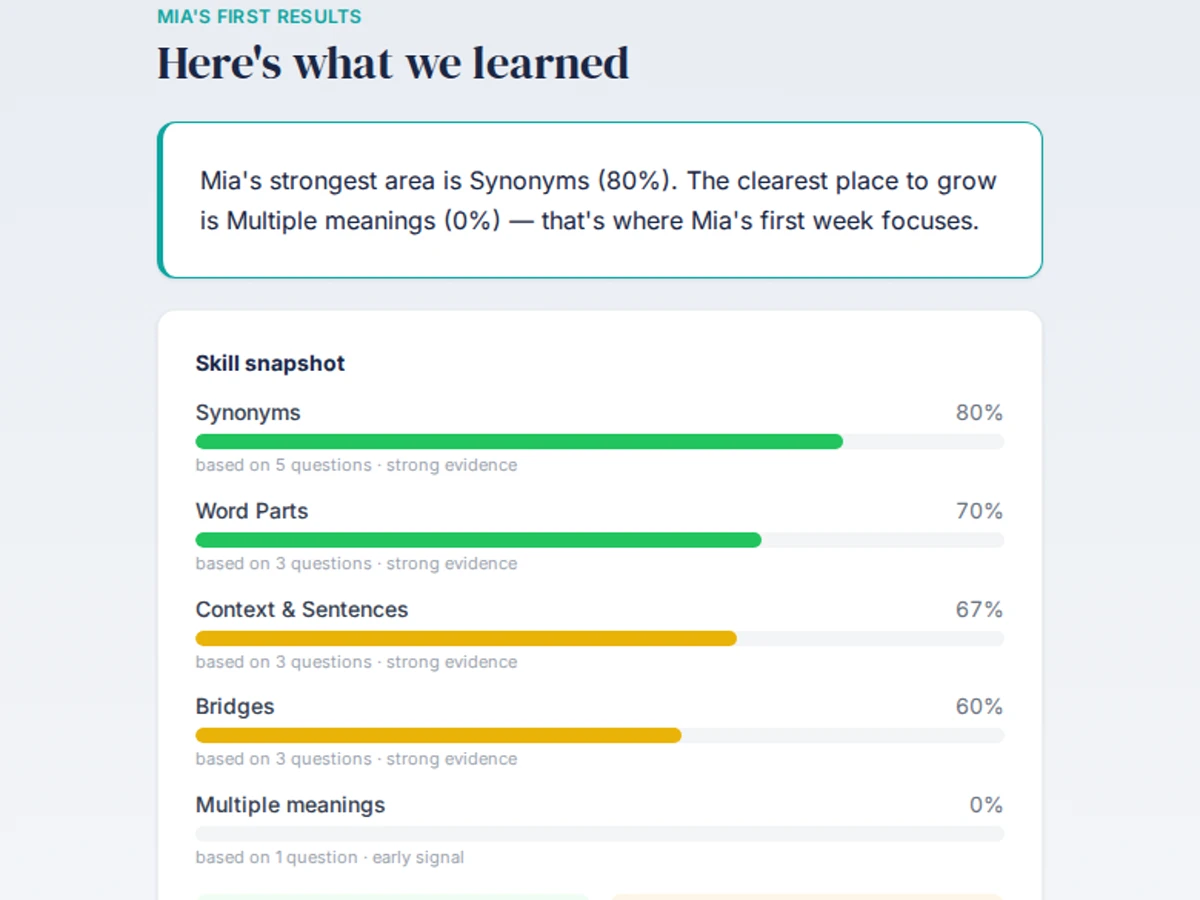
The check-up samples verbal skills and gives you an early strength, a growth area, and a first practice focus. It is not a full-length exam, an official SSAT or ISEE score, or an admissions prediction.
Your child studies vocabulary for an hour on Sunday night. By Wednesday's quiz, half the words are gone. By the end-of-term exam, it's as if the study session never happened. The frustration is real — and universal. But the problem isn't effort or intelligence. It's timing.
Cognitive science has known for over a century that when you review matters as much as what you review. Spaced repetition — the practice of reviewing material at strategically increasing intervals — is one of the most robust findings in learning research. And thanks to modern algorithms like FSRS, it's now possible to automate that scheduling so every study session is optimally timed.
This article explains the science behind spaced repetition, why it works especially well for vocabulary, and how parents can make it practical for children preparing for the SSAT or other standardized tests.
The Forgetting Curve: Why Cramming Fails
In 1885, German psychologist Hermann Ebbinghaus conducted a series of experiments on himself, memorizing lists of nonsense syllables and measuring how quickly he forgot them. His findings — now known as the forgetting curve — showed that memory decay is rapid and predictable: without any review, people forget roughly 50% of new information within one hour and over 70% within 24 hours.
The curve isn't linear. Forgetting is steepest in the first few hours after learning, then gradually levels off. This means the critical window for reinforcement is narrow: if you review before the memory has fully decayed, the second exposure strengthens the neural trace and extends the time before the next round of forgetting begins.
Each successive review flattens the curve further. After three or four well-timed reviews, what was once a fragile short-term memory has been consolidated into durable long-term storage. The key insight is deceptively simple: reviewing at the right moment — just before you would forget — strengthens memory far more than reviewing immediately or waiting too long.
This is why cramming produces the illusion of learning. Your child feels confident after a marathon study session because everything is still in short-term memory. But short-term memory is a leaky bucket. Without strategically timed reviews, those words drain away just as fast as they were poured in.
What Is Spaced Repetition?
Spaced repetition is a learning technique that schedules reviews at increasing intervals based on how well you know each item. If your child nails the meaning of a root on the first try, they won't see it again for two days. If they nail it again, the gap extends to five days, then two weeks, then a month. Items they struggle with are shown again sooner — perhaps later the same day or the next morning.
This approach — sometimes called "distributed practice" or "spaced practice" in research literature — stands in direct contrast to "massed practice," the technical term for cramming. Decades of research, including a landmark 2006 meta-analysis by Cepeda et al. , have consistently shown that spaced practice produces significantly stronger long-term retention than massed practice, across ages, subjects, and test formats.
The practical advantage is efficiency. Because spaced repetition focuses review time on items the learner is about to forget, it eliminates wasted repetitions on material already mastered. Students study less but remember more. For busy families juggling school, activities, and test prep, that trade-off matters enormously.
FSRS: The Next Generation of Spaced Repetition
The most widely known spaced repetition algorithm is SM-2, developed in the 1980s and used by tools like Anki. SM-2 was groundbreaking for its time, but it treats every learner identically — the same intervals, the same assumptions about memory strength, regardless of the individual.
FSRS (Free Spaced Repetition Scheduler), published at KDD 2023 , represents a significant leap forward. FSRS uses a mathematical model of memory that adapts to each individual learner. It tracks two parameters for every item: stability (how long the memory will last) and difficulty (how hard the item is for this specific learner). Together, these parameters produce a retrievability score — the probability that the learner can recall the item at any given moment.
In benchmarks against SM-2, FSRS achieves the same retention rates with fewer reviews — or higher retention rates with the same number of reviews (Ye, 2023). The default target retention is ~90% (the FSRS desired_retention parameter), meaning the algorithm schedules reviews so that a learner is expected to correctly recall about 9 out of every 10 items when they come up for review. That target is high enough to feel rewarding rather than discouraging, while still pushing memory consolidation.
For children, the adaptive nature of FSRS is especially valuable. A 9-year-old and a 14-year-old have different memory profiles, and even within the same age group, individual variation is enormous. FSRS adjusts automatically. Learn more about how LexiMap applies FSRS to root-based learning.
Why Spaced Repetition Works Especially Well for Vocabulary
Spaced repetition works for any type of factual knowledge — language learning, medical terminology, historical dates. But vocabulary has a unique property that makes spaced repetition especially powerful: words are networked.
Unlike isolated facts (e.g., "the Battle of Hastings was in 1066"), word knowledge is cumulative and interconnected. When your child reviews the root bene (good), they don't just strengthen one memory — they activate the entire word family: benefit, benevolent, benediction, benefactor, benign. Each review of the root reinforces all the words built from it.
This cross-activation effect — supported by research on morphological awareness — means that root-based spaced repetition produces compound returns. Reviewing the root spec/spect (to look) strengthens inspect, spectacle, perspective, retrospect, spectrum, and circumspect simultaneously. Traditional flashcard-based spaced repetition, where each card teaches a single word, misses this network effect entirely.
The combination is powerful: spaced repetition handles the timing of review, while root-based learning handles the structure of what's reviewed. Together, they produce vocabulary retention that neither approach achieves alone. For more on this distinction, see our article on root words vs. flashcards.
Making Spaced Repetition Work for Kids
The science is clear, but science alone doesn't get an 11-year-old to study vocabulary after school. Here are practical strategies that help spaced repetition work for children, not just college students and adult self-learners.
Keep sessions short
Ten to fifteen minutes per day is the sweet spot. Spaced repetition is designed to be efficient — the algorithm surfaces only the items that need review, so sessions are naturally focused. Longer sessions lead to fatigue, and fatigued practice produces weaker memory traces. If your child finishes their daily reviews in 8 minutes, that's not a sign they need to do more. It's a sign the system is working.
Same time, every day
Consistency matters more than duration. Attach the study session to an existing habit: right after breakfast, during the car ride to school, or immediately after dinner. When studying happens at a predictable time, it stops feeling like an intrusion and becomes routine. Skipping a day isn't catastrophic — FSRS adjusts the schedule — but the habit itself is what produces results over weeks and months.
Make progress visible
Children are motivated by visible progress. Streaks, mastery percentages, and "roots unlocked" counters all help. The goal is to create a sense of momentum — the feeling that every session moves the needle. Avoid showing raw performance metrics (like accuracy rates) in isolation, as these can feel punishing on hard days. Instead, emphasize cumulative progress: "You've mastered 42 out of 182 root families" is more motivating than "You got 6 out of 10 correct today."
Use multiple practice formats
Reviewing the same flashcard format every day gets boring fast. Multiple game modes — matching roots to meanings, building words from parts, identifying roots in context, solving analogy puzzles — keep the experience varied while still exercising the same underlying knowledge. Each format engages a slightly different cognitive pathway, which strengthens retention further.
Don't force extra when they're frustrated
If your child is struggling, the worst thing to do is extend the session. Frustration impairs encoding. Let them stop when the daily reviews are done — or even before, if they're visibly checked out. FSRS will reschedule the missed items for the next session. Long-term consistency matters more than any single day's performance.
Spaced Repetition vs. Cramming: The Data
The research on spaced vs. massed practice is extensive. Here is a simplified summary of what the evidence consistently shows for vocabulary retention:
| Metric | Cramming (Massed) | Spaced Repetition |
|---|---|---|
| Recall after 1 day | ~80% | ~65% |
| Recall after 2 weeks | ~30% | ~85% |
| Recall after 1 month | ~15% | ~80% |
| Study time required | 1-2 hours, once | 10-15 min/day |
| Best for | Tomorrow's quiz | Long-term mastery |
Notice the crossover: cramming wins on day one, but by two weeks later, spaced repetition has nearly tripled the retention rate. For SSAT prep — where students typically study over months, not days — the compounding advantage of spaced practice is decisive.
The data also explains a common parental frustration: "They studied for hours and still bombed the test." If the studying was massed into one or two long sessions, the forgetting curve predicts exactly this outcome. The effort was real, but the timing was wrong.
Spaced repetition is powerful for roots and vocabulary — but it schedules review across all the skills verbal tests demand, not roots alone. LexiMap applies the same optimized FSRS scheduling to all five domains the SSAT draws on: vocabulary knowledge (where roots are the on-ramp), relational reasoning, contextual inference, test execution, and metacognition. Each domain appears on the parent dashboard with its own retention curve, so you can see not just how many words your child has learned, but how their broader verbal skill set is consolidating over time.
Key Takeaways
- The forgetting curve is steep: without review, most new information is lost within 24 hours. Well-timed reviews flatten the curve and build durable long-term memory.
- Spaced repetition schedules reviews at increasing intervals, focusing study time on items the learner is about to forget. It produces dramatically better long-term retention than cramming.
- FSRS (Free Spaced Repetition Scheduler) adapts to each individual learner, achieving higher retention with fewer reviews than older algorithms like SM-2.
- Vocabulary is uniquely suited to spaced repetition because words are networked — reviewing one root activates and strengthens an entire word family.
- For kids: keep sessions to 10-15 minutes daily, build a consistent habit, make progress visible, vary the practice format, and never force extra study when frustrated.
- Cramming wins on day one; spaced repetition wins everywhere else. For months-long test prep, the choice is clear.
Next Steps
Ready to put spaced repetition to work? Here are three resources to continue:
- SSAT Vocabulary Guide — A complete roadmap for building SSAT verbal skills, including how spaced repetition fits into a broader study plan.
- Root Words vs. Flashcards — Why root-based learning produces better long-term retention than word-by-word flashcard memorization.
- How to Improve Your Child's SSAT Verbal Score — Evidence-based strategies, daily habits, and realistic improvement timelines.
Questions parents ask
What is spaced repetition, in plain terms?
A review schedule that shows your child each word again just before they'd forget it. Every successful recall stretches the next interval, so known words take almost no time and struggling words get more practice.
Why is it better than cramming?
Research on the spacing effect consistently shows spaced reviews produce far stronger long-term retention than massed practice. Cramming feels productive but fades within days; spaced practice is what still pays off weeks later on test day.
Get SSAT/ISEE vocabulary resources by email
Related Articles
The LexiMap Method: Roots, Spaced Repetition, and a 5-Domain Verbal Model
How LexiMap combines morphological roots, FSRS spaced repetition, and a 5-domain verbal model — vocabulary, relational reasoning, contextual inference, test execution, and metacognition — into one trainer for the SSAT and ISEE.
Root Words vs. Flashcards: Which SSAT Study Method Actually Works?
Compare root-based vocabulary learning with traditional flashcard memorization for SSAT and ISEE prep. Research-backed analysis of which method produces lasting results.
Vocabulary Building Methods for Entrance Exams: Roots and Spaced Repetition
Research-backed vocabulary building for entrance exams. Why root-based morphological learning and spaced repetition outperform flashcards for SSAT, ISEE, HSPT, and CogAT prep.
Why Flashcards Don't Work for Verbal Test Prep (And What to Do Instead)
Why flashcard vocabulary study fails on the SSAT, ISEE, and HSPT — and what cognitive science shows actually works: root-based learning and spaced repetition.
Related Guides
Vocabulary Study Methods: A Research-Based Guide for SSAT & ISEE Prep
Compare proven vocabulary study methods — root-based learning, flashcards, reading programs, spaced repetition, and contextual learning. Find the most effective approach for your child.
SSAT Vocabulary: The Complete Guide to Root-Based Learning
Master SSAT vocabulary through Latin and Greek roots. Learn how root-based learning, spaced repetition, and interactive practice build lasting verbal skills for grades 4-12.
SSAT® is a registered trademark of The Enrollment Management Association. ISEE® is a registered trademark of the Educational Records Bureau (ERB). LexiMap is not affiliated with or endorsed by these organizations.