ISEE Vocabulary: The Complete Guide to Root-Based Learning
The ISEE verbal reasoning section is one of the most consequential — and most misunderstood — parts of independent school admissions. Unlike the SSAT, which tests analogies, the ISEE evaluates vocabulary through synonyms and sentence completions. Both question types reward students who can decode word meaning structurally rather than recall definitions from a list.
This guide covers Lower, Middle, and Upper Level ISEE verbal preparation: exam format, word roots, sentence-completion strategies, and a study routine. Primary ISEE has a different format and no Verbal Reasoning section. Roots can help students make sense of related words, but recognizing a word part does not guarantee the meaning of an unfamiliar word; always check the whole word and its context.
Whether your child is entering 5th grade for the Lower Level or 9th grade for the Upper Level, the principles here apply. For specific root-by-root breakdowns, see our complete Latin and Greek roots reference. For the SSAT-specific version of this guide, see our SSAT vocabulary guide.
Find your child's ISEE verbal starting point
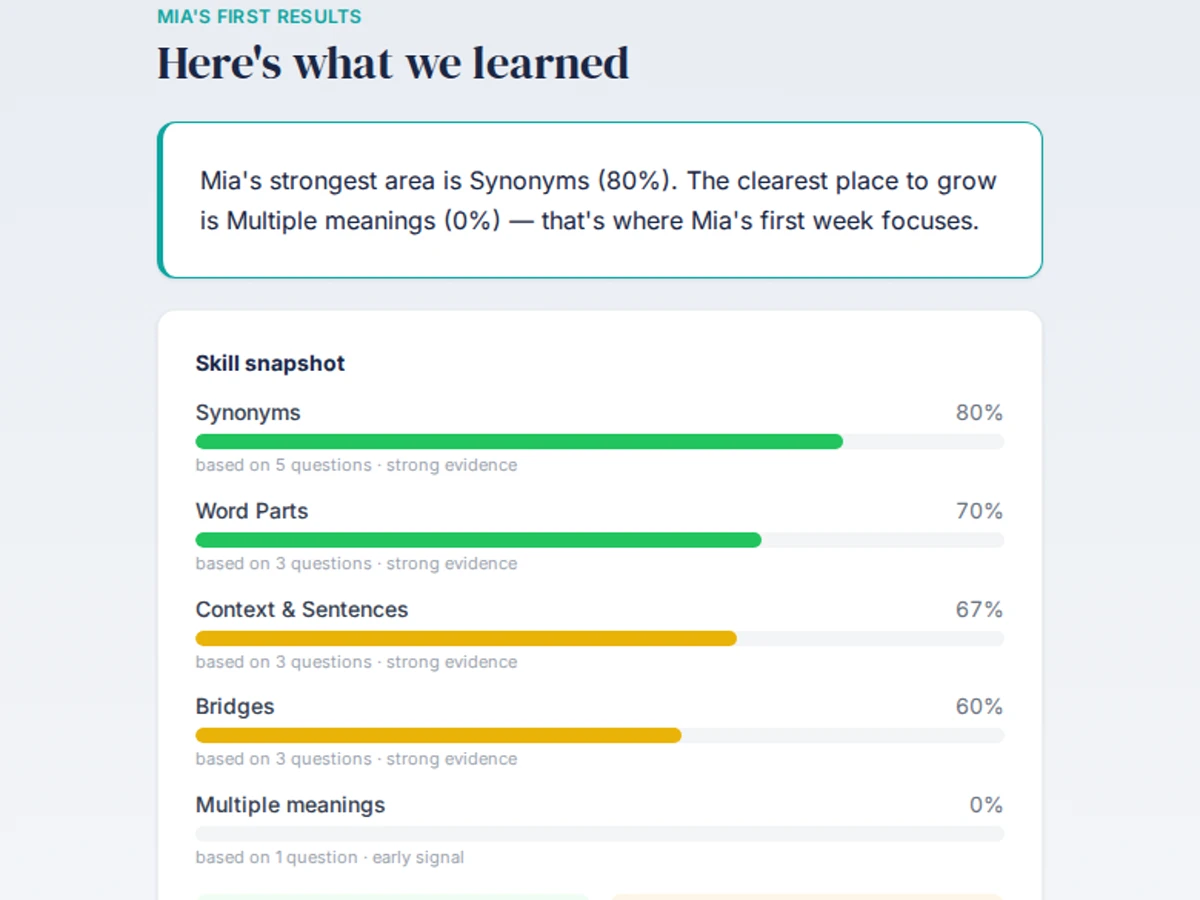
A short timed section — 16–20 questions on synonyms, sentence completions, and word roots — with a personalized parent report. Free, no card.
See a sample parent report before starting
The check-up samples verbal skills and gives you an early strength, a growth area, and a first practice focus. It is not a full-length exam, an official SSAT or ISEE score, or an admissions prediction.
How the ISEE Verbal Section Works
Choose the level by the grade your child is applying to enter. Verbal Reasoning appears at Lower, Middle, and Upper levels. Primary applicants take reading and mathematics, with auditory comprehension at Primary 2, rather than the verbal section described here.
| Level | Grades Entering | Questions | Time |
|---|---|---|---|
| Primary (2–4) | Entering 2–4 | No Verbal Reasoning section | Not applicable |
| Lower Level | Entering 5–6 | 34 questions | 20 minutes |
| Middle Level | Entering 7–8 | 40 questions | 20 minutes |
| Upper Level | Entering 9–12 | 40 questions | 20 minutes |
Exam-format sources: ERB's official family guide (test timing, page 10) and ERB's ISEE Quick Facts. Checked September 5, 2026. These are official exam lengths; LexiMap's free check-up is a shorter sample.
At the Lower, Middle, and Upper levels, questions split roughly evenly between synonyms and sentence completions. Synonym questions present a single word and ask the student to choose the answer choice closest in meaning. Sentence completions present a sentence with one blank and ask the student to choose the word that best completes the meaning.
No wrong-answer penalty. The ISEE does not deduct points for incorrect answers. Students should answer every question. Middle and Upper Level SSAT scoring differs; do not transfer a guessing rule from one exam or level to another.
ERB stanine scoring. The ISEE score report includes stanines from 1 to 9, where 5 is the middle band, alongside scaled scores and percentile ranks. A stanine summarizes performance relative to a norm group; it is not a percentage correct or an admissions guarantee. Ask each school how it uses scores. LexiMap's check-up report is a practice-planning tool, not an official ISEE score report.
ISEE vs SSAT: Key Differences
Vocabulary study can support preparation for both exams, but students also need practice with the question types and timing of their chosen level. The comparison below refers to ISEE Lower/Middle/Upper verbal sections and SSAT verbal sections:
| Feature | ISEE | SSAT |
|---|---|---|
| Question types | Synonyms + Sentence completions | Synonyms + Analogies |
| Wrong-answer penalty | No penalty | Quarter-point deduction at Middle/Upper; none at Elementary |
| Levels | Primary, Lower, Middle, Upper (4) | Elementary, Middle, Upper (3) |
| Scoring | Stanine 1–9 | Scaled scores and percentiles; scale depends on level |
| Can retake? | Once per testing season | Limits depend on test format and testing year |
| Key verbal skill | Contextual inference (sentence clues) | Relational reasoning (analogy bridges) |
The critical difference for preparation: the ISEE's sentence completions reward students who can combine context clues with word decoding, while the SSAT's analogies reward students who can identify relationships between word pairs. Both skills improve with root-based study, but dedicated sentence completion practice is essential for ISEE-specific preparation. For a detailed breakdown of the SSAT verbal section, see our SSAT verbal section breakdown.
Why Root-Based Learning Works for the ISEE
Root-based learning is one useful part of ISEE vocabulary preparation. Combine word-part study with whole-word meanings, sentence context, and timed practice; roots alone do not answer every question.
Research in morphological awareness — the ability to recognize meaningful parts within words — has examined whether explicit instruction in roots, prefixes, and suffixes supports vocabulary learning. Bowers, Kirby, and Deacon (2010) reported vocabulary effects of d = 0.35 relative to control conditions and d = 0.20 relative to alternative treatments across studies spanning preschool through Grade 8. That evidence concerns morphological instruction generally, not LexiMap or ISEE score gains; roots are one structural clue alongside whole-word study and context.
Consider the root cred, meaning "believe." From this single root, a student can decode:
- credible — worthy of being believed
- incredible — not believable (in- = not)
- credulous — too willing to believe
- credential — something that establishes belief in one's qualifications
- creed — a statement of belief
- incredulous — unwilling or unable to believe
- accredit — to officially recognize as meeting standards
- discredit — to cause to not be believed
These examples show how one word family can connect several meanings. The list is a study aid, not a guarantee of which words will appear on the ISEE. Confirm definitions in a dictionary and practice using each word in context.
Sentence completions especially benefit from root-based learning because they require two overlapping skills: understanding the context clues in the sentence and decoding the vocabulary in the answer choices. When a student encounters an unfamiliar word in the answer choices — say, magnanimous — recognizing magn (great) and anim (spirit, mind) reveals its meaning ("great-spirited," or generous) without prior memorization. Combined with context clues from the sentence stem, this gives students a reliable two-step decoding process. Learn more about how we apply this research in our methodology overview.
50 Word Parts to Practice for the ISEE
This editorial selection includes roots and prefixes useful for studying academic vocabulary. It is not an official ERB word list or a frequency ranking of secure test questions. Each entry gives a meaning, origin, and example words to explore.
When studying, focus on understanding the meaning connection between the root and each example word. Do not simply memorize the list — practice building new words from each root and identifying the root within unfamiliar words. That transfer skill is what the ISEE actually tests.
| Root | Meaning | Origin | Example Words |
|---|---|---|---|
| aud | hear | Latin | audience, audible, auditorium, audition |
| bene | good, well | Latin | benefit, benevolent, benediction, benefactor |
| cred | believe | Latin | credit, credible, incredible, credulous, credential |
| dict | say, speak | Latin | dictate, predict, verdict, contradict, diction |
| duc / duct | lead | Latin | conduct, deduce, introduce, produce, educate |
| fac / fact | make, do | Latin | factory, manufacture, effect, defect, facilitate |
| graph | write | Greek | autograph, biography, graphic, paragraph, telegraph |
| loc / loqu | speak | Latin | eloquent, loquacious, colloquial, elocution |
| magn | great | Latin | magnificent, magnify, magnitude, magnate |
| mal | bad | Latin | malice, malevolent, malfunction, malignant, malpractice |
| mand | order, command | Latin | mandate, command, demand, remand, mandatory |
| mit / miss | send | Latin | transmit, missile, emit, dismiss, remission |
| mort | death | Latin | mortal, immortal, mortify, mortuary, mortgage |
| nov | new | Latin | novel, renovate, innovate, novice, novelty |
| ped | foot | Latin | pedal, pedestrian, pedestal, expedition, impede |
| port | carry | Latin | transport, portable, export, import, deportation |
| rupt | break | Latin | interrupt, erupt, corrupt, rupture, abrupt |
| scrib / script | write | Latin | describe, manuscript, inscription, prescribe |
| spec / spect | look, see | Latin | inspect, spectacle, perspective, retrospect |
| struct | build | Latin | construct, structure, instruct, destruct, infrastructure |
| terr | earth, land | Latin | territory, terrain, terrestrial, subterranean |
| tract | pull, drag | Latin | attract, extract, traction, retract, subtract |
| ven / vent | come | Latin | adventure, event, intervene, convention, prevent |
| ver | truth | Latin | verify, verdict, veracity, veracious, aver |
| vid / vis | see | Latin | visible, evidence, provide, vision, supervise |
| viv | live | Latin | vivid, revive, survive, vitality, vivacious |
| voc / vok | call, voice | Latin | vocal, invoke, provoke, evocative, advocate |
| ambi | both | Latin | ambiguous, ambivalent, ambidextrous, ambiance |
| ante | before | Latin | antecedent, anterior, anteroom, antedate |
| circum | around | Latin | circumference, circumstance, circumvent, circumscribe |
| con / com | with, together | Latin | connect, community, combine, companion, compose |
| contra | against | Latin | contradict, contrast, contrary, contravene |
| de | down, from | Latin | descend, decline, depart, degrade, diminish |
| dis | apart, not | Latin | disagree, disconnect, disappear, disrupt, dismiss |
| ex | out | Latin | exit, export, exclude, external, exhale |
| in / im | not | Latin | invisible, impossible, imperfect, inadequate, inactive |
| inter | between | Latin | international, interact, intervene, interrupt, intercept |
| micro | small | Greek | microscope, microphone, microbe, microcosm |
| mono | one | Greek | monopoly, monologue, monotone, monochrome |
| multi | many | Latin | multiply, multitude, multimedia, multilingual |
| omni | all | Latin | omnivore, omniscient, omnipotent, omnipresent |
| pan | all | Greek | panorama, pandemic, pandemonium, panacea |
| peri | around | Greek | perimeter, periscope, peripheral, peripatetic |
| poly | many | Greek | polygon, polyglot, polysyllabic, polynomial |
| post | after | Latin | postpone, postscript, postmortem, posterior |
| pre | before | Latin | predict, prevent, preview, precaution, precede |
| re | again, back | Latin | return, rebuild, rewrite, reconsider, restore |
| sub | under | Latin | submarine, subtract, subconscious, subordinate |
| super | above | Latin | supernatural, superior, superb, supervise |
| trans | across | Latin | transport, transform, transcend, translate, transmit |
These are the same roots that appear on the SSAT — the vocabulary pool overlaps almost entirely between the two tests. What differs is how the tests ask about these words. On the ISEE, students encounter these roots primarily through synonym questions and sentence completions, which means practice should emphasize decoding words in context rather than identifying analogy relationships. For a deeper reference with 60+ roots organized by Latin and Greek origin, see our full Latin and Greek roots guide. For a focused set of 50 Latin roots with study notes, see 50 Latin roots that unlock 500+ words.
Sentence Completion Strategy
Sentence completions are where root knowledge and context reading combine. Here is a four-step method that gives students a repeatable system:
The 4-Step Method
- Read the full sentence. Do not jump to the answer choices. Read the sentence with the blank and form a mental prediction of what word would fit.
- Identify context clues. Look for contrast words ("although," "despite," "however"), cause-effect signals ("because," "therefore"), and descriptive clues that narrow the meaning.
- Decode unknown words via roots. Scan the answer choices for roots you recognize. Even partial recognition — knowing that bene means "good" or mal means "bad" — can eliminate choices.
- Confirm with context. Plug your best answer back into the sentence. Does it make logical sense? Does the tone match?
Worked Example 1
Although the speaker's argument was _______, the audience remained unconvinced by its logic.
- (A) ambiguous
- (B) cogent
- (C) laconic
- (D) frivolous
Step 1: "Although" signals contrast — the blank must describe something positive about the argument (since the audience was unconvinced despite it).
Step 2–3: Ambiguous means "unclear," so it does not fit the contrast. Cogent means "clear and compelling." This fits. Laconic means "using few words," which does not establish persuasiveness. Frivolous means "not serious." Here, knowing whole-word meanings is more useful than guessing a root from similar-looking letters.
Step 4: "Although the argument was cogent, the audience remained unconvinced." The contrast works. Answer: (B).
Worked Example 2
The explorer's _______ journey took her beneath the surface of the earth for three months.
- (A) peripheral
- (B) subterranean
- (C) transatlantic
- (D) unprecedented
Context clue: "beneath the surface of the earth." We need a word meaning "underground."
Root analysis: peri (around) → peripheral = "at the edges" — wrong. sub (under) + terr (earth) → subterranean = "under the earth" — perfect match. trans (across) → transatlantic = "across the Atlantic" — wrong. pre (before) → unprecedented = "never done before" — tempting but does not match the specific clue. Answer: (B).
Worked Example 3
Because the medicine was _______, the doctor believed it would help many different types of illness.
- (A) omnipotent
- (B) benign
- (C) versatile
- (D) malicious
Context clue: "Because" signals cause-effect. The blank describes a quality of the medicine that causes the doctor to believe it helps many types of illness. We need a word meaning "widely effective" or "adaptable."
Root analysis: omni (all) + potent (powerful) → omnipotent = "all-powerful" — too extreme. bene (good) → benign = "harmless, gentle" — does not explain treating many types. Versatile = "adaptable, effective in many ways" — matches the context. mal (bad) → malicious = "intending harm" — opposite. Answer: (C).
This four-step process — context first, root-based elimination, then confirmation — transforms guessing into structured reasoning. For more on ISEE-specific vocabulary tools, see our ISEE vocabulary builder tools comparison. If you are still deciding which app to practice with, our review of the best SSAT vocabulary apps compares the main options side by side.
Practice these roots interactively
LexiMap turns root learning into an interactive game with 18 exercise modes and FSRS spaced repetition. Start with a free, no-card check-up.
Take a real timed section — freeStudy Timeline by Grade
Effective ISEE vocabulary preparation depends on your child's grade level, current vocabulary strength, and test date. Below are research-informed guidelines for each ISEE level.
Applying to Grades 5–6: Lower Level
Study rhythm: Use short, repeatable sessions that fit your child's schedule. Keep retrieval active and revisit words after a delay; the right duration and frequency depend on the learner and the time available.
Focus areas: Start with a manageable set of common roots — words like vis (see), aud (hear), port (carry), and duct (lead). These roots appear in words students may already know (visible, audience, portable, conduct), making the root-meaning connection concrete. Add prefixes such as un-, re-, and pre- as the learner is ready.
Planning: Start when it is practical to revisit the material and include ISEE-style sentence completions. If the test is soon, prioritize the learner's current gaps and practice the official question format rather than trying to complete a fixed list.
Applying to Grades 7–8: Middle Level
Study rhythm: Build a repeatable routine that combines root families, context clues, and ISEE-style sentence completions. Adjust session length and frequency to the learner's starting point and schedule.
Focus areas: Build root families — not just the root cred (believe) in isolation, but connections between credible, incredible, incredulous, and credential. Practice context-based decoding: given a sentence with an unfamiliar word, can the student combine root analysis with sentence context to determine meaning? Add Greek word parts such as graph, poly, mono, and micro as the learner is ready; this is a study suggestion, not a measured test-frequency ranking.
Planning: Leave enough time for multiple retrieval opportunities and timed sentence-completion practice. The amount of preparation needed varies with prior vocabulary, available study time, and the test date.
Applying to Grades 9–12: Upper Level
Study rhythm: Combine root analysis with context clues and timed sentence-completion practice. Upper Level students may benefit from deeper sessions, but the appropriate routine depends on prior vocabulary, schedule, and test date.
Focus areas: Extend the word parts above with Greek forms like peri (around) and pan (all), and the Latin prefix circum (around). Practice sentence completions with subtle clues and answer choices with similar but distinct meanings. Compare words like "incredulous" and "incredible", or "prescribe" and "proscribe", using definitions and context alongside word-part knowledge.
Planning: Use the remaining preparation window to cycle through root families, whole-word meanings, and fresh sentence-completion questions. Students starting at different levels will need different amounts of practice; no fixed timeline guarantees vocabulary growth or decoding confidence.
Spaced Repetition: The Science of Retention
Learning a root once is not enough. Recall for newly acquired information can weaken over time — a pattern often discussed as the "forgetting curve," first documented by Hermann Ebbinghaus in the 1880s. Delayed review gives learners additional opportunities to retrieve the material.
The principle is straightforward: review material after delays rather than massing every session together. Intervals can lengthen when recall is successful and shorten when it is not; the useful schedule depends on the learner, content, and implementation.
Modern spaced repetition algorithms such as FSRS (Free Spaced Repetition Scheduler) use recall history to propose review intervals. This can make delayed retrieval easier to organize, but retention and study time vary by learner, content, and implementation; an algorithm does not guarantee an outcome.
The practical takeaway for parents: distribute practice across the week and revisit material after a delay. Choose a sustainable routine, then check retention with fresh questions rather than assuming a fixed schedule guarantees improvement. For a deeper dive into the science, see our guide to spaced repetition for kids. The LexiMap methodology page explains how FSRS is integrated into every practice session.
Common ISEE Prep Mistakes
Even motivated students and well-intentioned parents can fall into preparation traps. Here are the five most common mistakes and how to avoid them.
1. Word Lists Without Structure
Many prep books include lists of "1000 ISEE words" and suggest students memorize them. These lists cannot cover the full vocabulary pool, and rote memorization without structural understanding does not transfer to unfamiliar words. Root-based learning provides the structural framework that makes word lists meaningful rather than arbitrary.
2. Ignoring Sentence Context
Studying roots in isolation — just the root and its meaning — misses the point. Sentence completions require combining root knowledge with contextual clues. Practice should mirror the test format: read a sentence, identify clues, decode the answer choices, and confirm the match.
3. Cramming Before the Test
Cramming can create a temporary sense of familiarity. A student who reviews a large list immediately before the test may not be able to retrieve it under test conditions. Vocabulary acquisition takes repeated encounters and retrieval opportunities, but the amount and timing of review needed varies by learner.
4. Inconsistent Review
A common challenge is strong initial engagement followed by inconsistent review. When practice is irregular, a learner may need to re-establish earlier material before adding more. A sustainable review routine gives spaced repetition a better chance to support recall; it does not guarantee a particular result.
5. Not Practicing in Test Format
Recognizing a root on a flashcard is not the same as identifying it within an unfamiliar word during a timed test. Students need to practice root knowledge in multiple formats, especially sentence completions — the question type unique to the ISEE. Each format strengthens a different aspect of root knowledge. For a comparison of study methods, see our vocabulary study methods guide.
How LexiMap Teaches ISEE Vocabulary
LexiMap is a vocabulary training app designed specifically around the root-based, spaced repetition approach described in this guide. Here is what it includes:
- 182 curated root families covering Latin and Greek morphemes selected for ISEE and SSAT verbal practice, organized into progressive quest packs by difficulty level.
- 18 game modes — including drag-and-drop root matching, tap-select synonym identification, swipe-based word sorting, and context-based decoding exercises — that practice root knowledge across multiple cognitive skills.
- FSRS spaced repetition built into every session. The algorithm uses each child's recall history to schedule review opportunities; retention and the useful interval vary by learner and content.
- Quest-based progression that organizes study into structured sessions with warm-up, practice, and challenge segments, maintaining engagement while ensuring systematic coverage.
- Parent dashboard showing mastery progress, daily practice streaks, and which roots need additional review — giving parents visibility without requiring them to run the study sessions.
The app is designed for grades 4 through 12 and adapts difficulty to each child's level. You can start with ISEE context to personalize the first check-up, or view pricing for subscription details.
Frequently Asked Questions
How long does it take to see ISEE verbal-prep progress?
There is no single improvement timeline. Starting vocabulary, reading experience, practice quality, and consistency all matter. Check progress with fresh questions and delayed review; confidence alone does not establish readiness or predict an official exam score.
What grade should my child start ISEE vocabulary prep?
Choose the exam level by the grade your child is applying to enter: Lower for grades 5–6, Middle for 7–8, and Upper for 9–12. Begin with your child's current needs and available time rather than a guaranteed preparation duration. For detailed planning guidance, see our parent's guide to SSAT and ISEE prep.
Are Latin and Greek roots actually on the ISEE?
ISEE Verbal Reasoning uses synonyms and sentence completions, rather than a separate root-definition question type. Word parts can support vocabulary learning, but ERB does not publish a guaranteed list of words for your child's test. LexiMap includes explicit word-part practice as a learning exercise, which should not be confused with the official question format.
How is root-based learning different from flashcards?
Traditional flashcards teach one word at a time: the front says "benevolent" and the back says "kind, generous." Root-based learning teaches the structural components that compose many words: bene (good) + vol (wish) = one who wishes good. This structural understanding transfers to new words the student has never studied. Visit our FAQ page for more questions about our approach.
Can I prep for both SSAT and ISEE at the same time?
Vocabulary study can support both exams. Their formats, timing, scoring, and level expectations differ, so pair word study with practice for each exam your child will take. SSAT verbal includes analogies; ISEE Lower, Middle, and Upper verbal includes sentence completions. For the SSAT-specific guide, see our SSAT vocabulary guide. For a comprehensive root study resource covering both tests, see our root words study guide.
Can LexiMap complement tutoring?
Yes. LexiMap is designed to complement other preparation methods, not replace them. Students who work with tutors benefit from adding daily root-based practice because it builds the foundational vocabulary knowledge that makes other preparation more effective. A student who knows roots will get more out of a practice test because they can analyze their wrong answers structurally rather than just adding more words to a memorization list. The daily time commitment (10 to 20 minutes) is modest enough to fit alongside any other preparation schedule.
Get Started
Start with a manageable routine: learn word parts and whole-word meanings, revisit them over time, and practice sentence completions. Use your child's answers to choose the next focus and adjust the plan as you gather more evidence.
Related Guides
SSAT Vocabulary: The Complete Guide to Root-Based Learning
Master SSAT vocabulary through Latin and Greek roots. Learn how root-based learning, spaced repetition, and interactive practice build lasting verbal skills for grades 4-12.
Root Words for SSAT & ISEE: The Complete Study Guide
The definitive guide to Latin and Greek root words for SSAT and ISEE preparation. Curated root set, study strategies, grade-level timelines, and practice exercises for grades 4-12.
Vocabulary Study Methods: A Research-Based Guide for SSAT & ISEE Prep
Compare proven vocabulary study methods — root-based learning, flashcards, reading programs, spaced repetition, and contextual learning. Find the most effective approach for your child.
Related Articles
The Complete List of Latin and Greek Roots for SSAT Vocabulary
Learn 60+ Latin and Greek roots used in academic vocabulary for SSAT/ISEE preparation. Free root word tables, study strategies, and a test-question walkthrough for grades 4–12.
SSAT Vocabulary Prep: The Complete Parent Guide
Everything parents need to know about SSAT vocabulary prep — what the verbal section tests, how scoring works, and the strategies that build lasting vocabulary mastery.
50 Latin Root Words Every SSAT Student Should Know
Master the 50 most important Latin root words for the SSAT. Each root includes meaning, example words, and memory tips to build lasting vocabulary skills.
SSAT® is a registered trademark of The Enrollment Management Association. ISEE® is a registered trademark of the Educational Records Bureau (ERB). LexiMap is not affiliated with or endorsed by these organizations.