The Vocabulary Gap: Why Words Are Your Child's Greatest Equalizer
Find your child’s vocabulary gaps
Start with a free, no-card vocabulary check-up and get a personalized parent report.
Find the vocabulary gaps — freeSee a sample parent report before starting
The check-up samples verbal skills and gives you an early strength, a growth area, and a first practice focus. It is not a full-length exam, an official SSAT or ISEE score, or an admissions prediction.
Every institution your child will ever walk through — schools, universities, courtrooms, hospitals, workplaces — runs on a particular register of language. There is a vocabulary of belonging, and children who command it move through these systems more easily. Those who do not face a barrier that is mostly invisible, rarely named, and stubbornly consequential.
This is not a comfortable thing to say. But it points somewhere hopeful: of all the advantages that are passed down or withheld in childhood, word knowledge is one of the very few that families can deliberately cultivate. The vocabulary gap is real. It is also closeable — and vocabulary is the entry point into the broader verbal skill set that institutions actually reward. That is what this piece is about.
Language as Capital
More than fifty years ago, British sociologist Basil Bernstein drew a distinction between what he called "elaborated code" and "restricted code." Elaborated code is explicit, precise, and context-independent — the kind of language that schools, courts, and bureaucracies are built on. Restricted code is contextual, compressed, and community-bound — perfectly functional in the settings where it evolved, but not the language institutions expect.
Bernstein was not making a judgment about intelligence or culture. He was describing a structural mismatch: children who arrive already fluent in elaborated code are advantaged in settings that were designed around it, while children who are not face an extra translation burden, on top of everything else.
French sociologist Pierre Bourdieu extended this into an economic metaphor. He called it linguistic capital — a form of resource, like money or social connections, that institutions quietly reward. The vocabulary your child carries into a classroom, an admissions interview, or a hiring conversation is, in this sense, currency. It does not determine the outcome, but it changes the terms on which the transaction happens.
What both thinkers were pointing toward is something simpler than their academic language suggests: certain words are the price of admission. Not because those words are inherently superior, but because the systems children will navigate were built by people who used them.
Where the Gap Shows Up
The consequences of this are not abstract. They appear, measurably and repeatedly, in the domains that matter most.
In legal settings, the stakes can be stark. When people navigate the court system without an attorney — and therefore, for the most part, without fluent command of legal vocabulary — the outcomes are dramatically different. Studies of immigration proceedings show that self-represented individuals secured favorable outcomes in roughly 10% of cases, compared to 40% for those with legal representation (US Department of Justice data). In protective-order cases, the gap is even sharper: 32% success for self-represented petitioners versus 83% for those with attorneys (Temple University study). The vocabulary of rights, procedures, and argumentation is not a nicety in these settings. It is the mechanism through which the system either works for you or against you.
In the labor market, the picture is similarly clear. Economists have tracked the kinds of jobs the US economy has been adding over time. Deming (2017) found that occupations requiring high levels of social and verbal skill grew their share of total employment by roughly 12 percentage points between 1980 and 2012. The jobs requiring primarily routine manual or cognitive work shrank. Meanwhile, economists Heckman and Kautz have argued — across extensive longitudinal research — that so-called "soft skills," including communication ability and verbal fluency, rival years of schooling as predictors of long-run labor market outcomes.
In healthcare, vocabulary shapes whether people can understand their diagnosis, follow a treatment plan, advocate for themselves in an appointment, or navigate insurance paperwork. The costs of vocabulary deficits in medical settings are not small.
In education itself, the gap tends to compound rather than close on its own. Children who enter school with larger vocabularies encounter academic texts more fluently, which leads to more reading, which builds more vocabulary — a reinforcing loop that can work in either direction. Children who start behind often find the academic register increasingly foreign as the grade levels rise.
None of this is destiny. But it is worth understanding clearly, because you cannot close a gap you have not named.
The Hopeful Part: Vocabulary Is Teachable
Here is where the framing has to shift. Everything above describes a pattern — not a sentence. Vocabulary is not like height or socioeconomic background, which respond only slowly and partially to deliberate effort. It responds very directly to deliberate effort. That is the point.
Unlike many of the advantages that sort children into better and worse outcomes, word knowledge is genuinely buildable. It is acquired, not merely inherited. And because of how vocabulary works — particularly vocabulary built on the roots and patterns beneath English words — investing in it creates compounding returns rather than diminishing ones.
A child who learns the Latin root bene (meaning "good" or "well") does not just learn one word. They gain a key that unlocks benefit, benefactor, benevolent, beneficiary, benign, and dozens of words they have never explicitly studied. The same principle applies to the Greek and Latin roots that underlie a large share of the academic vocabulary tested on the SSAT and ISEE. Learning the system is far more powerful than memorizing the list. You can read more about why in the complete list of Latin and Greek roots, and see the broader case for why vocabulary investment pays so well in why vocabulary matters.
This is the equalizer dimension: a family that makes vocabulary a priority — not as cramming before a test, but as an ongoing habit of language — can substantially change a child's trajectory over the years that matter. No wealthy neighborhood required. No private school required. Deliberate, consistent attention to words is enough.
How Parents Can Start
None of what follows requires a curriculum or an app. These are habits, and habits are the unit of vocabulary growth.
Talk up, not down. Children acquire vocabulary from the language they are immersed in. When you use a precise word — exasperated instead of upset, adjacent instead of next to — and your child looks uncertain, pause and explain it. Do not simplify; expand. This is the single most powerful thing a parent can do at any age.
Name concepts explicitly. Many words children lack are not obscure vocabulary — they are abstract concepts (consequence, contradiction, implication) that adults use casually and children rarely encounter explained. When these come up in conversation or reading, stop and make the concept legible.
Favor roots over rote lists. A child who understands that -rupt means "break" can reason their way through interrupt, corrupt, rupture, and disrupt — words they may have never formally studied. Rote memorization of definitions is fragile; understanding the architecture of words is durable. The Latin and Greek roots are a good place to start building that architecture.
Value consistency over cramming. Memory science is unambiguous on this: spaced, repeated exposure to words vastly outperforms concentrated study. A child who encounters fifteen new words this week, revisits them next week, and sees them again in three weeks will retain far more than a child who studies a hundred words the night before a test. The mechanism behind this — and how to use it at home — is explained in spaced repetition for kids. The way words change the brain itself is a remarkable story worth reading in how vocabulary shapes the brain.
Read together, and talk about what you read. Reading exposes children to elaborated code in a way that conversation alone rarely does. But passive reading does not automatically produce word retention — discussion does. Ask what a word might mean from context. Look things up together. Make the vocabulary visible, not background noise.
These are not dramatic interventions. But done consistently, over months and years, they shift the vocabulary trajectory in ways that show up on tests, in classrooms, and — over a much longer arc — in the institutions your child will navigate as an adult.
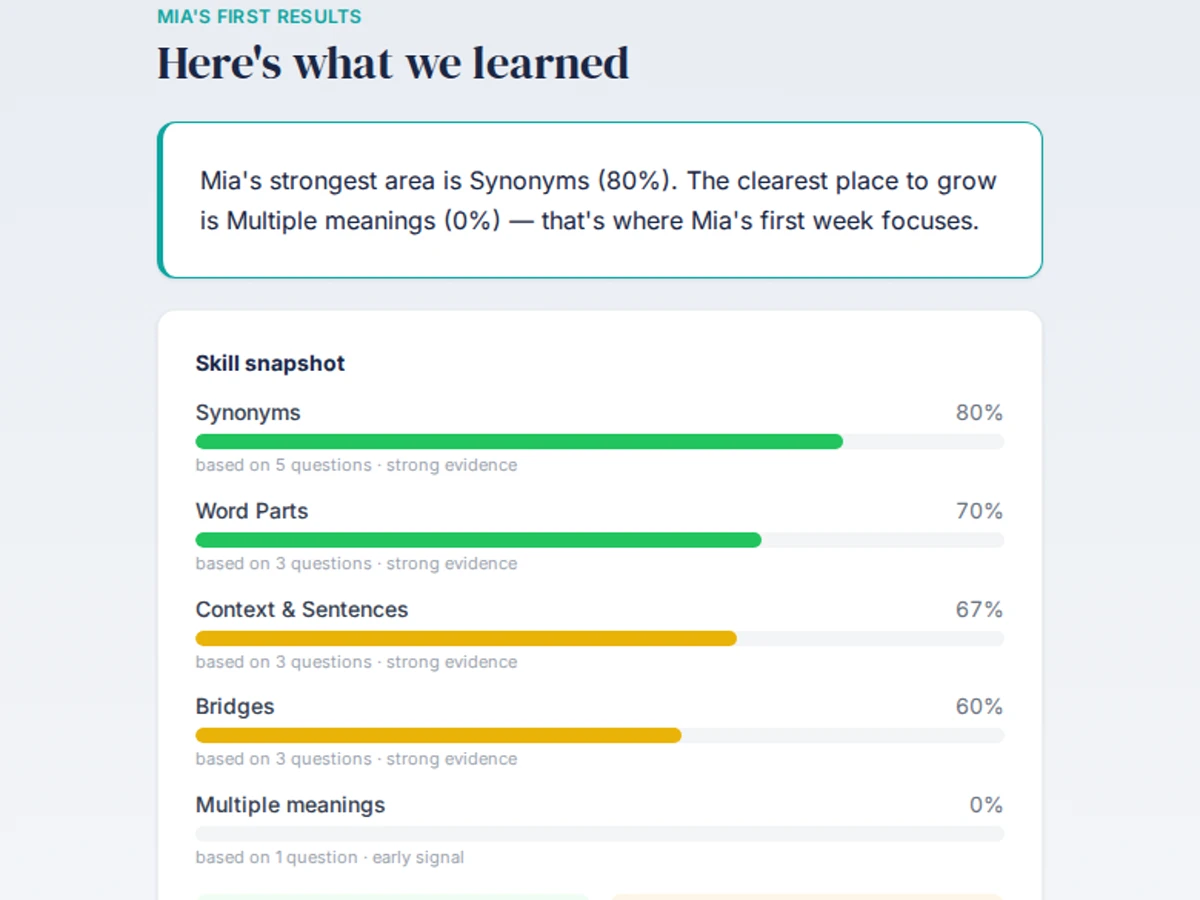
Vocabulary is the entry point — but the verbal skill set that tests and institutions reward extends further. On assessments like the SSAT, vocabulary knowledge is one of five domains: alongside it sit relational reasoning (how words and ideas connect), contextual inference (reading for meaning under time pressure), test execution (strategy, pacing, and error management), and metacognition (knowing what you know and when to apply it). If you are looking for a structured approach to building across all of these, LexiMap uses vocabulary and root-based learning as the on-ramp and then develops all five domains, surfacing each one on a parent dashboard — but the habits above work in any household, with or without an app.
Key Takeaways
- Vocabulary functions as linguistic capital: institutions built on an elaborated register of language quietly reward children who arrive already fluent in it.
- The gap shows up in high-stakes settings — legal, medical, professional — where the difference between commanding and lacking the right vocabulary can determine real outcomes.
- Socially and verbally skilled occupations grew by approximately 12 percentage points of employment share between 1980 and 2012 (Deming, 2017), and economists Heckman and Kautz find that verbal soft skills rival years of schooling in predicting life outcomes.
- Unlike many advantages, vocabulary responds directly to deliberate effort — making it one of the few levers families can actually pull, regardless of starting point.
- The most durable vocabulary is built on roots and patterns, rehearsed through spaced repetition, and cultivated through years of consistent, curious attention to words.
Further reading:
- Why Vocabulary Matters
- How Words Shape Your Child's Brain
- The Complete List of Latin and Greek Roots
Get SSAT/ISEE vocabulary resources by email
Related Articles
8 Ways a Strong Vocabulary Shapes Your Child's Future
Beyond test scores: the eight domains of adult life — from health and wealth to careers and emotional wellbeing — where research shows vocabulary makes a measurable difference.
Does Vocabulary Affect Test Scores? What the Research Actually Shows
A clear-eyed look at the evidence linking vocabulary to academic achievement, reading comprehension, and beyond — what's well-supported, what's overstated, and why it matters for test prep.
From SSAT to SAT to Career: Why Vocabulary Is the Gift That Keeps Giving
The vocabulary your child builds for the SSAT doesn't expire after test day — it compounds through the SAT, college, and a career. The research on vocabulary as a lifelong return.
Why Vocabulary Matters: The Research Case for Investing in Your Child's Words
Vocabulary isn't just a test-score booster — research links it causally to health, wealth, careers, and emotional wellbeing. Why word knowledge is one of the highest-return investments a parent can make.
Related Guides
SSAT Vocabulary: The Complete Guide to Root-Based Learning
Master SSAT vocabulary through Latin and Greek roots. Learn how root-based learning, spaced repetition, and interactive practice build lasting verbal skills for grades 4-12.
Root Words for SSAT & ISEE: The Complete Study Guide
The definitive guide to Latin and Greek root words for SSAT and ISEE preparation. Curated root set, study strategies, grade-level timelines, and practice exercises for grades 4-12.
SSAT® is a registered trademark of The Enrollment Management Association. ISEE® is a registered trademark of the Educational Records Bureau (ERB). LexiMap is not affiliated with or endorsed by these organizations.