Root Words for SSAT & ISEE: The Complete Study Guide
Find the vocabulary gaps before test day
Show all 12 roots
Sample roots we teach
- cred— believe
- bene— good, well
- mal— bad
- dict— say, speak
- spec / spect— look, see
- struct— build
- port— carry
- voc / vok— call, voice
- vid / vis— see
- tract— pull, drag
- magn— great
- ver— truth
Sample roots we teach
- cred— believe
- bene— good, well
- mal— bad
- dict— say, speak
- spec / spect— look, see
- struct— build
- port— carry
- voc / vok— call, voice
- vid / vis— see
- tract— pull, drag
- magn— great
- ver— truth
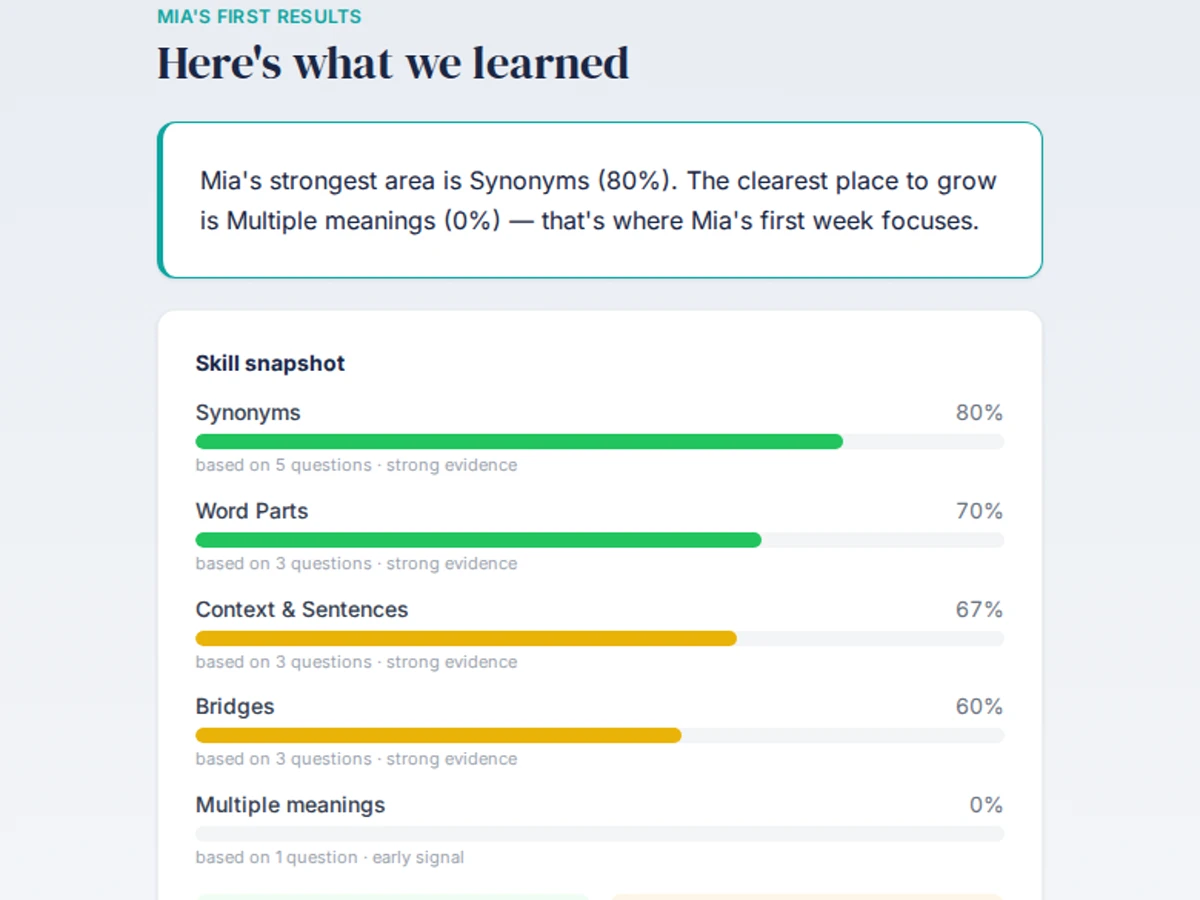
A free verbal check-up gives you an early strength, a growth area, and a first practice focus. Choose SSAT or ISEE to get started. No card required.
Start the free check-upSee a sample parent report before starting
The check-up samples verbal skills and gives you an early strength, a growth area, and a first practice focus. It is not a full-length exam, an official SSAT or ISEE score, or an admissions prediction.
Latin and Greek roots can help students connect unfamiliar words to meanings they already know. For SSAT and ISEE preparation, combine that skill with whole-word vocabulary, context clues, and practice in the question formats your child will take. Root knowledge is useful evidence about a word, not a guarantee of its definition or a higher test score.
The tables below are an editorial study selection, not an official SSAT or ERB vocabulary list or a ranking of words on secure exams. Learn each example's full definition and check how it is used in a sentence. Similar-looking letter sequences do not always share an origin, and a word's modern meaning may go beyond its parts.
Research context: Goodwin and Ahn's meta-analysis of morphological instruction examines literacy outcomes; it is not a trial of LexiMap or a guarantee of SSAT/ISEE score gains. For our approach and its limits, see the LexiMap methodology.
This guide is a comprehensive study resource. It covers what roots are and why they matter, selected Latin and Greek roots organized for study, practical prefixes and suffixes, how root analysis applies to each test format, study strategies, grade-level planning, and practice exercises. If you are looking for a quick-reference table of roots to bookmark, see our Latin and Greek roots reference post. This guide is where you come to understand the full system and build a study plan around it.
What Are Root Words?
English words are not indivisible units. Most academic and formal English words are constructed from smaller meaningful parts called morphemes. There are three types of morphemes that matter for vocabulary study: roots, prefixes, and suffixes.
A root is the core meaning-bearing element of a word. The root rupt means "break." It is the foundation on which words like interrupt, erupt, corrupt, rupture, abrupt, and disrupt are all built. The root carries the essential meaning; everything else modifies it.
A prefix is a morpheme attached to the beginning of a root that changes or refines its meaning. In the word interrupt, the prefix inter- means "between" — so interrupt literally means "break between" (to break into the middle of something). A suffix is a morpheme attached to the end of a root that typically changes the word's part of speech or adds grammatical meaning. In rupture, the suffix -ure turns the root into a noun meaning "the act or result of breaking."
Consider a simple example: un- + break + -able = unbreakable. The prefix un- means "not," the root is break, and the suffix -able means "capable of being." Put them together: "not capable of being broken." This is exactly how root analysis works on standardized tests — you decompose an unfamiliar word into familiar parts and reconstruct the meaning.
Why does this matter for the SSAT and ISEE? Because these tests deliberately include words that most students have not encountered in their everyday reading. The test designers expect students to use structural analysis — identifying roots, prefixes, and suffixes — to work out meanings. A student who knows that circum means "around" and spec means "look" can decode circumspect as "looking around carefully" — which maps directly to the correct answer "cautious" — without ever having memorized the word.
Latin Roots: The Foundation of Academic English
Latin roots form the backbone of formal and academic English vocabulary — the register most heavily tested on the SSAT and ISEE. This is a historical consequence: after the Norman Conquest of 1066, French (a Latin-derived language) became the language of government, law, and education in England. The everyday words of Old English survived in informal speech, but the formal, abstract, and institutional vocabulary of English was rebuilt from Latin through French.
This helps explain why many formal and academic words — including benediction, incredulous, infrastructure, and retrospect — are Latin-derived. Latin roots can give students another clue when they encounter that vocabulary on a standardized test.
The table below lists 25 Latin roots selected for SSAT and ISEE vocabulary practice. Each root is shown with its meaning and derived words to explore; the table is not an official test word list. When studying, focus on understanding the meaning connection between the root and each derived word — do not simply memorize the list.
| Root | Meaning | Example Words |
|---|---|---|
| duc / duct | lead | conduct, deduce, introduce, produce, educate, induction |
| scrib / script | write | describe, manuscript, inscription, prescribe, scripture |
| spec / spect | look, see | inspect, spectacle, perspective, retrospect, suspect |
| port | carry | transport, portable, export, import, deportation, rapport |
| dict | say, speak | dictate, predict, verdict, contradict, diction, edict |
| rupt | break | interrupt, erupt, corrupt, rupture, abrupt, disrupt |
| tract | pull, drag | attract, extract, traction, retract, subtract, distract |
| cred | believe | incredible, credible, credential, credulous, accredit, creed |
| ject | throw | reject, inject, project, eject, trajectory, dejected |
| mit / miss | send | transmit, missile, emit, dismiss, remission, commission |
| ven / vent | come | adventure, event, intervene, convention, prevent, revenue |
| fac / fact / fect | make, do | factory, manufacture, effect, defect, facilitate |
| cap / capt / cept | take, seize | capture, accept, concept, reception, capable |
| vid / vis | see | visible, evidence, provide, vision, supervise, envision |
| bene | good, well | benefit, benevolent, benediction, benefactor, benign |
| mal / male | bad, evil | malice, malevolent, malfunction, malignant, malady |
| aud | hear | audience, audible, auditorium, audition, audit, auditory |
| voc / voke | call, voice | vocal, invoke, provoke, evocative, advocate, revoke |
| ver | truth | verify, verdict, veracity, veracious, aver, veritable |
| mort | death | mortal, immortal, mortify, mortuary, mortgage, postmortem |
| viv / vit | life | vivid, vital, revive, survive, vitality, vivacious |
| pend / pens | hang, weigh | suspend, pendant, pension, compensate, pendulum |
| sens / sent | feel | sensitive, consent, sentiment, sensation, resent, sensory |
| struct | build | construct, structure, instruct, destruct, infrastructure |
| form | shape | transform, conform, reform, formulate, uniform, deform |
Notice the pattern: each root generates a cluster of related words. The root duc / duct (lead) connects conduct (lead together), deduce (lead from), introduce (lead into), produce (lead forward), and educate (lead out of ignorance). Once a student internalizes the root meaning, the entire family becomes transparent. This "one root, many words" multiplier is what makes root-based learning dramatically more efficient than word-by-word memorization.
When studying Latin roots, pay special attention to roots that have variant spellings. The root fac / fact / fect appears in factory, manufacture, effect, and defect — all from the same Latin verb facere (to make or do). Recognizing variant forms is essential because test words may use any spelling of the root.
Greek Roots: Scientific and Technical Vocabulary
While Latin roots dominate formal everyday English, Greek roots are the building blocks of scientific, philosophical, and technical vocabulary. Words built from Greek roots tend to feel more specialized — metamorphosis, chronological, philanthropy — and can be useful examples for academic vocabulary practice. Their presence and usefulness on a particular test vary by form and learner.
Greek roots have a distinctive property that makes them especially powerful for vocabulary building: they function as combining forms. Unlike Latin roots, which typically pair with a prefix or suffix, Greek roots frequently combine with each other to form compound words. The word telephone combines tele (far) and phone (sound) — literally "far sound." The word biography combines bio (life) and graph (write) — literally "life writing." This combining property means that knowing Greek roots lets students decode two-root compounds that would otherwise be completely opaque.
The 20 Greek roots below are a practical study selection for SSAT and ISEE preparation. Many also function as combining forms in scientific terminology; use them as a vocabulary study aid, not as a guarantee of test coverage or performance in science classes.
| Root | Meaning | Example Words |
|---|---|---|
| logos / log | word, study, reason | biology, logic, dialogue, prologue, analogy |
| graph / gram | write, draw | autograph, diagram, telegram, graphic, biography |
| phon / phone | sound, voice | telephone, symphony, phonetic, microphone, cacophony |
| bio | life | biology, biography, biodegradable, antibiotic, symbiosis |
| chrono | time | chronological, chronicle, synchronize, chronic, anachronism |
| geo | earth | geography, geology, geometry, geothermal, geocentric |
| path / pathos | feeling, suffering | sympathy, empathy, pathology, apathy, pathos |
| phil | love | philosophy, philanthropy, bibliophile, Anglophile, philharmonic |
| phob | fear | phobia, claustrophobia, arachnophobia, xenophobia, hydrophobia |
| arch | chief, ruler, ancient | monarch, anarchy, architect, archaeology, archetype |
| auto | self | automatic, autobiography, autonomy, autograph, autocrat |
| tele | far, distant | telephone, telescope, television, telepathy, telegram |
| poly | many | polygon, polyglot, polysyllabic, polynomial, polymath |
| mono | one, single | monopoly, monologue, monotone, monochrome, monastery |
| micro | small | microscope, microphone, microbe, microcosm, microclimate |
| macro | large | macroscopic, macroeconomics, macrocosm, macrobiotic |
| morph | form, shape | metamorphosis, morphology, amorphous, polymorph |
| hydro / hydr | water | hydrate, dehydrate, hydrogen, hydraulic, hydrophobia |
| therm | heat | thermometer, thermal, hypothermia, thermostat, exothermic |
| anti | against | antibiotic, antidote, antisocial, antithesis, antipathy |
Greek roots are particularly useful for the analogy section of the SSAT. Recognizing that phil means "love" and phob means "fear" immediately reveals the antonym relationship between words like philanthropy and xenophobia. Similarly, knowing that mono means "one" and poly means "many" helps students recognize the antonym pattern in monopoly versus polyglot. These root-level relationships are exactly the kind of structural knowledge that analogy questions reward.
Essential Prefixes and Suffixes
Roots carry core meaning, but prefixes and suffixes can expand the number of related words a learner can analyze. The prefixes and suffixes below are a practical study selection; their usefulness depends on the words and contexts the learner encounters.
Consider how prefixes transform the root duct (lead): intro- gives introduce (lead into), de- gives deduce (lead from), con- gives conduct (lead together), pro- gives produce (lead forward), re- gives reduce (lead back), and in- gives induction (leading in). Six prefixes, one root, six distinct words — each with a logically connected but nuanced meaning.
15 Prefixes to Practice
| Affix | Meaning | Examples | Root Combo |
|---|---|---|---|
| un- | not, opposite | unable, undo, unfair | un- + break + -able = unbreakable |
| re- | again, back | return, rebuild, rewrite | re- + struct = restructure |
| pre- | before | predict, prevent, preview | pre- + dict = predict (say before) |
| dis- | not, apart | disagree, disconnect, disrupt | dis- + rupt = disrupt (break apart) |
| in- / im- | not | invisible, impossible, inadequate | in- + cred + -ible = incredible |
| inter- | between | international, interact, intervene | inter- + rupt = interrupt |
| trans- | across | transport, transform, transcend | trans- + port = transport (carry across) |
| sub- | under | submarine, subtract, subordinate | sub- + struct = substructure |
| super- | above, over | supernatural, superior, supervise | super- + vis = supervise (see over) |
| ex- | out, from | exit, export, exclude | ex- + tract = extract (pull out) |
| con- / com- | with, together | connect, combine, compose | con- + struct = construct (build together) |
| post- | after | postpone, postscript, postmortem | post- + mort = postmortem (after death) |
| ante- | before | antecedent, anterior, anteroom | ante- + ced = antecedent (go before) |
| circum- | around | circumference, circumvent | circum- + spec = circumspect (look around) |
| de- | down, from | descend, decline, degrade | de- + struct = destruct (build down) |
10 Suffixes to Practice
| Affix | Meaning | Examples | Root Combo |
|---|---|---|---|
| -able / -ible | capable of | readable, visible, edible | cred + -ible = credible |
| -tion / -sion | act or state | education, decision, invasion | dic + -tion = diction |
| -ous / -ious | full of, having | generous, spacious, vivacious | viv + -acious = vivacious |
| -ment | result, action | achievement, development | compart + -ment = compartment |
| -ness | state, quality | kindness, darkness, awareness | vivid + -ness = vividness |
| -ive | having nature of | creative, active, productive | product + -ive = productive |
| -ology | study of | biology, psychology, geology | bio + -ology = biology |
| -ist | one who | scientist, artist, biologist | bio + log + -ist = biologist |
| -ful | full of | grateful, beautiful, powerful | grate + -ful = grateful |
| -less | without | careless, hopeless, senseless | sense + -less = senseless |
The real power emerges when students combine all three layers. Take the word indescribable: in- (not) + de- (down, fully) + scrib (write) + -able (capable of) = "not capable of being fully written down" — something so extraordinary that words cannot capture it. When studying, encourage your child to practice building words by combining roots with different prefixes and suffixes. This word-construction exercise deepens understanding and ensures the knowledge transfers to unfamiliar words on test day.
Practice these roots interactively
LexiMap turns root learning into an interactive experience with 18 game modes and FSRS spaced repetition. Master Latin and Greek roots through practice, not memorization.
Take a real timed section — freeSSAT vs ISEE: How Root Words Help on Each Test
The SSAT and ISEE test vocabulary in different formats, but root knowledge is equally powerful for both. Understanding the specific question types on each test helps you target practice effectively.
SSAT: Synonyms and Analogies
The SSAT verbal section contains two question types in equal proportion: synonyms and analogies. Synonym questions present a single word and ask the student to choose the closest match in meaning from five answer choices. Root analysis is directly applicable — if the student can identify the root within the target word, they can narrow down or eliminate answer choices based on meaning.
Analogy questions present a word pair with a specific relationship and ask the student to identify a parallel relationship among the answer choices. Root knowledge helps in two ways: first, it helps students understand the meanings of the words in the analogy stem; second, it helps students recognize structural relationships between words. For example, if the analogy stem is "BENEVOLENT : MALEVOLENT," a student who knows that bene means "good" and mal means "bad" immediately recognizes this as an antonym relationship. For a deep dive into analogy strategies, see our SSAT analogy practice guide.
ISEE: Synonyms and Sentence Completions
The ISEE verbal section tests synonyms (identical format to the SSAT) and sentence completions (instead of analogies). Sentence completions provide a sentence with a blank and ask the student to choose the word that best completes it. Root analysis combines with contextual clues in sentence completions: the sentence provides context about the meaning needed, and root knowledge helps the student verify whether a candidate answer word carries the right meaning.
For example, a sentence like "The explorer's _____ journey took her beneath the surface of the earth for three months" might offer subterranean as an answer choice. A student who knows sub (under) and terr (earth) can confirm that subterranean means "under the earth" — which matches the context clue "beneath the surface of the earth." Root analysis and context analysis reinforce each other, making the student more confident and accurate.
Study Strategies That Work
Having root tables to study from is necessary but not sufficient. How your child studies these roots matters as much as what they study. The following strategies are supported by cognitive science research and refined through practical experience with SSAT and ISEE preparation.
Spaced Repetition
Spaced repetition means reviewing material after delays rather than massing every session together. Review intervals can lengthen when recall is successful and shorten when it is not; the useful schedule depends on the learner, content, and implementation. FSRS (Free Spaced Repetition Scheduler) uses recall history to propose review opportunities, but it does not guarantee retention or reduce study time for every learner. The LexiMap methodology page explains how FSRS is integrated into every practice session.
Root Family Building
Do not study roots in isolation. For each root, build the complete family of derived words. Start with the root cred (believe) and trace it through credible, incredible, incredulous, credential, creed, accredit, and credulous. For each word, articulate how the root meaning connects to the word meaning. This builds the kind of relational network that transfers to unfamiliar words — when your child encounters discredit on the test, they can decode it as dis- (not) + cred (believe) = "to cause to not be believed."
Context-Based Practice
Roots should be practiced in the context of real words and real sentences, not as abstract root-meaning pairs. When a student encounters spec (look), they should immediately connect it to spectacle (something worth looking at), inspect (look into), retrospect (looking back), and suspect (look under, metaphorically). The richer the contextual network, the more likely the root knowledge will activate during a test.
Multi-Format Exercises
Recognizing a root on a flashcard is a different cognitive skill than identifying it within an unfamiliar word on a standardized test. Students need practice in multiple formats: root-to-meaning matching, word-building exercises, synonym identification using root analysis, analogy completion, and sentence context exercises. Each format strengthens a different aspect of root knowledge. If your child can match bene to "good" but cannot identify which answer choice is a synonym for beneficent, they need more transfer practice. For a deeper comparison of study approaches, see our roots vs flashcards analysis.
Daily Consistency Over Cramming
Spread review across the week instead of relying on a single cram session. Revisit words after a delay and check whether your child can use them in a new sentence. Choose a sustainable schedule and adjust it to the evidence of retention; no fixed routine guarantees a particular test result.
Grade-Level Study Plan
Effective preparation depends on your child's grade level, current vocabulary strength, and test date. Below are research-informed guidelines for each level.
Grades 4-6: Building the Foundation
Study rhythm: Use short, repeatable sessions that fit the learner's schedule. Keep retrieval active and revisit words after a delay; duration and frequency should be adjusted to the learner.
Focus areas: Start with a manageable set of common roots — words like vis (see), aud (hear), port (carry), and duct (lead). These roots appear in words students may already know (visible, audience, portable, conduct), which makes the connection between root and meaning concrete. Add prefixes such as un-, re-, and pre- as the learner is ready.
Planning: Start when it is practical to revisit the material and include SSAT-style synonym and analogy practice. If the test is soon, prioritize the learner's current gaps and the official question formats rather than trying to complete a fixed list.
Grades 7-8: Root Families and Analogies
Study rhythm: Build a repeatable routine that combines root families, context clues, and SSAT-style analogy practice. Adjust session length and frequency to the learner's starting point and schedule.
Focus areas: Build complete root families — not just the root cred (believe) in isolation, but the full chain from credible to incredible to incredulous to credential. Practice analogy relationships: if bene means good and mal means bad, then benevolent is to malevolent as beneficial is to malicious. Add Greek roots at this stage — graph, poly, mono, micro — as they appear more frequently at the Middle Level.
Planning: Leave enough time for multiple retrieval opportunities and timed analogy practice. The amount of preparation needed varies with prior vocabulary, available study time, and the test date.
Grades 9-12: Full Mastery and Contextual Decoding
Study rhythm: Combine root analysis with context clues and timed analogy practice. Upper Level students may benefit from deeper sessions, but the appropriate routine depends on prior vocabulary, schedule, and test date.
Focus areas: All roots in the tables above, plus advanced Greek combining forms like peri (around), pan (all), and circum (around). At this level, students should practice context-based decoding: given a sentence with an unfamiliar word, can they combine root analysis with sentence context to determine meaning? Students should also study commonly confused word pairs — words like incredulous versus incredible or prescribe versus proscribe — where root knowledge helps disambiguate.
Planning: Use the remaining preparation window to cycle through root families, whole-word meanings, and fresh analogy questions. Students starting at different levels will need different amounts of practice; no fixed timeline guarantees vocabulary growth or decoding confidence.
Practice: Decode These Words
Test your root knowledge with these eight words. For each one, try to identify the root(s) and prefix(es), then work out the meaning before checking the answer. This is exactly the process you should use on test day when you encounter an unfamiliar word.
circumspect — What does it mean?
Breakdown: circum- (around) + spec (look)
Meaning: cautious; looking around carefully before acting
incredulous — What does it mean?
Breakdown: in- (not) + cred (believe) + -ulous
Meaning: unwilling or unable to believe something
postmortem — What does it mean?
Breakdown: post- (after) + mort (death)
Meaning: an examination conducted after death
subterranean — What does it mean?
Breakdown: sub- (under) + terr (earth) + -anean
Meaning: existing or occurring beneath the earth's surface
benevolent — What does it mean?
Breakdown: bene (good) + vol (wish) + -ent
Meaning: well-meaning and kindly; wishing good for others
translucent — What does it mean?
Breakdown: trans- (across) + luc (light) + -ent
Meaning: allowing light to pass through partially
malfeasance — What does it mean?
Breakdown: mal- (bad) + feas/fac (do) + -ance
Meaning: wrongdoing, especially by a public official
omniscient — What does it mean?
Breakdown: omni- (all) + sci (know) + -ent
Meaning: knowing everything; all-knowing
If you decoded most of these correctly, the root knowledge in this guide is already working. If some were challenging, revisit the relevant root tables above and practice building additional words from those roots. The goal is not perfect recall of every root — it is the ability to use root analysis as a decoding strategy when you encounter unfamiliar words under test conditions.
Key Takeaways
- Word-part study can connect related words. Combine it with whole-word definitions, context, and exam-format practice; this curated list is not an official test vocabulary list.
- Latin roots dominate formal and academic vocabulary; Greek roots are common in scientific, philosophical, and technical terms.
- Prefixes and suffixes multiply the value of every root, turning one building block into dozens of decodable words.
- Root analysis works on both SSAT formats (synonyms + analogies) and ISEE formats (synonyms + sentence completions).
- Spaced retrieval, root family building, context-based practice, and multi-format exercises give learners opportunities to use the material in more than one way.
- Regular retrieval and multi-skill practice give students repeated opportunities to use root analysis; avoid treating a fixed schedule as a guarantee.
Next Steps
This guide gives you the complete framework for root-based vocabulary preparation. Here is where to go next:
- SSAT Vocabulary: The Complete Guide — our comprehensive SSAT vocabulary guide covering test format, scoring, and the full 50-root table with study timelines.
- ISEE Vocabulary: The Complete Guide — the ISEE-specific guide covering all 4 test levels, sentence completion strategies, and ERB stanine scoring.
- Vocabulary Study Methods — a deep dive into the science of vocabulary acquisition and the most effective study techniques.
- 50 Latin Roots That Unlock SSAT Words — an expanded Latin root reference with additional derived words and study notes.
- Latin and Greek Roots Quick Reference — the quick-reference table version of the roots in this guide.
- How the top SSAT vocabulary apps compare — a side-by-side look at the popular vocabulary apps, and where to start with a free check-up.
Related Guides
SSAT Vocabulary: The Complete Guide to Root-Based Learning
Master SSAT vocabulary through Latin and Greek roots. Learn how root-based learning, spaced repetition, and interactive practice build lasting verbal skills for grades 4-12.
The Parent's Complete Guide to SSAT & ISEE Prep
Everything parents need to know about SSAT and ISEE preparation. Test formats, timelines, study strategies, score interpretation, and how to support your child's verbal growth.
Vocabulary Study Methods: A Research-Based Guide for SSAT & ISEE Prep
Compare proven vocabulary study methods — root-based learning, flashcards, reading programs, spaced repetition, and contextual learning. Find the most effective approach for your child.
Related Articles
50 Latin Root Words Every SSAT Student Should Know
Master the 50 most important Latin root words for the SSAT. Each root includes meaning, example words, and memory tips to build lasting vocabulary skills.
The Complete List of Latin and Greek Roots for SSAT Vocabulary
Learn 60+ Latin and Greek roots used in academic vocabulary for SSAT/ISEE preparation. Free root word tables, study strategies, and a test-question walkthrough for grades 4–12.
SSAT Word List Organized by Root Word Families
Master SSAT vocabulary with this root-organized word list. 20 essential root families with 8-10 words each — the most efficient approach to SSAT synonym and analogy prep.
SSAT® is a registered trademark of The Enrollment Management Association. ISEE® is a registered trademark of the Educational Records Bureau (ERB). LexiMap is not affiliated with or endorsed by these organizations.