How Words Shape Your Child's Brain: The Neuroscience of Vocabulary
Find your child’s vocabulary gaps
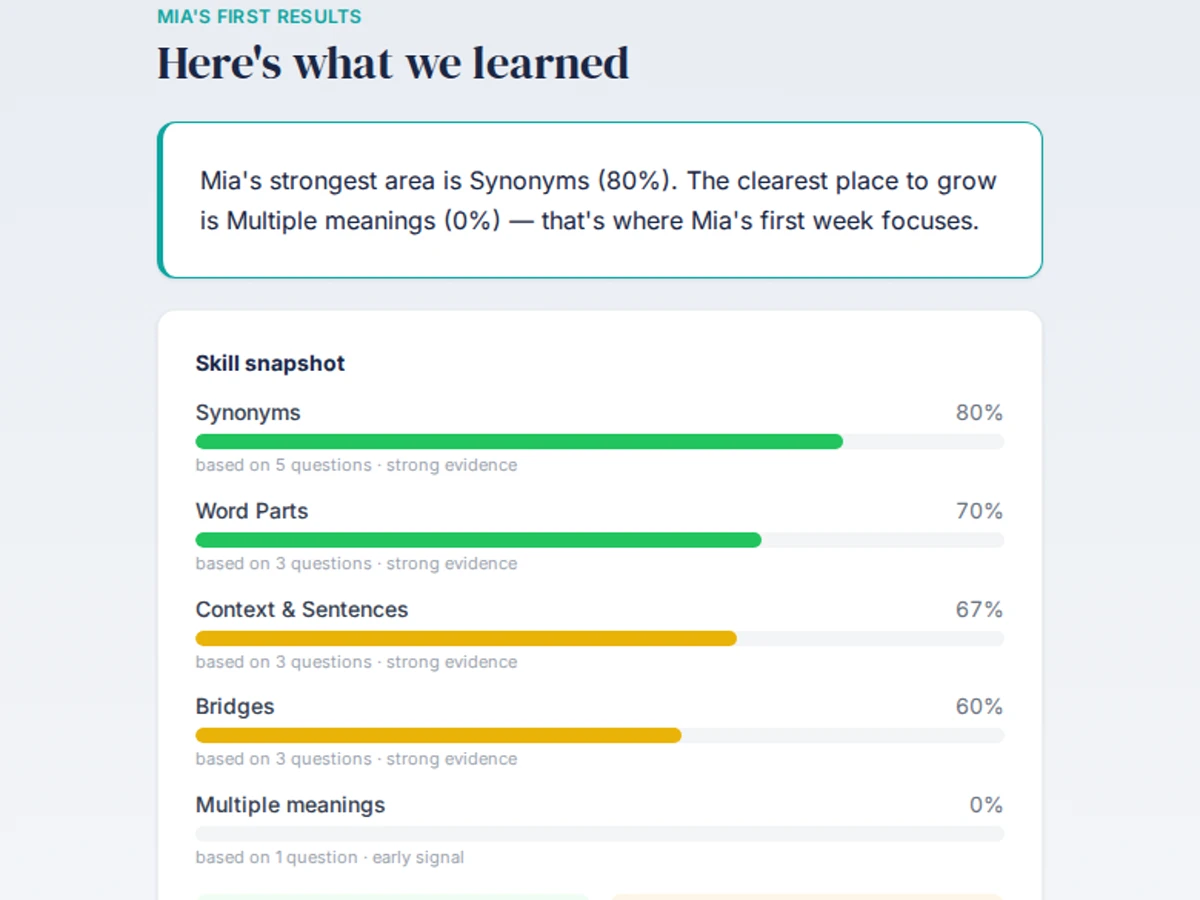
Start with a free, no-card vocabulary check-up and get a personalized parent report.
Find the vocabulary gaps — freeSee a sample parent report before starting
The check-up samples verbal skills and gives you an early strength, a growth area, and a first practice focus. It is not a full-length exam, an official SSAT or ISEE score, or an admissions prediction.
Most of us carry a quiet assumption about how vocabulary works: first your child grasps an idea, then they acquire the word for it. The label, in this view, is a courtesy — a way of pointing to understanding that already exists.
Research suggests the arrow often runs the other way.
Words don't merely name concepts we already hold. In many cases, having a precise word is what makes a concept graspable at all — what lets a child reason with it, communicate it, and act on it. The vocabulary gap isn't just a measurement problem; it's a thinking problem. And the evidence for this is piling up across neuroscience, behavioral economics, and developmental psychology in ways that matter directly for how parents can help their children thrive.
The research points to three broad ways that vocabulary acts on the brain. Two of them — access and decision — are perhaps familiar in outline, even if the evidence behind them is stronger than most parents realize. The third, regulation, is the one that tends to stop people cold.
Words as keys: access
The simplest way vocabulary shapes outcomes is by functioning as a gatekeeper. If you do not have a word for something, you often cannot exercise the right, understand the choice, or join the conversation.
Consider an adult signing a rental agreement without knowing what an "arbitration clause" means. She doesn't realize she has waived her right to take a dispute to court. The term is right there on the page. The absence isn't legal ignorance in any deep sense — it's a vocabulary gap. The word was the key, and she didn't have it.
This pattern recurs across every institution that runs on specialized language. The courtroom, the hospital, the insurance form, the college financial-aid packet — each of these systems rewards participants who can name what is happening to them. Those who can't are not necessarily less intelligent. They are simply locked out of concepts the system assumes they hold.
For children preparing for selective-school admissions, this dynamic shows up in a compressed form. Analogies, sentence completions, and reading-comprehension passages on tests like the SSAT and ISEE are exercises in access: the student either has the conceptual vocabulary to engage or they don't. But the stakes of access extend far beyond any single test. The words a child builds now are the keys she will carry into adulthood.
Words as tools: better decisions
A second mechanism is subtler. Some words don't just open doors — they restructure how we think.
Take "compound interest." If that phrase is just a noise in your ear, you cannot reason about the way debt accumulates, or why starting a retirement account at 22 is so different from starting at 32. The concept doesn't exist as a usable mental tool until you own the term precisely enough to call it up, apply it, and compare it against other options. Knowing the label isn't merely knowing a definition — it's having the cognitive equipment to make a different class of decision.
The same holds for words like "contraindication" (which prompts a different question of a pharmacist), "base rate" (which changes how you interpret a statistic), and "diversification" (which reorganizes how you think about financial risk). Each precise term encodes a concept that gives its owner a genuine structural advantage.
The PISA 2022 financial literacy assessment put a number on the gap. Only 13% of US 15-year-olds knew the term "diversification," and only 22% knew "compound interest." These teenagers are not incapable of learning these concepts — they simply haven't been given the vocabulary. And without the vocabulary, the concepts remain inaccessible just when the decisions they describe start to matter.
This is why vocabulary researchers talk about words as cognitive tools rather than labels. A child who owns precise language for a domain can reason inside that domain. One who doesn't is largely shut out, however intelligent she may be.
Words as regulation: naming calms the brain
Here is the finding that tends to surprise parents most: putting feelings into words is not just communication. It is a physiological event that changes what happens in the brain.
In a landmark 2007 neuroimaging study, Lieberman and colleagues found that when people simply named a feeling — "anger," "fear," "grief" — activity in the amygdala, the brain's threat-processing center, measurably decreased. The labelling itself was the calming mechanism, and it operated below the level of conscious effort.
What this means is that vocabulary and emotional regulation are not separate skills that happen to correlate. The naming is the regulating.
Lisa Feldman Barrett's research on emotional granularity pushes this further. People who distinguish between related emotional states — who feel the difference between "apprehensive" and "terrified," between "irritated" and "resentful" — don't just describe their inner experience with more precision. Their brains process emotions differently. Coarse labels ("I feel bad") engage generic coping. Granular labels ("I feel overwhelmed because I'm afraid of being judged") engage targeted, more effective responses.
Kashdan and colleagues (2015) examined what low emotional granularity actually predicts in people's lives. The results were striking: poor emotional vocabulary — a thin, undifferentiated feelings lexicon — was associated with higher rates of binge drinking, aggression, and self-harm. These are not fringe outcomes. They are among the most consequential behavioral risks in adolescence and early adulthood.
Notice what this implies: a feelings vocabulary is not a soft skill or a nicety. In this domain, the vocabulary is the intervention. Expanding a child's emotion lexicon is expanding her regulatory capacity in a direct, neurologically grounded sense.
What this means at the dinner table
The three mechanisms — access, decision, regulation — converge on a practical question: what can parents actually do?
The good news is that each mechanism suggests a concrete habit, and none of them require special equipment or tutoring sessions.
Teach precise feeling words, deliberately. When your child says "I feel bad," ask what kind of bad. Frustrated? Embarrassed? Left out? Anxious about tomorrow? The goal is not to interrogate — it's to expand. Each time you offer a more specific word and invite your child to try it on, you are doing something neurologically meaningful. You are adding a regulatory tool.
Name concepts out loud, even unfamiliar ones. When "compound interest" comes up in conversation, explain it briefly — not because your child needs to understand it fully right now, but because hearing it named in context is how conceptual vocabulary grows. The same applies to "contraindication" on a medicine bottle, "liability" in a news story, or "bias" when discussing a questionable claim. You are stocking a toolkit.
Treat new words as new thinking tools, not trivia. The frame matters. When you introduce a word the way you'd introduce a useful object — "here's a concept that will help you think about X" — children are more likely to reach for it. Words learned as tools get used; words learned as facts for a test get forgotten.
For a closer look at how vocabulary compounds across a childhood — and why earlier investment pays off more — see why vocabulary matters. For the science of how spaced repetition keeps new words from fading before they can do their work, spaced repetition for kids is a good next read. LexiMap is built around both: it teaches vocabulary as a reasoning system and schedules review so words stick long after the learning session ends. Vocabulary Knowledge is only one of five verbal domains LexiMap trains — the same breadth that explains why richer language shapes richer thinking across every domain of life.
Key Takeaways
- Vocabulary often precedes understanding rather than following it — having a precise word is frequently what makes a concept usable as a thinking tool.
- The access mechanism: without the right words, children (and adults) are locked out of systems, rights, and conversations that assume vocabulary they don't have.
- The decision mechanism: terms like "compound interest," "diversification," and "contraindication" encode concepts that enable a different quality of reasoning — PISA 2022 data show how rarely US teens own these terms.
- The regulation mechanism: affect labeling — simply naming an emotion — measurably reduces amygdala activity (Lieberman et al., 2007); a richer feelings vocabulary is not merely descriptive but physiologically regulatory; Kashdan and colleagues (2015) found that low emotional granularity predicts binge drinking, aggression, and self-harm.
- Parents can act on all three mechanisms at home: by naming feelings with precision, introducing conceptual vocabulary in context, and treating new words as thinking tools rather than trivia.
Further reading:
Get SSAT/ISEE vocabulary resources by email
Related Articles
8 Ways a Strong Vocabulary Shapes Your Child's Future
Beyond test scores: the eight domains of adult life — from health and wealth to careers and emotional wellbeing — where research shows vocabulary makes a measurable difference.
Does Vocabulary Affect Test Scores? What the Research Actually Shows
A clear-eyed look at the evidence linking vocabulary to academic achievement, reading comprehension, and beyond — what's well-supported, what's overstated, and why it matters for test prep.
Why Vocabulary Matters: The Research Case for Investing in Your Child's Words
Vocabulary isn't just a test-score booster — research links it causally to health, wealth, careers, and emotional wellbeing. Why word knowledge is one of the highest-return investments a parent can make.
The Vocabulary Gap: Why Words Are Your Child's Greatest Equalizer
Vocabulary quietly opens — or closes — doors to schools, professions, and institutions. Why the word gap is one of the few advantages families can actually close, and how to start.
Related Guides
SSAT Vocabulary: The Complete Guide to Root-Based Learning
Master SSAT vocabulary through Latin and Greek roots. Learn how root-based learning, spaced repetition, and interactive practice build lasting verbal skills for grades 4-12.
Root Words for SSAT & ISEE: The Complete Study Guide
The definitive guide to Latin and Greek root words for SSAT and ISEE preparation. Curated root set, study strategies, grade-level timelines, and practice exercises for grades 4-12.
SSAT® is a registered trademark of The Enrollment Management Association. ISEE® is a registered trademark of the Educational Records Bureau (ERB). LexiMap is not affiliated with or endorsed by these organizations.