Does Vocabulary Affect Test Scores? What the Research Actually Shows
Find your child’s vocabulary gaps
Start with a free, no-card vocabulary check-up and get a personalized parent report.
Find the vocabulary gaps — freeSee a sample parent report before starting
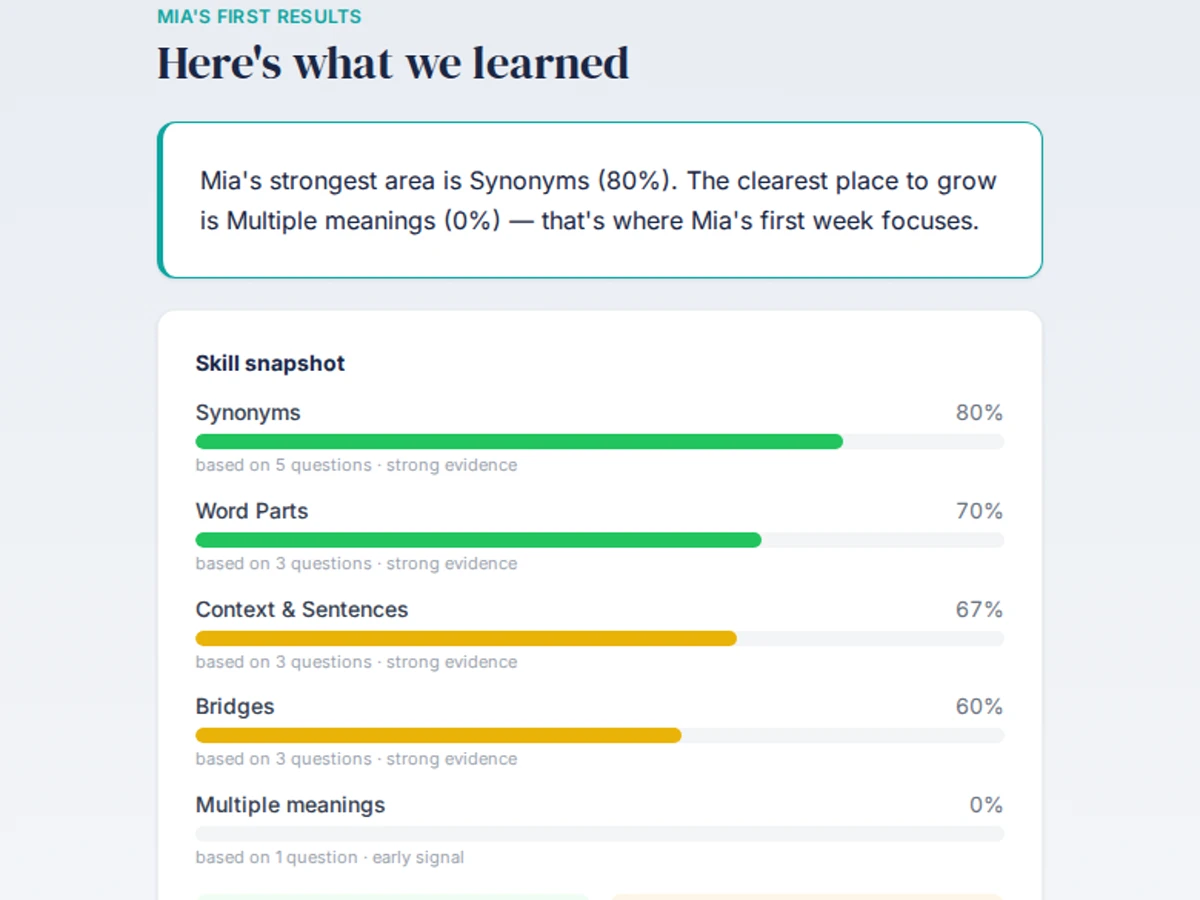
The check-up samples verbal skills and gives you an early strength, a growth area, and a first practice focus. It is not a full-length exam, an official SSAT or ISEE score, or an admissions prediction.
If you have ever Googled "vocabulary and test scores," you have probably encountered a version of this claim: learn X words and gain Y points on the SAT. It sounds authoritative. It is also not well grounded in the research literature. There is no clean, well-replicated study that maps vocabulary size to a specific point increase on a standardized test — and any program that promises otherwise is overselling.
That is not the same as saying vocabulary does not matter. It matters enormously. The honest version of the story is both more nuanced and more compelling: the research evidence is strong on academic achievement, reading comprehension, and long-term life outcomes — but the precise score-point conversion is not established, and vocabulary alone is not enough. A child also needs test strategy, stamina, and reading fluency working alongside their word knowledge.
This post walks through what the evidence actually supports, where popular claims go beyond it, and why vocabulary investment still makes sense as a central piece of test preparation — just for the right reasons.
What the Evidence Supports
Rather than abstract reassurance, it helps to look at what specific lines of research actually show. The table below summarizes four areas where the evidence is reasonably solid.
| Finding | Evidence | Source |
|---|---|---|
| Academic vocabulary → GPA | Academic Word List knowledge predicts ~16–25% of GPA variance | Coxhead 2000 |
| Critical-thinking ability → achievement | d = 0.428 across 47 studies | meta-analysis |
| Metacognition → academic progress | +7–8 months (across 355 studies) | EEF |
| Vocabulary → life outcomes | financial literacy ~30–40% of wealth gap; low health literacy HR ≈ 1.50 mortality | Lusardi 2017; Baker 2007 |
A few things are worth unpacking here.
The Coxhead finding on the Academic Word List is particularly relevant to standardized testing. Academic vocabulary — the tier of words that appear across subject areas in academic texts — predicts a meaningful share of grade-point variance. This is not casual correlation; the Academic Word List was developed by analyzing millions of words in academic texts across disciplines, and students who command it demonstrate stronger performance across the board.
The critical-thinking figure comes from a meta-analysis across 47 studies — a large-enough sample to be credible — and the effect size (d = 0.428) is considered moderate in educational research. What matters here is the direction of influence: higher-order reasoning ability, which depends in part on having precise language for abstract concepts, consistently predicts academic outcomes.
The Education Endowment Foundation figure on metacognition is striking: teaching students to think about how they think — which is itself a vocabulary-dependent skill — adds the equivalent of seven to eight months of academic progress over a year, averaged across 355 studies. The magnitude is hard to dismiss.
The life-outcomes evidence from Lusardi and colleagues and from Baker and colleagues extends the picture beyond school. These findings are discussed in more depth in the why vocabulary matters pillar piece and in vocabulary building for entrance exams.
What Is Commonly Overstated
The claim you see most often — something like "learn 1,000 words and improve your score by N points" — does not have a credible empirical basis. The research does not offer that equation, and the reason is not a gap in the science. It is that the relationship is genuinely more complex.
Test performance depends on multiple interacting factors: vocabulary depth, reading fluency, inference skills, test-taking strategy, stamina under time pressure, and familiarity with question formats. Improving one factor while the others lag will not reliably produce a predictable point gain. A student who acquires 500 new word definitions in isolation, without building the contextual inference skills to deploy them in an analogy or reading passage, will not necessarily outscore a student with a smaller but deeper vocabulary.
This matters for parents evaluating test-prep programs. A program that teaches vocabulary and nothing else — or that conflates word-list length with readiness — is optimizing for a measurable input rather than for genuine verbal ability. The programs with the strongest track records tend to train how words work (morphology, context, analogy) alongside which words to know. They also develop the metacognitive habits — monitoring comprehension, catching errors, recovering from uncertainty — that the EEF evidence flags as high-leverage.
The honest takeaway: vocabulary is necessary but not sufficient. Building it is high-leverage. Claiming it alone drives a specific point gain is overclaiming. That "not sufficient" gap is why LexiMap trains vocabulary as Vocabulary Knowledge — Domain 1 of five verbal domains — alongside Relational Reasoning, Contextual Inference, Test Execution, and Metacognition, so your child builds the full skill stack the research actually points to.
Why It Still Matters for Test Prep
Given all of that, why invest seriously in vocabulary at all?
Because the verbal sections of the SSAT and ISEE are structured in ways that directly reward word depth, and because reading comprehension — which occupies a large share of both exams — scales reliably with vocabulary.
SSAT verbal questions include analogy pairs that require understanding the precise relationship between two words, not just a surface familiarity with each one. ISEE sentence completion items require selecting the word that fits a specific semantic gap, which demands both definitional knowledge and sensitivity to connotation and register. These are not tasks you can approximate. Either you have seen the word in enough contexts to use it flexibly, or you are guessing.
Reading comprehension is where the vocabulary leverage is broadest. Researchers have observed for decades that vocabulary knowledge and reading comprehension move together — not because one is simply a proxy for the other, but because understanding what you read depends fundamentally on understanding the words in the text. A passage in an unfamiliar domain becomes tractable when your vocabulary gives you footholds; it becomes opaque when it does not. And both the SSAT and ISEE use passage content from science, history, and the humanities — exactly the domains where academic vocabulary matters most.
This is why vocabulary investment makes sense even without a clean score-point conversion number. The exact point gain is unknowable at the individual level, and it depends on too many other factors to predict. What is knowable is that verbal test performance is substantially mediated by word knowledge, and that word knowledge is one of the few factors in the equation that can be durably improved before test day.
LexiMap is built around this reality — training not just word lists but the roots, relationships, and inference skills that make vocabulary transferable to questions a student has never seen before.
Key Takeaways
- The strongest evidence for vocabulary links it to academic achievement, reading comprehension, GPA, and long-term life outcomes — not to a specific test-score point gain.
- Claims of the form "learn N words → gain X points" are not well grounded in the research; vocabulary is necessary but not sufficient for verbal test performance.
- Academic Word List knowledge predicts 16–25% of GPA variance (Coxhead 2000); metacognitive skills add an equivalent of +7–8 months of academic progress (EEF, 355 studies).
- SSAT and ISEE verbal sections are structurally designed to reward depth of word knowledge — analogies, sentence completion, and reading comprehension all depend on it directly.
- The honest case for vocabulary investment is not a guaranteed score jump — it is that vocabulary is a high-leverage, teachable skill that pays off on the exam and well beyond it.
Further reading:
- Why Vocabulary Matters
- 8 Ways a Strong Vocabulary Shapes Your Child's Future
- From SSAT to SAT to Career
Get SSAT/ISEE vocabulary resources by email
Related Articles
Why Vocabulary Matters: The Research Case for Investing in Your Child's Words
Vocabulary isn't just a test-score booster — research links it causally to health, wealth, careers, and emotional wellbeing. Why word knowledge is one of the highest-return investments a parent can make.
8 Ways a Strong Vocabulary Shapes Your Child's Future
Beyond test scores: the eight domains of adult life — from health and wealth to careers and emotional wellbeing — where research shows vocabulary makes a measurable difference.
How Words Shape Your Child's Brain: The Neuroscience of Vocabulary
Vocabulary isn't just labels for things your child already understands — naming a concept changes how the brain processes it. The research on how words drive access, decisions, and even emotional regulation.
The Vocabulary Gap: Why Words Are Your Child's Greatest Equalizer
Vocabulary quietly opens — or closes — doors to schools, professions, and institutions. Why the word gap is one of the few advantages families can actually close, and how to start.
Related Guides
SSAT Vocabulary: The Complete Guide to Root-Based Learning
Master SSAT vocabulary through Latin and Greek roots. Learn how root-based learning, spaced repetition, and interactive practice build lasting verbal skills for grades 4-12.
Root Words for SSAT & ISEE: The Complete Study Guide
The definitive guide to Latin and Greek root words for SSAT and ISEE preparation. Curated root set, study strategies, grade-level timelines, and practice exercises for grades 4-12.
SSAT® is a registered trademark of The Enrollment Management Association. ISEE® is a registered trademark of the Educational Records Bureau (ERB). LexiMap is not affiliated with or endorsed by these organizations.