The LexiMap Method: Roots, Spaced Repetition, and a 5-Domain Verbal Model
Find your child’s vocabulary gaps
Start with a free, no-card vocabulary check-up and get a personalized parent report.
Find the vocabulary gaps — freeSee a sample parent report before starting
The check-up samples verbal skills and gives you an early strength, a growth area, and a first practice focus. It is not a full-length exam, an official SSAT or ISEE score, or an admissions prediction.
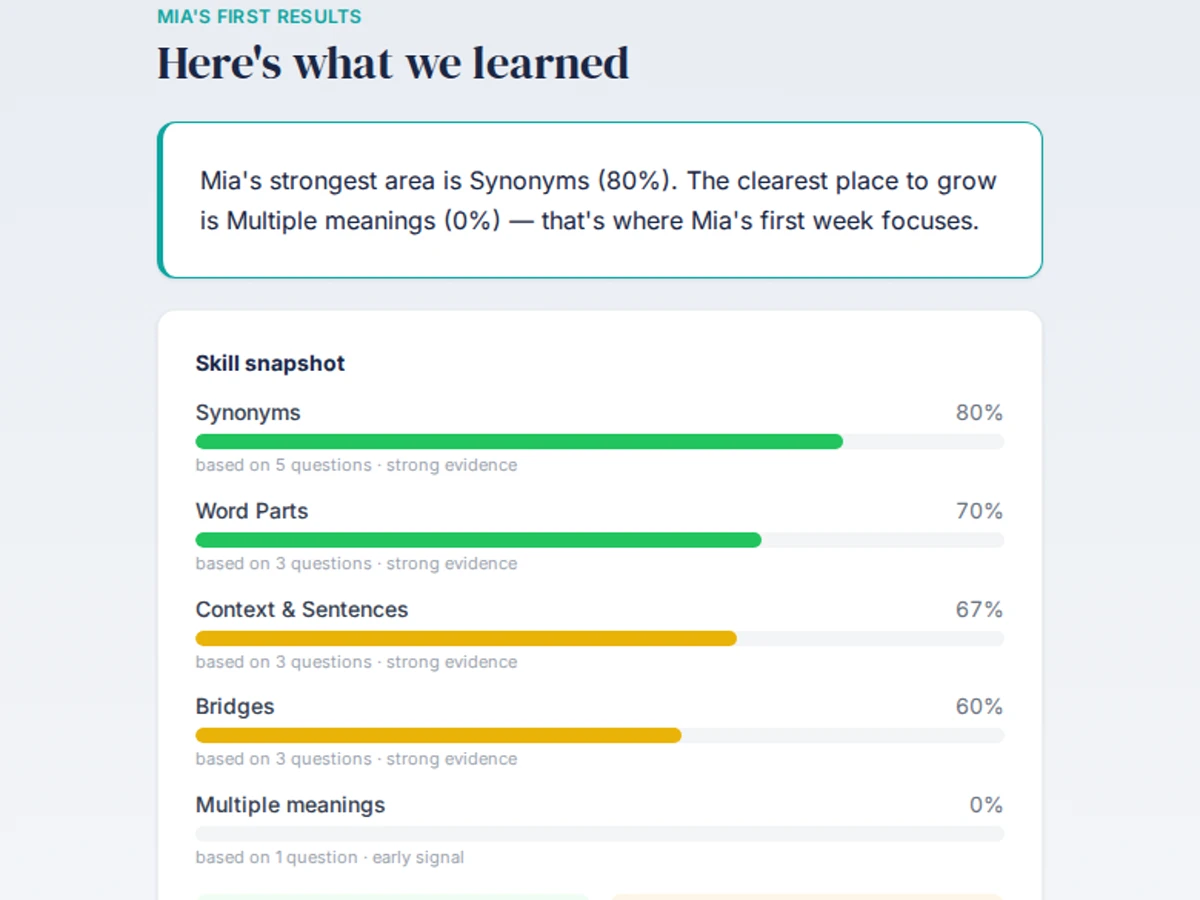
Your child sits down with a practice test. The diagnostic comes back: strong in math, weaker in verbal. The score report tells you vocabulary is the gap. What it does not tell you is how to close it.
That is where most parents find themselves stuck — knowing the problem but uncertain which solution actually works. Flashcards feel productive until the test reveals your child forgot half of what they studied. Generic vocabulary apps cover thousands of words but none of the right ones. Tutoring sessions help, but the knowledge fades between appointments.
LexiMap was built specifically to solve this problem, and it does so through three interlocking mechanisms. Understanding how they work — and how they work together — helps explain why LexiMap produces different results than the alternatives. This is the method behind the app.
Pillar 1: Morphological Pedagogy — Teaching the Periodic Table of Words
The most common vocabulary study approach is the most limited one: hand your child a list of 500 words and ask them to memorize definitions. Your child studies. They can recall what "benevolent" means on Tuesday. By Saturday, half of it has faded. By test day, they recognize the word but cannot be certain.
LexiMap's approach starts in a different place. Instead of building outward from individual words, it builds outward from roots — the Latin and Greek building blocks that underlie a large portion of the English vocabulary.
Think of it this way: chemists do not memorize the properties of every substance they encounter. They learn the periodic table. Once you understand how elements combine and behave, you can reason about thousands of compounds you have never seen before. Roots work the same way for vocabulary.
The "Bene" Example
Consider the Latin root bene, meaning "good" or "well." That one root illuminates a whole family of words:
- benefit — something that does good
- benevolent — wishing others well ( bene + volent, "to wish")
- benefactor — one who does good for another ( bene + factor, "maker/doer")
- benediction — a blessing, literally a "good saying" ( bene + diction, "saying")
- benign — kind, gentle, not harmful
- beneficiary — one who receives benefit
One root. Multiple words. And because your child knows the code, they can reason about words they have never studied. When they encounter "beneficent" on the SSAT Upper Level for the first time, they decode it.
Why This Compounds
LexiMap's curriculum is built on 160 Latin and Greek roots and 60 affixes. That combination covers a large share of the academic vocabulary tested on SSAT and ISEE verbal sections.
Each root multiplies their ability to decode unfamiliar words. A child who has mastered 40 roots can take an educated approach to hundreds of words. A child who has mastered 160 roots carries a decoding framework that works across standardized tests, college coursework, and professional life.
Read more: Root Words vs. Flashcards and The Complete List of Latin and Greek Roots .
Pillar 2: FSRS Spaced Repetition — Science-Based Scheduling That Outlasts Cramming
Learning a root is only the beginning. Without deliberate review, people forget roughly 70-80% of new vocabulary within a week.
Spaced repetition: review at precisely the moment your memory begins to fade. Each review reinforces the memory at the exact point of need.
What FSRS Means in Practice
LexiMap uses FSRS (Free Spaced Repetition Scheduler) — the current state of the art in memory scheduling. It adapts to your individual child's memory patterns.
FSRS targets ~90% recall at each review — meaning vocabulary learned through FSRS is retained at nearly 90% even weeks after the initial learning session. Compare that to 20-30% retention from cramming.
Eliminating the "Studied It, Forgot It" Cycle
FSRS eliminates this by handling scheduling automatically. Your child does not need to decide when to review. The app knows when that review is due.
For a deeper look: Spaced Repetition for Kids .
Pillar 3: The 5-Domain Verbal Model — Because the Test Is More Than Vocabulary
Roots and FSRS — Pillars 1 and 2 — build one thing exceptionally well: vocabulary knowledge. But a strong score on the SSAT and ISEE verbal sections depends on four more abilities, and a child can have a deep word bank and still lose points on pacing, on analogy relationships, or on second-guessing a correct answer. LexiMap treats the verbal section as five co-equal domains, trains each one directly, and tracks all five so progress is never reduced to "how many words do they know."
Vocabulary Knowledge is the foundation: breadth (how many words), depth (the precise shade a word carries), and connotation. And here the old binary question — does your child know this word or not? — really is insufficient. Knowing a word is a continuum: recognition ("I've seen this") deepens into association, into reliable recall, and finally into genuine ownership, where a child uses the word correctly in an unfamiliar context. Roots are what move a word along that continuum fastest, because the same building block illuminates a whole family at once.
Relational Reasoning is the skill the analogy questions measure: holding two words in mind and naming the relationship between them, discriminating near-synonyms from true synonyms, sorting antonyms, and navigating semantic fields. A child can know both words in an analogy and still miss it if they cannot articulate how the pair connects.
Contextual Inference is reading a sentence and using the surrounding clues — signal words, contrast cues, definitional hints — to pin down meaning. Sentence-completion items reward this directly, and it is also how strong readers survive the words they never studied.
Test Execution is the mechanical layer: pacing so the clock never wins, disciplined elimination of wrong choices, knowing when to guess and when to skip, building stamina across a long section, and triaging hard items instead of stalling on them.
Metacognition is the skill of managing the other four: calibrating confidence (knowing when you actually know), choosing the right strategy for a given item, noticing your own error patterns, and transferring a tactic from practice to test day.
All five domains are visible on the parent dashboard — grouped so you can see test-execution skills, learning skills, and behavioral skills at a glance. That is what turns a score report's blunt "verbal is the gap" into something actionable: you can see exactly where your child is already strong and which domain deserves this week's focus.
See also: 50 Latin Root Words Every SSAT Student Should Know .
How the Three Pillars Work Together: A Learning Journey
Week 1. Child is introduced to " bene" across several quest modes — tapping, dragging, selecting. By the end of the session the root has moved past mere recognition into a firm association: bene means good.
Week 2. FSRS schedules a review just as the memory fades, and recall becomes reliable. They also begin learning adjacent roots: "mal" (bad), "bon" (good), "belli" (war).
Week 3-4. Inference work begins. Contextual-inference and relational-reasoning modes present words they've never studied — "benediction," "malediction," "malefactor" — and analogy questions that ask them to name how two words relate.
Week 6. " bene" and the early roots are now owned — used correctly in unfamiliar contexts, not just recognized. FSRS has calibrated review schedules, and new roots continue to compound.
Test day. Child encounters "benign" in a sentence completion and "malevolent" in a synonym set. "Malevolent" — never studied specifically, but parsed instantly: " mal = bad, volent = wishing."
The Method Is the Product
LexiMap is not an app with a method attached. The method is the app. Every game mode, every question type, every scheduling decision traces back to one of the three pillars.
The morphological curriculum determines which roots and in what order. The FSRS engine determines when they review. The 5-domain model determines which verbal skill each question exercises — vocabulary, relational reasoning, contextual inference, test execution, or metacognition.
If curious about how this compares to traditional test prep methods, see Root Words vs. Flashcards .
All plans start with a 7-day free trial.
Key Takeaways
- Morphological root pedagogy teaches building blocks of words — 160 roots cover a large share of SSAT/ISEE academic vocabulary
- The "bene" root alone unlocks 8-12 words immediately
- FSRS spaced repetition targets ~90% recall at each review
- The 5-domain model spans vocabulary, relational reasoning, contextual inference, test execution, and metacognition — all tracked on the parent dashboard
- All three pillars work together: roots provide the on-ramp, FSRS preserves knowledge, and the 5-domain model maps the full verbal skill set
Further reading:
- Spaced Repetition for Kids
- Root Words vs. Flashcards
- 50 Latin Root Words
- Complete Latin and Greek Roots
Get SSAT/ISEE vocabulary resources by email
Related Articles
Root Words vs. Flashcards: Which SSAT Study Method Actually Works?
Compare root-based vocabulary learning with traditional flashcard memorization for SSAT and ISEE prep. Research-backed analysis of which method produces lasting results.
Spaced Repetition for Kids: The Science Behind FSRS and Why It Works
How spaced repetition and the FSRS algorithm help kids retain vocabulary long-term. The science of memory, forgetting curves, and why 10 minutes a day beats weekend cramming.
Vocabulary Building Methods for Entrance Exams: Roots and Spaced Repetition
Research-backed vocabulary building for entrance exams. Why root-based morphological learning and spaced repetition outperform flashcards for SSAT, ISEE, HSPT, and CogAT prep.
Why Flashcards Don't Work for Verbal Test Prep (And What to Do Instead)
Why flashcard vocabulary study fails on the SSAT, ISEE, and HSPT — and what cognitive science shows actually works: root-based learning and spaced repetition.
Related Guides
Vocabulary Study Methods: A Research-Based Guide for SSAT & ISEE Prep
Compare proven vocabulary study methods — root-based learning, flashcards, reading programs, spaced repetition, and contextual learning. Find the most effective approach for your child.
SSAT Vocabulary: The Complete Guide to Root-Based Learning
Master SSAT vocabulary through Latin and Greek roots. Learn how root-based learning, spaced repetition, and interactive practice build lasting verbal skills for grades 4-12.
SSAT® is a registered trademark of The Enrollment Management Association. ISEE® is a registered trademark of the Educational Records Bureau (ERB). LexiMap is not affiliated with or endorsed by these organizations.