How to Improve Your Child's SSAT Verbal Score: A Parent's Guide
Find your child's SSAT vocabulary gaps
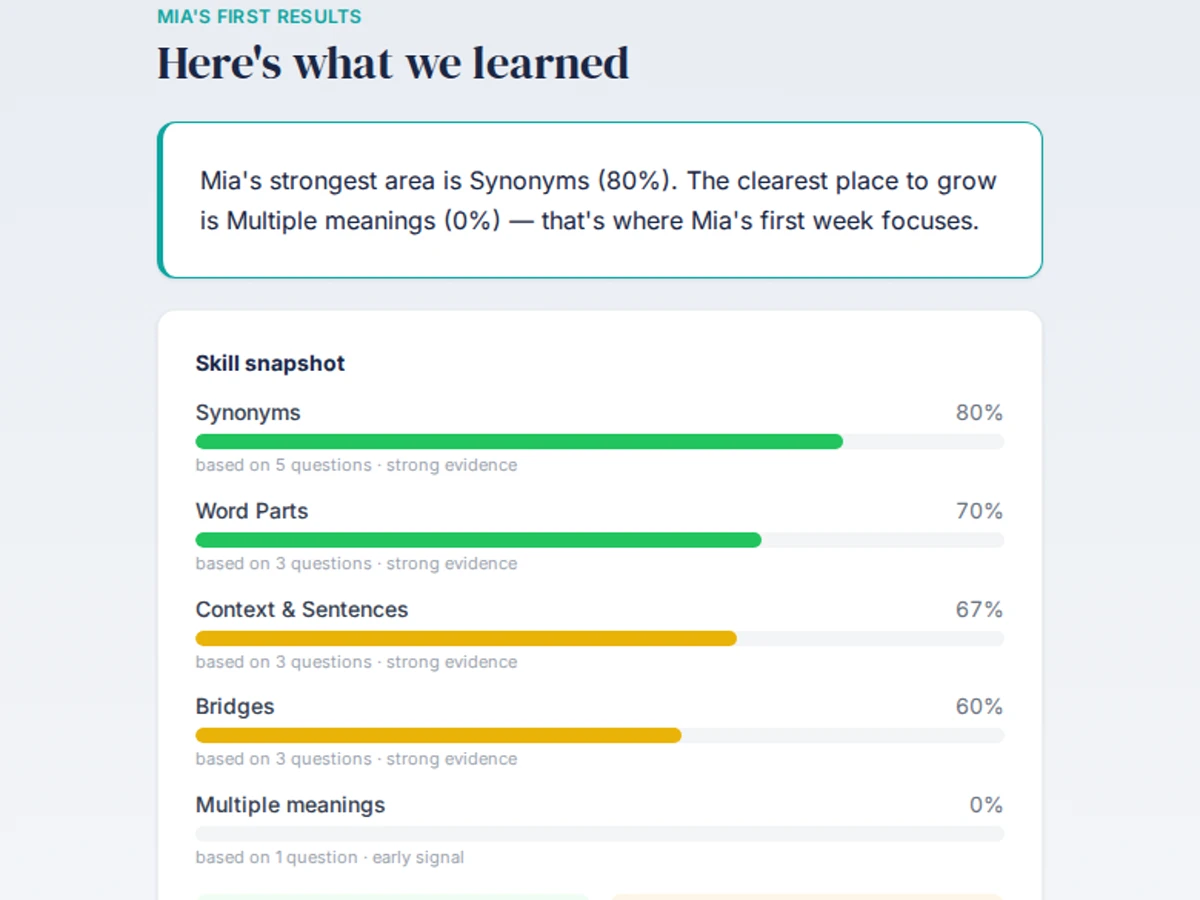
Start with a free, no-card SSAT check-up — 30 questions with a personalized parent report.
Find the SSAT vocabulary gaps — freeSee a sample parent report before starting
The check-up samples verbal skills and gives you an early strength, a growth area, and a first practice focus. It is not a full-length exam, an official SSAT or ISEE score, or an admissions prediction.
The verbal section is where most SSAT students lose ground. Unlike math — where the content is finite and sequential — the verbal section draws from a vast, unpredictable pool of vocabulary and analogy relationships. For parents watching their child struggle with practice tests, this can feel overwhelming.
The good news is that verbal scores are improvable, often dramatically. The catch is that most popular study methods — memorizing word lists, grinding flashcard decks, reading practice passages the night before — are among the least effective approaches for long-term vocabulary growth.
This guide breaks down what the SSAT verbal section actually tests, why common prep strategies fall short, and the five evidence-based methods that produce real, lasting improvement. If you're a parent planning your child's SSAT or ISEE prep, this is where to start.
Understanding the SSAT Verbal Section
The SSAT verbal section format varies by level. Middle and Upper Level tests contain 60 questions (30 synonyms, 30 analogies) with a 30-minute time limit. The Elementary Level has 30 questions in 20 minutes. The ISEE Verbal Reasoning section also varies: Lower Level has 34 questions in 20 minutes, while Middle and Upper Level have 40 questions in 20 minutes. Both sections test synonyms and sentence completions. Both tests are designed to assess depth and breadth of vocabulary knowledge.
Synonyms test whether your child can identify a word with the same or similar meaning. The difficulty comes from the vocabulary level: upper-level SSAT synonyms routinely include words like sanguine, circumspect, perfunctory, and equanimity — words that most adults would pause on.
Analogies (SSAT only) test the ability to identify relationships between word pairs. The student sees a pair like ARCHITECT : BLUEPRINT and must find the parallel relationship among the answer choices. This requires not just knowing what the words mean, but understanding how they relate to each other.
Scoring is percentile-based: your child's scaled score is compared against first-time test takers in the same grade (US & Canada) over the past three years. Percentiles are not gender-specific. A 50th percentile score means average performance; competitive independent schools typically look for 75th percentile and above, with the most selective schools expecting 85th+.
Importantly, the SSAT Middle and Upper Level tests have a quarter-point penalty for wrong answers (no penalty for skipping). The Elementary Level has no wrong-answer penalty. The ISEE has no penalty for incorrect answers on any level, so guessing strategy differs between the two tests. In both cases, confident vocabulary knowledge is more valuable than guessing — another reason why deep understanding of word structure beats surface-level memorization.
Why Most Vocabulary Prep Fails
If you've already invested in vocabulary prep and feel like it isn't working, you're not alone — and it's likely not your child's fault. The problem is usually the method, not the effort.
The Word List Ceiling
The most common approach is memorizing curated word lists — "Top 500 SSAT Words" or similar. This feels productive because the list is concrete and measurable. But it has a structural problem: the SSAT draws from a very large vocabulary pool. Even a 500-word list covers a small fraction. If the test presents a word that isn't on the list, the student has no strategy for decoding it.
The Flashcard Illusion
Flashcard apps like Quizlet are popular because they're convenient and create the feeling of learning. But basic flashcard practice — see a word, flip to see the definition — primarily trains one skill: recognition. SSAT questions test vocabulary in multiple formats: synonyms require nuanced meaning, analogies require relational reasoning, and the ISEE's sentence completions require contextual application. A student who can recognize a word on a flashcard may still fail to use that knowledge on test day.
The Cramming Trap
A comprehensive meta-analysis of spacing effect research (Cepeda et al., 2006) consistently shows that cramming produces short-term recall that fades rapidly, while spaced practice produces durable long-term retention. If the test happens to fall within a narrow window after cramming, some benefit materializes. But for students who test multiple times, or who need vocabulary for school and academic writing beyond test day, cramming provides zero lasting value. Worse, the stress of cramming can actually impair test-day performance.
5 Strategies That Actually Work
The following strategies are backed by educational research and address the specific demands of the SSAT and ISEE verbal sections.
1. Learn Root Words as Your On-Ramp
Root-word study is the fastest on-ramp to SSAT vocabulary — a strong early lever, though one of several your child will need. Latin and Greek roots are the building blocks of English vocabulary, as confirmed by a meta-analysis of morphological instruction (Bowers, Kirby, and Deacon, 2010) showing gains in vocabulary and reading comprehension — and a meta-analysis by Goodwin and Ahn (2013) showing significant positive effects on vocabulary and decoding — and the SSAT vocabulary pool draws heavily from Latinate and Greek-derived words. Over 60% of English words have Greek or Latin roots, and up to 90% of academic vocabulary is Latin/Greek-derived (Rasinski et al., 2008). LexiMap's 166 roots target the academic vocabulary most heavily tested on the SSAT and ISEE.
When a student knows that mal means "bad" and bene means "good," they can decode malevolent, malicious, benevolent, and beneficial — even if they've never studied those specific words. Each root unlocks 8–12 derived words, making root-based study dramatically more efficient than word-by-word memorization.
For a complete reference of essential roots, see our complete list of Latin and Greek roots for SSAT vocabulary.
2. Use Spaced Repetition Instead of Massed Practice
Spaced repetition is a study technique where review intervals increase as knowledge strengthens. Instead of studying the same 50 words every night, the system surfaces words that are about to be forgotten and defers words that are well known. This is vastly more efficient than reviewing everything equally.
Modern algorithms like FSRS (Free Spaced Repetition Scheduler) allow learners to target retention rates above 85%, significantly outperforming massed practice (cramming) which research consistently shows produces weaker long-term recall. The science is clear: spaced repetition is the most efficient way to build durable vocabulary knowledge. Learn more about how spaced repetition works in our methodology.
For practical purposes, this means your child should study vocabulary daily in short sessions (10–15 minutes) rather than in long weekend blocks. The daily habit is what activates the spacing effect.
3. Practice Vocabulary in Multiple Contexts
Seeing a word only in a definition format trains a narrow skill. The SSAT tests vocabulary through synonyms (nuanced meaning), analogies (relational reasoning), and in some formats, sentence context. Your child's study should mirror this variety:
- Matching exercises: Pair roots with meanings, then words with definitions
- Word building: Combine roots with prefixes/suffixes to construct real words
- Sentence completion: Choose the correct word for a blank in context
- Analogy practice: Identify relationships between word pairs
- Word families: Group words that share a common root and discuss how their meanings relate
Multi-context practice forces the brain to encode vocabulary through multiple pathways — what Bjork Lab research calls "desirable difficulties" — making retrieval more flexible and robust on test day.
4. Build a Daily Vocabulary Habit
Consistency matters more than intensity. A child who practices vocabulary for 10 minutes every day for 8 weeks will significantly outperform one who studies for 2 hours on weekends over the same period. The daily habit leverages the spacing effect (each session reinforces the previous one) and avoids the fatigue and diminishing returns of long study sessions.
Practical tips for establishing the habit:
- Anchor it to an existing routine. After breakfast, during the car ride to school, or right before reading time at night.
- Keep sessions short. 10–15 minutes is the sweet spot for retention without burnout.
- Track streaks. Visible progress (a calendar with check marks, an app's streak counter) creates momentum.
- Avoid combining with other test prep. Vocabulary study should feel like a separate, manageable commitment — not part of an overwhelming prep block.
5. Track Progress and Adjust
You can't improve what you don't measure. Regular tracking helps you (the parent) and your child understand what's working and where to focus effort. Key metrics to watch:
- Roots mastered: How many roots can your child define and recognize in derived words?
- Practice consistency: How many days per week is your child actually studying?
- Practice test scores: Take a practice verbal section every 2–3 weeks to measure score trends. Research on the testing effect shows that retrieval practice itself enhances learning.
- Confidence with unfamiliar words: Can your child use root analysis to decode words they haven't studied?
If practice test scores plateau after 4–6 weeks, the issue is usually not effort but method: check whether study is engaging multiple skill types, whether spaced repetition is being used, and whether root-based decoding is being practiced alongside word-level memorization.
Roots are a powerful on-ramp, but they are one skill inside a broader picture. The SSAT actually rewards five distinct verbal domains: vocabulary knowledge (where roots live), relational reasoning (analogies and word relationships), contextual inference (reading meaning from surrounding cues), test execution (pacing, elimination, guess discipline, and stamina), and metacognition (the self-monitoring skills that help your child adapt mid-test). A prep plan that only drills roots is leaving the other four domains untrained. LexiMap is built to develop all five — and its parent dashboard surfaces each domain separately so you can see exactly where your child is growing and where more work is needed.
How Long Does It Take to See Improvement?
Every child is different, but with consistent daily practice using the methods above, most families observe a predictable trajectory:
| Timeframe | What to Expect |
|---|---|
| 2 weeks | Improved word recognition. Your child starts noticing roots in everyday reading and conversation. "Wait, does incredible have the root cred in it?" |
| 6 weeks | Measurable vocabulary growth. Practice test synonym scores begin to improve. Root-based decoding becomes a conscious strategy for unfamiliar words. |
| 8–12 weeks | Significant score improvement. Students who commit to daily practice typically see meaningful percentile gains on the verbal section. Analogy performance improves as root-relationship awareness deepens. |
| Test day | Confident word analysis. Your child approaches unfamiliar words with a strategy — decomposing them into recognizable parts — instead of guessing or panicking. |
The recommended starting point is 8–12 weeks before the test date. This provides enough time for spaced repetition to build durable knowledge while allowing for natural variation in learning pace. Starting earlier is fine; starting later than 4 weeks limits what's achievable.
What to Look for in a Vocabulary Tool
Whether you choose an app, a tutor, workbooks, or a combination, evaluate any vocabulary prep tool against these criteria:
- Root-based curriculum: Does the tool teach root words or just individual vocabulary terms?
- Spaced repetition: Does the tool use an adaptive scheduling algorithm, or does every student see the same content in the same order? (See how our methodology combines roots with spaced repetition)
- Multi-skill practice: Does the tool go beyond flashcard recognition to include word building, context, and analogy exercises?
- SSAT/ISEE alignment: Is the content calibrated to standardized test vocabulary, or is it generic vocabulary instruction?
- Progress visibility: Can you (the parent) see what your child has mastered and where they need more practice?
- Age-appropriate engagement: Will your 10-year-old actually use it consistently, or will it feel like homework?
- Value for money: The best tool is one your child will actually use every day — compare what you get at each price point. (Compare plans and pricing)
The most expensive option isn't always the most effective. A well-designed app with the features above can deliver results comparable to private tutoring at a fraction of the cost — especially for vocabulary, where the key factor is consistent, spaced practice rather than one-on-one instruction.
Key Takeaways
- The SSAT verbal section tests vocabulary depth through synonyms and analogies — rote memorization of word lists has a low ceiling.
- Root-based learning is the highest-leverage strategy: over 60% of English words have Latin or Greek roots, and LexiMap's 166 roots target the academic vocabulary most tested on the SSAT/ISEE.
- Spaced repetition (daily 10–15 minute sessions) beats cramming by a wide margin for long-term retention.
- Multi-context practice — matching, building, analogy, context — builds flexible knowledge that transfers to test conditions.
- Most students see meaningful improvement within 6–8 weeks of consistent daily practice; start prep 8–12 weeks before the test date.
Your Action Plan
- Review the roots. Start with our complete list of Latin and Greek roots for the SSAT to see what your child will be learning.
- Set a daily schedule. Pick a consistent 10–15 minute window for vocabulary practice.
- Choose a tool that fits. Look for root-based curriculum, spaced repetition, and multi-skill exercises.
- Track progress. Take a practice verbal section now (baseline) and again every 2–3 weeks.
- Stay the course. Improvement is cumulative. The spacing effect rewards consistency over intensity.
Still have questions? Visit our FAQ or explore the LexiMap home page to learn more about how root-based learning works in practice.
Questions parents ask
How long does it take to improve an SSAT verbal score?
Plan for 8-12 weeks of consistent daily practice. Ten to fifteen minutes a day of root-based study with spaced repetition produces durable vocabulary gains; cramming word lists the week before the test rarely moves the verbal score. Check progress with a short practice section every 2-3 weeks so you can adjust the method, not just the effort.
What does the SSAT verbal section actually test?
At Middle and Upper Levels, 60 questions in 30 minutes: 30 synonyms and 30 analogies. Synonyms test vocabulary depth; analogies test whether a student can identify the relationship between word pairs. Scores are percentile-based against same-grade first-time test takers, and competitive independent schools typically look for the 75th percentile or above.
What is the most effective way to raise a verbal score?
Replace word-list memorization with root families plus spaced repetition. Each Latin or Greek root unlocks 8-12 related words your child can decode on test day, and spacing reviews keeps them retrievable. Add analogy-relationship practice and regular progress checks; those three habits account for most durable verbal improvement.
Get SSAT/ISEE vocabulary resources by email
Related Articles
The 90-Day SSAT Vocabulary Prep Plan for Parents
A week-by-week SSAT study schedule parents can actually follow — 15 minutes a day, five phases, from baseline diagnostic to test-day confidence.
SSAT Prep Cost Breakdown: What Parents Actually Spend in 2026
Honest breakdown of SSAT preparation costs — tutoring, apps, books, practice tests, and test fees. Find the most cost-effective approach for your child's verbal prep.
SSAT Vocabulary Prep: The Complete Parent Guide
Everything parents need to know about SSAT vocabulary prep — what the verbal section tests, how scoring works, and the strategies that build lasting vocabulary mastery.
SSAT vs ISEE: Which Test Does Your Child Need?
SSAT or ISEE? This honest comparison covers format, scoring, school preferences, and a clear decision framework to help you choose the right test for your child.
Related Guides
The Parent's Complete Guide to SSAT & ISEE Prep
Everything parents need to know about SSAT and ISEE preparation. Test formats, timelines, study strategies, score interpretation, and how to support your child's verbal growth.
SSAT Vocabulary List: 200+ Words Organized by Level and Root
Comprehensive SSAT vocabulary word lists organized by test level (Elementary, Middle, Upper) and root word family. Study the right words for your child's grade.
SSAT® is a registered trademark of The Enrollment Management Association. ISEE® is a registered trademark of the Educational Records Bureau (ERB). LexiMap is not affiliated with or endorsed by these organizations.