Root Words vs. Flashcards: Which SSAT Study Method Actually Works?
Find your child’s vocabulary gaps
Start with a free, no-card vocabulary check-up and get a personalized parent report.
Find the vocabulary gaps — freeSee a sample parent report before starting
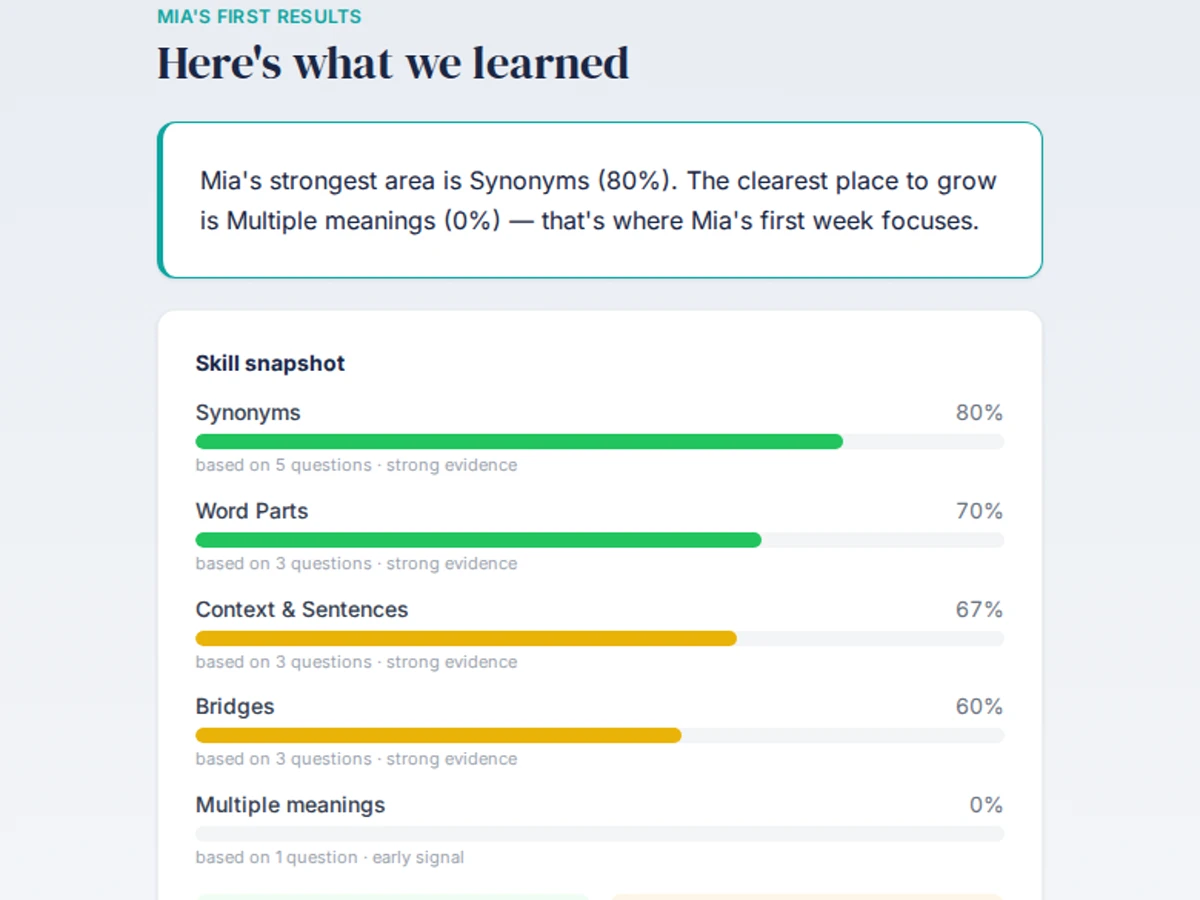
The check-up samples verbal skills and gives you an early strength, a growth area, and a first practice focus. It is not a full-length exam, an official SSAT or ISEE score, or an admissions prediction.
If you're helping your child prepare for the SSAT or ISEE, you've almost certainly thought about flashcards. They're the default study tool for vocabulary — simple, familiar, and available in every bookstore and app store. But are they actually the best approach for standardized test prep?
Over the past decade, research in cognitive science and morphological awareness has pointed toward a different method: learning the Latin and Greek roots that form the structural building blocks of English vocabulary. Rather than memorizing words one at a time, root-based learning teaches students to decode unfamiliar words by recognizing their components.
So which method actually works? The answer is more nuanced than "one is better than the other." In this article, we'll compare both approaches on the dimensions that matter most for SSAT and ISEE success — and show you how to combine them for maximum impact.
How Flashcards Work
Flashcards use rote association: one side shows the word, the other shows the definition. The student reviews the deck repeatedly, attempting to recall the definition from memory. Over time, the association strengthens and the student can recognize the word on the test.
The appeal is obvious. Flashcards are simple to create, easy to use, and provide immediate feedback. A parent can buy a pre-made SSAT deck and a child can start studying within minutes. Many digital tools like Quizlet and Anki have made flashcards even more accessible by adding features like audio pronunciation and progress tracking.
But flashcards have a fundamental limitation: they teach words in isolation. Each card represents a single word-definition pair with no structural connection to other words. A student who memorizes "benevolent = kind" gains nothing when they encounter "benediction" or "benefactor" on test day. Every unfamiliar word is a blank slate, requiring its own card and its own memorization effort.
Under the time pressure of a standardized test, rote associations are also fragile. Research on retrieval under stress shows that shallow encoding — where a learner hasn't processed the meaning deeply — is more susceptible to interference and forgetting during high-stakes situations.
How Root-Based Learning Works
Root-based learning takes a structural approach. Instead of memorizing individual words, students learn the morphemes — roots, prefixes, and suffixes — that compose English words. The root bene means "good." Once a student knows that single root, they can decode benefit (good result), benevolent (wishing good), benediction (good words/blessing), and benefactor (one who does good). One root unlocks an entire word family.
This approach is grounded in decades of research on morphological awareness — the ability to recognize and manipulate the meaningful parts of words. A landmark meta-analysis by Bowers, Kirby, and Deacon (2010) found that morphological instruction produced significant gains in vocabulary, reading comprehension, and spelling across all grade levels studied. A meta-analysis by Goodwin and Ahn (2013) reviewing morphological instruction across school-age learners similarly found significant positive effects on vocabulary knowledge and decoding.
The efficiency gains are substantial. Vocabulary size research by Nation (2001, Learning Vocabulary in Another Language) shows that knowing approximately 95–98% of words in a text is required for unassisted comprehension — a threshold that root-based coverage is designed to approach. Based on our content mapping analysis, a focused set of 182 root families (291 word parts including affixes) targets the academic vocabulary most heavily tested across all SSAT and ISEE levels. Over 60% of English words have Greek or Latin roots, and up to 90% of academic vocabulary is Latin/Greek-derived (Rasinski et al., 2008). That means a student who masters these 182 root families has structural access to the vast majority of test vocabulary — without needing to memorize thousands of individual words. For the complete list of these roots, see our guide to Latin and Greek roots for the SSAT.
Root-based learning also builds a transferable skill. A student who learns mal (bad) and dict (say) doesn't just know "malediction" — they can work out any word containing those roots, including words they've never seen before. This is the critical difference: flashcards teach words, roots teach the system.
Head-to-Head Comparison
Let's compare the two methods across the five dimensions that matter most for standardized test performance:
| Dimension | Flashcards | Root-Based Learning |
|---|---|---|
| Transfer to unknown words | None. Each word must be studied individually. | High. One root unlocks 5-15+ related words. |
| Retention over time | Moderate with spaced repetition; weak with cramming. | Strong. Structural understanding resists forgetting. |
| Study efficiency | Low. 1 card = 1 word learned. | High. 1 root = entire word family accessible. |
| Analogy performance | Limited. Knowing definitions doesn't reveal word relationships. | Strong. Root relationships directly map to analogy bridges. |
| Scalability | Linear. Doubling vocabulary requires doubling cards. | Exponential. Each new root multiplies accessible words. |
The comparison is clearest on analogy questions, which make up half of the SSAT verbal section. Analogies test the relationship between words, not just their definitions. A student who knows that bene (good) and mal (bad) are antonym roots can immediately identify the relationship between "benevolent" and "malevolent" — and match it to the correct answer pair. Flashcards that teach "benevolent = kind" and "malevolent = cruel" as separate cards don't reveal this structural connection.
For synonym questions, the advantage is equally clear. When a student encounters an unfamiliar word like "veracious," root knowledge ( ver = truth) provides a path to the answer. A flashcard-only student who hasn't studied that specific word has no fallback strategy — they must guess.
The Best of Both Worlds
Here's the insight that changes the debate: flashcards and roots are not mutually exclusive. The most effective study approach uses flashcards as a delivery mechanism for root-based content. Instead of one flashcard per word, you create one card per root — with the root on the front and its meaning plus word family on the back.
This hybrid approach gives you the structural power of root learning combined with the retrieval practice benefits of flashcards. When you add spaced repetition scheduling — where the algorithm determines when each root should be reviewed based on how well the student knows it — the combination becomes remarkably efficient.
The FSRS (Free Spaced Repetition Scheduler) algorithm takes this a step further by optimizing review timing based on individual memory patterns. Research shows that FSRS can maintain retention rates above 85% with significantly less study time than fixed-interval or random review schedules. When applied to root learning, it means students spend their time on the roots they're about to forget — and skip the ones they already know well.
But the content on each card matters just as much as the scheduling. A root-based card doesn't just ask "What does duct mean?" It asks the student to identify roots in words, build new words from roots, and recognize root relationships — engaging multiple cognitive skills in each session. See how our methodology combines FSRS spaced repetition with multi-skill root practice.
When Each Method Works Best
Despite the clear advantages of root-based learning for long-term preparation, traditional flashcards do have a specific use case: last-minute review. If a student has two weeks before their test and hasn't started prep, targeted word-definition flashcards can provide a quick score boost by covering the most frequently tested words. This is not ideal, but it's better than nothing.
For students with three months or more before their test — which is the timeline we recommend — root-based learning with spaced repetition is clearly superior. The compounding effect of root knowledge means that early investment pays increasing dividends as test day approaches. A student who learns 10 roots per week for 12 weeks has structural access to hundreds of words, while a student who memorizes 10 words per week on flashcards knows only 120.
Grade level also matters. Younger students (grades 3–5) preparing for the Elementary Level SSAT benefit especially from root learning because it builds a foundation they'll use through high school. Older students (grades 8–11) preparing for the Upper Level often have larger existing vocabularies and can use root knowledge to fill gaps more strategically.
Key Takeaways
- Traditional flashcards teach words in isolation — one card, one word, no transfer to unknown vocabulary.
- Root-based learning teaches the structural system behind English words — one root unlocks an entire word family.
- For SSAT/ISEE analogies, root knowledge is especially powerful because it reveals the relationships between words, not just their definitions.
- The most effective approach combines both: use flashcards as a delivery mechanism for root-based content, scheduled with spaced repetition.
- Start root-based prep at least 3 months before the test for maximum compounding effect.
Next Steps
Ready to move beyond pure flashcard memorization? Start with these resources:
- Root Words for the SSAT & ISEE — our complete guide to using roots for test prep
- SSAT Vocabulary Guide — level-by-level vocabulary expectations and strategies
- 50 Latin Roots That Unlock Hundreds of SSAT Words — a focused list to start building your child's root vocabulary
- Complete Latin & Greek Root Reference — the full 60+ root table with examples and study strategies
Root mastery is the on-ramp into a broader skill set — see how LexiMap builds all five verbal domains so your child's preparation doesn't stop at Vocabulary Knowledge.
Questions parents ask
Are flashcards bad for vocabulary learning?
No — they're a fine drill format. The problems are what's on the cards (isolated definitions instead of word structure) and when they're reviewed (ad hoc instead of scheduled). Fix both and flashcards become genuinely useful.
Why do roots beat word lists?
A word list teaches the words on the list. A root teaches the family: duc/duct (to lead) unlocks conduct, deduce, introduce, produce, educate, and more — including words your child meets for the first time on test day.
Get SSAT/ISEE vocabulary resources by email
Related Articles
SSAT Vocabulary Words: Why a List Won't Save Your Child on Test Day
Your child memorized hundreds of SSAT vocabulary words. So why didn't the score move? The structural flaw in word lists — and what actually works instead.
Why Flashcards Don't Work for Verbal Test Prep (And What to Do Instead)
Why flashcard vocabulary study fails on the SSAT, ISEE, and HSPT — and what cognitive science shows actually works: root-based learning and spaced repetition.
The LexiMap Method: Roots, Spaced Repetition, and a 5-Domain Verbal Model
How LexiMap combines morphological roots, FSRS spaced repetition, and a 5-domain verbal model — vocabulary, relational reasoning, contextual inference, test execution, and metacognition — into one trainer for the SSAT and ISEE.
SSAT Vocabulary Prep: The Complete Parent Guide
Everything parents need to know about SSAT vocabulary prep — what the verbal section tests, how scoring works, and the strategies that build lasting vocabulary mastery.
Related Guides
Vocabulary Study Methods: A Research-Based Guide for SSAT & ISEE Prep
Compare proven vocabulary study methods — root-based learning, flashcards, reading programs, spaced repetition, and contextual learning. Find the most effective approach for your child.
SSAT Vocabulary: The Complete Guide to Root-Based Learning
Master SSAT vocabulary through Latin and Greek roots. Learn how root-based learning, spaced repetition, and interactive practice build lasting verbal skills for grades 4-12.
SSAT® is a registered trademark of The Enrollment Management Association. ISEE® is a registered trademark of the Educational Records Bureau (ERB). LexiMap is not affiliated with or endorsed by these organizations.