SSAT Vocabulary: The Complete Guide to Root-Based Learning
The SSAT verbal section is the single biggest differentiator in competitive independent school admissions. While math and reading scores cluster tightly among strong applicants, vocabulary scores vary widely — and that variation comes down to preparation strategy. Students who rely on rote memorization of word lists hit a ceiling quickly. Students who learn the structural building blocks of English — Latin and Greek roots — can decode words they have never seen before.
This guide is a comprehensive resource for parents and students preparing for the SSAT (and ISEE) verbal sections. It covers everything from test format and scoring to the 50 most important roots, grade-by-grade study timelines, the science of spaced repetition, and common mistakes that derail preparation. Whether your child is in 4th grade or 12th, the principles here apply.
The core insight is simple: over 60% of English words have Latin or Greek roots, and up to 90% of academic vocabulary is Latin/Greek-derived (Rasinski et al., 2008). Each root unlocks an average of 8 to 12 derived words. That means mastering 50 roots gives your child structural access to 400 to 600 words — not through memorization, but through understanding. This guide shows you exactly how to build that understanding. For specific root-by-root breakdowns, see our complete Latin and Greek roots reference.
Find your child's SSAT verbal starting point
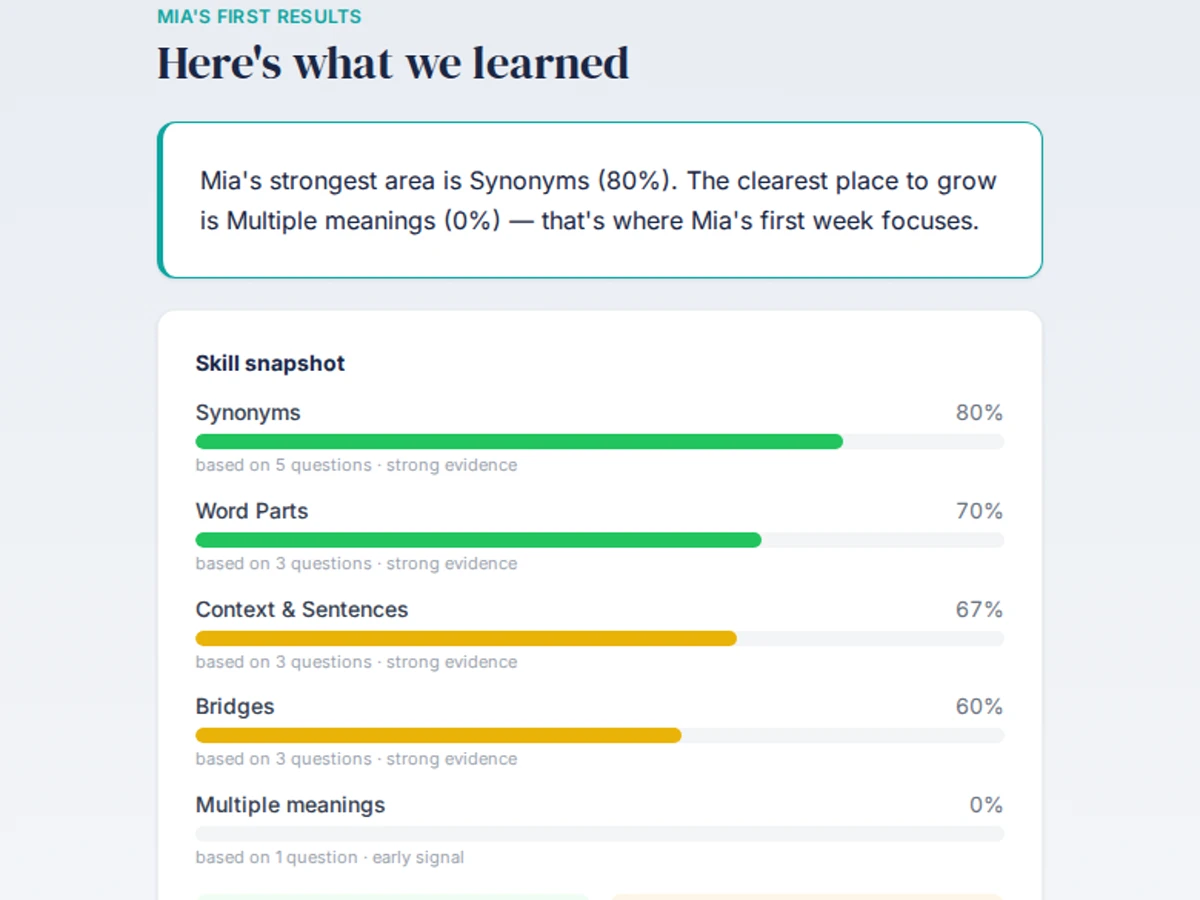
A short timed section — 30 questions on synonyms, analogies, and word roots — with a personalized parent report. Free, no card.
See a sample parent report before starting
The check-up samples verbal skills and gives you an early strength, a growth area, and a first practice focus. It is not a full-length exam, an official SSAT or ISEE score, or an admissions prediction.
How the SSAT Verbal Section Works
The SSAT is administered at three levels, each with a distinct verbal section format. Understanding the structure helps you target preparation effectively.
Middle and Upper Level (Grades 5-11)
The Middle Level (grades 5-7) and Upper Level (grades 8-11) verbal sections each contain 60 questions to be completed in 30 minutes. The questions split evenly: 30 synonym questions and 30 analogy questions. Synonym questions present a single word and ask the student to choose the answer choice closest in meaning. Analogy questions present a pair of words with a specific relationship and ask the student to identify a parallel relationship among the answer choices.
Scoring is percentile-based. Raw scores are calculated with a quarter-point penalty for incorrect answers (no penalty for omitted questions), then converted to scaled scores ranging from 440 to 710 for each section. The percentile rank — how your child's score compares to other test-takers at the same grade level — is what admissions committees primarily consider. A student scoring in the 75th percentile or above is generally competitive at selective schools; the most competitive programs look for 85th percentile and higher.
Elementary Level (Grades 3-4)
The Elementary Level verbal section contains 30 questions to be completed in 20 minutes: 15 synonym questions and 15 analogy questions. The vocabulary is grade-appropriate but still draws heavily from Latin and Greek roots — words like "construct," "invisible," and "predict" all appear at this level and are directly decodable through root knowledge.
A Note on the ISEE
The ISEE (Independent School Entrance Examination) tests verbal reasoning through synonym questions and sentence completion questions rather than analogies. The vocabulary demands overlap significantly with the SSAT, and root-based preparation supports both exams. If your child is taking the ISEE, everything in this guide applies — the roots, the study strategies, and the spaced repetition approach all transfer directly. For more on SSAT/ISEE verbal-prep strategy, see our parent's SSAT/ISEE verbal prep guide.
Why Root-Based Learning Works
Traditional vocabulary preparation asks students to memorize individual word-meaning pairs: "benevolent means kind," "malicious means harmful," "incredulous means skeptical." This approach has two problems. First, it scales poorly — the SSAT draws from a pool of thousands of words, and no list can cover them all. Second, memorized associations are fragile. Under test pressure, students frequently confuse similar-sounding words or blank on definitions they crammed the night before.
Root-based learning solves both problems through what linguists call morphological awareness — the ability to recognize meaningful parts within words. Consider the root cred, which means "believe." From this single root, a student can decode:
- credit — belief or trust (in someone's ability to repay)
- credible — worthy of being believed
- incredible — not believable (in- = not)
- credulous — too willing to believe
- credential — something that establishes belief in one's qualifications
- creed — a statement of belief
- incredulous — unwilling or unable to believe
- accredit — to officially recognize as meeting standards (grant credibility)
That is eight words from one root. Multiply this across 50 essential roots, and a student gains structural access to hundreds of words — including words they have never encountered in a study session. This is the "one root, many words" multiplier effect, and it is the reason root-based learning consistently outperforms list-based memorization in research studies on vocabulary acquisition.
The numbers support this approach. Over 60% of English words have Latin or Greek roots, and up to 90% of academic vocabulary is Latin/Greek-derived (Rasinski et al., 2008). The SSAT vocabulary pool draws heavily from these Latinate and Greek-derived words. English inherited its academic and formal vocabulary primarily from Latin (through French after the Norman Conquest) and its scientific and philosophical vocabulary primarily from Greek. The everyday conversational words come from Germanic Old English, but the words that distinguish a strong verbal score from a mediocre one — words like "magnanimous," "circumspect," "incredulous," and "subterranean" — are built from Latin and Greek roots. Learn more about how we apply this research in our methodology overview.
The 50 Most Important Latin & Greek Roots for the SSAT
The table below lists the 50 roots that appear most frequently in SSAT vocabulary. These include core Latin and Greek roots as well as the most productive prefixes — word-beginning elements that modify meaning. Each root is listed with its meaning, language of origin, and example words that commonly appear on standardized tests.
When studying, focus on understanding the meaning connection between the root and each example word. Do not simply memorize the list — practice building new words from each root and identifying the root within unfamiliar words. That transfer skill is what the SSAT actually tests.
| Root | Meaning | Origin | Example Words |
|---|---|---|---|
| aud | hear | Latin | audience, audible, auditorium, audition |
| bene | good, well | Latin | benefit, benevolent, benediction, benefactor |
| cred | believe | Latin | credit, credible, incredible, credulous, credential |
| dict | say, speak | Latin | dictate, predict, verdict, contradict, diction |
| duc / duct | lead | Latin | conduct, deduce, introduce, produce, educate |
| fac / fact | make, do | Latin | factory, manufacture, effect, defect, facilitate |
| graph | write | Greek | autograph, biography, graphic, paragraph, telegraph |
| loc / loqu | speak | Latin | eloquent, loquacious, colloquial, elocution |
| magn | great | Latin | magnificent, magnify, magnitude, magnate |
| mal | bad | Latin | malice, malevolent, malfunction, malignant, malpractice |
| mand | order, command | Latin | mandate, command, demand, remand, mandatory |
| mit / miss | send | Latin | transmit, missile, emit, dismiss, remission |
| mort | death | Latin | mortal, immortal, mortify, mortuary, mortgage |
| nov | new | Latin | novel, renovate, innovate, novice, novelty |
| ped | foot | Latin | pedal, pedestrian, pedestal, expedition, impede |
| port | carry | Latin | transport, portable, export, import, deportation |
| rupt | break | Latin | interrupt, erupt, corrupt, rupture, abrupt |
| scrib / script | write | Latin | describe, manuscript, inscription, prescribe |
| spec / spect | look, see | Latin | inspect, spectacle, perspective, retrospect |
| struct | build | Latin | construct, structure, instruct, destruct, infrastructure |
| terr | earth, land | Latin | territory, terrain, terrestrial, subterranean |
| tract | pull, drag | Latin | attract, extract, traction, retract, subtract |
| ven / vent | come | Latin | adventure, event, intervene, convention, prevent |
| ver | truth | Latin | verify, verdict, veracity, veracious, aver |
| vid / vis | see | Latin | visible, evidence, provide, vision, supervise |
| viv | live | Latin | vivid, revive, survive, vitality, vivacious |
| voc / vok | call, voice | Latin | vocal, invoke, provoke, evocative, advocate |
| ambi | both | Latin | ambiguous, ambivalent, ambidextrous, ambiance |
| ante | before | Latin | antecedent, anterior, anteroom, antedate |
| circum | around | Latin | circumference, circumstance, circumvent, circumscribe |
| con / com | with, together | Latin | connect, community, combine, companion, compose |
| contra | against | Latin | contradict, contrast, contrary, contravene |
| de | down, from | Latin | descend, decline, depart, degrade, diminish |
| dis | apart, not | Latin | disagree, disconnect, disappear, disrupt, dismiss |
| ex | out | Latin | exit, export, exclude, external, exhale |
| in / im | not | Latin | invisible, impossible, imperfect, inadequate, inactive |
| inter | between | Latin | international, interact, intervene, interrupt, intercept |
| micro | small | Greek | microscope, microphone, microbe, microcosm |
| mono | one | Greek | monopoly, monologue, monotone, monochrome |
| multi | many | Latin | multiply, multitude, multimedia, multilingual |
| omni | all | Latin | omnivore, omniscient, omnipotent, omnipresent |
| pan | all | Greek | panorama, pandemic, pandemonium, panacea |
| peri | around | Greek | perimeter, periscope, peripheral, peripatetic |
| poly | many | Greek | polygon, polyglot, polysyllabic, polynomial |
| post | after | Latin | postpone, postscript, postmortem, posterior |
| pre | before | Latin | predict, prevent, preview, precaution, precede |
| re | again, back | Latin | return, rebuild, rewrite, reconsider, restore |
| sub | under | Latin | submarine, subtract, subconscious, subordinate |
| super | above | Latin | supernatural, superior, superb, supervise |
| trans | across | Latin | transport, transform, transcend, translate, transmit |
Notice how many of these roots your child already encounters in everyday language. The word "transport" contains trans (across) and port (carry) — literally "carry across." The word "invisible" contains in (not) and vis (see) — literally "not able to be seen." Root-based study makes this structural knowledge conscious and transferable so it works on unfamiliar test words too. For a deeper reference with 60+ roots organized by Latin and Greek origin, see our full Latin and Greek roots guide.
Practice these roots interactively
LexiMap turns root learning into an interactive game with 18 exercise modes and FSRS spaced repetition. Start with a free, no-card check-up.
Take a real timed section — freeStudy Timeline by Grade
Effective vocabulary preparation is not one-size-fits-all. The ideal study intensity, focus areas, and timeline depend on your child's grade level, current vocabulary strength, and test date. Below are research-informed guidelines for each level.
Grades 4-6 (Elementary and Lower Middle Level)
Daily commitment: 10 to 15 minutes per day. At this age, short focused sessions are far more effective than longer study blocks. Attention spans are limited, and the goal is to build a habit of daily engagement rather than intensive cramming.
Focus areas: Start with the 20 highest-frequency roots — words like vis (see), aud (hear), port (carry), and duct (lead). These roots appear in words students already know (visible, audience, portable, conduct), which makes the connection between root and meaning concrete and intuitive. Add common prefixes like un-, re-, and pre- early — these are the most productive morphemes in English and give students immediate decoding power.
Timeline: 3 to 6 months before the test date. Starting earlier is always better at this level because younger students need more repetitions to solidify root knowledge. If the test is less than 3 months away, focus exclusively on the top 15 roots and common prefixes rather than trying to cover everything.
Grades 7-8 (Middle Level)
Daily commitment: 15 to 20 minutes per day. Students at this level can handle slightly longer sessions and benefit from more complex exercises that connect roots to analogy-style reasoning.
Focus areas: Build complete root families — not just the root cred (believe) in isolation, but the full chain from credible to incredible to incredulous to credential. Practice analogy relationships: if bene means good and mal means bad, then benevolent is to malevolent as beneficial is to malicious. This relational thinking is exactly what the analogy section tests. Add Greek roots at this stage — graph, poly, mono, micro — as they appear more frequently at the Middle Level than at Elementary.
Timeline: 4 to 8 months. The Middle Level SSAT draws from a substantially larger vocabulary pool than the Elementary Level. Students need time to build, reinforce, and connect root families. Starting at least 4 months before the test gives enough time for spaced repetition to move roots into long-term memory.
Grades 9-12 (Upper Level)
Daily commitment: 20 to 30 minutes per day. Upper Level students benefit from deeper engagement: not just recognizing roots, but using context clues alongside root analysis to narrow down meanings for words with multiple possible interpretations.
Focus areas: All 50 roots in the table above, plus advanced Greek combining forms like peri (around), pan (all), and circum (around). At this level, students should practice context-based decoding: given a sentence with an unfamiliar word, can they combine root analysis with sentence context to determine meaning? This mirrors the most challenging Upper Level questions. Students should also study commonly confused word pairs — words like "incredulous" versus "incredible" or "prescribe" versus "proscribe" — where root knowledge helps disambiguate.
Timeline: 6 to 12 months. The Upper Level verbal section is the most demanding standardized vocabulary test below the GRE. Sustained daily practice over at least 6 months is necessary for meaningful vocabulary growth and confident decoding. Students starting with weaker vocabularies should allow a full academic year.
Spaced Repetition: The Science of Retention
Learning a root once is not enough. The brain forgets newly acquired information in a predictable decay curve — what cognitive scientists call the "forgetting curve," first documented by Hermann Ebbinghaus in the 1880s. Without review, most new information is lost within days. Spaced repetition is the systematic antidote to this natural forgetting.
The principle is straightforward: review material at increasing intervals, timed to arrive just before the memory would fade. A new root might be reviewed after 1 day, then 3 days, then 7 days, then 14 days, then 30 days. Each successful recall strengthens the memory trace and extends the optimal interval before the next review. Material that a student struggles with gets reviewed more frequently; material that is well-known gets spaced further apart.
Modern spaced repetition algorithms like FSRS (Free Spaced Repetition Scheduler) optimize these intervals based on individual performance data. Unlike simple flashcard systems that use fixed intervals, FSRS adapts to each learner's actual retention patterns. Research published at KDD 2023 showed that FSRS achieves significantly higher retention rates than older algorithms like SM-2 while requiring fewer total reviews — meaning students spend less time studying and remember more.
For vocabulary specifically, spaced repetition is especially powerful because word knowledge is cumulative. Each review session does not just refresh the target root — it also activates the network of derived words and related roots that share structural connections. Reviewing duct naturally reminds the student of con-, de-, pro-, and other prefixes they have studied alongside it. This cross-activation means vocabulary built through spaced repetition grows stronger over time rather than plateauing.
The practical takeaway for parents: daily practice matters more than session length. Ten minutes of spaced review every day for four months will produce dramatically better results than two hours of cramming per week for the same period. The LexiMap methodology page explains how FSRS spaced repetition is integrated into every practice session.
Common Mistakes to Avoid
Even motivated students and well-intentioned parents can fall into preparation traps that waste time or produce shallow learning. Here are the five most common mistakes and how to avoid them.
1. Over-Relying on Word Lists
Many test prep books include lists of "1000 SSAT words" and suggest students memorize them. The problem is that these lists cannot cover the full vocabulary pool the SSAT draws from, and rote memorization without structural understanding does not transfer to unfamiliar words. Word lists are useful as supplementary exposure, but they should not be the primary study method. Root-based learning provides the structural framework that makes word lists meaningful rather than arbitrary.
2. Ignoring Context
Studying roots in isolation — just the root and its one-word meaning — misses the point. Roots need to be studied in the context of real words and real sentences. When a student learns that spec means "look," they should immediately connect it to "spectacle" (something worth looking at), "inspect" (look into), "retrospect" (looking back), and "suspect" (look under, metaphorically). The meaning of the root only becomes useful when practiced in context.
3. Cramming Before the Test
Cramming produces the illusion of knowledge. A student who reviews 200 roots the night before the test will feel confident walking in and then discover on question 5 that the information has not stuck. Vocabulary acquisition requires long-term memory formation, and long-term memory requires spaced repetition over weeks and months. If you have less than two weeks before the test, focus on high-frequency roots your child already partially knows rather than trying to learn new material.
4. Skipping Review Sessions
The most common failure pattern is strong initial engagement followed by inconsistent review. A student learns 15 roots in the first week, skips a week, learns 10 more, skips two weeks, and then discovers that the first 15 have largely been forgotten. Consistency is not optional with spaced repetition — it is the mechanism that makes it work. Set a daily practice time and protect it the way you would a piano lesson or sports practice.
5. Not Practicing in Multiple Formats
Recognizing a root on a flashcard is not the same as identifying it within an unfamiliar word on the SSAT. Students need to practice root knowledge in multiple formats: matching exercises, word-building activities, analogy completion, synonym identification, and sentence context exercises. Each format strengthens a different aspect of root knowledge. If your child can match bene to "good" but cannot identify which answer choice is a synonym for "beneficent," they need more transfer practice.
How LexiMap Teaches SSAT Vocabulary
LexiMap is a vocabulary training app designed specifically around the root-based, spaced repetition approach described in this guide. Here is what it includes:
- 182 curated root families covering the Latin and Greek morphemes most relevant to SSAT and ISEE verbal prep, organized into progressive quest packs by difficulty level.
- 18 game modes — including drag-and-drop root matching, tap-select synonym identification, swipe-based word sorting, and analogy completion — that practice root knowledge across multiple cognitive skills.
- FSRS spaced repetition built into every session. The algorithm tracks each child's performance on every root and schedules reviews at the optimal interval for long-term retention.
- Quest-based progression that organizes study into structured sessions with warm-up, practice, and challenge segments, maintaining engagement while ensuring systematic coverage.
- Parent dashboard showing mastery progress, daily practice streaks, and which roots need additional review — giving parents visibility without requiring them to run the study sessions.
The app is designed for grades 4 through 12 and adapts difficulty to each child's level. You can start with SSAT context to personalize the first check-up, or view pricing for subscription details.
Frequently Asked Questions
How long does it take to see SSAT verbal-prep progress?
Most students who practice consistently (10 to 20 minutes daily) begin to notice improved confidence with unfamiliar words within 4 to 6 weeks. Practice-test trend checks can become more informative after 8 to 12 weeks of daily root-based study with spaced repetition. The timeline depends heavily on starting vocabulary level, grade, and consistency. Students who practice daily build vocabulary habits faster than those who study in longer but less frequent sessions.
What grade should my child start vocabulary prep?
Root-based vocabulary learning is productive at any grade level from 4th grade onward. Students taking the Elementary Level SSAT in 4th or 5th grade benefit from starting 3 to 6 months before the test. For Middle and Upper Level, 4 to 8 months is ideal. That said, root knowledge is cumulative and valuable beyond test prep — students who begin root-based study early build a structural vocabulary advantage that compounds over years, helping with the SSAT, SAT, ACT, AP exams, and academic reading in general.
Are Latin and Greek roots really on the SSAT?
The SSAT does not test roots directly — there is no question that asks "what does the root cred mean?" However, over 60% of English words have Latin or Greek roots, and the academic vocabulary tested on the SSAT draws heavily from Latin and Greek origins. Words like "benevolent," "magnanimous," "circumspect," "incredulous," and "subterranean" are all common SSAT vocabulary — and all are decodable through root analysis. Root knowledge is the tool; the words it unlocks are what appear on the test.
How is root-based learning different from flashcards?
Traditional flashcards teach one word at a time: the front says "benevolent" and the back says "kind, generous." Root-based learning teaches the structural components that compose many words: bene (good) + vol (wish) = one who wishes good. This structural understanding transfers to new words the student has never studied. A student who knows bene can decode benefactor, beneficial, benediction, and benign — without having flashcards for any of them. Flashcards can be used as a delivery mechanism for root-based learning, but the content and approach are fundamentally different from word-by-word memorization. Visit our FAQ page for more questions about our approach.
Can my child use LexiMap alongside other test prep?
Yes. LexiMap is designed to complement other preparation methods, not replace them. Students who work with tutors, take practice tests, or use test prep books benefit from adding daily root-based practice because it builds the foundational vocabulary knowledge that makes other preparation more effective. A student who knows roots will get more out of a practice test because they can analyze their wrong answers structurally rather than just adding more words to a memorization list. The daily time commitment (10 to 20 minutes) is modest enough to fit alongside any other preparation schedule.
Get Started
Root-based learning is the most efficient path to lasting SSAT vocabulary mastery. Whether your child's test is 3 months away or a full year, the principles in this guide — learn roots, use spaced repetition, practice in multiple formats, and stay consistent — will produce measurable results.
Related Guides
Root Words for SSAT & ISEE: The Complete Study Guide
The definitive guide to Latin and Greek root words for SSAT and ISEE preparation. Curated root set, study strategies, grade-level timelines, and practice exercises for grades 4-12.
Vocabulary Study Methods: A Research-Based Guide for SSAT & ISEE Prep
Compare proven vocabulary study methods — root-based learning, flashcards, reading programs, spaced repetition, and contextual learning. Find the most effective approach for your child.
ISEE Vocabulary: The Complete Guide to Root-Based Learning
Prepare for Lower, Middle, and Upper Level ISEE verbal reasoning with word roots, sentence-completion strategies, official exam-format sources, and a practical study plan.
Related Articles
The Complete List of Latin and Greek Roots for SSAT Vocabulary
Learn 60+ Latin and Greek roots used in academic vocabulary for SSAT/ISEE preparation. Free root word tables, study strategies, and a test-question walkthrough for grades 4–12.
SSAT Vocabulary Prep: The Complete Parent Guide
Everything parents need to know about SSAT vocabulary prep — what the verbal section tests, how scoring works, and the strategies that build lasting vocabulary mastery.
50 Latin Root Words Every SSAT Student Should Know
Master the 50 most important Latin root words for the SSAT. Each root includes meaning, example words, and memory tips to build lasting vocabulary skills.
SSAT® is a registered trademark of The Enrollment Management Association. ISEE® is a registered trademark of the Educational Records Bureau (ERB). LexiMap is not affiliated with or endorsed by these organizations.