Vocabulary Building Methods for Entrance Exams: Roots and Spaced Repetition
Find your child’s vocabulary gaps
Start with a free, no-card vocabulary check-up and get a personalized parent report.
Find the vocabulary gaps — freeSee a sample parent report before starting
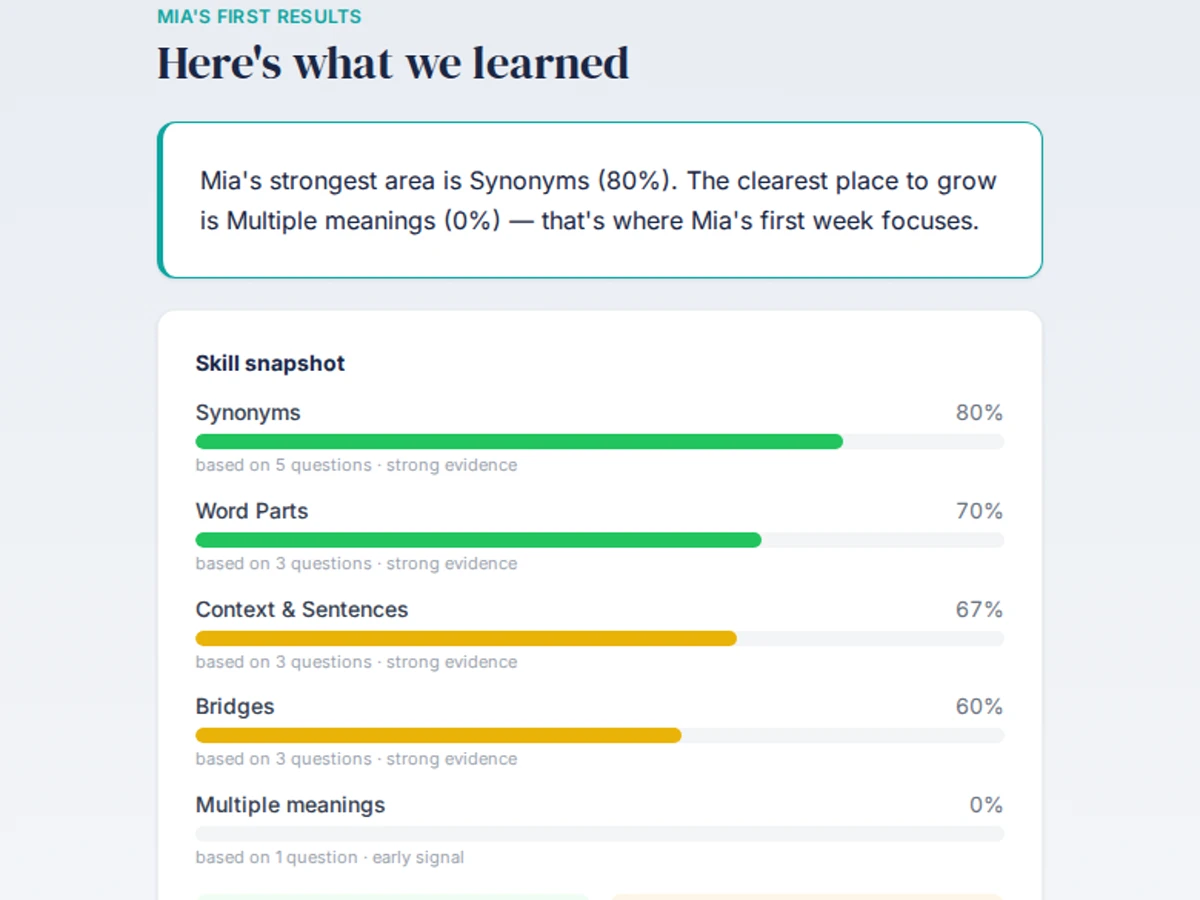
The check-up samples verbal skills and gives you an early strength, a growth area, and a first practice focus. It is not a full-length exam, an official SSAT or ISEE score, or an admissions prediction.
Building vocabulary for an entrance exam is fundamentally different from vocabulary study in school. When your child studies for a unit test, they learn a short list, demonstrate recall, and move on. When they are preparing for the SSAT, ISEE, HSPT, or CogAT verbal section, they need a different kind of vocabulary knowledge entirely: words that are retrievable under time pressure, distinguishable from near-synonyms, and acquired broadly enough to handle words they have never directly studied.
Two of the highest-leverage methods for this purpose are morphological analysis (root-based learning) and spaced repetition — each with a strong evidence base that other approaches lack. This guide explains why, shows you the research, and tells you exactly how to apply both to entrance exam preparation. They are two of several levers available to your child; the section below on combining methods will show how they fit alongside format practice, contextual inference work, and test-execution skills.
Why Most Vocabulary Study Methods Fail for Entrance Exams
The Flashcard Problem
Flashcards are the most common vocabulary study method — and the most misused. The problem is not that flashcards are inherently bad. The problem is how students use them.
The typical flashcard failure pattern:
- Your child reviews 50 vocabulary cards multiple times in one evening
- Cards start to feel familiar by the third pass — "I know this"
- Your child feels prepared
- Three weeks later, on the actual test, the words do not come back
What went wrong? Your child confused recognition with retrieval. Recognition is easy — seeing a word and feeling like you know it. Retrieval is hard — producing the word's precise meaning on demand under test conditions.
Most flashcard studying produces recognition without retrieval. The words feel learned because your child has seen them enough times to recognize them. But entrance exam questions do not offer recognition cues — they offer the word in isolation (SSAT synonyms) or in unfamiliar context, and your child must retrieve meaning from memory.
Research on this "fluency illusion" (Kornell & Bjork, 2008) shows that students consistently overestimate how well they have learned material that feels familiar. Massed flashcard review is the textbook generator of this illusion.
The Isolated Word Problem
The second failure mode: studying words as isolated units with no connection to other words.
If your child learns tenacious (persistent) as a single flashcard, they have one mental hook: the word tenacious maps to the definition persistent. Now they encounter the word pertinacious on the SSAT. They have never studied this word. They have no hook.
If instead your child knows the Latin root tenac- (to hold), they have a different situation. They see pertinacious and recognize the tenac- root (per- intensifies, so "intensely holding on"). The word probably means very stubborn or persistently holding to a position. That inference is strong enough to answer an SSAT synonym question: if the choices are brave, flexible, stubborn, kind, they can confidently select stubborn.
The isolated-word approach provides no transfer to novel words. The root-based approach provides exactly the transfer needed for an exam where your child will inevitably encounter words they have not directly studied.
The Science of Root-Based Learning
Morphological Awareness and Vocabulary Acquisition
Morphological awareness — the ability to analyze words by their meaningful parts (roots, prefixes, suffixes) — is one of the most robustly studied predictors of vocabulary growth.
A meta-analysis by Bowers, Kirby, and Deacon (2010) found statistically significant gains in vocabulary, reading comprehension, and spelling from morphological instruction across multiple studies. Another meta-analysis by Goodwin and Ahn (2013) confirmed significant gains in vocabulary and decoding specifically for school-age learners. The mechanism is straightforward: morphological instruction teaches students a system for vocabulary, not just individual words.
The transfer effect is the most important result. Students who learn morphological analysis do not just perform better on words they studied — they perform better on novel words encountered for the first time. This transfer is exactly what entrance exam preparation requires, because every test includes some words no student has directly studied.
The Multiplier Effect
Academic English is disproportionately Latin-derived. Researcher Coxhead (2000) developed the Academic Word List — 570 word families that account for approximately 10% of all academic and professional text. Of these, the vast majority have Latin or Greek roots.
For entrance exam vocabulary specifically, the Latin/Greek root proportion is even higher. The SSAT, ISEE, and HSPT draw from the formal academic register that standardized tests favor, and this register is heavily Latin-derived. Words like benevolent, circumspect, equanimous, perspicacious — staples of SSAT synonym sections — are transparently Latin in origin.
Each root family provides a multiplier. The root spec/spect (to look) unlocks: inspect, perspective, retrospect, circumspect, spectacle, speculate, suspect, respect, prospect, conspicuous, perspicacious — 11+ words from one root. A student who knows spec/spect does not have to memorize 11 separate flashcards; they need to learn one root and verify meanings of derived forms.
At 30+ roots, this multiplier effect produces coverage of hundreds of SSAT and ISEE vocabulary words — far beyond what any individual flashcard list can achieve.
The Science of Spaced Repetition
The Spacing Effect
The spacing effect is one of the oldest and most replicated findings in memory research. First documented by Hermann Ebbinghaus in 1885, it has been confirmed in hundreds of studies across virtually every type of learning material.
The finding: memory retention is dramatically better when practice sessions are spread over time with intervals between them, compared to massed practice (cramming) where the same material is reviewed repeatedly in a short window.
Cepeda et al. (2006) conducted a large-scale meta-analysis of spacing effect research and found robust effects across study types, ages, and domains. For vocabulary specifically, studies consistently show that spaced practice produces 2-3× better long-term retention than equivalent amounts of massed practice.
Why does spacing work? The leading explanation involves memory consolidation. When your child encounters new information, it enters a fragile short-term state. Sleep and rest allow the brain to consolidate memories into durable long-term storage. Massed review of the same material before consolidation can occur produces recognition without storage — hence the fluency illusion. Spacing allows consolidation between each review.
Desirable Difficulty
Spacing also works because of desirable difficulty (Bjork, 1994). When your child reviews a word they studied yesterday, retrieval is difficult because the memory has partially faded. This effortful retrieval is cognitively harder than re-reading a familiar word — but it is also more beneficial. The difficulty of the retrieval strengthens the memory trace.
This means the right time to review a vocabulary word is not when your child still knows it perfectly. It is slightly after they would have started to forget it — the optimal forgetting interval. Reviewing too soon wastes time (the word is too fresh, retrieval is effortless, no memory strengthening occurs). Reviewing too late misses the window (the word is forgotten and must be re-learned from scratch).
The FSRS (Free Spaced Repetition Scheduler) algorithm, which underlies LexiMap's vocabulary practice, calculates optimal review intervals for each word individually based on your child's historical retrieval accuracy. Words they know well get longer intervals; words they struggle with get shorter intervals.
Spaced Repetition vs. Distributed Practice
A distinction worth making: not all "spread out" study is spaced repetition. A child who reviews a word list once per week is doing distributed practice, which is better than cramming but not optimal. True spaced repetition personalizes the interval to each individual word and to each individual student's retention rate. A child who struggles with perspicacious will see it more often than inspect; the schedule adjusts to their actual forgetting curves.
For entrance exam preparation over 8-12 weeks, the cumulative advantage of optimized spaced intervals is substantial — research suggests retention rates 50-70% higher than equivalent massed study.
Combining Both Methods: The Root + Spaced Repetition System
The most efficient vocabulary preparation for entrance exams uses both methods in combination:
Phase 1: Root Acquisition (Weeks 1-4)
Begin with roots, not individual words. For each new root:
- Learn the root meaning and etymology (e.g., loqui/locut from Latin "to speak")
- Have your child generate words from the root before checking any list (this retrieval attempt improves subsequent learning even when it fails)
- Study 5-8 words derived from the root with their precise meanings and nuances
- Practice using each word in a sentence your child composes
This phase establishes the semantic scaffolding that makes later vocabulary acquisition more efficient. Once a student has loqui/locut, they understand eloquent, loquacious, colloquial, elocution, grandiloquent, circumlocution as a connected family rather than six isolated items.
Target: 25-30 root families covering the most commonly tested SSAT/ISEE/HSPT vocabulary domains.
Phase 2: Spaced Repetition Maintenance (Weeks 1-12, ongoing)
From day one of root study, begin spaced repetition review. Each word enters a review queue based on the FSRS algorithm:
- After initial study, reviewed the next day
- Then reviewed 3-4 days later
- Then 8-10 days later
- Then 20-25 days later
- Intervals continue growing for well-retained words
By week 8, your child is reviewing dozens of words per day at their individual optimal intervals — spending no more than 15-20 minutes total, but covering the entire vocabulary base across those minutes.
Phase 3: Bridge Integration for Analogies (Weeks 3-8)
As vocabulary builds, practice vocabulary words in analogy contexts. For each root family, identify natural analogy bridges within the family:
- BENEVOLENT : MALEVOLENT — antonym bridge (good intent vs. evil intent)
- VERACIOUS : LIAR — characteristic feature bridge (a truthful person is not a liar)
- LOQUACIOUS : SPEECH — characteristic feature bridge (a loquacious person uses a lot of speech)
- FORTIFY : WEAKEN — antonym bridge by function
This integration trains students to think about vocabulary in relational terms — exactly what the SSAT analogy section and CogAT verbal analogies subtest require.
Practical Application: Entrance Exam Vocabulary Schedules
For SSAT Upper Level (Grades 8-11)
A student with 10 weeks of preparation should target:
- 30 root families × ~8 words each = ~240 words in core curriculum
- Daily practice: 15 min root study (weeks 1-4), then 15 min spaced review (ongoing)
- Weekly practice: one timed synonym set (10-15 questions) from studied vocabulary
- Reading supplement: 30 min/day in grade-appropriate reading
At this level, the goal is vocabulary precision — knowing the subtle differences between obstinate, pertinacious, recalcitrant, tenacious, and dogged (all "stubborn" but with distinct connotations) — because the SSAT uses near-synonyms as distractors.
For SSAT Middle Level (Grades 5-7)
Same root-based approach but with 20-25 root families and a simpler vocabulary set. The key difference at this level: oral vocabulary (words a student has heard but not seen in writing) needs to bridge to reading vocabulary (words recognized in text). Read aloud with your child from books above their independent reading level to accelerate this bridge.
For ISEE (All Levels)
The ISEE includes sentence completion items that the SSAT lacks. In addition to root-based vocabulary and spaced repetition, ISEE preparation should explicitly include:
- Context-clue strategy: reading the full sentence, identifying signal words, predicting before looking at options
- Tone recognition: distinguishing positive, negative, and neutral sentences helps with word selection
- Practice with sentence completion format: the 3-step process (read, signal, predict) should become automatic
The root-based vocabulary built for SSAT preparation transfers directly to ISEE sentence completion — students who know word meanings precisely can use them both for direct synonym recall (SSAT-style) and for contextual inference (ISEE-style).
For HSPT Verbal (Catholic High Schools)
The HSPT's 16-second-per-question pace makes vocabulary ownership — instant recall, no deliberation — even more critical. The same root-based curriculum applies, but with extra emphasis on:
- Antonym awareness: for every vocabulary word, know its antonym (the HSPT tests antonyms explicitly)
- Speed drilling: add 2-minute synonym and antonym drills to build response speed
- Verbal logic practice: a small portion of HSPT vocabulary time should address syllogism structures (all/some/no logic)
For CogAT Verbal (Gifted Testing)
The CogAT measures reasoning ability, and its verbal battery tests word-relationship reasoning rather than pure vocabulary recall. Root-based learning is still the best vocabulary preparation, but for the CogAT, it should be explicitly paired with:
- Bridge-type practice: naming the relationship type before answering analogy questions
- Category precision practice: for verbal classification, distinguishing between broad categories and precise sub-categories
The Research on What Does Not Work
Rote Memorization of Word Lists
Traditional vocabulary instruction — assign a list of 20 words, students write sentences, take a test, move on — has been shown repeatedly to produce short-term recognition without long-term retention or transfer. Beck, McKeown, and Kucan (2013) argue that robust vocabulary instruction requires multiple encounters in varied contexts, deep processing (analyzing, applying, generating), and distributed review over time. A one-time word list assignment satisfies none of these requirements.
Context-Only Learning (No Explicit Instruction)
The other extreme — relying entirely on incidental vocabulary acquisition through reading — is insufficient for entrance exam preparation. Wide reading is valuable and should be part of any preparation plan, but it is too slow and too unpredictable to reliably produce the vocabulary breadth needed for the SSAT or HSPT within a 10-12 week window.
The research supports a combination: explicit morphological instruction (root-based study) combined with wide reading and spaced review. Each method compensates for the other's weaknesses.
Passive Re-reading of Study Materials
Repeatedly reading vocabulary lists, notes, or textbooks creates the fluency illusion without producing durable memory. The key variable is retrieval: successfully retrieving information from memory (rather than recognizing it on the page) is what strengthens memory storage.
Every study session should include retrieval practice — covering the definition and trying to recall it before looking, generating example sentences from memory, or practicing vocabulary in analogy and sentence completion contexts where your child cannot see the definition.
Putting It Together: A 10-Week Template
| Weeks | Root Study | Spaced Review | Additional Practice |
|---|---|---|---|
| 1-2 | Roots 1-8 (Latin: voc, sent, loqui, verd, cred, bene, mal, fort) | Daily: 10-15 min | — |
| 3-4 | Roots 9-16 (grat, greg, path, chron, rupt, scrib, terr + 1 Greek) | Daily: 15 min | Analogy bridges, 2x/week |
| 5-6 | Greek roots 1-8 (log, phil, graph, anthrop, bio, psych, chron, geo) | Daily: 15-20 min | Synonym clusters with precision |
| 7-8 | Affixes (prefix/suffix families) | Daily: 15-20 min | Near-synonym distinction practice |
| 9-10 | Review and gap fill | Daily: 20 min | Timed synonym sets; full practice tests |
Key Takeaways
- Root-based morphological learning and spaced repetition outperform every other vocabulary method for entrance exam preparation — they produce transfer to unfamiliar words and retention that survives to test day.
- The fluency illusion is the most common failure mode: your child may feel prepared after flashcard review, but feeling familiar is not the same as being able to retrieve a word under test pressure.
- Each root family multiplies coverage — the root spec/spect alone unlocks 11+ SSAT-relevant words; 30 roots can cover the core vocabulary range far more efficiently than any word list.
- 15 minutes of daily spaced-interval root practice produces better long-term retention than an hour of massed flashcard review — the schedule, not the volume, is what matters.
- Tailor the approach to the exam: ISEE prep needs explicit sentence completion practice from week 5; HSPT prep needs speed drilling; CogAT prep needs bridge-type and category-precision work.
Root-based learning is where your child's verbal preparation begins, not where it ends. The admissions tests your child is preparing for draw on vocabulary knowledge as the foundation, but they also assess relational reasoning (analogies and word relationships), contextual inference (sentence completions and reading comprehension), test execution (pacing, strategy, and error management), and metacognition (the self-awareness to know what your child actually knows under pressure). LexiMap treats vocabulary as the on-ramp into all five of these domains and surfaces each one on a parent dashboard — so you can see whether the preparation is broad enough to translate into the score your child needs.
For the specific root families and word lists, see our SSAT word list by root families. For the case against flashcards, see our why flashcards don't work post. LexiMap's vocabulary practice engine delivers root-based instruction with FSRS spaced repetition automatically — start a free session.
Get SSAT/ISEE vocabulary resources by email
Related Articles
The LexiMap Method: Roots, Spaced Repetition, and a 5-Domain Verbal Model
How LexiMap combines morphological roots, FSRS spaced repetition, and a 5-domain verbal model — vocabulary, relational reasoning, contextual inference, test execution, and metacognition — into one trainer for the SSAT and ISEE.
Root Words vs. Flashcards: Which SSAT Study Method Actually Works?
Compare root-based vocabulary learning with traditional flashcard memorization for SSAT and ISEE prep. Research-backed analysis of which method produces lasting results.
Why Flashcards Don't Work for Verbal Test Prep (And What to Do Instead)
Why flashcard vocabulary study fails on the SSAT, ISEE, and HSPT — and what cognitive science shows actually works: root-based learning and spaced repetition.
Spaced Repetition for Kids: The Science Behind FSRS and Why It Works
How spaced repetition and the FSRS algorithm help kids retain vocabulary long-term. The science of memory, forgetting curves, and why 10 minutes a day beats weekend cramming.
Related Guides
Vocabulary Study Methods: A Research-Based Guide for SSAT & ISEE Prep
Compare proven vocabulary study methods — root-based learning, flashcards, reading programs, spaced repetition, and contextual learning. Find the most effective approach for your child.
SSAT Vocabulary: The Complete Guide to Root-Based Learning
Master SSAT vocabulary through Latin and Greek roots. Learn how root-based learning, spaced repetition, and interactive practice build lasting verbal skills for grades 4-12.
SSAT® is a registered trademark of The Enrollment Management Association. ISEE® is a registered trademark of the Educational Records Bureau (ERB). LexiMap is not affiliated with or endorsed by these organizations.