Best SSAT Vocabulary Apps and Tools: A 2026 Comparison
Find your child’s vocabulary gaps
Start with a free, no-card vocabulary check-up and get a personalized parent report.
Find the vocabulary gaps — freeSee a sample parent report before starting
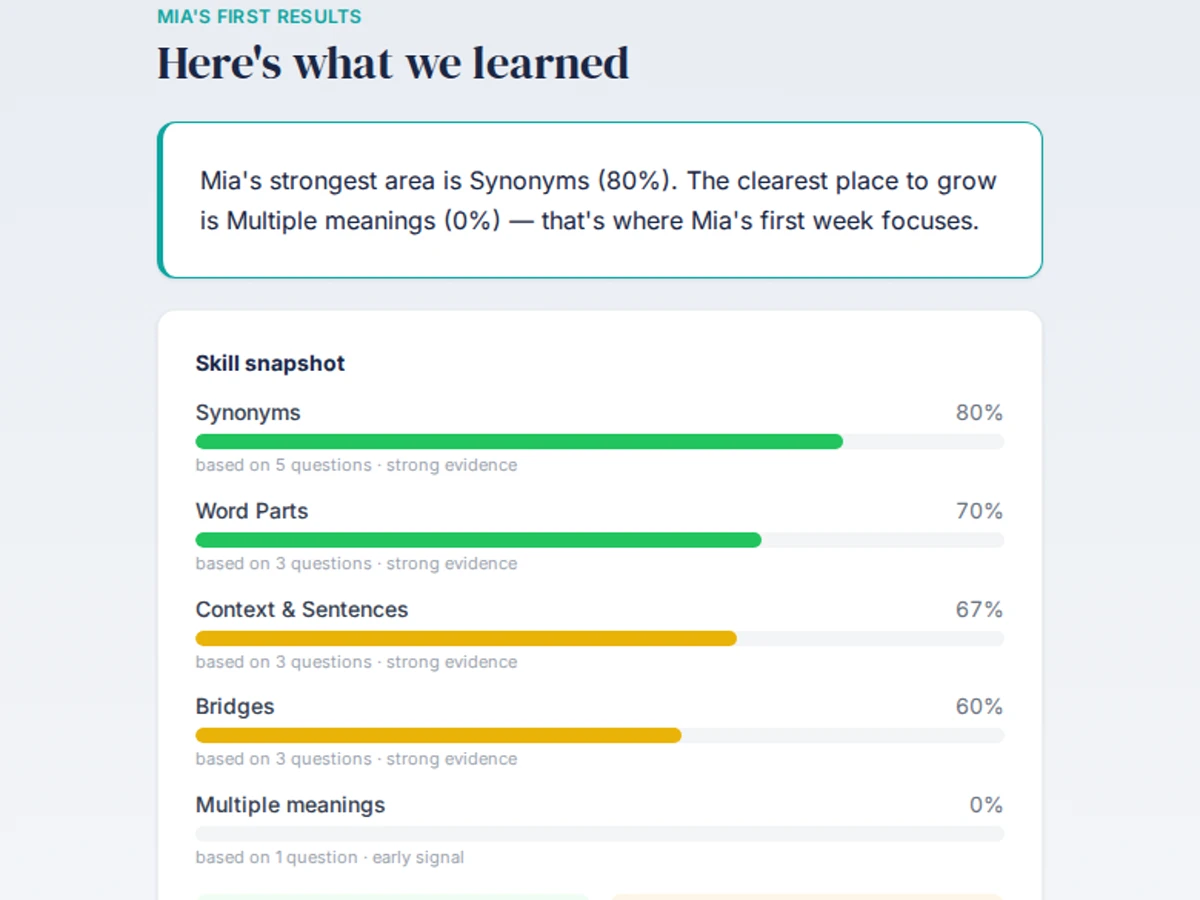
The check-up samples verbal skills and gives you an early strength, a growth area, and a first practice focus. It is not a full-length exam, an official SSAT or ISEE score, or an admissions prediction.
Last updated September 5, 2026
Finding the right vocabulary prep tool for the SSAT or ISEE can feel overwhelming. Between flashcard apps, practice test books, general vocabulary platforms, and specialized prep tools, parents face dozens of options — each promising results, few explaining how they actually work. The stakes feel high: the verbal section is often the hardest to improve quickly, and choosing the wrong tool means wasted time during a preparation window that's already tight.
This comparison evaluates five common approaches to SSAT vocabulary preparation against practical criteria: does the tool teach word structure (not just definitions), does it use evidence-based retention methods, is the content aligned to the test's verbal work, will your child actually use it consistently, and can you track progress? We'll look at each approach honestly — including where each one helps and where it leaves work to the learner.
Disclosure: LexiMap publishes this comparison and is included as one of the options. Competitor descriptions and feature links were checked against public provider documentation on September 5, 2026. Features, pricing, and access can change; we did not independently test every product or claim score outcomes.
What to Look For in an SSAT Vocabulary Tool
Before comparing specific tools, it helps to understand the five criteria that separate effective vocabulary preparation from busy work. These aren't arbitrary preferences — they're grounded in how vocabulary is tested on the SSAT and ISEE, and how memory works according to cognitive science research.
- Root-based learning (one useful lever among several): Students may encounter unfamiliar words on the SSAT. Tools that teach Latin and Greek roots give students another way to reason about meaning — recognizing that bene means "good" connects benefit, benevolent, and benediction. Root-based instruction is one criterion among several, not a prerequisite that rules out every other approach.
- Spaced repetition (SRS): A meta-analysis by Cepeda et al. (2006) and additional research support spacing review sessions over massed practice. Tools that implement spaced repetition schedule reviews from recall history, with the exact behavior depending on the product.
- SSAT/ISEE content alignment: A general vocabulary list may not match the exam's level, question types, or scope. Look for a tool that explains what it covers and how its practice maps to the verbal work your child needs.
- Engagement and game mechanics: A well-designed tool is useless if your child won't open it. Varied interaction patterns — drag-and-drop, tap-select, swipe, timed challenges — can help practice feel less repetitive.
- Parent visibility: Parents managing their child's test prep need to know what's working. Progress dashboards, mastery tracking, and session summaries let you see whether practice is translating into retention without hovering over your child's shoulder.
The Comparison: Five Approaches to SSAT Vocabulary Prep
Each approach below has legitimate strengths. The question isn't which tool is "best" in the abstract — it's which approach matches your child's learning needs, your preparation timeline, and your budget.
LexiMap
LexiMap is a quest-based vocabulary trainer built specifically for SSAT and ISEE preparation. Its pedagogy is grounded in research on morphological instruction and centers on root-based learning: students learn curated roots, affixes, and derived words alongside exam-format practice. Rather than memorizing thousands of isolated definitions, students learn structural relationships that can help them reason about unfamiliar words.
Retention is handled by the FSRS spaced repetition algorithm, which schedules reviews based on each student's individual recall patterns. See how LexiMap applies FSRS to root-based learning. Content is delivered through interactive game modes — including drag-and-drop root matching, swipe-based synonym sorting, tap-select word building, and timed challenge rounds — organized into quest sessions with structured segments (ChargeUp, QuestRun, Finale). This variety gives students practice with recognition, construction, derivation, and contextual inference.
LexiMap includes a parent dashboard for tracking mastery progress, works offline as a progressive web app (PWA), and supports short, repeatable practice sessions. The content is pre-built and SSAT/ISEE-aligned — there's no need to create or curate your own study materials. A free SSAT check-up is available. Current paid options are listed in the pricing details.
Roots are one route into vocabulary knowledge, but the SSAT asks students to use a broader set of verbal skills. LexiMap's five-domain learning model covers vocabulary knowledge, relational reasoning, contextual inference, test execution, and metacognition. Each domain shows up on the parent dashboard separately; these are product learning categories, not official SSAT scoring categories.
Quizlet
Quizlet is a widely used flashcard platform with user-created decks and free and paid study options. Many SSAT tutors create Quizlet decks for their students, and shared SSAT vocabulary sets are available to study from immediately. Check the provider's current study-mode documentation for what is available on a particular account.
Quizlet documents a spaced-repetition feature, but access and behavior can depend on the study mode and account. A deck remains dependent on the words and explanations its creator supplied, and Quizlet does not provide LexiMap's built-in root-based curriculum. Students or parents may need to review deck quality and add practice that applies words in context.
Content quality varies widely because anyone can create a deck. Some community SSAT decks are excellent; others contain errors, irrelevant words, or incomplete definitions. There's no parent dashboard, and no built-in mechanism to ensure the vocabulary being studied actually aligns with what the SSAT tests. Quizlet is a solid general-purpose tool, but it requires significant curation effort from parents or tutors to be effective for standardized test prep.
Anki
Anki is an open-source spaced-repetition tool with substantial control over decks and scheduling. Its manual explains how its scheduling works and how users can configure cards and reviews. Anki ships without an SSAT curriculum, so the learner or parent supplies the deck, checks its quality, and sets up the study system.
The challenge for SSAT prep is everything surrounding that excellent algorithm. Anki ships with no content — you build or import your own decks. There are no pre-built SSAT vocabulary decks from the developers, and community-shared decks vary in quality. The interface is functional but austere: plain text flashcards with no game modes, no animations, and no engagement mechanics designed for younger students. For a motivated high schooler, this might be fine. For a 4th or 5th grader who needs to stay engaged through months of vocabulary practice, Anki's interface can feel like a chore.
Anki also requires setup knowledge. Configuring deck settings, understanding scheduling controls, and customizing card templates all have learning curves. There's no root-based pedagogy built in, no parent dashboard, and no SSAT-specific content alignment. Anki suits self-directed learners who are willing to build their own system, but that system takes time from both parent and student.
Traditional Practice Tests (Princeton Review, Kaplan, etc.)
Practice test books from publishers like Princeton Review, Kaplan, and Barron's serve an important role in SSAT preparation: they familiarize students with the published test format, question types, timing constraints, and scoring patterns. For students approaching their test date, working through full practice sections under timed conditions is useful. A paper section can also add physical timing practice that an app may not provide.
However, practice tests measure performance — they don't replace vocabulary instruction. A student who encounters the word "magnanimous" on a practice test and gets it wrong has identified a gap, but the test itself may not provide the root-based understanding (magn = great, anim = spirit) that could help with related words. There is also no built-in guarantee that missed words will be reviewed at a useful interval.
Practice books vary in price and number of tests. Check the edition and included explanations before buying. Use practice tests after or alongside vocabulary instruction to review gaps and build test-taking stamina. For more on structuring a complete prep timeline, see our SSAT vocabulary study guide.
General Vocabulary Apps (Vocabulary.com, Wordly Wise, Membean)
Platforms like Vocabulary.com, Wordly Wise Online, and Membean offer structured vocabulary instruction with varying degrees of adaptive technology. Vocabulary.com uses a game-like interface with adaptive question selection and a large curated word corpus. Wordly Wise provides a systematic, level-based curriculum used in schools. Membean describes contextual learning with word roots and etymological connections, and offers personal and homeschool plans alongside school use.
These tools have real strengths: they provide more structure than a blank deck, and some incorporate root-based or contextual connections. Their primary purpose is general vocabulary development rather than an SSAT-specific verbal curriculum, so families should check whether the content and practice formats match their child's preparation needs.
Game mechanics vary: Vocabulary.com has a points-based challenge system; Wordly Wise is more traditional and workbook-style; Membean uses a contextual approach with images and word maps. Parent visibility also varies — some offer teacher/parent dashboards, others don't. Families should treat these as supplements when they need SSAT-specific content and question formats.
Feature Comparison Table
| Feature | LexiMap | Quizlet | Anki | Practice Tests | Vocab Apps |
|---|---|---|---|---|---|
| SSAT/ISEE-specific content | Yes | Depends on deck | Depends on deck | Depends on book | Varies |
| Spaced repetition | Yes | Feature and access vary | Yes | No | Varies |
| Latin/Greek roots | Yes | Depends on deck | Depends on deck | Depends on book | Varies |
| Parent dashboard | Yes | No | No | No | Varies |
| Game-based learning | Yes | Yes | No | No | Partial |
Which Tool Is Right for Your Child?
There's no single answer — the right choice depends on where your child is starting from, how much time you have before the test, and what kind of learning experience keeps them engaged. Here's a decision framework:
- If your child needs to build vocabulary from scratch: Consider a tool that teaches word structure, not just definitions. LexiMap's root-based approach or a general vocabulary app like Membean can provide structured instruction; flashcard tools require the family to choose or build the teaching content.
- If your child already has strong vocabulary and needs test format familiarity: Practice tests from Princeton Review or Kaplan are the right move. They simulate the actual test experience and help with pacing, question strategy, and managing test anxiety.
- If you want a DIY approach with full control: Anki lets you build the deck, tune scheduling, and add multimedia. That flexibility comes with setup time.
- If engagement and motivation are the primary challenge: LexiMap's game modes (drag-drop, swipe, tap-select, timed challenges) are designed to keep practice sessions feeling varied and rewarding, which can help a learner sustain practice over time.
- If budget is the primary concern: Check the providers' current offerings: Anki documents its platform options on its official site, while Quizlet documents free and subscription study options in its help center. Both require more parent effort to curate SSAT-relevant content.
Key Takeaways
- Every tool on this list can contribute to SSAT vocabulary preparation — practice tests build test-taking stamina, Anki and Quizlet offer flexible flashcard study, and general vocabulary apps provide structured instruction.
- LexiMap combines root-based pedagogy, spaced repetition, SSAT-aligned content, and interactive practice in one product; families should compare that bundle with the setup effort of other options.
- Flashcard tools can support review, but SSAT-specific content and root-based structure depend on the deck and the learner's setup.
- DIY tools like Anki give maximum control but demand significant parent and student setup effort; they are best suited for self-directed older students.
- General vocabulary apps like Membean support broad academic vocabulary; they are not presented as SSAT/ISEE-specific curricula.
- Engagement and consistency matter for younger students — even a well-designed tool is ineffective if your child won't open it.
If you're looking for a tool that brings these elements together in a single platform designed specifically for SSAT and ISEE prep, try LexiMap's free SSAT check-up and see how root-based learning with spaced repetition works in practice. For more on the science behind this approach, read our guide on Latin and Greek roots for SSAT vocabulary.
Questions parents ask
What is the best SSAT vocabulary app?
It depends on your child's starting point. Compare whether a tool teaches word structure (roots), offers spaced-repetition options, explains its SSAT/ISEE alignment, keeps your child engaged, and shows parents progress. Purpose-built tools like LexiMap combine these features; general flashcard tools may require the family to add or curate some of them.
Is Quizlet enough for SSAT vocabulary prep?
Usually not on its own. Quizlet offers spaced-repetition study features, but a user-created deck isn't necessarily curated to SSAT/ISEE vocabulary and feature availability depends on the study mode and account. It works best as a supplement unless a parent or tutor has reviewed the deck and plan.
Do word roots really help on the SSAT?
They can. Recognizing a root can give a student another route to the meaning of an unfamiliar word — bene (good), for example, connects benefit, benevolent, and benediction. Pair root study with SSAT format practice as test day approaches.
Get SSAT/ISEE vocabulary resources by email
Related Articles
Best ISEE Vocabulary Apps and Tools: A 2026 Comparison
Compare the best ISEE vocabulary prep apps — LexiMap, Quizlet, general vocabulary platforms, and practice tests. What actually prepares kids for ISEE synonyms and sentence completions.
Best Vocabulary Apps for Private-School Admissions Tests (2026)
Compare vocabulary prep apps for private-school entrance exams — SSAT, ISEE, HSPT, and more. What to look for, honest tool comparisons, and how to choose for your child.
LexiMap vs. Test Innovators: SSAT Vocabulary Prep Compared
Side-by-side comparison of LexiMap and Test Innovators for SSAT vocabulary preparation. See how root-based learning with spaced repetition compares to traditional practice tests.
LexiMap vs. Membean for SSAT and ISEE Vocabulary Prep
Compare LexiMap and Membean for grades 6–12 vocabulary learning and focused SSAT/ISEE verbal practice, including personal-plan access and where each tool fits.
Related Guides
SSAT Vocabulary List: 200+ Words Organized by Level and Root
Comprehensive SSAT vocabulary word lists organized by test level (Elementary, Middle, Upper) and root word family. Study the right words for your child's grade.
The Parent's Complete Guide to SSAT & ISEE Prep
Everything parents need to know about SSAT and ISEE preparation. Test formats, timelines, study strategies, score interpretation, and how to support your child's verbal growth.
SSAT® is a registered trademark of The Enrollment Management Association. ISEE® is a registered trademark of the Educational Records Bureau (ERB). LexiMap is not affiliated with or endorsed by these organizations.