The Complete List of Latin and Greek Roots for SSAT Vocabulary
Find the SSAT vocabulary gaps before test day
Show all 12 roots
Sample SSAT roots we teach
- cred— believe
- bene— good, well
- mal— bad
- dict— say, speak
- spec / spect— look, see
- struct— build
- port— carry
- voc / vok— call, voice
- vid / vis— see
- tract— pull, drag
- magn— great
- ver— truth
Sample SSAT roots we teach
- cred— believe
- bene— good, well
- mal— bad
- dict— say, speak
- spec / spect— look, see
- struct— build
- port— carry
- voc / vok— call, voice
- vid / vis— see
- tract— pull, drag
- magn— great
- ver— truth
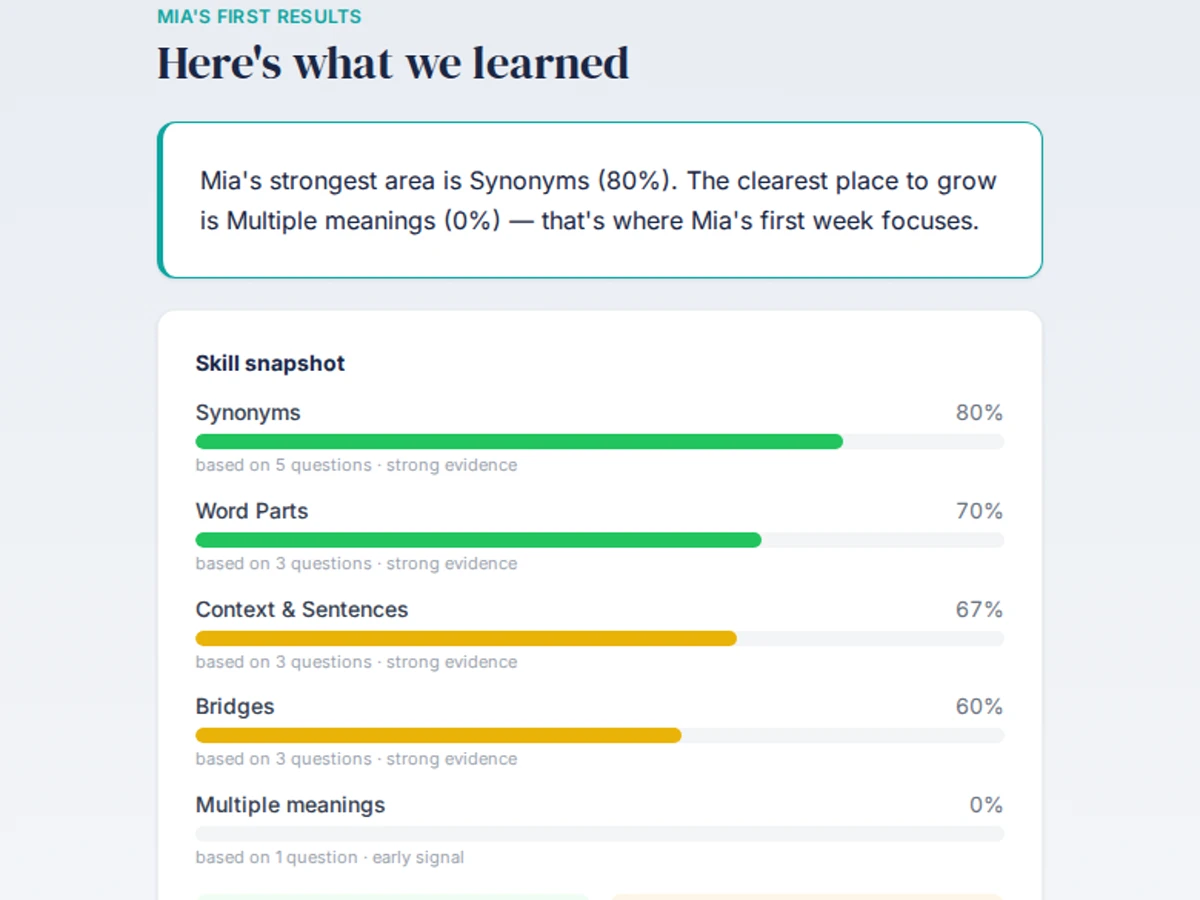
A free SSAT verbal check-up samples 30 questions and gives you an early strength, a growth area, and a first practice focus. No card required.
Start the free check-upSee a sample parent report before starting
The check-up samples verbal skills and gives you an early strength, a growth area, and a first practice focus. It is not a full-length exam, an official SSAT or ISEE score, or an admissions prediction.
Last updated September 5, 2026
Disclosure: LexiMap publishes this guide and its product is mentioned as one way to study. The research and exam links below were checked against their public pages on September 5, 2026; we did not independently test score outcomes. Root examples are teaching aids, and a root can suggest meaning without determining a word's full modern definition.
If your child is preparing for the SSAT or ISEE, you've probably wondered: how can anyone memorize thousands of vocabulary words? A root-based approach can reduce the amount of isolated memorization, but it does not replace learning words in context. Research in morphological awareness describes how teaching the Latin and Greek roots underlying English words can help students approach unfamiliar vocabulary. A meta-analysis by Goodwin and Ahn (2013) reported gains in vocabulary knowledge and decoding across grade levels, while Carlisle (2010) and broader systematic reviews link it to reading-comprehension benefits as well — especially for students who struggle with literacy.
Vocabulary size research by Nation (2001, Learning Vocabulary in Another Language) describes the word coverage needed for unassisted comprehension. Many English words have Latin or Greek origins, including much academic vocabulary. On standardized tests like the SSAT and ISEE students still need to apply vocabulary knowledge to the question format and context. LexiMap's curriculum uses root study as one part of that preparation.
This guide provides a reference set: 35 Latin roots, 25 Greek roots, and common prefixes and suffixes — along with practical strategies for studying them effectively. Whether your child is in 4th grade or 11th, these roots can support vocabulary study alongside context and format practice. For a broader look at study approaches, see our parent's guide to improving SSAT verbal scores.
Why Root Words Are the Key to SSAT/ISEE Vocabulary
The SSAT verbal section includes synonyms and analogies. Root knowledge can give students another route to meaning, alongside recall and context. When a student encounters the word "benevolent" and recognizes bene (good) and vol (wish), the correct synonym — "kind" or "generous" — may become easier to reason toward even if the full word has not been studied directly.
The ISEE verbal section similarly tests synonyms and adds sentence completions, where context clues combine with morphological knowledge to identify the right answer. In both tests, root awareness can complement direct word study: students learn relationships among building blocks rather than relying only on isolated definitions.
This approach is supported by decades of educational research. A meta-analysis of morphological instruction studies (Bowers, Kirby, & Deacon, 2010) reported gains associated with explicit teaching of roots, prefixes, and suffixes in vocabulary knowledge, reading comprehension, and spelling across the studies reviewed.
Put simply: one root can connect an entire word family. The root duc/duct (to lead) connects conduct, deduce, introduce, produce, reduce, educate, induction, and aqueduct. That's eight examples from a single root; the strength of each connection depends on the word's history and current meaning.
Latin Roots for the SSAT
Latin roots are common in formal and academic English. The 35 roots below are a practical study set for SSAT and ISEE preparation. For each root, we provide a meaning and 4–5 example words; the tables are teaching material, not an official test word list.
| Root | Meaning | Example Words |
|---|---|---|
| bene | good, well | benefit, benevolent, benediction, benefactor |
| mal / male | bad, evil | malice, malevolent, malfunction, malignant |
| dict | say, speak | dictate, predict, verdict, contradict, diction |
| scrib / script | write | describe, manuscript, inscription, prescribe |
| port | carry | transport, portable, export, import, deportation |
| duc / duct | lead | conduct, deduce, introduce, produce, educate |
| rupt | break | interrupt, erupt, corrupt, rupture, abrupt |
| ject | throw | reject, inject, project, eject, trajectory |
| spec / spect | look, see | inspect, spectacle, perspective, retrospect |
| aud | hear | audience, audible, auditorium, audition |
| cred | believe | incredible, credible, credential, credulous |
| fac / fact / fect | make, do | factory, manufacture, effect, defect |
| ver | truth | verify, verdict, veracity, aver, veracious |
| voc / voke | call, voice | vocal, invoke, provoke, evocative, advocate |
| mit / mis | send | transmit, missile, emit, dismiss, remission |
| pend / pens | hang, weigh | suspend, pendant, pension, compensate |
| tract | pull, drag | attract, extract, traction, retract, subtract |
| ven / vent | come | adventure, event, intervene, convention, prevent |
| form | shape | transform, conform, reform, formulate, uniform |
| clar | clear | clarify, declare, clarity, clarion |
| pon / pos / posit | place, put | compose, deposit, position, expose, oppose |
| cap / capt / cept | take, seize | capture, accept, concept, reception, capable |
| sens / sent | feel | sensitive, consent, sentiment, sensation, resent |
| vid / vis | see | visible, evidence, provide, vision, supervise |
| ter / terr | earth, land | territory, terrain, terrestrial, subterranean |
| aqu | water | aquatic, aquarium, aqueduct, aquifer |
| corp / corpor | body | corpse, corporate, corporal, incorporate |
| viv / vit | life | vivid, vital, revive, survive, vitality |
| mort | death | mortal, immortal, mortify, mortuary |
| temp / tempor | time | temporary, contemporary, tempo, extemporaneous |
| equ | equal | equal, equitable, equivalent, equanimity, equator |
| sol | alone, sun | solitary, solo, solar, solitude, desolate |
| ambi / amphi | both, around | ambiguous, ambivalent, amphibian, ambidextrous |
| nov | new | novel, renovate, innovate, novice |
| grat | pleasing, thankful | grateful, gratitude, congratulate, gratify |
Notice how many of these roots appear in everyday English. Your child already uses words built from these roots — the goal of root-based study is to make that structural knowledge conscious and useful when reasoning about unfamiliar words.
Greek Roots for the SSAT
Greek roots often appear in scientific, philosophical, and technical vocabulary. Many function as prefixes or combining forms, which can help students reason through compound words.
| Root | Meaning | Example Words |
|---|---|---|
| logos / log | word, study, reason | biology, logic, dialogue, prologue, analogy |
| graph / gram | write, draw | autograph, diagram, telegram, graphic, biography |
| phon / phone | sound, voice | telephone, symphony, phonetic, microphone |
| chrono | time | chronological, chronicle, synchronize, chronic |
| bio | life | biology, biography, biodegradable, antibiotic |
| geo | earth | geography, geology, geometry, geothermal |
| hydro / hydr | water | hydrate, dehydrate, hydrogen, hydraulic |
| therm | heat | thermometer, thermal, hypothermia, thermostat |
| path / pathos | feeling, suffering | sympathy, empathy, pathology, apathy, pathos |
| phil | love | philosophy, philanthropy, bibliophile, Anglophile |
| phob | fear | phobia, claustrophobia, arachnophobia, xenophobia |
| arch | chief, ruler, ancient | monarch, anarchy, architect, archaeology |
| auto | self | automatic, autobiography, autonomy, autograph |
| poly | many | polygon, polyglot, polysyllabic, polynomial |
| mono | one, single | monopoly, monologue, monotone, monochrome |
| micro | small | microscope, microphone, microbe, microcosm |
| macro | large | macroscopic, macroeconomics, macrocosm |
| tele | far, distant | telephone, telescope, television, telepathy |
| neo | new | neologism, neonatal, neophyte, neo-classical |
| pseudo | false | pseudonym, pseudoscience, pseudo-intellectual |
| anti | against | antibiotic, antidote, antisocial, antithesis |
| syn / sym | together, same | synonym, synthesis, sympathy, symphony, symbol |
| hyper | over, above, excessive | hyperactive, hyperbole, hypertension |
| hypo | under, below | hypothesis, hypothermia, hypodermic, hypocrite |
| morph | form, shape | metamorphosis, morphology, amorphous, polymorph |
Greek roots can also support analogy work, where students identify relationships between word pairs. Recognizing that phil means "love" and phob means "fear" helps explain the contrast between philanthropy (love of humanity) and xenophobia (fear of strangers), though students still need to check each word's full meaning.
Common Prefixes and Suffixes That Multiply Root Power
Roots rarely appear in isolation. English words are built by attaching prefixes (before the root) and suffixes (after the root) to modify meaning. Learning common affixes can expand the number of words your child can analyze from a single root.
Consider the root duct (lead): add intro- for introduce, de- for deduce, con- for conduct, pro- for produce, re- for reduce, and in- for induction. Six prefixes, one root, six distinct words — each with a nuanced but logically connected meaning.
Essential Prefixes
| Root | Meaning | Example Words |
|---|---|---|
| un- | not, opposite | unable, undo, unfair, uncertain |
| re- | again, back | return, rebuild, rewrite, reconsider |
| pre- | before | predict, prevent, preview, precaution |
| post- | after | postpone, postscript, postmortem, posterior |
| dis- | not, apart | disagree, disconnect, disappear, disrupt |
| mis- | wrong, badly | mistake, misunderstand, mislead, misfortune |
| in- / im- / il- / ir- | not | invisible, impossible, illegal, irregular |
| inter- | between, among | international, interact, intervene, interrupt |
| trans- | across, beyond | transport, transform, transcend, translate |
| sub- | under, below | submarine, subtract, subconscious, subordinate |
| super- / sur- | above, over | supernatural, superior, surface, surpass |
| ex- | out, from | exit, export, exclude, external, exhale |
Essential Suffixes
| Root | Meaning | Example Words |
|---|---|---|
| -able / -ible | capable of | readable, flexible, visible, edible |
| -tion / -sion | act or state | education, decision, invasion, creation |
| -ous / -ious | full of, having | generous, curious, dangerous, spacious |
| -ment | result, action | achievement, development, judgment, movement |
| -ness | state, quality | kindness, darkness, happiness, awareness |
| -ive | having nature of | creative, active, productive, sensitive |
| -ology | study of | biology, psychology, geology, technology |
| -ist | one who | scientist, artist, biologist, novelist |
When studying, encourage your child to practice building words by combining roots with different prefixes and suffixes. This "word construction" exercise gives the child practice applying structural knowledge to new contexts; they should still confirm the full word meaning.
How to Study Root Words Effectively
Having a list of roots is only one part of preparation. How your child studies these roots matters as much as what they study. Research supports spacing and active retrieval as useful study principles. For a step-by-step study plan built around the roots in these tables, see our root words study guide for the SSAT and ISEE.
1. Spaced Repetition Over Cramming
Research on spacing supports reviewing material at intervals rather than massing every session together. Spaced repetition — reviewing roots at increasing intervals based on how well they're known — is designed to support retention over time. The FSRS algorithm used by modern learning tools schedules reviews from recall history. Actual retention varies by learner, content, and use. See how LexiMap applies FSRS spaced repetition to root-based learning. If you are choosing a tool to handle that scheduling for your child, our review of the best SSAT vocabulary apps compares how each one handles review timing.
Practically, short, repeatable sessions can make spaced review easier to maintain than occasional cramming. The key is to give your child repeated opportunities to retrieve the material and adjust the routine when it is not sustainable.
2. Multi-Skill Practice
Recognizing a root in a multiple-choice list is a different cognitive skill than constructing a word from a root, identifying a root in context, or matching derived words to their root families. Studying should engage multiple skill types:
- Recognition: Matching a root to its meaning (e.g., bene → "good")
- Construction: Building words from roots + affixes (e.g., bene + -fic + -ial → beneficial)
- Derivation: Identifying which words share a common root (e.g., benefit, benevolent, benediction all contain bene)
- Context: Using root knowledge to determine meaning in a sentence
- Analogy: Using root relationships to solve analogy-style questions
This multi-skill approach gives practice with skills used by SSAT and ISEE verbal questions — an example of what learning science researchers call "desirable difficulties." Synonyms involve word meaning; analogies involve relational reasoning; sentence completions involve contextual inference. Explore our five-domain verbal model to see how LexiMap organizes instruction; those five domains are its learning framework, not official SSAT or ISEE scoring categories.
Root Words in Action: SSAT Question Walkthrough
Let's walk through how root knowledge helps solve a typical SSAT synonym question:
VERACIOUS most nearly means:
- (A) greedy
- (B) truthful
- (C) courageous
- (D) beautiful
- (E) ancient
A student who has memorized "veracious = truthful" can answer this directly. If a student has not seen the word before, root analysis offers one possible route:
- Identify the root: ver means "truth"
- Connect to known words: verify (check truth), verdict (true statement), veracity (truthfulness)
- Apply to the question: veracious = having the quality of truth = truthful
- Confirm answer: (B)
The student used a root as a clue, then checked it against the answer choices. Root analysis can make an unfamiliar word more approachable, but it does not guarantee the complete modern meaning of every derived word.
Now consider an analogy question:
BENEVOLENT is to MALEVOLENT as
- (A) kind is to cruel
- (B) smart is to clever
- (C) brave is to heroic
- (D) happy is to elated
- (E) quick is to fast
Root analysis points to the relationship: bene (good) and mal (bad) are contrasting roots. Benevolent (wishing good) and malevolent (wishing evil) are opposites. The answer is an antonym pair: (A) kind is to cruel.
Key Takeaways
- Latin and Greek roots are useful structural clues in SSAT/ISEE vocabulary; this guide's examples show how to study them alongside direct word and context practice.
- Latin roots are common in formal, academic vocabulary; Greek roots often appear in scientific and technical terms.
- Prefixes and suffixes can expand what a student analyzes from a root, while each word still needs to be learned in context.
- Effective root study uses spaced retrieval and multi-skill practice (recognition, construction, derivation, context, and analogy), with a routine the learner can sustain.
- Root knowledge can make some unfamiliar words more approachable, but it does not replace learning meanings in context.
Your Next Step
Bookmark this page as a reference for your child's SSAT/ISEE prep. For a deeper dive into how to structure a complete study plan, read our parent's guide to improving SSAT verbal scores. And if you have questions about how LexiMap works, visit our FAQ.
Strong root knowledge supports LexiMap's Vocabulary Knowledge domain. See how LexiMap trains all five verbal domains — Vocabulary Knowledge, Relational Reasoning, Contextual Inference, Test Execution, and Metacognition. This is LexiMap's instructional framework; it is not an official SSAT or ISEE scoring model.
Questions parents ask
Why do Latin and Greek roots matter for SSAT vocabulary?
Many English words contain Latin or Greek building blocks, especially in academic vocabulary. A student who recognizes roots can use that structure as one clue when approaching an unfamiliar test word — bene (good) appears in benevolent, benefactor, and benediction — while still checking the full word, context, and answer choices.
How many roots should my child learn for the SSAT or ISEE?
Start with a manageable set: this guide covers 35 Latin roots, 25 Greek roots, and common prefixes and suffixes. The right scope depends on your child's level, timeline, and current vocabulary; combine root study with words in context and exam-format practice.
What's the best way to study word roots?
Short, regular sessions support spaced practice. Mix recognition with active use — building words from roots, deriving meanings in context, and solving analogy questions — and adjust the routine to your child's starting point and test date.
Get SSAT/ISEE vocabulary resources by email
Related Articles
50 Latin Root Words Every SSAT Student Should Know
Master the 50 most important Latin root words for the SSAT. Each root includes meaning, example words, and memory tips to build lasting vocabulary skills.
SSAT Vocabulary Prep: The Complete Parent Guide
Everything parents need to know about SSAT vocabulary prep — what the verbal section tests, how scoring works, and the strategies that build lasting vocabulary mastery.
SSAT Word List Organized by Root Word Families
Master SSAT vocabulary with this root-organized word list. 20 essential root families with 8-10 words each — the most efficient approach to SSAT synonym and analogy prep.
ISEE Reading Comprehension: How Vocabulary Knowledge Determines Your Child's Score
Learn how vocabulary knowledge affects your child's ISEE reading comprehension score — and which prep strategies transfer beyond the Verbal Reasoning section.
Related Guides
SSAT Vocabulary: The Complete Guide to Root-Based Learning
Master SSAT vocabulary through Latin and Greek roots. Learn how root-based learning, spaced repetition, and interactive practice build lasting verbal skills for grades 4-12.
Root Words for SSAT & ISEE: The Complete Study Guide
The definitive guide to Latin and Greek root words for SSAT and ISEE preparation. Curated root set, study strategies, grade-level timelines, and practice exercises for grades 4-12.
SSAT® is a registered trademark of The Enrollment Management Association. ISEE® is a registered trademark of the Educational Records Bureau (ERB). LexiMap is not affiliated with or endorsed by these organizations.