Roots Aren't Enough: Why Knowing Word-Parts Doesn't Equal Test-Day Points
Find your child’s vocabulary gaps
Start with a free, no-card vocabulary check-up and get a personalized parent report.
Find the vocabulary gaps — freeSee a sample parent report before starting
The check-up samples verbal skills and gives you an early strength, a growth area, and a first practice focus. It is not a full-length exam, an official SSAT or ISEE score, or an admissions prediction.
Your child has done the real work. They can tell you that bene means good and mal means bad. They recognize malediction on a word list and get it right every time at the kitchen table. Then the practice test comes back and there are still too many wrong answers in the verbal section — on exactly the kind of words they have been studying. You are left wondering what is going wrong.
Nothing is broken. Your child's root knowledge is real. The problem is that the test is not measuring what they practiced. Recognition in a calm session is not the same skill as application under a ticking clock, with four plausible answer choices arranged to catch a student who has memorized rather than understood. That gap between the two has a name: transfer.
If your child has built a solid roots foundation and the scores are not reflecting it yet, this post is for you. It explains what transfer is, why it does not happen automatically, and how to build it — so that what your child knows at the kitchen table actually shows up where it counts.
Strong root knowledge, weak scores (the surprise)
The pattern surprises a lot of parents, because the logic of test prep seems so linear: learn the roots, get the words, get the score. And for a while, it works that way. Early gains from root learning are real and significant. Your child encounters a word they have never seen — circumspect, say — recognizes circum (around) and makes an educated guess. Correct.
But somewhere in the middle of prep, gains slow down even as the root vocabulary keeps growing. Your child knows more roots than ever, and yet the verbal score plateaus. The questions that stump them are the ones where root knowledge should be giving them the biggest advantage.
What is happening is a mismatch between the kind of knowing that practice has built and the kind of doing that the test demands. The test does not ask "what does circum mean?" It asks your child to pick the word closest in meaning to circumspect from four options, one of which is a near-synonym trap, one of which contains a root they know but do not recognize in context, and one of which uses a familiar word in an unexpected relationship. Recognition is a prerequisite — but it is the entry ticket, not the prize.
What "transfer" means and why it is the goal
Transfer is the ability to use something you learned in one context to solve a problem in a different context. It sounds simple, but it is where most learning quietly stalls.
A child who learned that mal means bad in a root drill has near transfer if they can recognize malevolent on a synonym list. They have far transfer if — mid-test, under time pressure, reading an analogy with a word they have never seen — they can break it apart, extract the root, infer the relationship, and select the correct bridge in under twenty seconds.
That second version is what test day actually demands. And it does not come from more memorization. It comes from something different: practice that forces your child to use the knowledge rather than just recognize it. Transfer is not a bonus feature of good prep — it is the goal. Root recognition is just the start of the journey to get there.
Recognition is not application (the depth progression)
There is a natural depth progression in how thoroughly your child knows a word or root. Think of it as four levels of mastery:
Recognize — Your child sees malevolent and knows they have studied it. It feels familiar. This is the shallowest level. Recognition alone is often enough for a simple definition question in a relaxed setting, but it breaks down easily under pressure or in an unfamiliar format.
Recall — Your child can produce the meaning without a prompt: mal means bad, vol relates to will, so malevolent means wishing evil. This is more robust than recognition. Recall holds up better under moderate pressure and in varied formats.
Infer — Your child encounters maleficent — a word they have not studied — and reasons from mal (bad) plus fic (make or do) to arrive at "causing harm." This is where root knowledge starts to earn its return: the child is not retrieving a memorized definition; they are doing morphological reasoning in real time.
Apply — Your child does all of the above in under twenty seconds, while holding the analogy format in mind, with four answer choices designed to catch shallow knowers, on question 23 of a 30-question section. This is test-day transfer.
Most prep lives at the first two levels and calls it done. The test lives at the last two. This depth progression describes what it means to truly master a word or root — not a product model, just the reality of what full command looks like. The gap is not a content gap. It is an application gap.
From root to synonym answer under time pressure
Synonym questions seem like the simplest verbal question type — find the word closest in meaning — and they are, when the words are familiar. When the target word is unfamiliar, root knowledge is supposed to be the safety net. But the safety net only catches your child if they actually reach for it.
Here is what application looks like on a synonym question with a word your child has not explicitly studied:
Choose the word most nearly the same in meaning as MAGNANIMOUS.
Your child sees magn (great, large) and anim (spirit, mind). Together: large-spirited. The correct answer — generous — is reachable from the root, even if the word has never appeared on a study list.
The child who only recognizes roots from drills will often freeze here. The word is not on their list. They do not find a memorized association. They guess. The child with transfer will reach for the root automatically, under clock pressure, build a working definition, and use it to eliminate the wrong answers. The difference is not what they know. It is whether they can activate that knowledge when it counts.
Application of this kind is trained by doing exactly this — working through unfamiliar words from roots under timed conditions, not by reviewing known words again.
From root to analogy bridge (the double use of roots)
Analogies demand something more than synonym questions: your child has to identify the relationship between words, not just their meanings. This is where roots do double duty — and where the transfer gap is especially costly.
Consider this stem pair:
BENEVOLENT : MALEVOLENT
A child who recognizes both words can often name the relationship from memory: they are opposites. But the root knower has something more powerful. They can see that bene (good) and mal (bad) are antonym roots — and that means the relationship is structural, not just definitional. When they scan the answer choices for a pair with the same structure, they are not hunting by feel. They are matching a pattern.
Now consider a harder case, where neither word is on the study list. The child who can decompose both words from roots and identify the structural opposition can still name the bridge correctly. The child who can only work from memorized definitions is stuck.
This is the double use roots make possible in analogies: they decode unfamiliar vocabulary and they reveal the relationship type at the same time, which is exactly what a bridge question is testing. For a deeper look at how bridge types work, see SSAT Analogy Practice: Bridge Types.
From root to sentence completion (charge + context)
Sentence completion questions introduce a third demand on top of the first two: your child has to hold the root's meaning in working memory while also processing the surrounding sentence for tone, signal words, and logical charge.
Consider a sentence like:
Despite her ____ tone, the speaker's words landed like a reprimand.
The blank needs a word that contrasts with "reprimand" — something mild, gentle, or conciliatory. A child who knows bene and sees benign in the answer choices can connect the root to the contextual charge. But only if they are doing both things simultaneously: reading the sentence's logic and activating the root.
That simultaneous processing is the hardest version of transfer, and it is the version most directly tested on the ISEE. Root knowledge does not automatically transfer into sentence completion performance. Your child has to practice holding the root's meaning while also reading context — a different skill from root drill, and one that has to be trained explicitly. For more on using context signal words effectively, see Contextual Inference and the ISEE Verbal Section.
Building transfer: application-forcing practice (and the dashboard)
Transfer does not develop from reviewing what your child already knows. It develops from encountering the knowledge in unfamiliar contexts and being required to use it rather than recognize it. That means practice design matters as much as content coverage.
The most important shift is from recognition-format practice (see a word, confirm the meaning) to application-format practice (encounter an unfamiliar word mid-problem, decode it, use it, answer correctly). Root drills are fine for building the knowledge base. The transfer layer needs something different: timed exposure to unfamiliar words where the only path to the correct answer runs through morphological reasoning.
A few practical principles for building transfer at home:
- Vary the format. A root learned only in synonym drills will not automatically surface in an analogy. The same root needs to appear across question types so that the child's access to it becomes flexible rather than format-bound.
- Remove the safety net occasionally. Let your child attempt questions on words they have not studied. The productive struggle of reaching for a root and reasoning from it is where transfer builds.
- Debrief the reasoning, not just the answer. After a wrong answer, ask your child to walk through what they were thinking. Was the root accessible? Did they use it? Did they see the context signal? The process is more diagnostic than the result.
- Increase time pressure gradually. Transfer is most fragile under stress. Building it under moderate time pressure — not relaxed, not panicked — is where the skill hardens into habit.
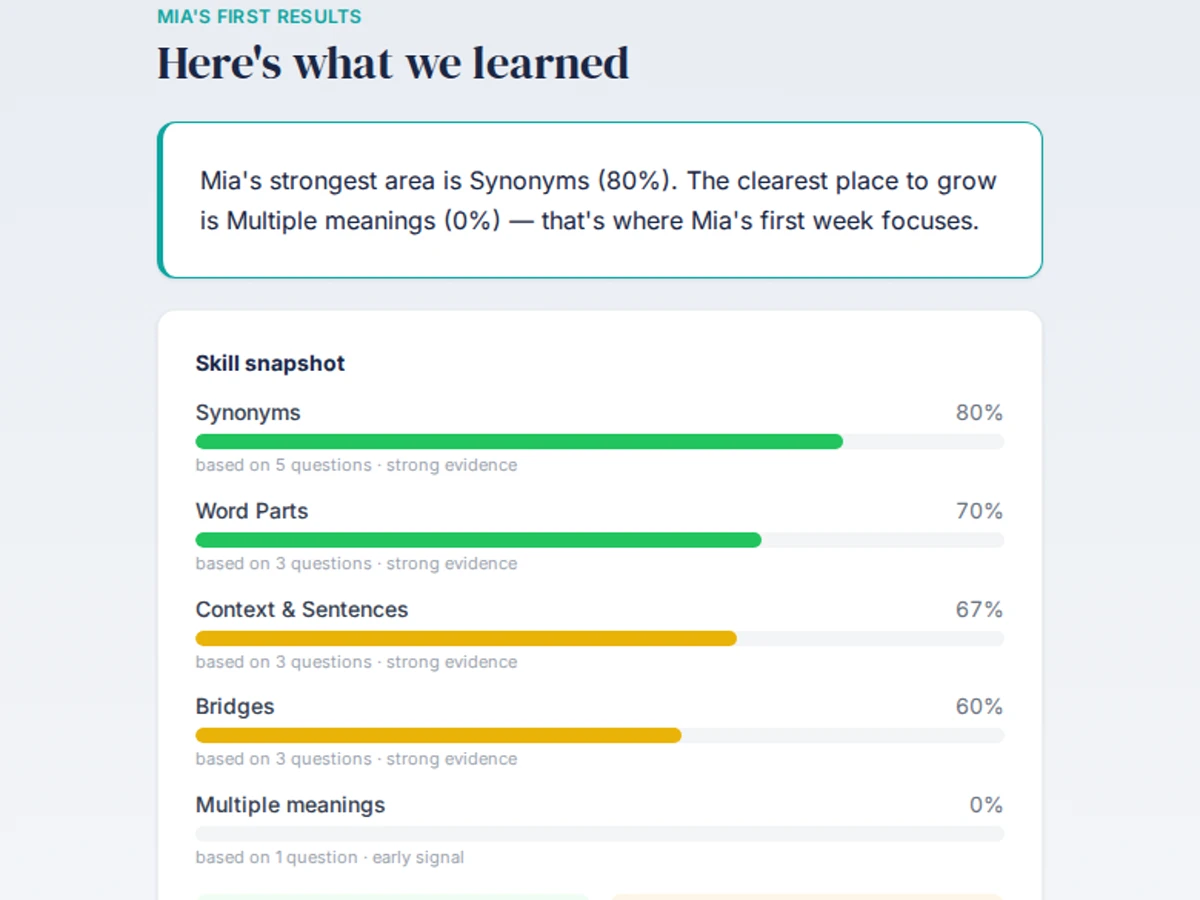
In LexiMap, the parent dashboard's Learning Skills view is built to surface exactly this layer. It tracks not just which roots your child has seen, but whether they are applying them flexibly — across question types, in unfamiliar words, under timed conditions. That distinction between exposure and application is something most prep tools never measure. A child can have a green word-count bar and a red transfer indicator, and the dashboard is how you see it before it shows up as a plateau on a practice test. All plans start with a 7-day free trial.
This is the moment where the roots audience tends to graduate into LexiMap's broader framework. Strong root knowledge is real progress — the on-ramp is solid. Transfer is the bridge into the other four verbal domains: Relational Reasoning, Contextual Inference, Test Execution, and Metacognition. Each one of those rewards a child who can apply what they know, not just recognize it. The deeper account of how metacognition sits above all of these is in Metacognition and the Parent Process-Skills Dashboard.
Key Takeaways
- Root recognition ≠ score.
- Transfer is the application layer above memorization.
- The same root serves all three question types when applied.
- Application is trained by application, not more memorization.
- This is where the roots audience graduates into the other four domains.
Further reading:
- The LexiMap Method
- Root Words vs. Flashcards
- 50 Latin Root Words Every SSAT Student Should Know
- SSAT Analogy Practice: Bridge Types
- Metacognition & the Parent Process-Skills Dashboard
Get SSAT/ISEE vocabulary resources by email
Related Articles
ISEE Reading Comprehension: How Vocabulary Knowledge Determines Your Child's Score
Learn how vocabulary knowledge affects your child's ISEE reading comprehension score — and which prep strategies transfer beyond the Verbal Reasoning section.
Last-Minute SSAT Prep: Your 30-Day Vocabulary Plan
Test in 30 days? Here's the prioritized week-by-week SSAT vocabulary plan — 20–30 min/day, roots first, proven strategies, no panic required.
Beyond the Score: Metacognition and the Parent Process-Skills Dashboard
The strongest test-takers manage how they think. How to build your child's confidence calibration, error awareness, and strategy selection — and track it as a parent.
SSAT Vocabulary Prep: The Complete Parent Guide
Everything parents need to know about SSAT vocabulary prep — what the verbal section tests, how scoring works, and the strategies that build lasting vocabulary mastery.
Related Guides
SSAT Vocabulary: The Complete Guide to Root-Based Learning
Master SSAT vocabulary through Latin and Greek roots. Learn how root-based learning, spaced repetition, and interactive practice build lasting verbal skills for grades 4-12.
SSAT Vocabulary List: 200+ Words Organized by Level and Root
Comprehensive SSAT vocabulary word lists organized by test level (Elementary, Middle, Upper) and root word family. Study the right words for your child's grade.
SSAT® is a registered trademark of The Enrollment Management Association. ISEE® is a registered trademark of the Educational Records Bureau (ERB). LexiMap is not affiliated with or endorsed by these organizations.