SSAT Vocabulary Prep: The Complete Parent Guide
Find your child's SSAT vocabulary gaps
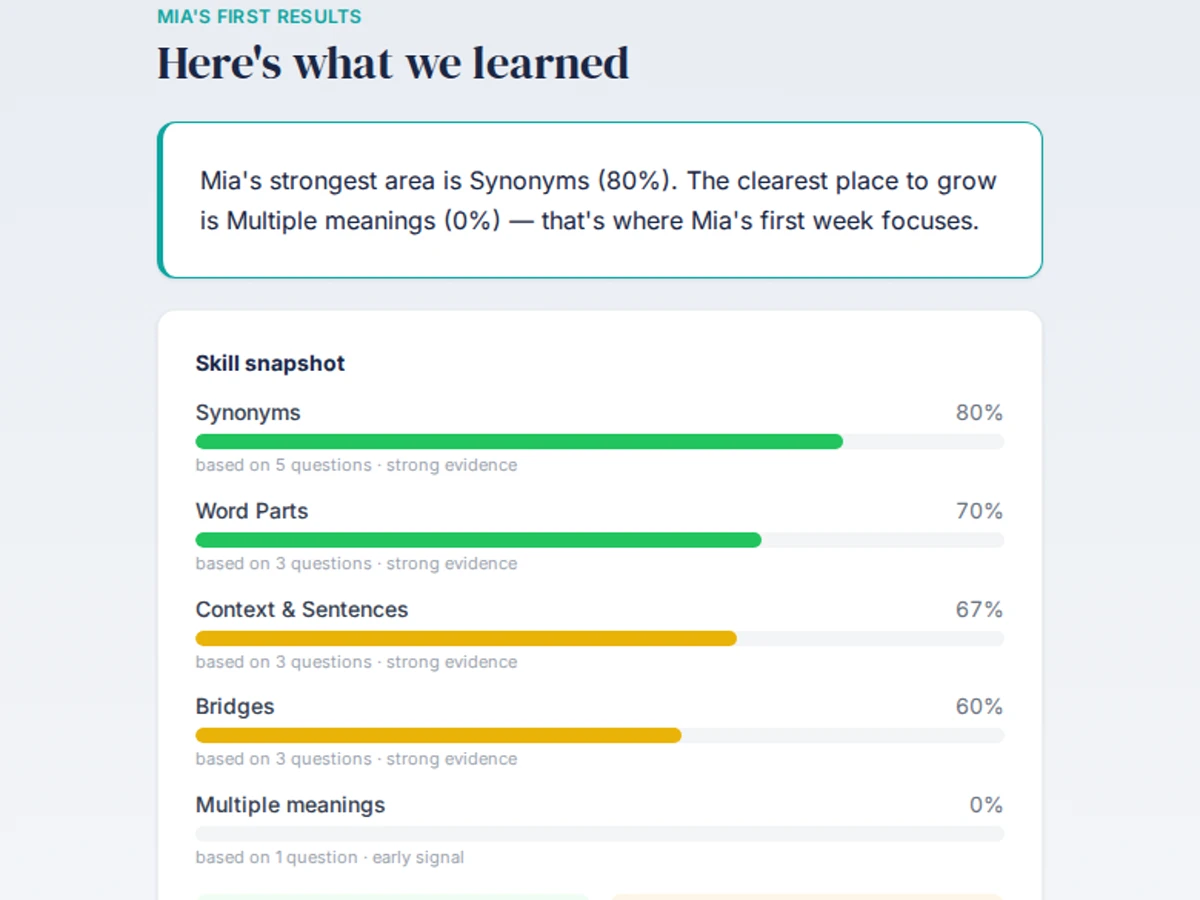
Start with a free, no-card SSAT check-up — 30 questions with a personalized parent report.
Find the SSAT vocabulary gaps — freeSee a sample parent report before starting
The check-up samples verbal skills and gives you an early strength, a growth area, and a first practice focus. It is not a full-length exam, an official SSAT or ISEE score, or an admissions prediction.
Most parents approaching SSAT prep for the first time expect a reading problem. After the first diagnostic, they discover it's actually a vocabulary problem — and that the tools they naturally reach for (flashcard apps, word lists, tutoring sessions) are slower and less effective than the alternatives.
This guide is written for parents, not students. If you've recently registered your child for the SSAT, or you're three months from test day wondering whether vocabulary prep is on track, you'll find concrete answers here: what the verbal section actually tests, why vocabulary matters more than most families realize, which preparation approaches work, and what timeline makes sense for your child's grade level.
This guide covers the full picture. Where specific topics run deep — the SSAT verbal section format and scoring, the science of spaced repetition for kids, and the complete list of high-value Latin and Greek roots — we'll cross-link to the dedicated posts rather than repeat the same material in abbreviated form.
What the SSAT Verbal Section Actually Tests
The SSAT verbal section is one of three scored sections on the test, and it carries significant weight. At the Upper Level, the verbal section contains 60 questions answered in 30 minutes. At other levels, the format adjusts slightly, but the question types remain consistent across all levels: synonyms and analogies.
That's it. Two question types. No reading passages, no fill-in-the-blank sentences, no context clues. Your child either knows the words and the relationships, or they don't.
Synonyms
Synonym questions present a single word in capital letters, followed by five answer choices. Your child must select the word or phrase closest in meaning to the stimulus word.
Example format:
BENEVOLENT:
(A) hostile (B) curious (C) kind (D) boisterous (E) cautious
The answer is (C). But here's what makes synonym questions difficult: the words tested are deliberately drawn from a vocabulary range above grade level. The SSAT is a selective admissions test designed to spread candidates across a wide scoring range. The words are chosen because most students won't know them from casual reading alone.
This is precisely why passive vocabulary — words your child has encountered in books or conversation — isn't sufficient. The test deliberately reaches beyond that range.
Analogies
Analogy questions present a paired relationship, then ask your child to identify another pair that shares the same relationship structure.
Example format:
Physician : Hospital ::
(A) actor : theater (B) bread : baker (C) student : teacher (D) fish : ocean (E) soldier : weapon
The answer is (A). A physician works in a hospital; an actor works in a theater. The relationship type here is "person to their workplace."
Analogies are harder than synonyms for most students because they require two things simultaneously: knowing the vocabulary in the stem pair AND recognizing the logical relationship (bridge type) between them. A student who knows what "physician" means but can't identify the bridge type will still choose the wrong answer.
For a thorough breakdown of all question types, timing, scoring, and what percentile ranges look like across test levels, see SSAT Verbal Section Breakdown: Format, Scoring, and What to Expect.
How the SSAT Verbal Section Is Scored
Understanding the scoring mechanics helps you interpret practice test results and calibrate what "good enough" means for your child's target schools.
The SSAT uses a scaled score, not a raw score. Raw points (correct answers minus one-quarter point for incorrect answers) are converted to a scaled score, which is then expressed as a percentile relative to all SSAT test-takers in the same grade over the past three years. That percentile is what schools actually see.
Several things are worth understanding here:
The comparison pool is self-selected and highly motivated. Unlike the SAT or ACT, which have large general test-taking populations, the SSAT is primarily taken by students applying to selective independent schools. The pool skews toward prepared, academically strong students. A 50th percentile on the SSAT is not the same as 50th percentile on a general population test — it represents the middle of a competitive cohort.
Selective schools typically target the 75th percentile or above. The most selective independent schools — Exeter, Andover, Groton, and comparable schools in major metro areas — look for verbal percentiles in the 85th–95th range. Understanding your child's target school's typical admit profile helps you assess how much headroom you have.
The verbal section has real room for improvement with preparation. Unlike quantitative reasoning, which develops slowly with mathematical maturity, vocabulary is highly trainable in a compressed timeline. A child who adds 500 to 800 words to their working vocabulary over three to six months of focused preparation can see substantial percentile gains.
Wrong answers carry a small penalty. The one-quarter point deduction for incorrect answers means guessing randomly is mildly negative in expectation. However, if your child can eliminate two answer choices, guessing from the remaining three is mathematically worthwhile. Teaching this strategy is a small but meaningful test-day skill.
Why Vocabulary Is the Highest-Leverage Prep Target
Parents often ask whether they should prioritize verbal or quantitative prep. The honest answer depends on diagnostic scores — but for most students, vocabulary is the higher-leverage target.
Here's why:
Vocabulary is the most learnable component of the verbal section. Analogy reasoning can be taught through bridge-type training (more on that below), but the vocabulary in analogy stems is the same pool as synonym questions. If your child owns the vocabulary, both question types become more tractable.
Vocabulary knowledge compounds. Learning the root bene (meaning "good" or "well") doesn't just help with the word "benevolent." It helps with "benefactor," "benediction," "beneficial," "benign," and every other word built from that root — including words your child has never encountered. This is structurally different from memorizing individual word definitions, where each word is learned in isolation.
The numbers behind this: 160 Latin and Greek roots cover a large share of the academic vocabulary tested on the SSAT. That means learning 160 building blocks gives your child decoding ability across the majority of the verbal section's content — not just the specific words they've reviewed.
The verbal section is tested in isolation. Unlike reading comprehension, where context clues can compensate for vocabulary gaps, synonym questions offer no such assistance. Your child is presented with a single word. Either they know it, or they don't. Preparation that builds actual vocabulary knowledge pays off more directly here than preparation that teaches test-taking workarounds.
Vocabulary gains persist. A child who learns 600 words for the SSAT doesn't lose that knowledge after test day. The same roots that decode "mellifluous" on the SSAT will decode "malevolent" on the SAT, "benevolence" in a college essay prompt, and "beneficiary" in a legal document. Vocabulary preparation is one of the few academic investments with a genuinely long payoff window.
The Two Approaches to Vocabulary Prep (and Why One Works Better)
When parents search for SSAT vocabulary prep, they typically encounter two approaches: word lists and root-based learning. Understanding the difference in how these approaches work — and in what they produce — is the most important thing you can read in this guide.
The Word List Approach
The word list approach is intuitive: identify the words most commonly tested on the SSAT, build flashcards or use a flashcard app, and review until your child can match definitions to words.
Publishers like Barron's and Kaplan have produced SSAT vocabulary lists for years. Quizlet has thousands of SSAT vocabulary decks created by parents and tutors. The appeal is obvious: it's organized, measurable, and familiar.
The problem is cognitive science. Rote memorization without structural understanding produces shallow, fragile memory. Research on vocabulary acquisition consistently shows that words learned through definition memorization alone are retained at low rates, particularly when the learner doesn't use the word in context or understand why it means what it means. Without the underlying structure — the etymology, the root, the family of related words — each definition is an isolated fact that competes with other isolated facts for limited memory capacity.
When a child reviews a flashcard for "benevolent" and sees "kind, well-meaning," they form a weak association between the two strings of letters. When they review it again next week, some of that association has faded. When they see "benevolent" on test day, the recall depends entirely on whether the memory happened to survive.
There's a useful comparison explored in Root Words vs. Flashcards: Which SSAT Study Method Actually Works? — the short answer is that roots outperform flashcards for long-term retention, and the gap widens over time.
The Root-Based Approach
Root-based learning takes a different starting point: instead of memorizing the words themselves, your child learns the building blocks that words are constructed from.
Latin and Greek roots are the etymological foundation of the majority of academic English vocabulary. The root bene comes from Latin and means "good" or "well." From that single building block:
- benevolent (bene + vol = good-wishing): charitable, well-meaning
- benefactor (bene + factor = good-doer): someone who provides help or support
- benediction (bene + dict = good-saying): a blessing or spoken expression of goodwill
- beneficial (bene + fic = good-making): producing good results
- benign (from Latin benignus, same root): gentle, not harmful
A child who understands bene doesn't need to memorize five separate definitions. They have a decoding strategy that works on all five words — and on any other "bene-" word they encounter, including words they've never studied and words the SSAT writers haven't yet included in any word list.
This is why 160 roots can cover a large share of SSAT vocabulary. The roots are not 160 random words; they are the 160 most generative building blocks in academic English. Mastering them creates compounding returns: each root unlocks an entire family of related words.
The complete list of high-value roots and the families they unlock is covered in depth in The Complete List of Latin and Greek Roots for SSAT Vocabulary, and a focused list of the highest-priority Latin roots is in 50 Latin Root Words Every SSAT Student Should Know.
How Deep Vocabulary Knowledge Works: Five Facets
One of the quiet inefficiencies in most vocabulary prep approaches is treating word knowledge as binary: either your child knows a word or they don't. This binary framing leads to study habits that optimize for the wrong thing.
LexiMap's framework spans five domains — vocabulary knowledge, relational reasoning, contextual inference, test execution, and metacognition — all tracked on the parent dashboard. The five facets below live inside the first of those domains, Vocabulary Knowledge (Domain 1), and describe what it means to truly know a word at the depth the SSAT requires:
A more accurate picture of vocabulary knowledge has five distinct depth dimensions, each of which the SSAT can probe:
1. Recognition (chunk spotting). Can your child identify the root or meaningful unit within a word? Given "melancholy," can they spot that "mela-" comes from the Greek root for dark or black?
2. Meaning recall. Can your child retrieve the meaning of a word when they see it? This is what flashcard practice targets — but it's only one of five facets.
3. Contextual fit. Can your child determine whether a word makes sense in a given context? Synonym questions require not just knowing what a word means, but judging whether the answer choice would work in the same context as the stem word.
4. Discrimination (synonym discrimination). Can your child distinguish between near-synonyms? "Benevolent" and "charitable" both mean something like "generous toward others" — but they have different connotations and wouldn't be perfectly interchangeable in all contexts. The SSAT exploits this by placing tempting near-synonyms as wrong answer choices.
5. Retention under pressure. Can your child access the word reliably in a timed test environment, not just during a relaxed study session?
Tracking these five dimensions separately gives a more accurate picture of genuine vocabulary knowledge than a simple "knows/doesn't know" count. A child who has all five facets for a word is genuinely prepared for that word on test day. A child who only has the second facet (meaning recall) will get caught by the discrimination traps the SSAT routinely sets.
This is why the depth of preparation matters as much as the breadth.
Understanding SSAT Analogies: The Bridge-Type System
Analogy questions are the component that most surprises parents who haven't encountered them recently. They require a specific type of reasoning that benefits from explicit instruction — and that most test prep approaches handle poorly.
The key insight is that SSAT analogies are not vocabulary tests disguised as logic puzzles. They're logic puzzles that require vocabulary. The relationship type (the "bridge") between the two words in the stem is the real question. Your child needs to:
- Know both words in the stem pair well enough to identify their relationship
- Name the relationship type precisely ("this is a part-to-whole relationship" or "this is a function relationship")
- Find the answer pair that shares that exact relationship type
The naming step is the one most students skip — and it's the most important. Students who try to evaluate answer choices without first naming the bridge type are susceptible to misleading choices that share vocabulary domain with the stem without actually replicating the relationship.
The SSAT uses a consistent set of relationship types across analogy questions. Roughly 28 distinct bridge types appear with regularity, including:
- Degree: Words that differ in intensity (warm : scorching :: pleased : ecstatic)
- Part to whole: A component and its containing structure (petal : flower :: spoke : wheel)
- Function: A tool and its purpose (thermometer : temperature :: scale : weight)
- Cause and effect: A cause and its predictable result (negligence : accident :: practice : improvement)
- Type and category: A specific instance and its broader class (sonata : composition :: haiku : poem)
- Characteristic quality: A thing and a defining attribute (chameleon : adaptable :: glacier : slow)
- Person and related tool or environment: (surgeon : scalpel :: conductor : baton)
A student who has been explicitly taught to identify and name these relationship types approaches analogies very differently from a student who is pattern-matching based on intuition. The named bridge type becomes a filter.
Students who do this correctly start to enjoy analogies more than synonyms, because the logical reasoning gives them a problem-solving handle even on unfamiliar vocabulary.
The full taxonomy of analogy bridge types, with worked examples, is covered in SSAT Analogy Practice: Master All 10 Bridge Types with Examples.
The Science Behind Effective Vocabulary Retention
Preparation that builds genuine vocabulary mastery requires understanding something about how memory works — specifically, about why information is forgotten and what can be done about it.
The research on forgetting is unambiguous: without review, newly learned information decays exponentially. Within 24 hours of learning a new word, most people have lost a substantial portion of their ability to recall it. Within a week, significantly more has faded. This is why cramming — studying intensively in the days before a test — produces weak, fragile memory that often collapses on test day.
The remedy is spaced repetition: reviewing material at intervals timed to match the natural forgetting curve. When your child reviews a word just before it would have been forgotten, the memory is not simply refreshed — it's rebuilt at a higher strength, and the interval before the next review can be extended. Each successful review makes the memory more durable.
Modern spaced repetition scheduling uses algorithms that track each individual item's history and predict when review is due. The FSRS algorithm (Free Spaced Repetition Scheduler) is the current state of the art. In benchmarked testing, FSRS targets ~90% recall at each review.
The deeper explanation of the science is in Spaced Repetition for Kids: The Science Behind FSRS and Why It Works.
The practical implication for parents: vocabulary prep that uses a well-implemented spaced repetition system is dramatically more efficient than prep that doesn't. Your child studies less while retaining more.
Prep Strategies That Work: Practical Actions for Parents
Starting Today: Build the Root-Study Habit
The single most effective thing you can do regardless of how much time you have before test day is to begin root-based vocabulary study and make it a daily habit. Even 10–15 minutes per day produces meaningful results when it's done consistently over months.
Start with the highest-frequency roots — the ones that appear in the most SSAT vocabulary words. Latin roots like bene (good), mal (bad), port (carry), dict (say or speak), scrib/script (write), and aud (hear) each unlock 8–15 or more words that appear regularly on the test.
For each root, don't just learn the definition — spend a few minutes with your child generating words that use it. Mal means bad or evil: malevolent, malicious, malign, malignant, malpractice, malfunction, malodorous. Finding these connections is more engaging than memorizing isolated definitions and produces stronger encoding in memory.
Contextual Practice: Using New Words
Passive exposure and active recall are both important, but using words actively — in sentences, in conversation, in writing — produces the strongest long-term memory. This doesn't require formal drilling.
Analogy Practice: Name the Bridge First
When your child encounters analogy practice questions, establish the habit of naming the bridge type before looking at the answer choices.
Vocabulary in Context: Reading Above Grade Level
Sustained reading above grade level is one of the most effective long-term vocabulary strategies.
Practice Tests: Diagnose, Then Act
Practice tests serve a specific function in SSAT prep: they give you a clear picture of where your child stands. What practice tests do not do is fix the gaps they identify. The right rhythm is: practice test to diagnose, then targeted vocabulary study to build, then another practice test to measure progress.
Prep Timelines: When to Start and How to Structure Preparation
Six Months or More Before Test Day: Ideal
With six months of lead time, your child can build vocabulary knowledge at a sustainable pace without pressure. The structure:
- Months 1–2: Foundation roots (the 40–50 highest-frequency Latin and Greek roots)
- Months 3–4: Intermediate roots alongside analogy bridge-type training
- Months 5–6: Full test-conditions practice tests, targeted review
Three to Four Months: Still Very Effective
- Month 1: Foundation roots (highest-frequency 30–40 roots), daily 15–20 minutes
- Month 2: Continue root study, begin analogy bridge-type instruction, first diagnostic
- Months 3–4: Full practice test rhythm, targeted vocabulary review
One to Two Months: Targeted Focus
With six to eight weeks remaining, prioritize ruthlessly:
- Focus on the 30–40 highest-frequency roots only
- Use spaced repetition to maximize retention
- Prioritize analogy bridge-type training
- Take a diagnostic practice test in week 1
Younger Children (Grades 4–5)
For younger students, shorter daily sessions (10 minutes) with more emphasis on exploration and engagement. The habits formed at age 8 compound dramatically by age 12.
See When to Start SSAT Prep: The Complete Timeline for Every Grade for full coverage.
What to Look for in a Vocabulary Prep Tool or Resource
- Does it teach root-based vocabulary, or just word lists?
- Does it use spaced repetition?
- Is the content actually aligned to SSAT vocabulary?
- Can your child use it independently?
- Does it track mastery across multiple dimensions?
- Is it appropriate for your child's age?
For a direct comparison of SSAT prep tools, see How to Improve Your Child's SSAT Verbal Score: A Parent's Guide.
Putting the Prep Stack Together
What Vocabulary Prep Handles
Root-based vocabulary preparation directly covers:
- Synonym questions
- Analogy vocabulary (the stem pair words and most answer choice words)
- Reading comprehension vocabulary
- Long-term transfer (SAT vocabulary, college reading, and beyond)
What Vocabulary Prep Does Not Replace
- Analogy bridge-type reasoning
- Quantitative reasoning
- Reading comprehension strategies
- Test familiarity
The Complementary Stack
Many families use a practice test platform (Test Innovators, Piqosity) for diagnostic data and test-condition practice, and a separate vocabulary-focused resource for the actual vocabulary instruction.
A Note on LexiMap
Among the tools built specifically for SSAT vocabulary prep, LexiMap is designed around the principles described in this guide: root-based morphological instruction across 160 Latin and Greek roots and 60 affixes, FSRS spaced repetition scheduling (~90% recall target), depth tracking across the five facets of vocabulary knowledge, and a game-based interface designed for ages 8 and up. Content covers all six SSAT and ISEE test levels. One subscription covers up to four children.
It's not the only resource worth considering — good tutors, quality practice test platforms, and root-word reference materials all have their place. The free trial doesn't require a credit card.
Key Takeaways
- The SSAT verbal section tests two question types — synonyms and analogies — both of which require strong vocabulary knowledge
- The comparison pool for SSAT percentile scores is a highly motivated, prepared cohort of students targeting selective independent schools
- Root-based vocabulary learning outperforms word-list memorization because roots produce compounding coverage: 160 Latin and Greek roots unlock a large share of SSAT vocabulary
- Spaced repetition is the scientifically validated approach to durable vocabulary retention. The FSRS algorithm targets ~90% recall at each review
- Word knowledge is not binary. Vocabulary knowledge has five depth facets — recognition, meaning recall, contextual fit, discrimination, and retention under pressure — all of which the SSAT can probe
- Analogy success depends on explicitly naming the bridge type before evaluating answer choices
- Six months of daily root-based study at 15 minutes per day is the ideal preparation timeline
- Vocabulary prep works best as part of a complementary stack: root-based vocabulary study for instruction, practice test platforms for diagnosis
Further Reading
- 50 Latin Root Words Every SSAT Student Should Know
- SSAT Analogy Practice: Master All 10 Bridge Types with Examples
- The Complete List of Latin and Greek Roots for SSAT Vocabulary
- How to Improve Your Child's SSAT Verbal Score: A Parent's Guide
- Root Words vs. Flashcards: Which SSAT Study Method Actually Works?
- SSAT Verbal Section Breakdown
- Spaced Repetition for Kids
- When to Start SSAT Prep
Get SSAT/ISEE vocabulary resources by email
Related Articles
50 Latin Root Words Every SSAT Student Should Know
Master the 50 most important Latin root words for the SSAT. Each root includes meaning, example words, and memory tips to build lasting vocabulary skills.
ISEE Verbal Section: The Parent's Complete Guide
Everything parents need to know about the ISEE verbal reasoning section — question types, scoring, levels, and what vocabulary prep actually works for your child.
Last-Minute SSAT Prep: Your 30-Day Vocabulary Plan
Test in 30 days? Here's the prioritized week-by-week SSAT vocabulary plan — 20–30 min/day, roots first, proven strategies, no panic required.
The Complete List of Latin and Greek Roots for SSAT Vocabulary
Learn 60+ Latin and Greek roots used in academic vocabulary for SSAT/ISEE preparation. Free root word tables, study strategies, and a test-question walkthrough for grades 4–12.
Related Guides
SSAT Vocabulary: The Complete Guide to Root-Based Learning
Master SSAT vocabulary through Latin and Greek roots. Learn how root-based learning, spaced repetition, and interactive practice build lasting verbal skills for grades 4-12.
The Parent's Complete Guide to SSAT & ISEE Prep
Everything parents need to know about SSAT and ISEE preparation. Test formats, timelines, study strategies, score interpretation, and how to support your child's verbal growth.
SSAT® is a registered trademark of The Enrollment Management Association. ISEE® is a registered trademark of the Educational Records Bureau (ERB). LexiMap is not affiliated with or endorsed by these organizations.