Beyond the Score: Metacognition and the Parent Process-Skills Dashboard
Find your child’s vocabulary gaps
Start with a free, no-card vocabulary check-up and get a personalized parent report.
Find the vocabulary gaps — freeSee a sample parent report before starting
The check-up samples verbal skills and gives you an early strength, a growth area, and a first practice focus. It is not a full-length exam, an official SSAT or ISEE score, or an admissions prediction.
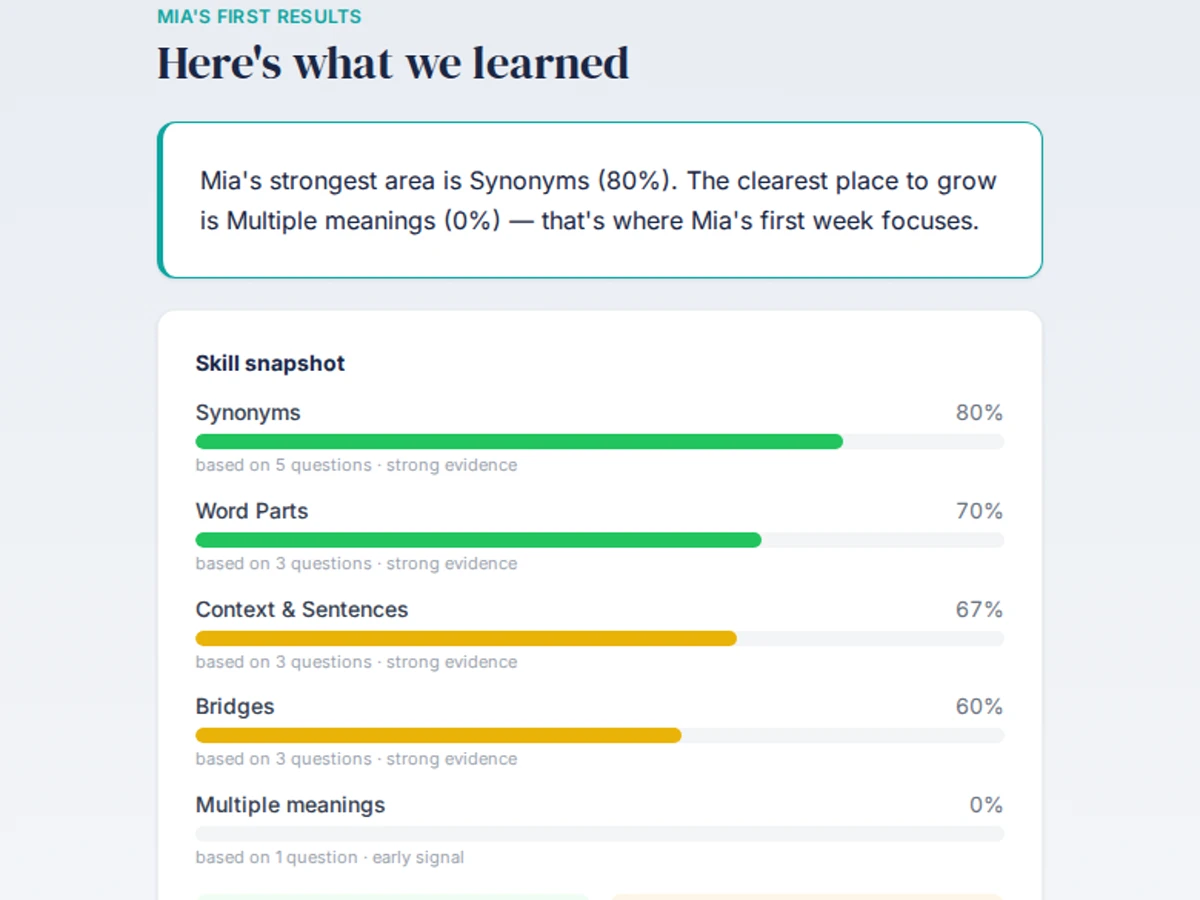
If you have watched your child study hard, learn the words, and still come back from a practice test with a disappointing score, you already know the feeling this post is about. The vocabulary went in. The effort was real. And yet something between knowing the material and using it under pressure broke down.
That something has a name. Researchers call it metacognition — the set of skills your child uses to manage their own thinking. It is the layer that sits above vocabulary, above analogies, above context clues. And on the SSAT and ISEE, it is frequently the difference between a child who plateaus and a child who keeps improving.
This post is about what metacognition is, why it matters more than most prep programs admit, and — the part most parents have never had access to — how you can actually see it. LexiMap surfaces these habits in a parent process-skills dashboard, so the invisible becomes coachable. We will spend real time on that, because it is the piece that changes what a parent can do at home.
Why smart, hard-working kids still plateau
The most common story we hear from parents goes like this. A child starts prep, makes fast early gains, and then stalls. The word lists keep growing, the study hours keep adding up, but the score stops moving. Effort is no longer translating into results.
This is rarely a vocabulary problem. By the time a child has put in real hours, they usually know more words than their score reflects. The plateau is almost always happening in the gap between knowing and doing — the moment where a child has to choose how to spend their limited time, decide whether to trust an answer, recognize that a question is a trap, or move on instead of grinding.
Those are not vocabulary skills. They are self-management skills, and most prep never touches them. Flashcard apps drill recall. Tutoring sessions often re-teach content the child already half-knows. Practice tests produce a score but not a diagnosis of why the score came out that way. So the child does more of the thing that already worked once — more words, more drilling — and is surprised when it stops paying off.
LexiMap trains five co-equal verbal-skill domains, and only one of them is about words:
- Vocabulary Knowledge — roots, affixes, standalone vocabulary, polysemy. (Roots are one skill inside this domain, not the whole game.)
- Relational Reasoning — analogies, synonyms, antonyms; seeing how words relate.
- Contextual Inference — context clues, signal words, sentence completion; deriving meaning from surroundings.
- Test Execution — pacing, elimination, guess discipline, stamina, triage.
- Metacognition — confidence calibration, strategy selection, error-pattern awareness, transfer.
A child can be strong in Vocabulary Knowledge and weak in the last two, and that combination produces exactly the plateau parents describe. The fix is not more words. It is building the manage-your-own-thinking layer — and that is what the rest of this post is about.
What metacognition is, in plain parent language
Metacognition is a long word for a simple idea: thinking about your own thinking. It is the part of your child's mind that watches the rest of their mind work and makes adjustments.
A useful way to picture it: there is the player on the field, and there is the coach on the sideline. The player runs the play — reads the question, recalls the word, picks an answer. The coach watches the player and asks the questions that change outcomes. Am I actually sure about this, or am I guessing? I've gotten this kind of question wrong before — what went wrong last time? Is this the moment to slow down or the moment to move on?
Younger children, and stressed children of any age, tend to play with no coach on the sideline. They answer on instinct, do not notice when they are uncertain, and repeat the same mistakes because nothing inside them is tracking the pattern. Stronger test-takers have an active internal coach. That coaching voice is metacognition, and the encouraging part for parents is that it is learnable. It is not a fixed trait or a personality type. It is a set of habits that can be taught, practiced, and — crucially — observed.
For the rest of this post we will break metacognition into four concrete, coachable sub-skills: confidence calibration, error-pattern awareness, strategy selection, and transfer. Each one is a specific habit you can help your child build, and each one shows up in the dashboard.
Confidence calibration: knowing what you don't know
Calibration is the match between how confident your child feels and how often they are actually right. A well-calibrated child feels sure on the questions they get right and feels uncertain on the questions they get wrong. That sounds obvious, but most children are poorly calibrated in one of two directions, and each one costs points in a different way.
The overconfident child feels certain on questions they actually miss. They read a synonym question, the first answer choice feels right, and they lock it in without checking the alternatives. On a test that buries tempting near-synonyms in the wrong answers, overconfidence walks straight into the traps. These children rush, and their errors cluster on exactly the questions they were most sure about.
The underconfident child knows more than they trust. They second-guess correct answers, change right answers to wrong ones, and burn time agonizing over questions they had already solved. On a timed test, that hesitation has a double cost: lost points from the changes, and lost minutes that should have gone to harder questions later.
Calibration is the skill that prevents both panic-guessing and overconfidence. A calibrated child knows the difference between "I am confident because I decoded this from the root" and "I am confident because this word is familiar and I have a hunch." That distinction drives smarter test-day decisions: when to commit, when to slow down, when to eliminate and guess, and when to skip and come back.
You build calibration by making confidence explicit. Before you check an answer with your child, ask them to rate how sure they are. Then look at the result together. Over time, your child learns to feel the difference between real knowledge and a comfortable guess — and that internal signal is one of the most valuable things a test-taker can own.
Error-pattern awareness: mistakes have types
Here is a reframe that changes how families use practice tests: a wrong answer is data, not a verdict. The score tells you how many your child missed. It does not tell you why — and the why is where all the improvement lives.
Errors are not random. They cluster into types, and each type points to a different fix:
- Vocabulary gaps — the word was genuinely unknown. The fix is content: more roots, more reading, more exposure.
- Decoding misfires — your child knew the root but applied it wrong, or a prefix flipped the meaning and they missed it. The fix is decoding practice, not more memorization.
- Bridge errors — on analogies, your child knew both words but named the relationship wrong. The fix is relational-reasoning practice, naming the bridge before scanning answers.
- Context misreads — your child ignored a signal word ("although," "despite," "because") that should have steered the answer. The fix is contextual-inference work.
- Pacing errors — your child ran out of time and missed easy questions at the end, or sank ten minutes into one hard question. The fix is test-execution practice.
- Trap errors — your child fell for the tempting-but-wrong near-synonym or the answer that matched the topic but not the relationship. The fix is elimination discipline.
A child who can say "I keep losing points on context misreads, not vocabulary" has done something powerful: they have turned a vague disappointment into a targeted plan. Errors cluster into types you can target — and the entire point of error-pattern awareness is to make practice efficient. Instead of re-studying everything, your child works on the one or two categories that are actually costing them points. (The mechanics of how content knowledge fails to transfer into test performance are explored further in Roots Aren't Enough: The Transfer Gap.)
Strategy selection: the right tool per question type
Imagine handing your child a toolbox and watching them reach for the same tool no matter the job. That is what most under-prepared test-takers do: they try to recall their way through every question, even the ones that recall cannot solve.
Strong test-takers carry several tools and choose deliberately. On the SSAT and ISEE verbal sections, the main tools are:
- Root-decode. When the word is unfamiliar but built from a known root, break it apart. Malediction — mal (bad) plus dict (speak) — points toward "a curse." This is the bridge from Vocabulary Knowledge into a live answer, and it only pays off if your child chooses to use it under pressure.
- Context clues. On sentence-completion and reading questions, the surrounding sentence often constrains the answer. Signal words and tone tell your child whether the missing word should be positive or negative, strong or mild — before they even consider the choices.
- Eliminate. When the answer will not come directly, work backward. Cross off the choices that are clearly wrong and shrink the field. Two eliminations turn a blind guess into a coin flip with the odds tilted your child's way.
- Educated guess and move on. When nothing is landing and the clock is running, the right move is to make the best available guess and protect time for questions your child can solve. Knowing when to stop is itself a skill.
The right strategy per question type is a learnable decision. The metacognitive skill here is not knowing the four tools — it is the split-second choice of which one fits this question. A child who reflexively tries to recall an answer they could have decoded, or grinds on a question they should have guessed and skipped, is losing points to poor tool selection, not poor knowledge. Strategy selection is the habit of pausing for half a second to ask "what kind of question is this, and what is my best move?" — and then committing.
Transfer: turning practice gains into test-day performance
Transfer is the bridge from the practice session to the test, and it is the place where the most prep effort quietly leaks away. A child can know 600 words cold in a calm session at the kitchen table and still underperform on test day, because the test environment is different: a ticking clock, real stakes, fatigue, and no second tries.
This is the deepest reason the headline of this post matters — roots are the on-ramp; metacognition is the destination. Knowing roots is necessary but not sufficient. The payoff arrives only when your child reliably applies what they know under pressure, and application under pressure is a metacognitive skill, not a content one.
Several things block transfer, and each is addressable:
- Stamina. Verbal endurance fades over a long section. A child who is sharp for ten minutes and foggy at minute twenty-five needs practice that builds test-length focus, not just short bursts.
- State management. Test anxiety narrows thinking. A calibrated, well-rehearsed child walks in knowing their tools and trusting their preparation, which lowers the panic that scrambles recall.
- Context shift. Words learned in only one format can fail to surface in another. The fix is varied practice — seeing the same root in synonyms, in analogies, and in context — so the knowledge is flexible rather than brittle.
Transfer is built by making practice resemble the test: timed conditions, varied formats, and full-length stamina work, paired with the calibration and strategy habits above. The goal is a child whose knowledge does not just exist, but shows up when it counts.
The parent process-skills dashboard: making the invisible visible
Everything above shares one frustrating quality: it is invisible. You can see a vocabulary score. You cannot see your child's calibration, their error patterns, their strategy choices, or whether their knowledge transfers under pressure. And you can't coach what you can't see. This is the single biggest reason these skills go untrained — not because parents do not care, but because parents have never had a window into them.
LexiMap's parent process-skills dashboard is built to be that window. It surfaces how your child is working, not just how many words they have learned. Where a word count tells you about coverage, the process-skills view tells you about the habits that actually move scores — the metacognitive layer this whole post is about. It organizes those habits into three headings a parent can act on:
- Test Execution Skills. This view reflects how your child performs under the conditions that matter: pacing, elimination discipline, guess behavior, stamina, and triage. It is where pacing errors and trap errors become visible as a pattern rather than a one-off bad day.
- Learning Skills. This is the metacognition view — confidence calibration, strategy selection, error-pattern awareness, and transfer. It is where you can see whether your child is becoming a better manager of their own thinking, independent of how many words they have memorized.
- Behavioral Skills. This view reflects the habits underneath the work — the consistency and engagement that determine whether the other two ever get a chance to develop.
The reason this matters so much is timing. Without visibility, a calibration problem or a recurring error type only reveals itself in a disappointing test score — weeks or months in, after the habit has hardened. With the dashboard, the parent dashboard turns these invisible skills into a coachable signal you can act on early, while there is still runway to fix it. You stop guessing about why the score is stuck and start working on the specific habit that is holding it back.
It also changes the conversation at home. "How did studying go?" is a hard question for a child to answer honestly. But "the dashboard shows you have been guessing fast on the questions you miss — want to try slowing down on those?" is concrete, specific, and not a judgment of effort. The dashboard gives you a shared, neutral picture to coach from, which keeps the conversation about skills rather than about character. That is the wedge: most tools show parents a number. LexiMap shows parents the process behind the number — and the process is the thing you can actually change.
A weekly parent routine for building metacognition
You do not need to be a test-prep expert to build these skills. You need a light, repeatable routine and the willingness to ask a few good questions. Here is a weekly rhythm that fits into a normal family schedule.
During practice — make confidence explicit. A few times a week, before you check an answer together, ask your child: "How sure are you, and why?" Listen for the difference between "I decoded it from the root" and "it just felt right." You are training them to notice their own certainty — the core of calibration — and you are doing it in seconds, not in a special study block.
After a practice test — sort the misses by type. Resist the urge to re-teach every wrong answer. Instead, sit down together and ask of each miss: was this a vocabulary gap, a decoding slip, a bridge error, a context misread, a pacing problem, or a trap? Tally them. The category that shows up most is next week's focus. This single habit turns practice tests from a source of anxiety into a planning tool.
Once a week — check the dashboard together. Open the parent process-skills dashboard and look at the three views — Test Execution, Learning, and Behavioral — alongside your child. Pick one thing to work on. Maybe calibration is the gap, maybe pacing, maybe consistency. One focus per week is plenty; trying to fix everything at once fixes nothing.
In everyday life — name the tools. When a hard word comes up in reading or conversation, model the strategy out loud: "I don't know that word, but bene means good, so let's guess from there." You are showing your child that strategy selection is normal and that not-knowing is the start of a process, not a failure.
The throughline of all four habits is the same: you are helping your child install the coach on the sideline. Keep it short, keep it calm, and keep it focused on one skill at a time.
All plans start with a 7-day free trial.
Key Takeaways
- Metacognition is the manage-your-own-thinking layer above vocabulary.
- Calibration prevents both panic-guessing and overconfidence.
- Errors cluster into types you can target.
- The right strategy per question type is a learnable decision.
- The parent dashboard turns these invisible skills into a coachable signal.
Further reading:
- The LexiMap Method
- How to Improve Your Child's SSAT Verbal Score
- SSAT Vocabulary Prep: A Parent's Guide
- The Invisible Curriculum: Test-Execution Skills
- Roots Aren't Enough: The Transfer Gap
Get SSAT/ISEE vocabulary resources by email
Related Articles
From Error Log to Score Gains: The Habit That Compounds Verbal Practice
A simple error log turns missed questions into your child's biggest score driver. How to categorize verbal mistakes, spot patterns, and convert them into points.
Roots Aren't Enough: Why Knowing Word-Parts Doesn't Equal Test-Day Points
Your child memorized the roots but still misses questions. The transfer gap — and how to turn root knowledge into the applied reasoning the verbal section rewards.
Best ISEE Vocabulary Apps and Tools: A 2026 Comparison
Compare the best ISEE vocabulary prep apps — LexiMap, Quizlet, general vocabulary platforms, and practice tests. What actually prepares kids for ISEE synonyms and sentence completions.
Best SSAT Vocabulary Apps and Tools: A 2026 Comparison
Compare the best SSAT vocabulary prep tools — LexiMap, Quizlet, Anki, practice tests, and vocabulary apps. See which approach actually builds lasting verbal skills.
Related Guides
SSAT Vocabulary List: 200+ Words Organized by Level and Root
Comprehensive SSAT vocabulary word lists organized by test level (Elementary, Middle, Upper) and root word family. Study the right words for your child's grade.
The Parent's Complete Guide to SSAT & ISEE Prep
Everything parents need to know about SSAT and ISEE preparation. Test formats, timelines, study strategies, score interpretation, and how to support your child's verbal growth.
SSAT® is a registered trademark of The Enrollment Management Association. ISEE® is a registered trademark of the Educational Records Bureau (ERB). LexiMap is not affiliated with or endorsed by these organizations.