50 Latin Root Words Every SSAT Student Should Know
Find the SSAT vocabulary gaps before test day
Show all 12 roots
Sample SSAT roots we teach
- cred— believe
- bene— good, well
- mal— bad
- dict— say, speak
- spec / spect— look, see
- struct— build
- port— carry
- voc / vok— call, voice
- vid / vis— see
- tract— pull, drag
- magn— great
- ver— truth
Sample SSAT roots we teach
- cred— believe
- bene— good, well
- mal— bad
- dict— say, speak
- spec / spect— look, see
- struct— build
- port— carry
- voc / vok— call, voice
- vid / vis— see
- tract— pull, drag
- magn— great
- ver— truth
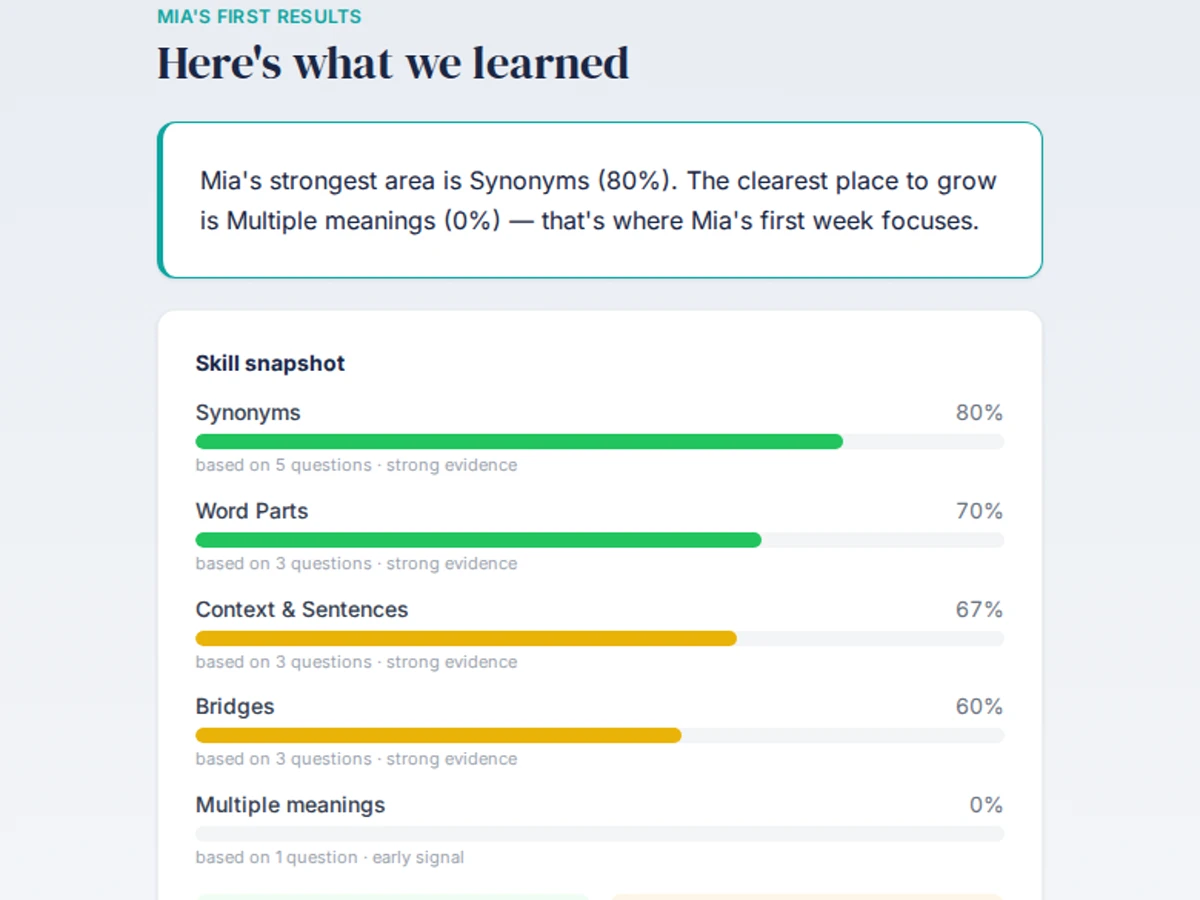
A free SSAT verbal check-up samples 30 questions and gives you an early strength, a growth area, and a first practice focus. No card required.
Start the free check-upSee a sample parent report before starting
The check-up samples verbal skills and gives you an early strength, a growth area, and a first practice focus. It is not a full-length exam, an official SSAT or ISEE score, or an admissions prediction.
When students sit down for the SSAT or ISEE verbal section, they face a daunting reality: hundreds of unfamiliar words, each one a potential trap. The traditional advice — "just memorize more words" — only goes so far. There are simply too many English words to memorize one at a time, and most of those memorized definitions fade within weeks.
There is a better approach. Latin roots are the building blocks that compose the majority of formal English vocabulary. Learn 50 roots and you gain the ability to decode hundreds — even thousands — of words you have never studied directly. A single root like duc/duct (to lead) unlocks conduct, deduce, introduce, produce, reduce, educate, induction, and aqueduct. That is eight words from one root, and the pattern holds across every entry in the table below.
In our comprehensive Latin and Greek roots guide, we mapped 166 roots that target the academic vocabulary most heavily tested across all SSAT/ISEE levels. Over 60% of English words have Greek or Latin roots, and up to 90% of academic vocabulary is Latin/Greek-derived (Rasinski et al., 2008). This post distills that research into the 50 most essential Latin roots — the ones that give you the greatest coverage for the least effort.
Whether your child is preparing for the Lower Level SSAT in 5th grade or the Upper Level in 11th, these 50 roots are the foundation on which lasting vocabulary mastery is built.
Why Latin Roots Matter for the SSAT
Roughly 60% of English words derive from Latin, and that percentage climbs even higher in the formal, academic register that standardized tests favor. The SSAT and ISEE deliberately draw from this register: words like benevolent, circumvent, and incredulous are staples precisely because they separate students who have deep vocabulary knowledge from those who only know conversational English.
Latin roots dominate this formal register because English absorbed thousands of Latin words during two major historical waves. The first came through Norman French after 1066, bringing words related to law, government, and culture. The second arrived during the Renaissance, when scholars borrowed directly from Latin for scientific, medical, and philosophical terminology. The result is that virtually every "hard" English word on the SSAT has Latin DNA.
The practical benefit is what linguists call the multiplier effect. Unlike memorizing individual word definitions, learning a root gives you access to an entire word family. Consider the root spec/spect (to look or see). From this single root spring inspect, spectacle, perspective, retrospect, speculate, suspect, respect, prospect, and circumspect. That is nine words from one root — and a student who knows the root can make educated guesses about all of them, even words encountered for the first time on test day.
This is not just theory. A meta-analysis of morphological instruction (Bowers, Kirby, & Deacon, 2010) found statistically significant gains in vocabulary, reading comprehension, and spelling when students learned roots and affixes explicitly. A meta-analysis by Goodwin and Ahn (2013) confirmed significant gains in vocabulary and decoding across school-age learners, and Carlisle (2010) found that instruction in morphological awareness improved literacy achievement across multiple studies. The evidence is clear: root-based learning works, and Latin roots are where the highest returns lie for SSAT preparation.
The 50 Essential Latin Roots
The table below presents 50 Latin roots organized by frequency and importance on the SSAT and ISEE. The first 35 are core roots — the fundamental building blocks of Latin-derived English vocabulary. The final 15 are high-value prefixes of Latin origin that modify those core roots. For each entry, we provide the meaning and five example words commonly tested on standardized exams.
How to use this table: Start by scanning for roots you already recognize. You will likely find that your child already uses words built from most of these roots every day. The goal is to make that structural knowledge conscious so it transfers to unfamiliar words on test day.
| Root | Meaning | Example Words |
|---|---|---|
| bene | good, well | benefit, benevolent, benediction, benefactor, benign |
| mal / male | bad, evil | malice, malevolent, malfunction, malignant, malady |
| dict | say, speak | dictate, predict, verdict, contradict, diction |
| scrib / script | write | describe, manuscript, inscription, prescribe, scripture |
| port | carry | transport, portable, export, import, deportation |
| duc / duct | lead | conduct, deduce, introduce, produce, educate |
| rupt | break | interrupt, erupt, corrupt, rupture, abrupt |
| ject | throw | reject, inject, project, eject, trajectory |
| spec / spect | look, see | inspect, spectacle, perspective, retrospect, speculate |
| aud | hear | audience, audible, auditorium, audition, auditory |
| cred | believe | incredible, credible, credential, credulous, creed |
| fac / fact | make, do | factory, manufacture, effect, defect, facilitate |
| ver | truth | verify, verdict, veracity, aver, veracious |
| voc / voke | call, voice | vocal, invoke, provoke, evocative, advocate |
| mit / mis | send | transmit, missile, emit, dismiss, remission |
| pend / pens | hang, weigh | suspend, pendant, pension, compensate, pendulum |
| tract | pull, drag | attract, extract, traction, retract, subtract |
| ven / vent | come | adventure, event, intervene, convention, prevent |
| form | shape | transform, conform, reform, formulate, uniform |
| clar | clear | clarify, declare, clarity, clarion, clarinet |
| pon / pos | place, put | compose, deposit, position, expose, oppose |
| cap / capt | take, seize | capture, accept, concept, reception, capable |
| sens / sent | feel | sensitive, consent, sentiment, sensation, resent |
| vid / vis | see | visible, evidence, provide, vision, supervise |
| ter / terr | earth, land | territory, terrain, terrestrial, subterranean, terrace |
| aqu | water | aquatic, aquarium, aqueduct, aquifer, aquamarine |
| corp | body | corpse, corporate, corporal, incorporate, corps |
| viv / vit | life | vivid, vital, revive, survive, vitality |
| mort | death | mortal, immortal, mortify, mortuary, mortgage |
| temp / tempor | time | temporary, contemporary, tempo, extemporaneous, temporal |
| equ | equal | equal, equitable, equivalent, equanimity, equator |
| sol | alone, sun | solitary, solo, solar, solitude, desolate |
| ambi | both, around | ambiguous, ambivalent, ambidextrous, ambient, ambition |
| nov | new | novel, renovate, innovate, novice, novelty |
| grat | pleasing, thankful | grateful, gratitude, congratulate, gratify, ingrate |
| loc / loqu | speak, talk | eloquent, loquacious, colloquial, elocution, soliloquy |
| magn | great, large | magnificent, magnify, magnitude, magnanimous, magnum |
| mand | order, command | mandate, command, demand, mandatory, countermand |
| struct | build | construct, structure, destruct, instruct, obstruct |
| ped | foot | pedestrian, pedal, pedestal, expedition, impede |
| ante | before | antecedent, anterior, anteroom, antebellum, antedate |
| circum | around | circumference, circumvent, circumstance, circumscribe, circumnavigate |
| con / com | with, together | connect, combine, compress, congress, community |
| contra | against | contradict, contrary, contrast, contravene, contraband |
| de | down, from, away | descend, decline, depart, degrade, demolish |
| dis | not, apart | disagree, disconnect, disappear, disrupt, dismiss |
| ex | out, from | exit, export, exclude, external, exhale |
| in / im | not | invisible, impossible, impartial, inactive, inadequate |
| inter | between, among | international, interact, intervene, interrupt, intermission |
| trans | across, beyond | transport, transform, transcend, translate, transparent |
A few things to notice in this table. First, many roots appear in two or more spelling variants (e.g., duc/duct, cap/capt). These variants come from different Latin verb forms but carry the same core meaning. Second, the last ten entries are Latin-origin prefixes, which function as roots in their own right. Prefixes like con/com (together), dis (apart), and trans (across) appear in hundreds of English words and combine with the core roots above to form a massive web of vocabulary.
Third, look at how the roots interact. Combine con (together) with struct (build) and you get construct. Swap in de (down) and you get destruct. Add in (into) and you get instruct. Three different words, one shared root, three different prefixes — and a student who understands the system can decode all three without ever having memorized their definitions individually.
How to Study These Roots
Having a list of 50 roots is a starting point, not a study plan. How your child practices matters as much as what they practice. Here are four research-backed strategies that turn root knowledge into lasting vocabulary skill.
1. Use Spaced Repetition, Not Cramming
Cramming produces short-term recall that fades rapidly. Spaced repetition — reviewing roots at increasing intervals based on how well they are known — builds durable long-term retention. The FSRS algorithm used by modern learning tools targets retention rates above 85%, far outperforming massed practice. See how our methodology applies FSRS to root-based learning.
In practice, this means daily sessions of 10–15 minutes are far more effective than one long weekend cram session, as spacing effect research consistently demonstrates. Consistency beats intensity every time.
2. Build Word Families from Each Root
After learning a root, challenge your child to brainstorm as many words as they can that contain it. For example, starting with ject (throw): reject (throw back), inject (throw in), project (throw forward), eject (throw out), trajectory (path of something thrown), dejected (thrown down, sad). This exercise strengthens the root-meaning connection and builds a network of related vocabulary.
3. Practice Multiple Skills
The SSAT tests vocabulary through synonyms and analogies; the ISEE adds sentence completions. Each question type requires a different cognitive skill. Effective root study should engage all of them:
- Recognition: Match a root to its meaning (e.g., cred = "believe")
- Construction: Build words by combining roots with prefixes and suffixes
- Derivation: Identify which words in a list share a common root
- Context: Use root knowledge to determine meaning within a sentence
- Analogy: Use root relationships to solve word-pair problems
4. Connect Roots to Each Other
Roots do not exist in isolation — they combine. Once your child knows a handful of roots, have them practice identifying multiple roots in a single word. The word incredible contains three parts: in (not) + cred (believe) + -ible (capable of) = "not capable of being believed." Breaking complex words into their component parts is exactly the skill the SSAT rewards.
Quick Quiz: Test Your Root Knowledge
Try these five questions to see how root knowledge works in practice. For each word, use the root hint to determine the meaning. Answers are below.
- What does "incredulous" mean?
Hint: in = not, cred = believe
- What does "circumvent" mean?
Hint: circum = around, ven/vent = come
- What does "malevolent" mean?
Hint: mal = bad, vol = wish
- What does "extract" mean?
Hint: ex = out, tract = pull
- What does "antecedent" mean?
Hint: ante = before, ced = go
Answers
- Incredulous = not believing; skeptical. From in (not) + cred (believe) + -ulous (inclined to). A person who is incredulous finds something hard to believe.
- Circumvent = to go around; to find a way to avoid an obstacle. From circum (around) + vent (come). Literally "to come around" something.
- Malevolent = wishing evil or harm to others. From mal (bad) + vol (wish) + -ent (having the quality of). The opposite of benevolent.
- Extract = to pull out. From ex (out) + tract (pull/drag). A dentist extracts a tooth by pulling it out.
- Antecedent = something that comes before. From ante (before) + ced (go) + -ent (one who). In grammar, the antecedent is the noun that comes before a pronoun.
If your child could answer three or more of these using only the root hints, they are already demonstrating the core skill that root-based study develops: structural decoding. If the exercise felt challenging, that is perfectly fine — it means there is real ground to gain by studying these roots systematically.
Key Takeaways
- Latin roots are the single most efficient lever for SSAT/ISEE vocabulary preparation — 50 roots unlock access to hundreds of test-level words.
- The formal, academic vocabulary tested on the SSAT and ISEE is overwhelmingly Latin-derived, making root knowledge directly applicable on test day.
- Roots, prefixes, and suffixes combine like building blocks. Learning the system lets students decode words they have never encountered before.
- Effective study uses spaced repetition (short daily sessions), word family building, and multi-skill practice across recognition, construction, derivation, context, and analogy.
- Root knowledge does not replace memorization — it supercharges it by giving students a framework for organizing and retaining vocabulary.
Next Steps
Ready to go deeper? Here are three resources to continue building your child's vocabulary foundation:
- The SSAT Vocabulary Guide — A comprehensive overview of what the SSAT verbal section tests and how to prepare for it systematically.
- SSAT Analogy Practice: Bridge Types — Learn the relationship patterns tested in SSAT analogies and practice applying root knowledge to solve them.
- How to Improve Your Child's SSAT Verbal Score — A parent's guide to building a complete study plan with realistic timelines and daily habits.
Bookmark this page as a quick reference during your child's study sessions. When they encounter an unfamiliar word in practice or in everyday reading, come back to this table and look for the root. Over time, that habit of structural analysis will become automatic — and that is when root-based learning truly pays off.
Roots are the on-ramp — Vocabulary Knowledge is the first of the five verbal domains the SSAT and ISEE actually score — but the journey continues through relational reasoning, contextual inference, test execution, and metacognition.
Questions parents ask
Which Latin roots appear most on the SSAT?
High-frequency roots like bene (good), mal (bad), dict (say), scrib/script (write), port (carry), duc/duct (lead), spec/spect (look), and cred (believe) recur across SSAT-level academic vocabulary — each unlocks several words your child can decode without having studied them.
How long does it take to learn 50 roots?
With 10–15 minutes of daily spaced-repetition practice, most students can work through a 50-root set in several weeks — the durable version of that knowledge comes from spaced reviews over 8–12 weeks, not from a single cram pass.
Get SSAT/ISEE vocabulary resources by email
Related Articles
SSAT Word List Organized by Root Word Families
Master SSAT vocabulary with this root-organized word list. 20 essential root families with 8-10 words each — the most efficient approach to SSAT synonym and analogy prep.
The Complete List of Latin and Greek Roots for SSAT Vocabulary
Learn 60+ Latin and Greek roots used in academic vocabulary for SSAT/ISEE preparation. Free root word tables, study strategies, and a test-question walkthrough for grades 4–12.
SSAT Vocabulary Prep: The Complete Parent Guide
Everything parents need to know about SSAT vocabulary prep — what the verbal section tests, how scoring works, and the strategies that build lasting vocabulary mastery.
Last-Minute SSAT Prep: Your 30-Day Vocabulary Plan
Test in 30 days? Here's the prioritized week-by-week SSAT vocabulary plan — 20–30 min/day, roots first, proven strategies, no panic required.
Related Guides
Root Words for SSAT & ISEE: The Complete Study Guide
The definitive guide to Latin and Greek root words for SSAT and ISEE preparation. Curated root set, study strategies, grade-level timelines, and practice exercises for grades 4-12.
SSAT Vocabulary: The Complete Guide to Root-Based Learning
Master SSAT vocabulary through Latin and Greek roots. Learn how root-based learning, spaced repetition, and interactive practice build lasting verbal skills for grades 4-12.
SSAT® is a registered trademark of The Enrollment Management Association. ISEE® is a registered trademark of the Educational Records Bureau (ERB). LexiMap is not affiliated with or endorsed by these organizations.