SSAT Vocabulary List: 200+ Words Organized by Level and Root
Find the SSAT vocabulary gaps before test day
Show all 12 roots
Sample SSAT roots we teach
- cred— believe
- bene— good, well
- mal— bad
- dict— say, speak
- spec / spect— look, see
- struct— build
- port— carry
- voc / vok— call, voice
- vid / vis— see
- tract— pull, drag
- magn— great
- ver— truth
Sample SSAT roots we teach
- cred— believe
- bene— good, well
- mal— bad
- dict— say, speak
- spec / spect— look, see
- struct— build
- port— carry
- voc / vok— call, voice
- vid / vis— see
- tract— pull, drag
- magn— great
- ver— truth
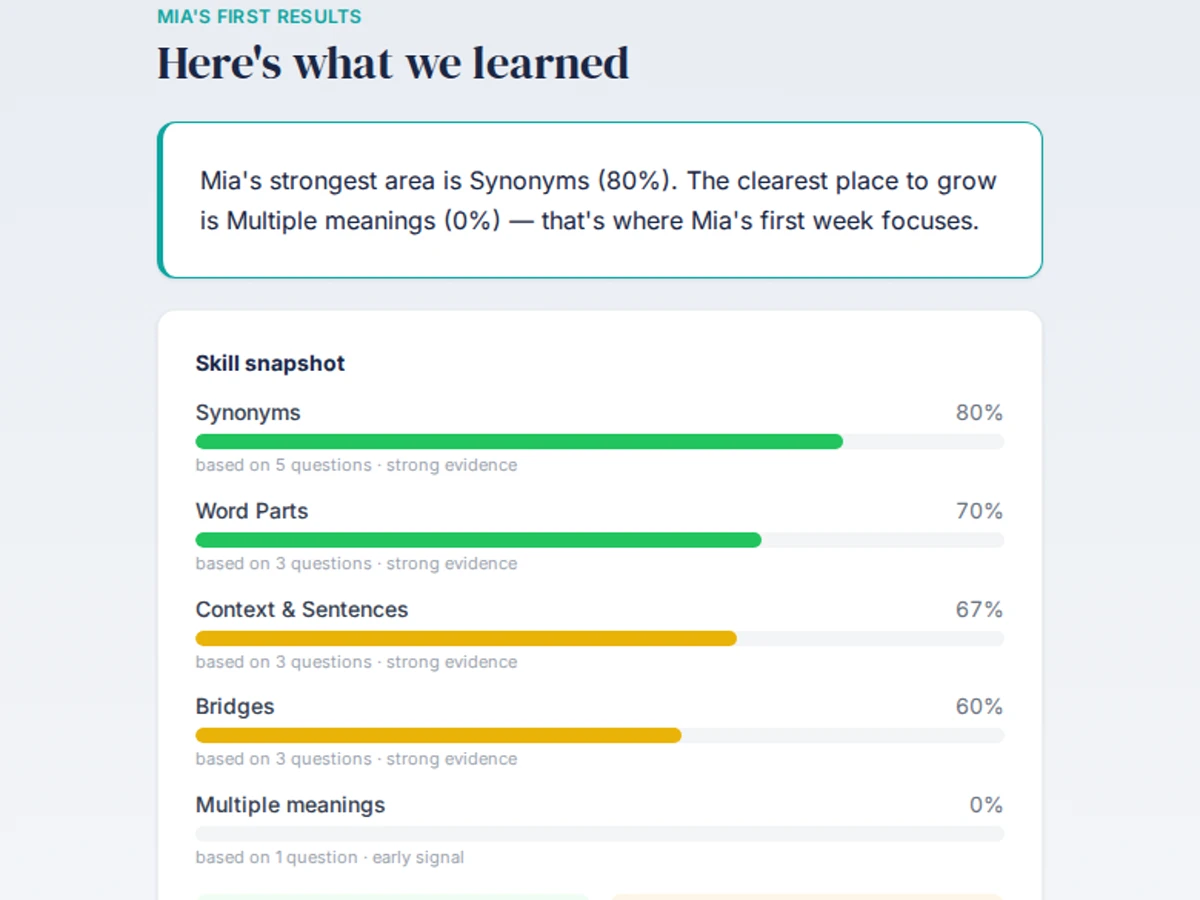
A free SSAT verbal check-up samples 30 questions and gives you an early strength, a growth area, and a first practice focus. No card required.
Start the free check-upSee a sample parent report before starting
The check-up samples verbal skills and gives you an early strength, a growth area, and a first practice focus. It is not a full-length exam, an official SSAT or ISEE score, or an admissions prediction.
Most SSAT vocabulary lists give you a random alphabetical dump of 500 words. You print it out, your child stares at it for a few days, and half the words evaporate before test day. The problem is not your child's memory — it is the list itself. Alphabetical order creates no structural connections between words, which means every word is an isolated fact competing for limited mental storage.
This list is organized differently. Every word is grouped by its Latin or Greek root family, so your child can see the structural connections that make vocabulary stick. When you learn that spec means "look," you don't just memorize spectacle — you unlock inspect, perspective, retrospect, and circumspect as a connected family. Over 60% of English words have Latin or Greek roots, and LexiMap's curated root set targets the academic vocabulary most tested on the SSAT.
The words below are also organized by SSAT test level — Elementary, Middle, and Upper — so you study the right words for your child's grade. For the complete study strategy behind this list, including spaced repetition timelines and common preparation mistakes, see our comprehensive SSAT vocabulary study guide.
How This List Is Different
Traditional word lists organize vocabulary alphabetically. "Aberration" sits next to "abhor" next to "abject" — three unrelated words that happen to start with "ab." Your brain has no reason to connect them, so it treats each one as a separate memorization task. With 500 words, that is 500 separate tasks.
Root-organized lists work with your brain instead of against it. When benevolent, beneficial, benefactor, and benediction appear together under the root bene (good), your child learns one concept and gets four words. The root becomes a hook that holds the entire family in memory. Research in morphological awareness consistently shows that students who learn words through structural analysis retain more vocabulary and transfer that knowledge to unfamiliar words more reliably than students who memorize isolated definitions.
Each table below groups words by root family and shows the root decomposition so the structural connection is visible. The "Meaning" column provides a test-ready definition — the kind of concise meaning your child would need to match on a synonym question. For a deeper exploration of the roots themselves, see our complete Latin and Greek roots reference.
Elementary Level Words (Grades 3-4)
These 40 words are built from the most common roots that Elementary Level students already encounter in everyday language. Words like "construct" and "invisible" feel familiar — the goal is to make your child conscious of why they know what these words mean. Once the root connection is explicit, it transfers to less familiar words on test day.
Start here regardless of your child's grade. Even Upper Level students benefit from confirming they understand the foundational roots before moving to harder vocabulary.
| Word | Root | Meaning |
|---|---|---|
| visible | vis | able to be seen |
| invisible | in + vis | not able to be seen |
| vision | vis | the ability to see; a mental image |
| audience | aud | a group that listens or watches |
| audible | aud | loud enough to be heard |
| transport | trans + port | to carry across a distance |
| portable | port | easy to carry |
| import | im + port | to carry goods into a country |
| construct | struct | to build something |
| structure | struct | something that has been built |
| instruct | in + struct | to teach; to build knowledge in someone |
| predict | pre + dict | to say what will happen before it does |
| dictate | dict | to say words aloud for someone to write |
| conduct | con + duct | to lead or guide |
| produce | pro + duc | to lead forward; to make or create |
| erupt | e + rupt | to break out suddenly |
| interrupt | inter + rupt | to break into a conversation |
| return | re | to come back again |
| rebuild | re | to build again |
| rewrite | re | to write again |
| preview | pre | to see before others |
| precaution | pre | care taken before something happens |
| unfair | un | not fair |
| unable | un | not able |
| disagree | dis | to not agree |
| disappear | dis | to stop being visible |
| attract | ad + tract | to pull toward |
| subtract | sub + tract | to pull away; to take a number from another |
| transform | trans + form | to change shape or form |
| uniform | uni + form | having one form; matching clothing |
| adventure | ad + vent | an exciting experience that comes to you |
| event | e + vent | something that comes about; an occurrence |
| novel | nov | new and original; a long story |
| novice | nov | a person who is new to something |
| pedal | ped | a lever worked by the foot |
| pedestrian | ped | a person traveling on foot |
| autograph | auto + graph | a person's own handwritten signature |
| paragraph | para + graph | a section of writing |
| biography | bio + graph | the written story of someone's life |
| biology | bio + logos | the study of living things |
Study these words interactively
LexiMap organizes its complete Latin and Greek root library into interactive exercises with FSRS spaced repetition — so your child actually remembers them on test day.
Take a real timed section — freeMiddle Level Words (Grades 5-7)
Middle Level vocabulary demands a significant step up from Elementary. These 60 words include the kind of formal, academic vocabulary that distinguishes strong verbal scores. Many appear in both synonym and analogy questions. Notice how root families create natural antonym and synonym pairs — bene (good) words pair naturally against mal (bad) words, which is exactly the kind of relationship analogies test.
The root decomposition column shows how each word breaks down. Encourage your child to practice covering the "Meaning" column and reconstructing the definition from the root parts alone.
| Word | Root | Meaning |
|---|---|---|
| benevolent | bene + vol | wishing good for others; kind and generous |
| beneficial | bene + fic | producing a good result; helpful |
| benefactor | bene + fact | a person who does good; a supporter |
| benediction | bene + dict | a good word; a blessing |
| malicious | mal | intending to do harm |
| malfunction | mal + funct | a failure to work correctly |
| malcontent | mal + content | a person who is not satisfied |
| malignant | mal + gn | harmful; tending to cause death |
| credible | cred | worthy of being believed |
| incredible | in + cred | too extraordinary to be believed |
| incredulous | in + cred | unwilling or unable to believe |
| credential | cred | evidence of one's qualifications |
| spectacle | spec | an impressive sight worth looking at |
| perspective | per + spec | a particular way of looking at something |
| retrospect | retro + spec | looking back at the past |
| inspect | in + spec | to look into carefully |
| eloquent | e + loqu | fluent and persuasive in speaking |
| loquacious | loqu | very talkative |
| colloquial | col + loqu | used in ordinary conversation |
| verify | ver | to confirm the truth of something |
| veracity | ver | truthfulness; accuracy |
| verdict | ver + dict | a true statement; a jury's decision |
| advocate | ad + voc | to call for support; a supporter |
| provoke | pro + vok | to call forth a reaction; to anger |
| evocative | e + voc | calling up strong images or feelings |
| invoke | in + vok | to call upon for help or as authority |
| transmit | trans + mit | to send across a distance |
| dismiss | dis + miss | to send away |
| remission | re + miss | a lessening of severity; sending back |
| reject | re + ject | to throw back; to refuse |
| project | pro + ject | to throw forward; a planned undertaking |
| trajectory | tra + ject | the path of something thrown |
| vivid | viv | intensely alive; bright and clear |
| revive | re + viv | to bring back to life |
| vitality | vit | the state of being alive and energetic |
| mortal | mort | subject to death |
| immortal | in + mort | not subject to death; living forever |
| mortify | mort | to cause to feel shame (as if dying) |
| capture | capt | to take by force; to seize |
| concept | con + cept | an idea taken together; an abstract notion |
| capable | cap | having the ability to take on a task |
| sensitive | sens | quick to detect or feel |
| sentiment | sent | a feeling or opinion |
| consent | con + sent | to feel together; to agree |
| suspend | sus + pend | to hang from above; to stop temporarily |
| pendant | pend | something that hangs, especially jewelry |
| compensate | com + pens | to make up for; to weigh equally |
| compose | com + pos | to put together; to create |
| deposit | de + posit | to put down; to place for safekeeping |
| oppose | ob + pos | to place oneself against; to resist |
| grateful | grat | feeling or showing thanks |
| gratitude | grat | the quality of being thankful |
| congratulate | con + grat | to express pleasure at someone's success |
| multitude | multi | a large number of people or things |
| multilingual | multi + ling | speaking many languages |
| omnivore | omni + vor | an animal that eats all types of food |
| omniscient | omni + sci | knowing all things |
| polygon | poly + gon | a shape with many angles and sides |
| polyglot | poly + glot | a person who speaks many languages |
Upper Level Words (Grades 8-11)
Upper Level vocabulary is the most challenging standardized vocabulary test below the GRE. These 70 words represent the sophisticated Latin and Greek derivatives that separate high scorers from the pack. Words like magnanimous, circumspect, and obsequious rarely appear in everyday conversation, but they are directly decodable through root analysis.
Pay special attention to words built from multiple roots — circumlocution combines circum (around) and loc (speak), literally "speaking around" a point. These multi-root words are favorites on the Upper Level because they reward students who can decompose word structure rather than relying on memorization.
| Word | Root | Meaning |
|---|---|---|
| magnanimous | magn + anim | having a great soul; generous in forgiving |
| magnificent | magn + fic | impressively great; splendid |
| magnitude | magn | greatness of size, extent, or importance |
| magnate | magn | a great or powerful person in business |
| circumspect | circum + spec | looking around carefully; cautious |
| circumscribe | circum + scrib | to draw a line around; to limit |
| circumvent | circum + vent | to come around; to find a way to avoid |
| circumlocution | circum + loc | speaking around the point; indirect language |
| subterranean | sub + terr | existing under the earth |
| terrestrial | terr | relating to the earth or land |
| terrain | terr | a stretch of land with specific characteristics |
| extraterrestrial | extra + terr | originating outside the earth |
| veracious | ver | habitually truthful |
| verisimilitude | ver + simil | the appearance of being true |
| aver | a + ver | to declare as true; to assert |
| ambiguous | ambi + ag | having two or more possible meanings |
| ambivalent | ambi + val | having both positive and negative feelings |
| ambidextrous | ambi + dext | able to use both hands equally well |
| apathy | a + path | lack of feeling or interest |
| empathy | em + path | feeling what another person feels |
| antipathy | anti + path | a strong feeling against; deep dislike |
| pathology | path + logos | the study of disease and suffering |
| facilitate | fac | to make easier |
| defect | de + fect | a flaw; something made incorrectly |
| manufacture | manu + fact | to make by hand or machine |
| efficacious | ef + fic | effective; producing the desired result |
| prescribe | pre + scrib | to write before; to order a treatment |
| proscribe | pro + scrib | to write publicly against; to forbid |
| circumscribe | circum + scrib | to write around; to restrict |
| manuscript | manu + script | a document written by hand |
| inscription | in + script | words written into a surface |
| mandate | mand | an official order or command |
| mandatory | mand | required by command; compulsory |
| remand | re + mand | to send back into custody by order |
| philanthropy | phil + anthrop | love of humankind; charitable giving |
| philosophy | phil + soph | love of wisdom |
| bibliophile | biblio + phil | a lover of books |
| antithesis | anti + thesis | the direct opposite |
| antipathy | anti + path | a deep-seated feeling against |
| antidote | anti + dot | a remedy given against poison |
| synthesis | syn + thesis | the combining of parts into a whole |
| symbiosis | sym + bio | living together in mutual benefit |
| synchronize | syn + chron | to cause to happen at the same time |
| hyperbole | hyper + bol | exaggeration; throwing beyond the truth |
| hyperactive | hyper + act | excessively active |
| hypothesis | hypo + thesis | a statement placed under investigation |
| hypocrite | hypo + crit | one who judges from below; a pretender |
| pseudonym | pseudo + nym | a false name used by an author |
| pseudoscience | pseudo + sci | false or pretend science |
| metamorphosis | meta + morph | a change of form or shape |
| amorphous | a + morph | without definite form or shape |
| neologism | neo + log | a newly coined word or expression |
| neophyte | neo + phyt | a new convert; a beginner |
| equanimity | equ + anim | calmness of mind; equal temperament |
| equitable | equ | fair and equal in treatment |
| equivocal | equ + voc | open to two or more interpretations |
| solitary | sol | alone; without companions |
| soliloquy | sol + loqu | speaking alone; a speech to oneself |
| desolate | de + sol | left alone; barren and empty |
| contemporary | con + tempor | existing at the same time; modern |
| extemporaneous | ex + tempor | done without preparation; off the cuff |
| temporal | tempor | relating to time; not eternal |
| incorporate | in + corpor | to include as part of a body or group |
| corporal | corpor | relating to the body |
| peripheral | peri | on the outer edge; not central |
| peripatetic | peri + pat | walking around; traveling from place to place |
| panacea | pan + ac | a cure for all diseases or problems |
| pandemonium | pan + demon | wild uproar; all demons let loose |
| panorama | pan + oram | a complete view in all directions |
| obsequious | ob + sequ | excessively eager to obey or serve |
| obstinate | ob + stin | stubbornly refusing to change |
| obscure | ob + scur | not clearly seen; hidden from view |
How to Use This List
A word list is only as useful as your study method. Here are five principles that turn this list into lasting vocabulary knowledge:
- Study by root family, not alphabetically. Work through one root group at a time. Learn the root meaning first, then see how each word in the family connects to it. This builds the structural understanding that transfers to unfamiliar words.
- Start with roots you partially know. If your child already knows "visible" and "invisible," begin with the vis root. The familiar words serve as anchors for less familiar ones like "supervise" and "envision."
- Use spaced repetition. Review each root family at increasing intervals — after 1 day, then 3, then 7, then 14. Short daily sessions (10-15 minutes) consistently outperform longer cramming sessions. See our methodology page for how FSRS scheduling optimizes these intervals.
- Test yourself by covering the meaning column. Read the word and root, then reconstruct the meaning before checking. Active recall is far more effective than passive re-reading for long-term retention.
- Connect roots across levels. The root spec appears in Elementary ("inspect"), Middle ("spectacle," "perspective"), and Upper ("circumspect") words. Studying across levels reinforces the root and shows how the same building block creates increasingly sophisticated words.
For a complete root-by-root breakdown with example sentences and analogy practice, see our 50 Latin and Greek roots for SSAT words.
Words That Appear on Both SSAT and ISEE
The SSAT and ISEE are different tests — the SSAT uses synonyms and analogies, while the ISEE uses synonyms and sentence completions. But both draw from the same pool of Latin and Greek-derived academic vocabulary. The overlap is substantial: most words that appear frequently on one test also appear on the other.
The 15 words below are among the highest-frequency crossover vocabulary. If your child is preparing for either test (or both), these words deserve priority. Every one of them is decodable through root analysis, which means root-based preparation works equally well for SSAT and ISEE verbal sections.
| Word | Root | Meaning |
|---|---|---|
| benevolent | bene + vol | kind and generous; wishing good |
| credible | cred | believable; worthy of trust |
| eloquent | e + loqu | fluent and persuasive in speech |
| incredulous | in + cred | unwilling to believe; skeptical |
| malicious | mal | intending to cause harm |
| magnanimous | magn + anim | generous and forgiving |
| circumspect | circum + spec | careful and cautious |
| subterranean | sub + terr | below the surface of the earth |
| veracious | ver | truthful; accurate |
| ambiguous | ambi + ag | open to more than one interpretation |
| vivid | viv | intensely alive; producing strong images |
| retrospect | retro + spec | looking back at the past |
| facilitate | fac | to make easier |
| transmit | trans + mit | to send from one place to another |
| advocate | ad + voc | to speak in favor of; a supporter |
For a deeper comparison of how the two tests approach vocabulary, see our root words for SSAT and ISEE guide.
Key Takeaways
- Organizing vocabulary by root family — not alphabetically — creates structural connections that improve retention and transfer to unfamiliar words.
- The 200+ words in this list span all three SSAT levels and are grouped by difficulty so your child studies grade-appropriate vocabulary.
- Root decomposition turns each word from an isolated fact into a solvable puzzle: circum (around) + spec (look) = circumspect (looking around carefully; cautious).
- Spaced repetition and active recall (covering the meaning column) are far more effective than passive re-reading or cramming.
- The same roots and words appear on both the SSAT and ISEE, so root-based preparation serves both tests simultaneously.
Related Guides
The Parent's Complete Guide to SSAT & ISEE Prep
Everything parents need to know about SSAT and ISEE preparation. Test formats, timelines, study strategies, score interpretation, and how to support your child's verbal growth.
SSAT Vocabulary: The Complete Guide to Root-Based Learning
Master SSAT vocabulary through Latin and Greek roots. Learn how root-based learning, spaced repetition, and interactive practice build lasting verbal skills for grades 4-12.
Root Words for SSAT & ISEE: The Complete Study Guide
The definitive guide to Latin and Greek root words for SSAT and ISEE preparation. Curated root set, study strategies, grade-level timelines, and practice exercises for grades 4-12.
Related Articles
SSAT Vocabulary Prep: The Complete Parent Guide
Everything parents need to know about SSAT vocabulary prep — what the verbal section tests, how scoring works, and the strategies that build lasting vocabulary mastery.
SSAT Word List Organized by Root Word Families
Master SSAT vocabulary with this root-organized word list. 20 essential root families with 8-10 words each — the most efficient approach to SSAT synonym and analogy prep.
50 Latin Root Words Every SSAT Student Should Know
Master the 50 most important Latin root words for the SSAT. Each root includes meaning, example words, and memory tips to build lasting vocabulary skills.
SSAT® is a registered trademark of The Enrollment Management Association. ISEE® is a registered trademark of the Educational Records Bureau (ERB). LexiMap is not affiliated with or endorsed by these organizations.