SSAT Analogy Practice: Master All 10 Bridge Types with Examples
Find your child’s vocabulary gaps
Start with a free, no-card vocabulary check-up and get a personalized parent report.
Find the vocabulary gaps — freeSee a sample parent report before starting
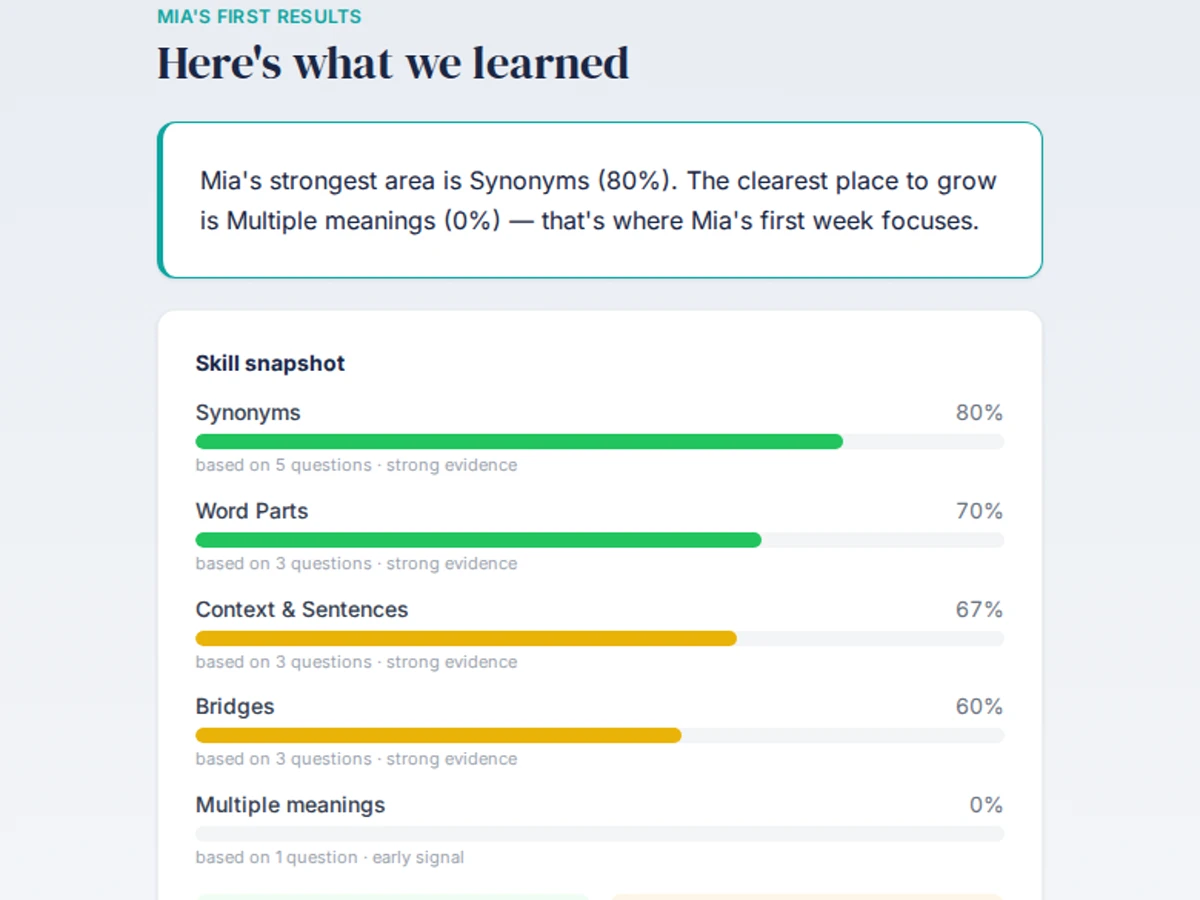
The check-up samples verbal skills and gives you an early strength, a growth area, and a first practice focus. It is not a full-length exam, an official SSAT or ISEE score, or an admissions prediction.
Analogies make up half the SSAT verbal section — 30 out of 60 questions. That means your child's analogy performance alone can determine whether their verbal score lands in the 50th percentile or the 85th. Yet most students approach analogies by feel, guessing at relationships without a systematic framework. The result is inconsistent scores and unnecessary frustration.
The fix is surprisingly straightforward. SSAT analogies draw from a finite set of relationship types — what test-prep specialists call "bridge types." Once a student learns to identify these bridges, analogy questions stop being puzzles and start being pattern-matching exercises. Instead of staring at four answer choices hoping one "feels right," they apply a systematic method that works every time.
This guide covers all 10 bridge types with worked examples, shows how root-word knowledge can assist on select bridges, and provides practice questions to build confidence. The core analogy skill is relational reasoning — naming the bridge precisely enough to rule out wrong answers — with roots serving as a decoding aid when a stem word is unfamiliar. For a broader look at raising SSAT verbal scores, see our parent's guide to improving SSAT verbal scores.
What Are SSAT Analogies?
An SSAT analogy presents a pair of words that share a specific relationship (the "stem pair"), then asks the student to find another pair with the same relationship. The format looks like this:
PAINTER is to CANVAS as
- (A) teacher is to student
- (B) writer is to paper
- (C) doctor is to hospital
- (D) singer is to audience
- (E) chef is to restaurant
The key insight is that analogies don't test vocabulary in isolation — they test relational reasoning. A student might know every word in the question and still get it wrong if they misidentify the relationship. A painter works on a canvas (it's the medium); a writer works on paper (also a medium). The answer is (B). "Teacher is to student" or "chef is to restaurant" might sound right, but those are different relationship types entirely.
This is why learning bridge types matters more than memorizing word lists. When a student can name the relationship — "this is a worker-to-medium bridge" — they can systematically eliminate wrong answers and find the right one.
The 10 Bridge Types
Every SSAT analogy falls into one of these ten relationship categories. Learning them gives your child a mental checklist to run through on every question.
1. Synonym Bridge
The two words mean the same thing, or very nearly the same thing.
KIND : GENEROUS :: brave : courageous
The relational move: A synonym bridge requires naming the relationship with precision — not "these words are similar" but "these words mean the same thing." Students who form a sharp bridge sentence ("Kind means the same as generous") can test every answer choice systematically and rule out near-synonyms that don't quite match. Roots provide a backup when one word is unfamiliar, but the primary skill is recognizing sameness of meaning, not decoding etymology.
2. Antonym Bridge
The two words have opposite meanings.
BENEVOLENT : MALEVOLENT :: construct : demolish
Root knowledge genuinely helps here. Antonym prefixes are among the clearest morphological signals on the test. The prefix bene means "good" and mal means "bad" — so benevolent and malevolent are instant opposites. Similarly, con (together) and de (down/apart) signal that construct and demolish run in opposite directions. When a stem pair contains recognizable opposite-signaling roots, the antonym bridge snaps into focus immediately.
3. Part-to-Whole Bridge
One word is a component or section of the other.
CHAPTER : BOOK :: verse : poem
The relational move: The key skill here is distinguishing containment from other relationships. A chapter is not a type of book or a function of a book — it is a part of a book. Students should build the bridge sentence as precisely as possible: "A chapter is a component of a book," then confirm the answer pair fits the same containment structure. Getting the direction right (part → whole, not whole → part) is the relational reasoning challenge.
4. Category/Type Bridge
One word is a specific example of the other, more general word.
ROSE : FLOWER :: sparrow : bird
Why this is relational reasoning: The critical skill here is distinguishing classification from containment. A rose is not a part of a flower — it is a flower (it belongs to the category). Students must ask: "Is X a member of the Y category?" and hold that precise bridge sentence — "A rose is a type of flower" — firmly while testing each answer. Confusing category with part-to-whole is one of the most common errors on these questions.
5. Degree/Intensity Bridge
Both words describe the same quality, but one is much stronger or weaker than the other.
WARM : SCORCHING :: annoyed : furious
The relational move: Degree bridges are a classic relational reasoning trap because they superficially resemble synonym bridges — both words describe the same quality. The distinction is intensity, and the precise bridge sentence unlocks it: "Warm is a weak version of scorching." Students who form that sentence can immediately rule out true synonyms (which share the quality at the same level) and antonyms (which run in opposite directions). Naming the degree relationship explicitly is the skill; vocabulary decoding is secondary.
6. Function/Purpose Bridge
One word names an object; the other describes what that object does or is used for.
TELESCOPE : MAGNIFY :: thermometer : measure
Root knowledge genuinely helps here. Many instrument and tool names are Greek compound words that encode their function in the morphology. tele (far) + scope (look) tells you a telescope's purpose is to see far away; therm (heat) + meter (measure) tells you a thermometer measures heat. When a stem word is an unfamiliar instrument name, parsing its roots can reveal the function — making the bridge sentence straightforward to build.
7. Characteristic Bridge
One word is a defining quality or trait of the other.
SUGAR : SWEET :: vinegar : sour
The relational move: The challenge on characteristic bridges is specificity — many things can have many qualities, so the bridge sentence must capture a defining trait, not just an occasional one. "Sugar is characteristically sweet" works; "sugar is sometimes dissolved" does not — the latter isn't a defining relationship. Students should ask: "Is this quality essentially true of the thing by its very nature?" That precision separates correct answers from distractors. If a stem word is unfamiliar, roots can help decode the characteristic being named.
8. Cause-and-Effect Bridge
One word produces, leads to, or results in the other.
STUDY : KNOWLEDGE :: exercise : fitness
Why this is relational reasoning: The primary skill on cause-and-effect bridges is tracking directionality. "Study produces knowledge" and "knowledge results from study" are the same fact stated in opposite directions — but on the SSAT, the answer pair must match the stem pair's direction exactly. Students who build a directional bridge sentence and then verify the answer pair runs in the same direction will avoid the classic reversal trap. Roots are a backup if a formal vocabulary word for the outcome is unfamiliar.
9. Worker-to-Tool Bridge
One word names a person (or role); the other names the instrument or tool that person characteristically uses.
ARTIST : BRUSH :: surgeon : scalpel
The relational move: Worker-to-tool bridges require students to identify which word plays which role and then hold that structure. The bridge sentence must specify direction: "An artist characteristically uses a brush," not just "artist and brush go together." Answer pairs with plausible but wrong role assignments — like listing a workplace instead of a tool — fail when the bridge sentence is applied precisely. Knowing suffixes like -ist or -er/-or can help identify the "worker" word when one is unfamiliar, but role-assignment reasoning is the core skill.
10. Grammar/Word-Form Bridge
The two words share the same root but are different parts of speech or grammatical forms.
ACT : ACTION :: decide : decision
Root knowledge genuinely helps here. Word-form bridges are directly about morphology — how roots combine with suffixes to change a word's grammatical role. act (verb) becomes action (noun) via -tion; decide (verb) becomes decision (noun) via -sion. Students who understand how suffixes like -tion, -ment, -ness, and -ous transform words across parts of speech can identify this bridge type at a glance and verify that the answer pair undergoes the same suffix transformation.
Strategy: The Bridge Sentence Method
The most reliable technique for solving SSAT analogies is the bridge sentence method. Here's how it works in three steps:
- Create a sentence that precisely describes the relationship between the stem pair. For TELESCOPE : MAGNIFY, the bridge sentence is: "A telescope is a tool used to magnify."
- Test each answer choice by plugging it into the same sentence. "A thermometer is a tool used to measure" — yes, that works. "A ruler is a tool used to draw" — not quite, a ruler measures length. The sentence reveals which pair shares the exact same relationship.
- Make your bridge specific. If more than one answer choice fits, your bridge sentence is too vague. Tighten it. Instead of "A telescope helps magnify," say "A telescope is an optical instrument whose primary function is to magnify." The more precise the bridge, the fewer false matches.
This method works because it forces students to articulate the relationship before evaluating answers — preventing the common mistake of picking an answer that simply "sounds related" to one of the stem words.
How Root Words Help with Analogies
Root knowledge gives students two distinct advantages on analogy questions. First, it helps them understand unfamiliar vocabulary in the stem pair — if a student doesn't know what benevolent means, they can't identify the relationship. Second, roots reveal the relationship itself. When bene and mal are recognized as opposite-meaning roots, the antonym bridge is immediately apparent.
Some root pairs are especially useful for analogies. The sensory roots spec/spect (see) and aud (hear) form natural parallel pairs: spectacle is to sight as concert is to hearing. The directional prefixes ex (out) and im/in (in) create antonym pairs: export vs. import, exhale vs. inhale. These structural patterns repeat across dozens of words.
For a deep dive into the roots that appear most frequently on the SSAT, see our 50 Latin roots guide and our comprehensive Latin and Greek roots reference.
Practice Questions
Try these five analogy questions. For each one, identify the bridge type before looking at the answer.
-
MICROSCOPE : ENLARGE ::
-
(A) camera : photograph
-
(B) filter : purify
-
(C) computer : type
-
(D) lamp : darken
-
(E) book : write
Show answer
(B) filter : purify — Function bridge. A microscope is a tool that enlarges; a filter is a tool that purifies. Root clue: micro (small) + scope (look) = a device for looking at small things, i.e., enlarging them.
-
VIVID : DULL ::
-
(A) bright : brilliant
-
(B) ancient : old
-
(C) transparent : opaque
-
(D) large : huge
-
(E) careful : cautious
Show answer
(C) transparent : opaque — Antonym bridge. Vivid and dull are opposites; transparent and opaque are opposites. Root clue: viv (life) tells you vivid means lively or intense — the opposite of dull.
-
PETAL : FLOWER ::
-
(A) tree : forest
-
(B) key : piano
-
(C) leaf : green
-
(D) garden : yard
-
(E) seed : grow
Show answer
(B) key : piano — Part-to-whole bridge. A petal is a part of a flower; a key is a part of a piano. Note: (A) is tempting, but a tree is not a part of a forest the way a petal is part of a flower — a forest is a collection of trees.
-
CONTENT : ELATED ::
-
(A) tired : exhausted
-
(B) happy : sad
-
(C) fast : slow
-
(D) warm : cold
-
(E) loud : noisy
Show answer
(A) tired : exhausted — Degree/intensity bridge. Content is mildly happy; elated is extremely happy. Tired is mildly fatigued; exhausted is extremely fatigued. Both pairs move along the same quality from mild to intense.
-
CREATE : CREATION ::
-
(A) run : runner
-
(B) observe : observation
-
(C) quick : quickly
-
(D) beauty : beautiful
-
(E) happy : happiness
Show answer
(B) observe : observation — Grammar/word-form bridge. Create (verb) becomes creation (noun) via the suffix -tion. Observe (verb) becomes observation (noun) via -tion. The other choices change form too, but using different suffix patterns — (B) mirrors the exact verb-to-noun transformation.
Key Takeaways
- Analogies are 30 of 60 SSAT verbal questions — mastering them is non-negotiable for a strong score.
- All SSAT analogies use one of 10 bridge types: synonym, antonym, part-to-whole, category, degree, function, characteristic, cause-and-effect, worker-to-tool, and grammar/word-form.
- The bridge sentence method (create a precise sentence, then test each answer) is the most reliable solving technique.
- Root-word knowledge provides a double advantage: it decodes unfamiliar vocabulary and reveals the relationship type, especially for antonym, function, and word-form bridges.
- Practice identifying the bridge type before looking at answer choices. This single habit, an example of what researchers call desirable difficulties, eliminates most careless errors.
Get SSAT/ISEE vocabulary resources by email
Related Articles
5 SSAT Analogy Strategies That Actually Work on Test Day
Master SSAT analogies with 5 proven strategies: bridge sentences, root word analysis, elimination technique, relationship reversal, and difficulty calibration.
Beyond Analogies: Relational Reasoning Across the Whole Verbal Section
Analogies, synonyms, antonyms, and word families all test one skill: relational reasoning. How to develop the relationship-thinking that lifts your child's whole verbal score.
SSAT Verbal Study Strategies: Your 3-Month Plan
A research-backed 3-month SSAT verbal study plan covering synonyms, analogies, and vocabulary. Week-by-week schedule for Middle and Upper Level students.
50 Latin Root Words Every SSAT Student Should Know
Master the 50 most important Latin root words for the SSAT. Each root includes meaning, example words, and memory tips to build lasting vocabulary skills.
Related Guides
SSAT Vocabulary: The Complete Guide to Root-Based Learning
Master SSAT vocabulary through Latin and Greek roots. Learn how root-based learning, spaced repetition, and interactive practice build lasting verbal skills for grades 4-12.
SSAT Vocabulary List: 200+ Words Organized by Level and Root
Comprehensive SSAT vocabulary word lists organized by test level (Elementary, Middle, Upper) and root word family. Study the right words for your child's grade.
SSAT® is a registered trademark of The Enrollment Management Association. ISEE® is a registered trademark of the Educational Records Bureau (ERB). LexiMap is not affiliated with or endorsed by these organizations.