ISEE Reading Comprehension: How Vocabulary Knowledge Determines Your Child's Score
Find your child's ISEE vocabulary gaps
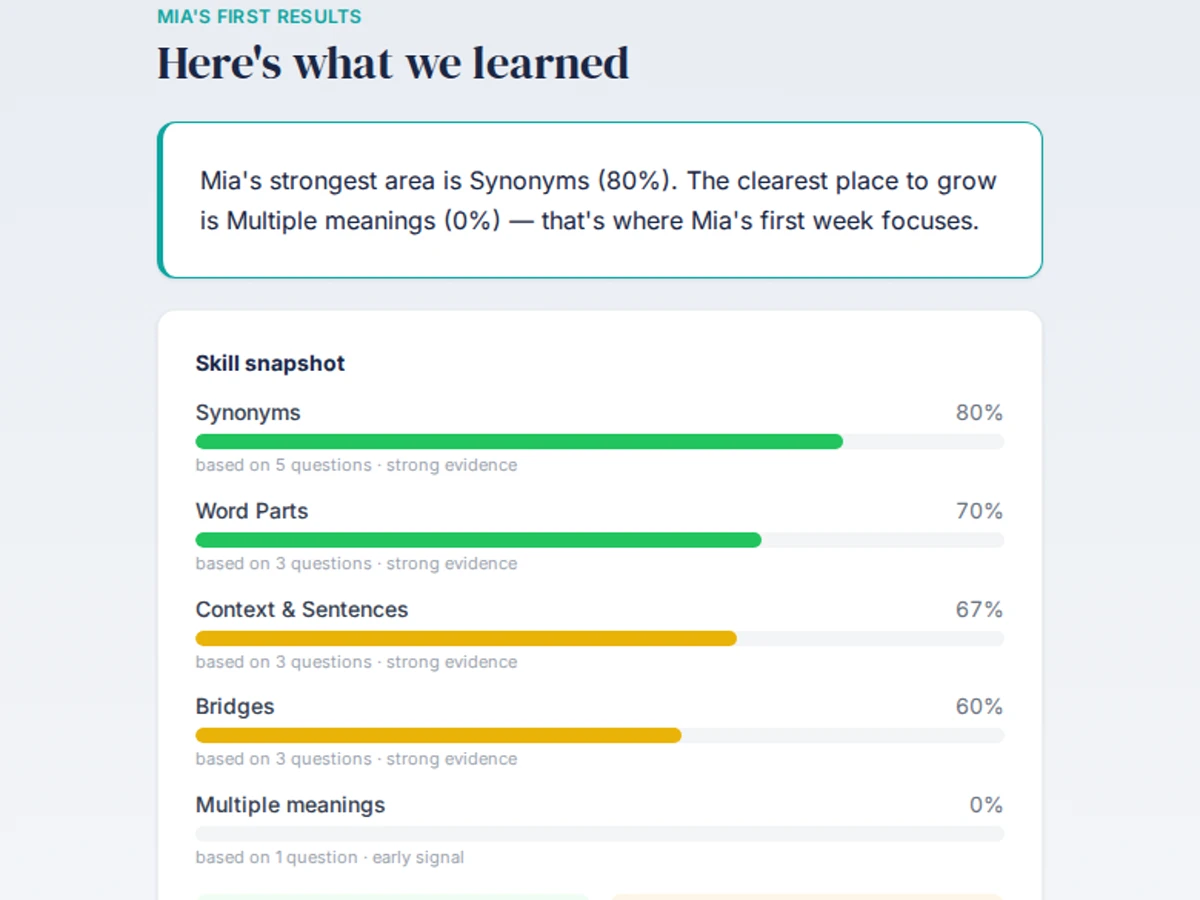
Start with a free, no-card ISEE check-up — 16–20 questions with a personalized parent report.
Find the ISEE vocabulary gaps — freeSee a sample parent report before starting
The check-up samples verbal skills and gives you an early strength, a growth area, and a first practice focus. It is not a full-length exam, an official SSAT or ISEE score, or an admissions prediction.
Most parents preparing their child for the ISEE spend months on one thing: drilling vocabulary for the Verbal Reasoning section. Synonym lists, sentence completion drills, flashcard decks. They cover hundreds of words and feel ready.
Then they look at the full ISEE structure and notice something they may have overlooked: Reading Comprehension is a separate, scored section — and it also tests vocabulary. Just in a completely different way.
Here is the gap that undermines a surprising number of otherwise well-prepared test-takers. Your child can recognize that "benevolent" means kind and still stumble when they encounter the word in a dense passage about 19th-century philanthropy, because the reading section does not ask them to recall a definition. It asks them to infer meaning from context, process academic prose at speed, and answer questions about what the author actually meant.
This post explains exactly how vocabulary knowledge functions in the ISEE reading comprehension section, what preparation strategies transfer from verbal prep and what does not, and how to build the specific inference skills the reading section rewards.
Why Reading Comprehension Is Not the Same as Verbal Reasoning
The ISEE has two distinct verbal-skill sections, and understanding the difference is the foundation of any serious prep strategy.
Verbal Reasoning tests isolated word knowledge: synonyms (choose the word closest in meaning) and sentence completions (fill in the blank). Success depends on recognition — does your child know the word or not? Study strategies that work here: memorize definitions, learn roots, drill word lists.
Reading Comprehension tests something different: the ability to understand vocabulary as it functions within connected text. The question "What does 'ameliorate' most nearly mean as used in paragraph 2?" is not asking for a stored definition. It is asking your child to read the surrounding sentences, understand the author's argument, and reason from context to meaning.
The vocabulary skill required is categorically different. Recognition (Verbal Reasoning) and contextual inference (Reading Comprehension) are related but distinct. A child who has drilled 2,000 flashcard definitions and developed no inference strategy has prepared for only half the test.
This is not a flaw in how parents approach prep — most prep materials underemphasize this distinction. Fixing it starts with understanding the section itself.
How the ISEE Reading Comprehension Section Is Structured
The ISEE is published by the Educational Records Bureau (ERB). It comes in four levels based on the grade a student is applying to enter:
| ISEE Level | Applying to Enter | Reading Comprehension |
|---|---|---|
| Primary | Grades 2–4 | Reading-focused, no Verbal Reasoning |
| Lower | Grades 4–5 | Reading Comprehension section included |
| Middle | Grades 6–7 | 25 Reading Comprehension questions |
| Upper | Grades 8–9 | 25 Reading Comprehension questions |
For the Middle and Upper levels — the most common among children ages 10–14 preparing for competitive private schools — the Reading Comprehension section includes multiple passages followed by questions. Passage topics rotate across four categories: humanities, science, social studies, and fiction. Questions test main idea, inference, vocabulary in context, supporting detail, and author's purpose.
An important note: unlike the SSAT, the ISEE has no guessing penalty. Your child should answer every question, even if they are not certain. This makes inference strategies particularly valuable — an educated guess built on root knowledge and context reading is almost always better than a blank.
The Vocabulary Problem in Reading Comprehension
Vocabulary knowledge does not just help with reading comprehension. Research consistently identifies it as the primary bottleneck.
Paul Nation's foundational vocabulary research (2001, Learning Vocabulary in Another Language) established that readers typically need to know approximately 95–98% of the words in a text to comprehend it without support. When a reader encounters unfamiliar words at a higher rate than that threshold, comprehension degrades — not gradually, but sharply. Understanding of the surrounding sentences weakens, passage-level argument tracking breaks down, and inference questions become guesses rather than reasoned answers.
ISEE reading passages are written with this threshold in mind — in the wrong direction for unprepared students. They are deliberately dense with what vocabulary researchers Beck, McKeown, and Kucan (2013, Bringing Words to Life) call Tier 2 academic vocabulary: words like "ameliorate," "repudiate," "ephemeral," and "ostensible" that appear frequently in sophisticated written text but rarely in everyday conversation.
A child with conversational English fluency and strong reading habits may still be below the 95% threshold for ISEE passage vocabulary. The result is not that they cannot read the passage — they can. They get lost in it. Inference questions become significantly harder when three words in a sentence are unfamiliar instead of one.
The takeaway for preparation: vocabulary depth for the reading section is not about recognizing word definitions. It is about being close enough to the 95–98% threshold on academic vocabulary that comprehension stays intact throughout the passage. This is what root-word mastery actually does. It does not just add words — it moves the threshold.
Context Clues: The Skill Most Prep Programs Miss
Here is the good news that most prep programs underemphasize: the Reading Comprehension section hands your child a resource that the Verbal Reasoning section does not — the surrounding text.
Context clue reading is the in-test strategy for encountering unfamiliar vocabulary in a passage. It is a trainable skill, not a natural talent. Stahl and Nagy (2006, Teaching Word Meanings) document that explicit instruction in contextual vocabulary strategies improves reading comprehension performance — the skill is learnable with targeted practice.
There are four types of context clues your child can use:
1. Definition clues — the author defines the term directly or with a restatement. "The scientist was known for her equanimity, her calm composure in the face of unexpected results." (The phrase "calm composure" restates the meaning of equanimity.)
2. Contrast clues (antonym clues) — the context signals an opposite meaning. "Unlike her impulsive brother, Mara was always deliberate, weighing every option before acting." ("Unlike" signals a contrast — deliberate means roughly the opposite of impulsive.)
3. Example clues — the surrounding text gives examples that point to the meaning. "The curator organized artifacts from many antiquated objects — a 200-year-old compass, faded maps, and brass instruments long out of production." (The examples clarify that antiquated means very old or outdated.)
4. Inference clues (logic clues) — meaning must be inferred from the logic of the situation. "The prolonged drought left the villagers destitute, without food stores or resources to survive the winter." (The logic of the situation — drought + no food + no resources — points to destitute meaning impoverished or without means.)
Teaching your child to pause at an unfamiliar word, identify which type of context clue the author may have provided, and reason from it takes practice. But it is one of the highest-leverage preparation activities for the reading section. For more on how relationship thinking works in the verbal sections, see our ISEE analogy practice guide.
Root-Word Inference: Why 160 Roots Beat 3,000 Flashcards
Context clues work when the author provides them. But the most durable vocabulary strategy for reading comprehension is one that does not depend on what the author chose to include: morphological knowledge — the ability to decode words from their roots.
Research in morphological instruction has consistently shown that teaching students to understand the structure of words produces stronger vocabulary and reading outcomes than isolated word memorization. A 2013 meta-analysis by Goodwin and Ahn found significant positive effects on vocabulary and decoding across multiple studies. Bowers, Kirby, and Deacon (2010) similarly found that morphological instruction improved vocabulary and morphological awareness in a systematic review covering decades of research, and a separate meta-analysis by Goodwin and Ahn (2010) found reading-comprehension gains specifically for children who struggle with literacy.
The mechanism is straightforward. A student who has internalized the Latin root bene (meaning well, good) does not need to have previously encountered a word to make sense of it:
- benefactor — one who does good for another
- benevolent — well-wishing, charitable
- beneficiary — one who receives something good
- beneficial — producing a good effect
Now when that student encounters "malevolent" in an ISEE passage — a word they may never have studied — they have two tools working together: the root vol (wishing, willing) and the prefix mal (bad, ill). Without having seen the word, they can reason to approximately "ill-wishing" or "wishing harm" — which is precisely what it means.
This is the inference engine that root-word mastery builds. It does not produce a finite list. It produces a system that generates likely meanings for words the student has never studied.
For the reading comprehension section specifically, root mastery means that even when a passage contains unfamiliar vocabulary, your child is rarely starting from zero. They have partial decoding available almost immediately. Combined with context clue strategy, partial decoding plus context reasoning produces reliable inference. That is the skill the reading section tests and rewards.
For a deeper look at why root words outperform flashcards in long-term retention, see our post on root words vs. flashcards. For a full inventory of the most useful Latin and Greek roots for test prep, see Latin and Greek roots for SSAT vocabulary.
How to Practice ISEE Reading Comprehension Vocabulary
A structured preparation sequence matters. Here is how to approach it:
Step 1: Audit the verbal vs. reading vocabulary overlap
Begin by distinguishing your child's vocabulary strength from their inference strength. Have them read one ISEE-level passage and underline any words they cannot define confidently. Then, separately, have them try to infer meanings from context clues before looking anything up. This reveals the gap: does your child need to expand vocabulary depth, improve inference skill, or both?
For most children starting ISEE prep, the answer is both — but the root-word inference engine is faster to build productively than raw vocabulary expansion.
Step 2: Build roots and passage practice in parallel
Run roots and passage practice in parallel — root decoding is one of several context-attack tools, alongside the four context-clue types — rather than gating reading practice behind months of roots first. Both skills reinforce each other: roots make context clues more actionable; passages show roots in action.
The sequence that works: learn 3–5 roots per week using spaced repetition, build each root's word family with examples, and reinforce with short reading encounters. Ebbinghaus's forgetting curve research (1885, still foundational in modern learning science) established that without spaced repetition, most new information is lost within days. A spaced repetition system — reviewing vocabulary at increasing intervals as retention strengthens — dramatically extends retention. Our spaced repetition for kids post explains how this works in practice for this age group.
Step 3: Practice in context, not in isolation
Once the root foundation is developing, introduce ISEE-style reading comprehension passages with deliberate vocabulary attention. After reading each passage, go back and identify every Tier 2 academic word. For each one: (a) can your child identify the root, if any? (b) what context clue was available, if any? (c) what was the actual meaning?
This post-reading vocabulary review, done consistently over 2–3 months of passage practice, builds the transfer between root knowledge, context clue strategy, and full reading comprehension skill.
Target 3–6 months of structured preparation before the exam. For a full review of the best tools and resources for this sequence, see our ISEE vocabulary builder tools guide. For guidance on prep timelines, see when to start SSAT prep.
Where LexiMap Fits: The Five-Domain Verbal Trainer
Roots are where your child starts, not where LexiMap stops. The SSAT and ISEE don't just test whether your child knows a word — they test five distinct verbal domains, and LexiMap trains all five:
- Vocabulary Knowledge — roots, word families, and connotation (the on-ramp).
- Relational Reasoning — analogy bridge types and synonym discrimination.
- Contextual Inference — sentence completions, signal words, and meaning from context.
- Test Execution — pacing, answer elimination, and guess discipline under time pressure.
- Metacognition — strategy selection, error awareness, and knowing when to skip.
Each domain shows up on the parent dashboard, so you can see exactly where your child is strong and where to focus — something a word list or flashcard deck can't give you.
For reading comprehension specifically, Contextual Inference is the central domain: LexiMap trains all four context-clue types alongside root decoding, so your child builds both tools in parallel rather than reaching for roots alone. Spaced repetition schedules review automatically based on retention performance, keeping vocabulary sharp without manual tracking.
If your child is beginning ISEE prep and you are looking for a vocabulary foundation to build on, start with our full ISEE vocabulary guide and explore how LexiMap fits into a complete preparation plan.
Frequently Asked Questions
Is ISEE reading comprehension vocabulary the same as the verbal section vocabulary?
No. The ISEE Verbal Reasoning section tests synonym recognition and sentence completions — isolated word knowledge. The Reading Comprehension section requires your child to infer word meanings within the context of a passage. Both sections benefit from deep vocabulary knowledge, but they test different vocabulary skills. Strong verbal prep alone does not guarantee strong reading comp performance without specific inference strategy.
How many questions are on the ISEE reading comprehension section?
The Middle and Upper ISEE levels each include 25 reading comprehension questions. Passage types include humanities, science, social studies, and fiction. For current section structure and timing, consult the official ISEE guide from the ERB — formats are occasionally updated.
Does learning root words help with ISEE reading comprehension?
Root-word study helps build the vocabulary-and-decoding foundation that reading comprehension draws on. A meta-analysis by Goodwin and Ahn (2013) shows that morphological instruction produces meaningful gains in vocabulary knowledge and decoding, and the systematic review by Bowers et al. (2010) links it to stronger vocabulary and word-decoding; documented reading-comprehension gains are strongest for students who struggle with literacy (Goodwin & Ahn, 2010). Root knowledge helps your child decode unfamiliar words from their structure, which supports vocabulary-in-context questions — and all students should pair it with timed passage practice.
How early should my child start preparing for ISEE reading comprehension?
3–6 months before the exam is the recommended minimum for meaningful preparation. Root-word instruction takes time to develop into automatic inference — earlier preparation allows the morphological foundation to form before intensive passage practice begins. For guidance on the full prep timeline, see our post on when to start SSAT prep, which covers timing frameworks that apply equally to ISEE.
Key Takeaways
- ISEE reading comprehension tests contextual inference, not stored definitions — a child can recognize "ameliorate" on a flashcard and still miss a vocabulary-in-context question in a passage.
- Readers need to know roughly 95–98% of words in a text for comprehension to hold; ISEE passages are dense with Tier 2 academic vocabulary, and root mastery moves that threshold.
- Four context clue types — definition, contrast, example, and inference — are trainable skills that let students decode unfamiliar words from the text itself rather than depending solely on prior memorization.
- Morphological instruction (root-based learning) produces significant gains in vocabulary and word-decoding across grade levels; reading-comprehension gains are documented specifically for students who struggle with literacy (Goodwin & Ahn, 2010). For all readers, it builds the vocabulary-and-decoding foundation comprehension draws on — pair it with timed passage practice.
- The most effective prep sequence: run root-word instruction and passage practice in parallel, combining root decoding and context clue strategy together from the start; roots are a powerful accelerant, not a prerequisite gate.
Get SSAT/ISEE vocabulary resources by email
Related Articles
ISEE Analogy Practice: How Relationship Thinking Helps with Synonyms & Sentence Completions
The ISEE doesn't test analogies — but analogy thinking is the key to ISEE synonyms and sentence completions. Learn bridge types, practice questions, and root word strategies.
ISEE Verbal Section: The Parent's Complete Guide
Everything parents need to know about the ISEE verbal reasoning section — question types, scoring, levels, and what vocabulary prep actually works for your child.
ISEE Verbal Reasoning Strategies by Level: Primary Through Upper
Level-by-level ISEE verbal strategies for Primary through Upper Level. Vocabulary, sentence completion, and reading comprehension prep tailored to each grade band.
ISEE Vocabulary Builder: Best Tools and Strategies for 2026
Compare the best ISEE vocabulary building tools and strategies. Learn how root-based learning, spaced repetition, and targeted practice prepare students for ISEE verbal reasoning.
Related Guides
SSAT Vocabulary: The Complete Guide to Root-Based Learning
Master SSAT vocabulary through Latin and Greek roots. Learn how root-based learning, spaced repetition, and interactive practice build lasting verbal skills for grades 4-12.
Root Words for SSAT & ISEE: The Complete Study Guide
The definitive guide to Latin and Greek root words for SSAT and ISEE preparation. Curated root set, study strategies, grade-level timelines, and practice exercises for grades 4-12.
SSAT® is a registered trademark of The Enrollment Management Association. ISEE® is a registered trademark of the Educational Records Bureau (ERB). LexiMap is not affiliated with or endorsed by these organizations.