Last-Minute SSAT Prep: Your 30-Day Vocabulary Plan
Find your child’s vocabulary gaps
Start with a free, no-card vocabulary check-up and get a personalized parent report.
Find the vocabulary gaps — freeSee a sample parent report before starting
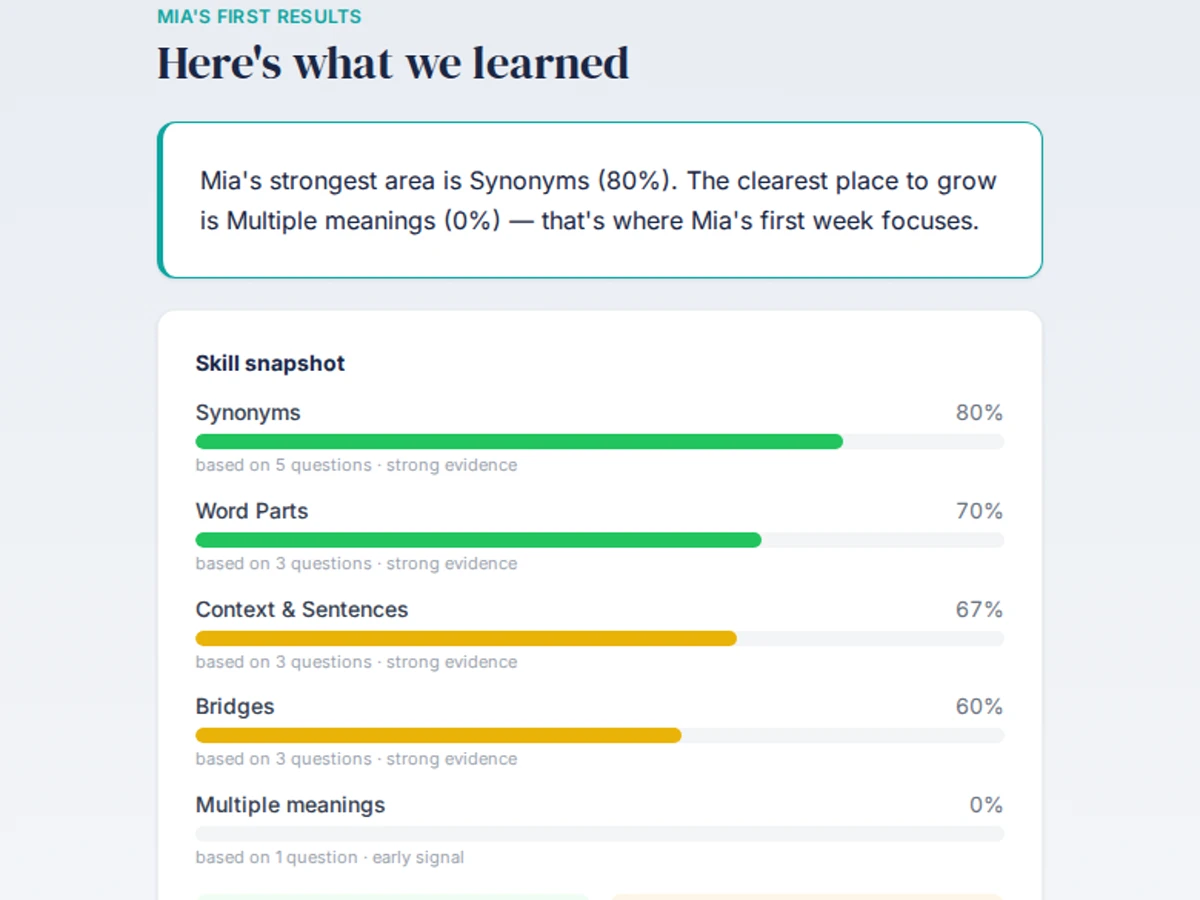
The check-up samples verbal skills and gives you an early strength, a growth area, and a first practice focus. It is not a full-length exam, an official SSAT or ISEE score, or an admissions prediction.
You have a month. Maybe you just looked at the calendar and felt your stomach drop. Maybe the test registration happened earlier than expected, or life got in the way of the prep you meant to start in September. Whatever the reason, you're here now, and the test is in roughly 30 days.
First: you are not too late to make a real difference.
Thirty days is not the ideal window. The 90-day plan exists for a reason. But 30 days is enough time to meaningfully move the needle on the part of the SSAT and ISEE verbal sections that responds fastest to targeted preparation. The families who get this wrong aren't the ones who started late. They're the ones who started late and then tried to do everything—and burned out their child.
This plan is not "do everything in less time." It's "do the right things in the time you have."
Before you start, see When to Start SSAT Prep: The Complete Timeline for Every Grade .
What 30 Days Can and Cannot Do
In 30 days, your child can:
- Learn the 50 to 75 highest-frequency Latin and Greek roots
- Develop a working strategy for analogy questions—naming the bridge type before selecting an answer
- Build familiarity with the test format and timing
- Improve by meaningful percentile points
- Walk into test day with genuine confidence
In 30 days, your child cannot:
- Learn 5,000 word definitions and retain them
- Fundamentally change their reading level
- Guarantee a specific score outcome
The research on morphological instruction is consistent: even a few weeks of focused root-word study produces measurable gains. A student who learns the root spec (look, see) can decode speculate, inspection, perspicacious, and circumspect.
The Prioritization Framework
Priority order:
- Roots over word lists. 50 roots will unlock more vocabulary more durably than 500 individual words.
- Analogy strategies over reading comprehension. Reading comprehension improvement is slow. Analogy strategy improvement is fast. See 5 SSAT Analogy Strategies That Actually Work on Test Day .
- Practice test review over practice test volume. One test reviewed carefully is worth more than three taken and filed. With 30 days you have time for two full practice tests.
Week 1: Diagnostic and the Top 50 Roots
Daily time: 20–25 minutes, 6 days
Take a baseline diagnostic first. Score it.
- Record verbal raw score (synonyms and analogies separately)
- List every unknown word from missed questions
- Check whether missed analogies were vocabulary problems or relationship-identification problems
Then shift to roots. The top 50 highest-frequency roots: port (carry), dict (say/speak), spec (look/see), aud (hear), bene (good), mal (bad), voc/vox (voice/call), cred (believe), duc/duct (lead), scrib/script (write).
Learn each root as a family. The root duct (lead) generates conduct, deduct, induct, educate, abduct, aqueduct, viaduct.
See 50 Latin Root Words Every SSAT Student Should Know .
Week 1 checklist:
- Baseline diagnostic taken under timed conditions
- Verbal raw score documented
- Study schedule established
- 25 to 30 roots introduced
- Spaced review started—roots from Day 1 revisited by Day 4
Week 2: Next 50 Roots, Bridge Types, First Timed Section
Daily time: 25–30 minutes, 6 days
Two tracks in parallel: continue roots + introduce analogy bridge-type strategy.
For roots, push through roots 26–75: luc/lux (light), rupt (break), gress (step/walk), vers/vert (turn), viv (live/life), cis (cut), clam/claim (shout), mit/miss (send), pend/pens (hang/weigh), quir/quis (seek/ask).
For analogies, introduce five most useful bridge types: function, type/category, degree, part-to-whole, worker-to-tool.
End of Week 2: one timed verbal section under real conditions.
Week 2 checklist:
- Roots 26–75 introduced
- All five primary bridge types introduced
- Child can name bridge types before evaluating answer choices
- One timed verbal section completed and scored
- Spaced review active
Week 3: Final High-Value Roots, Full Practice Test, Weak-Area Focus
Daily time: 25–30 minutes, 6 days
Cover another 20–25 roots. Goal: solid command of 75–100 roots, not 160.
Midway through Week 3, take a full timed practice test. This tells you how much verbal has moved and where gaps remain.
Common gap: asymmetry between synonyms and analogies. Roots help synonyms quickly. Analogies need additional bridge-type practice.
Week 3 checklist:
- Roots 76–100 introduced (or gap-focused review)
- Full timed practice test completed and scored
- Verbal score change documented
- Weakest bridge types identified and drilled
- Weakest root families reviewed
Week 4: Review, Confidence, Logistics, and No New Material in the Final 3 Days
Daily time: 20 minutes, 5–6 days
Week 4 is for consolidation, not pushing further.
Continue spaced review of the weakest root families. Sessions at 20 minutes—no marathon review. See SSAT Analogy Practice .
Go back to the Week 1 word list. The contrast is often dramatic. This is a concrete confidence builder.
Do not introduce new material in the final three days. Cramming new material displaces existing knowledge.
Test-day logistics:
- Confirm test center location and travel time
- Pack materials the evening before
- Plan a normal evening and morning
Week 4 checklist:
- No new vocabulary in final three days
- Spaced review continues through Day 24–25
- Baseline comparison completed
- Core bridge types reviewed
- Test-day logistics confirmed
- Normal sleep and morning routine planned
A Word on What Not to Do
Don't extend sessions into multiple hours. Distributed learning outperforms massed practice. See Spaced Repetition for Kids .
Don't cancel school activities. Burning out a 10-year-old is counterproductive.
Don't amplify your own anxiety. Children read parental emotion accurately. Your child is working hard. The score will reflect that.
A focused 30-day plan should do more than cram roots — it should also build test execution and metacognition. Roots are the on-ramp into vocabulary knowledge, one of five verbal domains the SSAT actually rewards. Alongside vocabulary knowledge, your child also needs relational reasoning (analogy bridge recognition), contextual inference (reading from surrounding cues), test execution (pacing, elimination, guess discipline under the quarter-point penalty, and stamina across a full sitting), and metacognition (the self-monitoring that catches over-spending time on a single hard question). LexiMap trains all five domains and shows each on a parent dashboard, so even in a compressed timeline you can see exactly where your child's gains are landing.
How LexiMap Helps When Time Is Short
The FSRS algorithm tracks retention at the individual root level and schedules review at the precise moment before forgetting. With 30 days and no room for wasted sessions, that precision matters.
Training across all five verbal domains — not just vocabulary — ensures your child can deploy what they know under time pressure.
Try LexiMap free for 7 days at leximap.ai —7-day free trial.
Key Takeaways
- You have enough time to make a meaningful difference in 30 days—if you prioritize ruthlessly
- Roots over word lists: 50 high-frequency roots cover more test vocabulary than 500 definitions
- Analogy strategy over reading comprehension: bridge-type recognition is fast to learn
- Review over volume: one analyzed practice test beats three taken and filed
- No new material in the final three days
- Daily sessions of 20–30 minutes, every day, without gaps
Further Reading
- 50 Latin Root Words Every SSAT Student Should Know
- When to Start SSAT Prep: The Complete Timeline for Every Grade
- SSAT Analogy Practice: Bridge Types
- Spaced Repetition for Kids
- 5 SSAT Analogy Strategies That Actually Work on Test Day
Get SSAT/ISEE vocabulary resources by email
Related Articles
The 90-Day SSAT Vocabulary Prep Plan for Parents
A week-by-week SSAT study schedule parents can actually follow — 15 minutes a day, five phases, from baseline diagnostic to test-day confidence.
SSAT Vocabulary Prep: The Complete Parent Guide
Everything parents need to know about SSAT vocabulary prep — what the verbal section tests, how scoring works, and the strategies that build lasting vocabulary mastery.
50 Latin Root Words Every SSAT Student Should Know
Master the 50 most important Latin root words for the SSAT. Each root includes meaning, example words, and memory tips to build lasting vocabulary skills.
ISEE Reading Comprehension: How Vocabulary Knowledge Determines Your Child's Score
Learn how vocabulary knowledge affects your child's ISEE reading comprehension score — and which prep strategies transfer beyond the Verbal Reasoning section.
Related Guides
SSAT Vocabulary: The Complete Guide to Root-Based Learning
Master SSAT vocabulary through Latin and Greek roots. Learn how root-based learning, spaced repetition, and interactive practice build lasting verbal skills for grades 4-12.
Root Words for SSAT & ISEE: The Complete Study Guide
The definitive guide to Latin and Greek root words for SSAT and ISEE preparation. Curated root set, study strategies, grade-level timelines, and practice exercises for grades 4-12.
SSAT® is a registered trademark of The Enrollment Management Association. ISEE® is a registered trademark of the Educational Records Bureau (ERB). LexiMap is not affiliated with or endorsed by these organizations.