SSAT Verbal Section Breakdown: Format, Scoring, and What to Expect
Find your child's SSAT vocabulary gaps
Start with a free, no-card SSAT check-up — 30 questions with a personalized parent report.
Find the SSAT vocabulary gaps — freeSee a sample parent report before starting
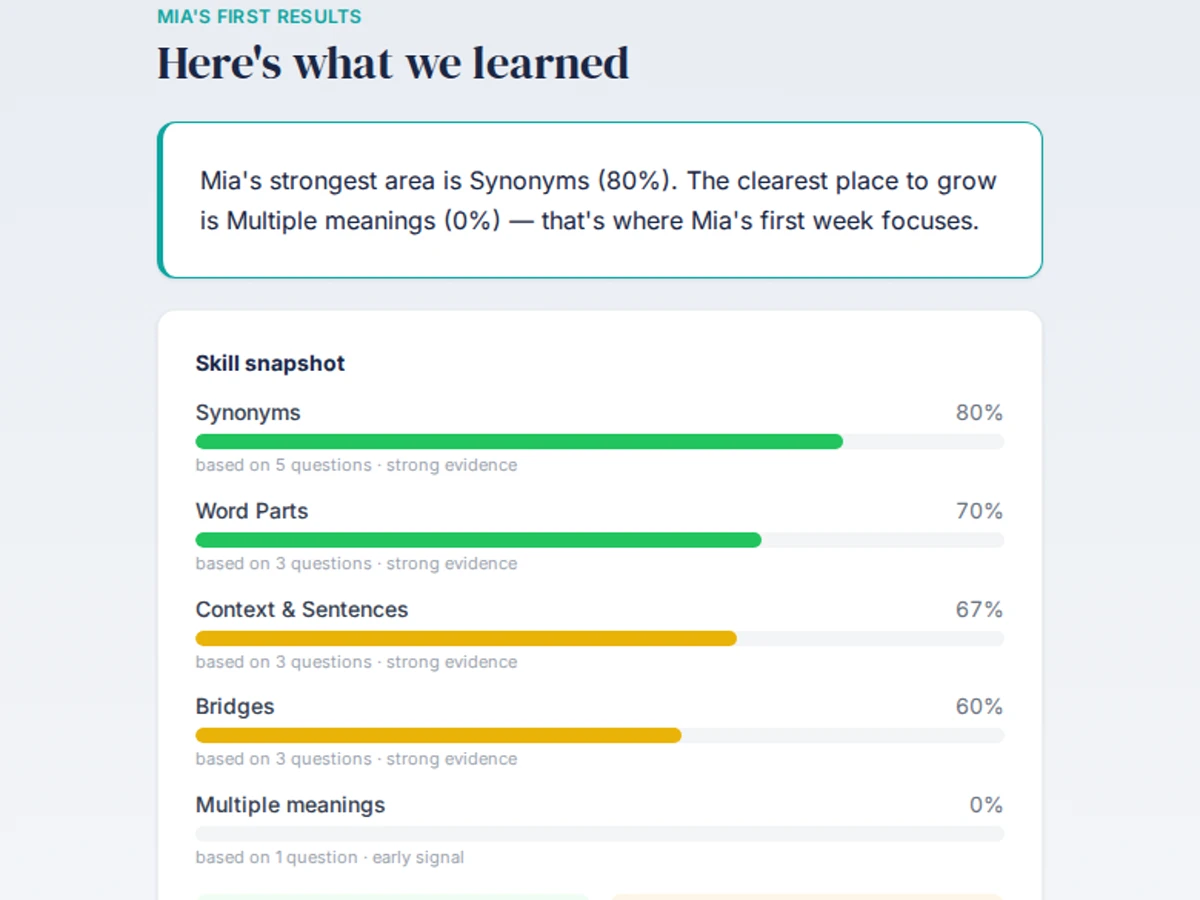
The check-up samples verbal skills and gives you an early strength, a growth area, and a first practice focus. It is not a full-length exam, an official SSAT or ISEE score, or an admissions prediction.
The SSAT verbal section is one of the most important — and most misunderstood — parts of the test. Many families jump straight into vocabulary drills without first understanding what the section actually tests, how it's scored, and how the format changes across test levels.
That's a mistake. Understanding the format is the first step to targeted preparation. A student who knows that analogies make up half the verbal section will study differently than one who assumes it's all synonyms. A student who understands the quarter-point penalty will approach guessing differently than one who doesn't.
This guide provides a complete breakdown of the SSAT verbal section: question types, timing, scoring, and how it compares to the ISEE. Whether your child is taking the Elementary, Middle, or Upper Level test, you'll know exactly what to expect and how to prepare.
Section Format by Level
The SSAT is offered at three levels, each targeting a different grade range. The verbal section structure varies significantly between the Elementary Level and the Middle/Upper Levels:
| Dimension | Elementary (Grades 3–4) | Middle (Grades 5–7) | Upper (Grades 8–11) |
|---|---|---|---|
| Total questions | 30 | 60 | 60 |
| Time allowed | 20 minutes | 30 minutes | 30 minutes |
| Time per question | 40 seconds | 30 seconds | 30 seconds |
| Synonyms | 15 questions | 30 questions | 30 questions |
| Analogies | 15 questions | 30 questions | 30 questions |
| Answer choices | 5 per question | 5 per question | 5 per question |
The critical detail here is time per question. At the Middle and Upper Levels, students have just 30 seconds per question — which means there's no time to deliberate. Students need to recognize vocabulary and identify relationships quickly, which is why structural knowledge (roots, prefixes, suffixes) is so valuable: research on morphological awareness shows it provides a fast decoding strategy even for unfamiliar words. Stahl and Nagy (2006, Teaching Word Meanings) further document how explicit vocabulary instruction improves comprehension performance under time pressure.
Elementary Level students get slightly more time per question (40 seconds), but the vocabulary difficulty is calibrated to be appropriately challenging for grades 3–4. The 50/50 split between synonyms and analogies is consistent across all three levels.
Synonym Questions
Synonym questions present a single word in capital letters and ask the student to choose the answer choice that means most nearly the same thing. There is no sentence context — just the word and five options. This makes synonym questions a pure vocabulary test.
Example:
GREGARIOUS most nearly means
- (A) generous
- (B) sociable
- (C) courageous
- (D) peculiar
- (E) reserved
The correct answer is (B). A student who recognizes the root greg (group, flock) can connect it to "congregation" and "aggregate" — words about groups — and reason that "gregarious" means someone who enjoys being in groups, i.e., sociable.
Synonym questions reward two strategies: direct recall (if the student knows the word) and root decomposition (if they don't). Students who rely solely on flashcard memorization have only the first strategy available. Students who know roots have both — giving them a significant advantage on unfamiliar words. For a comprehensive root reference, see our complete list of Latin and Greek roots for the SSAT.
Analogy Questions
Analogy questions present a pair of words with a specific relationship, and the student must identify the answer pair that shares the same relationship. These questions test relational reasoning — the ability to identify how words connect to each other.
Example:
Architect is to building as
- (A) teacher is to school
- (B) composer is to symphony
- (C) doctor is to hospital
- (D) judge is to courtroom
- (E) pilot is to airplane
The correct answer is (B). The relationship is "creator to creation" — an architect creates a building, a composer creates a symphony. The other options involve people who work in a place or operate a vehicle, which are different relationship types.
Solving analogies requires two steps: first, identify the "bridge" (relationship type) between the stem pair; second, find the answer pair that matches the same bridge. Common bridge types include part-to-whole, cause-to-effect, degree (mild to extreme), tool-to-user, and antonyms. For an in-depth look at all bridge types with practice questions, see our SSAT analogy practice guide.
Root knowledge is especially useful for analogy questions because many analogy pairs are built on morphological relationships. When phil (love) and phob (fear) appear as antonym roots in a stem pair, a student who knows those roots can identify the antonym bridge instantly — without needing to know the full definitions of both words.
Scoring Explained
SSAT scoring uses a two-step process: raw score calculation followed by scaling.
Raw Score
The raw score is calculated as: +1 point for each correct answer, −0.25 points for each wrong answer, and 0 points for skipped questions. This quarter-point penalty is designed to discourage random guessing. Statistically, random guessing among five choices yields an expected value of zero (one correct in five tries = +1, minus four wrong at −0.25 each = −1, net zero). However, if a student can eliminate even one answer choice, the expected value of an educated guess becomes positive.
Guessing Strategy:
- Can't eliminate any choices: Skip the question.
- Can eliminate 1+ choices: Make an educated guess.
- Can eliminate 3+ choices: Definitely answer — the odds strongly favor you.
Scaled Scores and Percentiles
Raw scores are converted to scaled scores on a fixed range. For the Middle and Upper Levels, the verbal scaled score ranges from 440 to 710. For the Elementary Level, the range is 300 to 600. These scaled scores allow comparison across different test dates and versions.
Schools primarily look at percentile ranks, which compare your child's performance to other test-takers applying to the same grade. A 75th percentile score means your child scored higher than 75% of the comparison group. Most competitive independent schools look for scores at or above the 50th percentile, while the most selective schools typically expect 75th percentile or above.
How the ISEE Verbal Section Compares
Many families apply to schools that accept either the SSAT or the ISEE, so understanding the differences is important. The ISEE verbal reasoning section has the same number of questions (40 at Middle and Upper Level) but a fundamentally different question mix: it tests synonyms and sentence completions — there are no analogy questions.
Sentence completions provide a sentence with a blank and ask the student to choose the word that best completes the meaning. These questions test vocabulary in context, combining word knowledge with reading comprehension. The ISEE also does not have a guessing penalty — there is no deduction for wrong answers, so students should answer every question.
Despite these format differences, the underlying vocabulary pool is remarkably similar. Both tests draw from the same tier of formal, academic English words with Latin and Greek origins. This means root-based preparation is equally effective for either test — a student who masters core roots is prepared for both the SSAT and the ISEE, regardless of which format they encounter.
Preparation Strategy
An effective SSAT verbal preparation plan combines three elements: structural vocabulary knowledge, spaced practice, and format familiarity.
1. Build root knowledge first. Spend the first 4–6 weeks learning Latin and Greek roots, prefixes, and suffixes. This builds the decoding foundation that research shows makes all subsequent vocabulary work more efficient. Aim for 8–10 roots per week, using spaced repetition to lock in retention. See our SSAT vocabulary guide for a detailed week-by-week plan.
2. Practice both question types. Synonym and analogy questions require different cognitive skills. Dedicate equal practice time to each. For analogies, focus on identifying bridge types before looking at answer choices — this trains the systematic approach that works under time pressure.
3. Take timed practice sections. Once your child has built foundational vocabulary, practice under timed conditions. The 30-second-per-question pace at the Middle and Upper Levels requires quick recognition and decision-making. Timed practice builds the automatic recall needed for test day.
For a comprehensive look at how root learning, spaced repetition, and multi-skill practice work together, read our guide to improving SSAT verbal scores.
The SSAT verbal section maps naturally onto a five-domain framework that goes beyond vocabulary alone. Synonyms draw on Vocabulary Knowledge; analogies are the test's signature measure of Relational Reasoning; the timing and guessing rules in this guide are squarely Test Execution skills. Contextual Inference and Metacognition — knowing which strategy to reach for and catching overconfidence in real time — are the difference-makers at the 75th+ percentile. Roots are a powerful on-ramp into Vocabulary Knowledge and Relational Reasoning, but high scorers have developed all five. LexiMap is structured around exactly these five domains and tracks each one in a parent dashboard, so preparation stays well-rounded as the test date approaches.
Key Takeaways
- The SSAT verbal section splits evenly between synonyms (50%) and analogies (50%) at all three levels.
- Middle and Upper Level students have 30 seconds per question — speed and automatic recognition matter.
- The quarter-point penalty means strategic guessing: skip if you can't eliminate any choices, guess if you can eliminate one or more.
- Scaled scores range from 440–710 (Middle/Upper) and 300–600 (Elementary). Schools primarily evaluate percentile ranks.
- The ISEE tests synonyms and sentence completions (no analogies, no guessing penalty) but uses a similar vocabulary pool — root-based prep works for both tests.
- Effective preparation combines root knowledge, spaced repetition, question-type practice, and timed sections.
Questions parents ask
What's on the SSAT verbal section?
At Middle and Upper Levels: 60 questions in 30 minutes — 30 synonyms and 30 analogies. Synonyms test vocabulary depth; analogies test relationship recognition between word pairs.
What SSAT verbal score do competitive schools look for?
Scores are percentile-based against same-grade test takers, and each school publishes its own expectations. Many schools want at least the 50th percentile, while the most selective typically expect the 75th percentile or above — check the admissions profile of each target school.
Get SSAT/ISEE vocabulary resources by email
Related Articles
SSAT vs ISEE: Which Test Does Your Child Need?
SSAT or ISEE? This honest comparison covers format, scoring, school preferences, and a clear decision framework to help you choose the right test for your child.
Best SSAT Vocabulary Apps and Tools: A 2026 Comparison
Compare the best SSAT vocabulary prep tools — LexiMap, Quizlet, Anki, practice tests, and vocabulary apps. See which approach actually builds lasting verbal skills.
Best Vocabulary Apps for Private-School Admissions Tests (2026)
Compare vocabulary prep apps for private-school entrance exams — SSAT, ISEE, HSPT, and more. What to look for, honest tool comparisons, and how to choose for your child.
How to Improve Your Child's SSAT Verbal Score: A Parent's Guide
Evidence-based strategies to raise your child's SSAT verbal score. Root-based learning, spaced repetition, daily habits, and realistic improvement timelines.
Related Guides
SSAT Vocabulary List: 200+ Words Organized by Level and Root
Comprehensive SSAT vocabulary word lists organized by test level (Elementary, Middle, Upper) and root word family. Study the right words for your child's grade.
The Parent's Complete Guide to SSAT & ISEE Prep
Everything parents need to know about SSAT and ISEE preparation. Test formats, timelines, study strategies, score interpretation, and how to support your child's verbal growth.
SSAT® is a registered trademark of The Enrollment Management Association. ISEE® is a registered trademark of the Educational Records Bureau (ERB). LexiMap is not affiliated with or endorsed by these organizations.