When to Start SSAT Prep: The Complete Timeline for Every Grade
Find your child’s vocabulary gaps
Start with a free, no-card vocabulary check-up and get a personalized parent report.
Find the vocabulary gaps — freeSee a sample parent report before starting
The check-up samples verbal skills and gives you an early strength, a growth area, and a first practice focus. It is not a full-length exam, an official SSAT or ISEE score, or an admissions prediction.
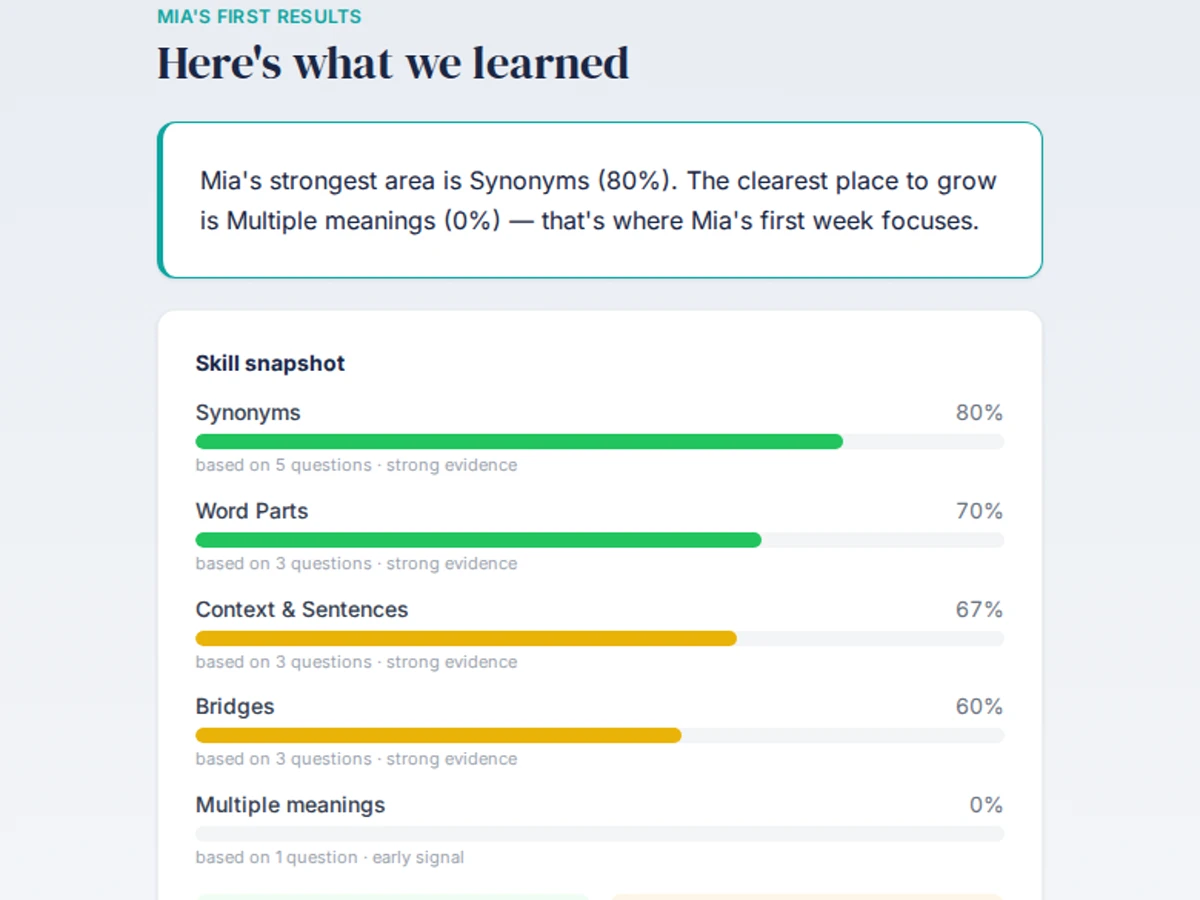
"When should we start preparing for the SSAT?" is the most common question parents ask when their child is heading toward independent school admissions. The answer depends on your child's grade level, test date, and starting point — but the research points to clear guidelines that apply across all three SSAT levels.
This guide provides grade-by-grade timelines, daily study recommendations, and milestone checkpoints so you can plan a preparation schedule that builds real competence without burning out your child. The core principle is simple: vocabulary is cumulative, so earlier is better — but there are effective strategies even for late starters.
The Short Answer
- Vocabulary preparation: 3–12 months before the test date. Vocabulary knowledge is cumulative and benefits from spaced repetition over time. A meta-analysis by Cepeda et al. (2006) confirmed that distributed practice significantly outperforms massed practice for long-term verbal recall.
- Test format practice: 4–8 weeks before the test date. Practice tests are most valuable once a vocabulary foundation is in place.
- General rule: Starting earlier is always better for vocabulary because each day of spaced repetition compounds retention. There is no such thing as "too early" for root-based vocabulary study.
Elementary Level Timeline (Grades 3–4)
The Elementary Level SSAT is designed for students applying to grades 4–5. The vocabulary demands are lighter than higher levels, but the verbal section still tests synonyms that reward root knowledge. At this age, the priority is building a positive learning habit rather than covering every root.
- Recommended lead time: 3–6 months
- Daily study time: 10–15 minutes
- Focus areas: Top 20 foundational roots (e.g., bene, mal, dict, scrib, port), common prefixes (un-, re-, pre-), and recognition-based game modes
- Key goal: Build the daily habit and establish a positive association with vocabulary study. Consistency matters more than volume at this age.
For younger students, keep sessions short and game-oriented. The SSAT vocabulary guide covers which roots to prioritize by grade level. The most important outcome at this stage is that your child learns how roots work — that words are built from meaningful parts — rather than memorizing a long list.
Middle Level Timeline (Grades 5–7)
The Middle Level SSAT is the most commonly taken level, used for admission to grades 6–8. The verbal section includes both synonyms and analogies, and the vocabulary is noticeably more demanding than the Elementary Level. Students need a broader root foundation and exposure to analogy reasoning patterns.
- Recommended lead time: 4–8 months
- Daily study time: 15–20 minutes
- Focus areas: Full Latin and Greek root families (aim for 80–120 roots), all common prefixes and suffixes, analogy-solving practice using root relationships
- Practice tests: One baseline test at the start, then weekly tests in the final 4 weeks
- Key goal: Build transferable decoding skills so your child can handle unfamiliar words, not just words they've memorized.
At the Middle Level, analogies are a significant scoring factor. Students who understand root relationships — for example, that bene (good) and mal (bad) are antonym roots — can identify analogy patterns structurally rather than relying on familiarity with the specific words used. See our complete root word reference for the full list of roots to cover.
Upper Level Timeline (Grades 8–11)
The Upper Level SSAT is used for admission to grades 9–12 and has the most demanding verbal section. Vocabulary words are drawn from a broader, more sophisticated range, and analogy relationships are more complex. Students at this level benefit from a deeper, more comprehensive approach to root study.
- Recommended lead time: 6–12 months
- Daily study time: 20–30 minutes
- Focus areas: All 182 root families including advanced Greek combining forms, context-based inference, multi-root word analysis, and sophisticated analogy patterns
- Practice tests: Baseline test at month 2, then biweekly from month 4 onward, weekly in the final month
- Key goal: Achieve sustained daily practice that builds deep, durable vocabulary knowledge. Upper Level scores reward breadth and precision.
Upper Level students often have the most to gain from root-based learning because the vocabulary is most likely to include unfamiliar words. A student who has internalized 150+ roots can decode words like magnanimous (magn = great + anim = spirit) or circumlocution (circum = around + loc = speak) without having studied them directly.
Monthly Milestone Checkpoints
Regardless of your child's grade level, use these monthly checkpoints to gauge whether preparation is on track. The specific numbers assume daily practice of 15–20 minutes using a spaced-repetition system. Progress will vary by student — these are benchmarks, not rigid requirements.
Retention rate refers to the percentage of previously studied roots your child can correctly recall in review sessions. This is the metric that distinguishes durable learning from short-term cramming, a distinction well-documented in forgetting curve research. A high retention rate (85%+) indicates that spaced repetition is working and the knowledge will hold up on test day. If retention drops below 80%, reduce the pace of new roots and increase review sessions. For more on how spaced repetition drives these retention numbers, see our methodology page.
Practice test scores become meaningful after 2–3 months of vocabulary study. Taking a practice test too early can produce discouraging results that don't reflect your child's growing knowledge base. Wait until month 3 for a baseline, then track gains over time.
What If We Started Late?
Not every family has 6–12 months to prepare. If your child's test date is less than 3 months away, don't try to cover all 166 roots. A focused, strategic approach is more effective than rushed breadth.
Late-start strategy (fewer than 3 months):
- Focus on the top 15 highest-frequency roots: bene, mal, dict, scrib, port, duc, rupt, ject, spec, cred, graph, logos, phon, bio, auto. These 15 roots unlock hundreds of testable words.
- Master the 12 most common prefixes: un-, re-, pre-, dis-, in-/im-, inter-, trans-, sub-, super-, ex-, mis-, post-. Combined with core roots, prefixes multiply decoding power immediately.
- Take a practice test in week 2 to establish a baseline, then one per week in the final 4 weeks.
- Study 20–25 minutes daily — slightly more than the standard recommendation to compensate for the compressed timeline.
Even 6–8 weeks of focused root study can produce measurable gains, as research on morphological instruction confirms. The key is consistency — daily sessions allow spaced repetition to work even in a compressed timeframe. Don't try to cover everything; a student who deeply knows 30 roots will outperform one who has superficially seen 100.
A start-timeline should sequence more than vocabulary. Roots are the on-ramp — the first lever to pull — but a complete SSAT timeline works across all five verbal domains the test rewards. Vocabulary knowledge (roots, affixes, word families) comes first because it compounds the most with time. Relational reasoning (analogy bridge types) layers in once vocabulary has a foundation. Contextual inference sharpens through sentence-writing and reading practice. Test execution — pacing, elimination, guess discipline under the quarter-point penalty, stamina across a full sitting — enters in the final practice phase when timed conditions begin. Metacognition, the self-monitoring that lets your child recalibrate mid-section, is the last domain to polish, right before test day. LexiMap surfaces all five on a parent dashboard so you can see at a glance which domains are on track and which need more time in your schedule.
Key Takeaways
- Start vocabulary preparation 3–12 months before the test. Start practice tests 4–8 weeks before.
- Daily consistency (10–30 minutes depending on grade) beats weekend cramming sessions.
- Younger students should focus on building the habit; older students should aim for breadth and depth.
- Track retention rate as your primary progress metric — it predicts test-day performance better than the number of roots "seen."
- Late starters should narrow focus to the 15 highest-frequency roots and common prefixes rather than trying to cover everything.
Next Steps
Ready to build your child's SSAT prep plan? These resources will help you get started:
- SSAT Vocabulary Guide — Grade-level root recommendations and study strategies
- How to Improve Your Child's SSAT Verbal Score — Evidence-based strategies for score improvement
- The Complete List of Latin and Greek Roots for SSAT Vocabulary — All 60+ roots with meanings and example words
Questions parents ask
When should my child start SSAT prep?
For vocabulary, earlier is better: durable gains come from 3–12 months of daily practice, so starting a season or more ahead of test day is ideal. Format and pacing practice matter most in the final 4–8 weeks.
Is one month enough to prepare?
One month is enough to sharpen formats, pacing, and test strategy, and to patch targeted vocabulary gaps. It's not enough to transform vocabulary breadth, which is why earlier starts pay off most on the verbal section.
Get SSAT/ISEE vocabulary resources by email
Related Articles
The 90-Day SSAT Vocabulary Prep Plan for Parents
A week-by-week SSAT study schedule parents can actually follow — 15 minutes a day, five phases, from baseline diagnostic to test-day confidence.
How to Improve Your Child's SSAT Verbal Score: A Parent's Guide
Evidence-based strategies to raise your child's SSAT verbal score. Root-based learning, spaced repetition, daily habits, and realistic improvement timelines.
Last-Minute SSAT Prep: Your 30-Day Vocabulary Plan
Test in 30 days? Here's the prioritized week-by-week SSAT vocabulary plan — 20–30 min/day, roots first, proven strategies, no panic required.
SSAT Prep Cost Breakdown: What Parents Actually Spend in 2026
Honest breakdown of SSAT preparation costs — tutoring, apps, books, practice tests, and test fees. Find the most cost-effective approach for your child's verbal prep.
Related Guides
The Parent's Complete Guide to SSAT & ISEE Prep
Everything parents need to know about SSAT and ISEE preparation. Test formats, timelines, study strategies, score interpretation, and how to support your child's verbal growth.
SSAT Vocabulary List: 200+ Words Organized by Level and Root
Comprehensive SSAT vocabulary word lists organized by test level (Elementary, Middle, Upper) and root word family. Study the right words for your child's grade.
SSAT® is a registered trademark of The Enrollment Management Association. ISEE® is a registered trademark of the Educational Records Bureau (ERB). LexiMap is not affiliated with or endorsed by these organizations.