ISEE Verbal Section: The Parent's Complete Guide
Find your child's ISEE vocabulary gaps
Start with a free, no-card ISEE check-up — 16–20 questions with a personalized parent report.
Find the ISEE vocabulary gaps — freeSee a sample parent report before starting
The check-up samples verbal skills and gives you an early strength, a growth area, and a first practice focus. It is not a full-length exam, an official SSAT or ISEE score, or an admissions prediction.
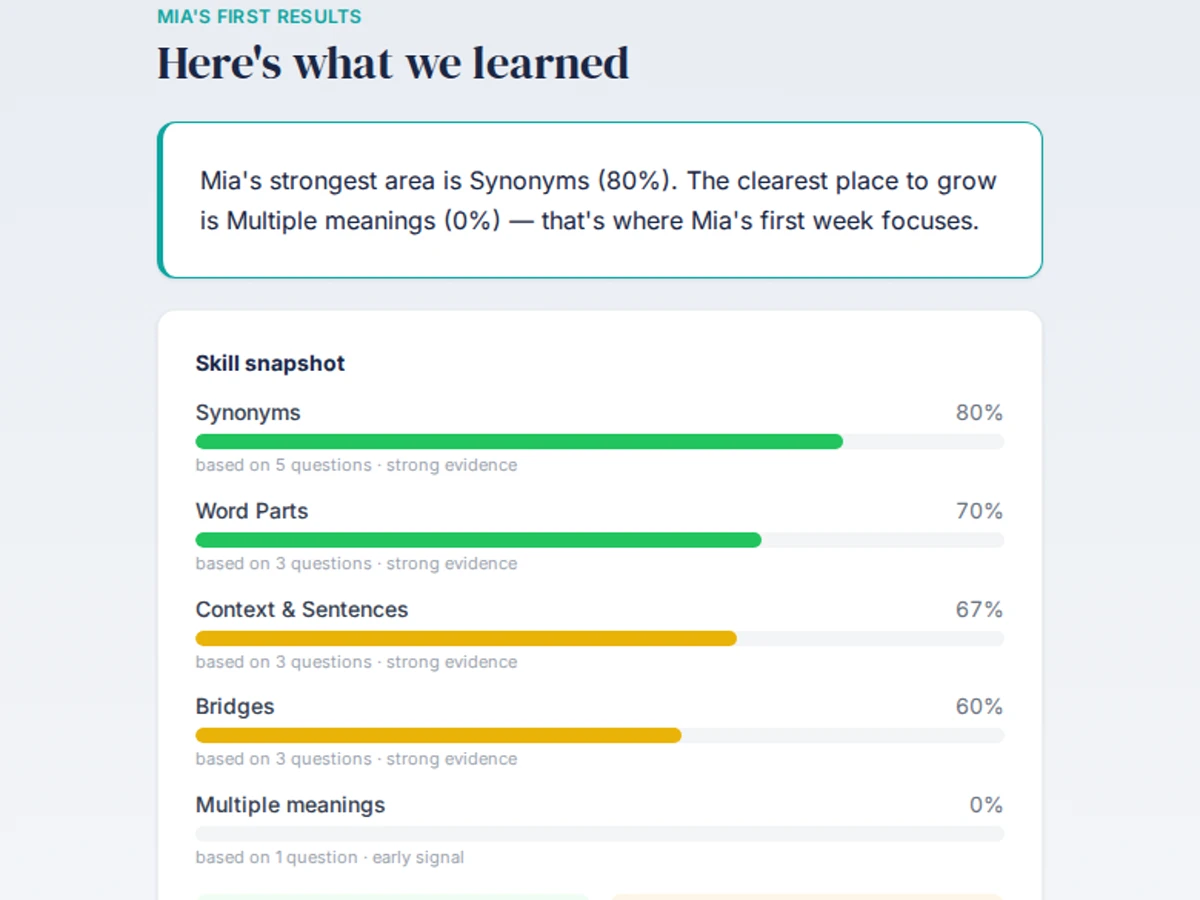
Most parents who discover their child needs to take the ISEE focus first on math — it feels concrete, measurable, and teachable. Then they look at the verbal section and wonder: how do you prepare a child for 40 questions that test vocabulary and reasoning ability?
The short answer is that ISEE verbal is highly preparable, and the parents who understand how it actually works get a meaningful edge over those who treat it as a mystery. This guide walks you through everything you need to know: what the ISEE verbal section tests, how it's scored, what changes across test levels, and what vocabulary preparation actually works for your child.
If your child is also considering the SSAT, the comparison between the two tests' verbal sections is worth understanding — we'll cover that too.
1. What the ISEE Verbal Section Actually Tests
The ISEE verbal section is formally called "Verbal Reasoning," and that label matters. It is not a reading test. It is not a grammar test. It is primarily a vocabulary test with a reasoning layer on top.
Every question on the ISEE verbal section either requires your child to know a word precisely or to reason about word relationships. The two question types — sentence completions and vocabulary in context (synonyms) — both have vocabulary knowledge as their foundation.
This has a practical implication for your prep strategy: vocabulary is the input. The more precisely your child understands words, the easier both question types become. A child who understands the word "ameliorate" at the level of a dictionary definition may recognize it in a sentence completion. A child who understands it more deeply — who knows it comes from the Latin root melior (better), who has seen it in context, who can distinguish it from "mitigate" and "alleviate" — will handle it correctly even when it appears in an unfamiliar sentence structure.
That depth of vocabulary knowledge is what separates strong scorers from average scorers on ISEE verbal.
2. ISEE Verbal Question Types Explained
The ISEE verbal section contains exactly two question types.
Sentence Completions
Sentence completions present your child with a sentence that has one or two blanks, followed by four answer choices. Your child's job is to identify the word or words that best complete the sentence's meaning.
Single-blank example:
The scientist's theory was considered ________ by her peers, who found it too speculative and lacking in experimental support. (A) groundbreaking (B) controversial (C) meticulous (D) tenuous
The correct answer is (D) tenuous — meaning weak or without substance. Notice that to answer confidently, your child needs to know all four words.
Double-blank examples appear at the Middle and Upper levels. These require your child to find two words that work together to complete the sentence.
Because the director refused to ________ the film's original vision, critics praised the work as ________ in an industry known for compromise. (A) compromise ... derivative (B) alter ... uncompromising (C) defend ... ordinary (D) abandon ... formulaic
The correct answer is (B). Your child needs to identify that the clause structure sets up a cause-and-effect relationship between the two blanks.
Sentence completions reward vocabulary knowledge, logical reasoning, and — importantly — the ability to identify tone and direction cues in the surrounding sentence. Words like "because," "although," "despite," and "however" are signposts that tell your child whether the blank should complement or contrast with the surrounding text.
Vocabulary in Context (Synonyms)
In this question type, your child is given a word and asked to select the word among four choices that is closest in meaning. Pure vocabulary questions.
Example:
DILIGENT (A) clever (B) persistent (C) industrious (D) obedient
The answer is (C) industrious. But notice that (B) persistent is a plausible distractor.
This is why vocabulary preparation built on root knowledge outperforms simple memorization. A child who knows that "diligent" derives from the Latin root diligentia (care, attentiveness) will intuitively understand that it describes effortful, careful work — and will gravitate toward "industrious" over "persistent."
3. ISEE Levels: How Verbal Differs from Lower to Upper
The ISEE has four test levels.
| ISEE Level | Grade Applying For | Verbal Questions | Time |
|---|---|---|---|
| Primary (2, 3, 4) | Grades 2–4 | Varies by primary level | Varies |
| Lower Level | Grades 5–6 | 34 questions | 20 minutes |
| Middle Level | Grades 7–8 | 40 questions | 20 minutes |
| Upper Level | Grades 9–12 | 40 questions | 20 minutes |
Lower Level Verbal
The Lower Level is taken by students applying to grades 5 and 6. The vocabulary at this level includes words your child may have encountered in reading but likely hasn't studied deliberately — words like "cordial," "dubious," "languid," and "vivid."
Middle Level Verbal
The Middle Level targets grades 7 and 8. Words like "ameliorate," "equivocal," "perfunctory," and "pernicious" are fair game. Double-blank sentence completions appear here with greater frequency.
Upper Level Verbal
The Upper Level is taken by students applying to high school programs. "Truculent," "sycophant," "dilatory," "obsequious," "implacable." Many of these words share roots with more common words, but children who have not studied roots will not be able to see those connections on the fly.
4. ISEE Scoring: Scaled Scores, Stanines, and What They Mean
Scaled Scores
Each student receives a scaled score for the verbal section. Scaled scores are designed to allow comparison across different test administrations.
Stanines
The number that schools pay the most attention to is the stanine, which stands for "standard nine."
| Stanine | Percentile Range | Interpretation |
|---|---|---|
| 9 | 96–99th | Outstanding |
| 8 | 89–95th | Excellent |
| 7 | 77–88th | Above average |
| 6 | 60–76th | High average |
| 5 | 40–59th | Average |
| 4 | 23–39th | Below average |
| 3 | 11–22nd | Well below average |
| 2 | 4–10th | Low |
| 1 | 1–3rd | Very low |
Most competitive independent schools have informal stanine expectations — often a combined stanine of 6 or above across sections, with schools at the most selective end expecting 7+ on verbal.
The Peer Group Comparison
Your child's verbal score is measured against every other student who takes that ISEE level. These are not average students. A stanine of 5 at the Upper Level puts your child in the middle of a population of motivated, academically prepared students.
The Percentile Implication of Vocabulary
ISEE verbal is 40 questions. The difference between a stanine 5 and a stanine 7 is often 4–6 additional correct answers.
5. ISEE vs. SSAT Verbal: The Key Differences
| Feature | ISEE Verbal | SSAT Verbal |
|---|---|---|
| Question types | Sentence completion, synonym | Synonym, analogy |
| Analogies | None | Yes — up to 30 of 60 verbal questions |
| Primary skill tested | Vocabulary precision and sentence logic | Vocabulary + relational reasoning |
| Penalty for wrong answers | No penalty | 0.25-point deduction |
| Test levels | Primary, Lower, Middle, Upper | Elementary, Middle, Upper |
| Scoring | Stanines 1–9 | Scaled score + percentile |
The most important structural difference is the analogy question type. If your child is considering both tests, analogy preparation is SSAT-specific but vocabulary preparation applies to both. For a deeper look, see ISEE Analogy Practice: How Relationship Thinking Helps.
The other key difference is the wrong-answer penalty on the SSAT. The ISEE does not penalize wrong answers.
6. The Vocabulary Scope: What Words Does Your Child Need to Know?
There is no fixed vocabulary list for the ISEE. What vocabulary researchers have found is that a relatively small set of Latin and Greek roots provides access to a surprisingly large portion of academic vocabulary.
For example:
- The root bene (Latin: good, well) unlocks benefactor, benevolent, beneficial, benediction, and benign
- The root mal (Latin: bad, ill) unlocks malevolent, malicious, malign, malignant, and malpractice
- The root port (Latin: to carry) unlocks transport, import, export, portable, deportation, and portfolio
Across all three ISEE levels, the 160 Latin and Greek roots that make up LexiMap's curriculum provide 167–200% content coverage relative to the actual test vocabulary.
The vocabulary scope differs by level:
- Lower Level: Words your child might recognize from reading but may not know precisely
- Middle Level: Genuinely challenging vocabulary requiring deliberate study
- Upper Level: Vocabulary that requires deliberate preparation
For a deeper exploration, see ISEE Vocabulary Builder: Best Tools and Strategies for 2026.
7. The Five-Domain Verbal Framework: What the ISEE Actually Measures
The ISEE verbal section is often described as a "vocabulary test," but the reasoning demands on the test reflect a broader set of skills. Researchers and test designers recognize five distinct domains that predict verbal performance — and strong preparation addresses all five.
Domain 1: Vocabulary Knowledge
This is the foundation. Vocabulary knowledge goes beyond memorizing definitions — it encompasses breadth (how many words your child knows), depth (how precisely they understand each word), and connotation (the emotional weight and register a word carries). Root-based study is the most efficient on-ramp here: 160 Latin and Greek roots provide access to the majority of academic vocabulary at all ISEE levels.
A note on depth: a child's grasp of a word naturally deepens over time — from rough recognition, to connecting the word to its root family, to recalling the meaning independently, to inferring meaning in unfamiliar contexts, to using the word with connotative precision. This progression happens within the Vocabulary Knowledge domain through consistent root study and spaced repetition; it is not a separate framework.
Domain 2: Relational Reasoning
Relational reasoning is the ability to see how words relate to each other — synonym/antonym discrimination, semantic field boundaries, and analogy relationships. On the ISEE, this domain drives performance on synonym questions where plausible distractors require your child to distinguish closely related words. (On the SSAT, analogy questions make relational reasoning even more explicit.)
Domain 3: Contextual Inference
Sentence completions are a contextual inference task. Your child must identify direction cues ("because," "although," "despite"), infer what the blank requires from the sentence's logic, and select the word that fits the intended meaning. Children who know words but cannot read sentence structure will underperform relative to their vocabulary knowledge.
Domain 4: Test Execution
Timed, high-stakes conditions create their own demands. Test execution covers pacing (20 minutes for 34–40 questions), elimination strategy on hard items, guess discipline (always answer — no penalty on the ISEE), and stamina across the full test. Many children lose points not from vocabulary gaps but from poor time management or anxiety-driven rushing.
Domain 5: Metacognition
Metacognition is the hardest domain to develop and the most rewarding. It includes confidence calibration (knowing when you actually know a word versus when you are guessing), strategy selection (deciding when to infer from roots versus when to move on), and error-pattern awareness (noticing the specific question types or word categories where your child consistently struggles). A child with strong metacognition learns faster because they can direct their own practice more efficiently.
Most vocabulary study programs address Domain 1 only. Root-based vocabulary study with spaced repetition builds Domain 1 systematically; pairing that with sentence completion practice and periodic diagnostic review builds the full picture.
For the research behind spaced repetition, see Spaced Repetition for Kids: The Science Behind FSRS and Why It Works.
8. ISEE Verbal Prep Strategies That Work
Strategy 1: Start with Roots, Not Word Lists
The root-based alternative is more efficient. Your child learns 160 Latin and Greek roots. Each root they master provides a framework for understanding 8–15 related words.
For detailed roots, see The Complete List of Latin and Greek Roots for SSAT Vocabulary.
Strategy 2: Use Spaced Repetition, Not Massed Practice
The FSRS algorithm targets ~90% recall at each review. Daily short sessions (15–20 minutes) spread over time will dramatically outperform intensive cramming.
For comparison of methods, see Root Words vs. Flashcards.
Strategy 3: Practice Sentence Completions Systematically
- Identify the direction cue first
- Predict before you read the choices
- On double-blank questions, eliminate on the first blank
Strategy 4: Build Contextual Familiarity Through Reading
Reading builds vocabulary exposure, and vocabulary study makes reading more comprehensible. See ISEE Reading Comprehension.
Strategy 5: Track Progress with Diagnostic Practice Tests
Take an initial diagnostic, then schedule practice tests every 3–4 weeks.
9. Building a Prep Timeline
6 Months Before the Test
- Establish a daily vocabulary practice routine (15–20 minutes)
- Begin root study with the most common Latin roots
- Take one diagnostic practice test
- Identify the primary gap type
3–4 Months Before the Test
- Continue root study, covering Greek roots
- Begin regular sentence completion practice
- Take a second diagnostic
6–8 Weeks Before the Test
- Review all studied roots
- Complete full verbal sections under timed conditions
- Take a third diagnostic
- Do not introduce large amounts of new vocabulary
1–2 Weeks Before the Test
- Light review of the most-studied root families
- No all-night cramming
10. Tools and Resources
Practice Test Platforms
Test Innovators and Piqosity.
Vocabulary Building
LexiMap is a root-based ISEE vocabulary trainer covering all three ISEE levels with FSRS spaced repetition (~90% recall target) and a five-domain dashboard that shows parents exactly where their child stands across vocabulary knowledge, relational reasoning, contextual inference, test execution, and metacognition. It covers both ISEE and SSAT preparation in a single subscription.
11. Frequently Asked Questions
How many questions are on the ISEE verbal section?
Lower Level: 34 questions (20 min). Middle and Upper: 40 questions (20 min each).
Is there a penalty for wrong answers on the ISEE?
No. Your child should answer every question.
What stanine should my child aim for?
Depends on target schools. Most moderately selective: 5–7. Highly selective: 7–9.
How is the ISEE verbal section different at different levels?
All levels share the same question types. Differences are in vocabulary difficulty and frequency of double-blank completions.
How long should my child prepare for ISEE verbal?
Six months of daily 15–20 minute sessions is ideal. Three months of consistent daily practice will produce meaningful improvement.
Can my child improve their verbal stanine significantly?
Yes — verbal stanine is among the most improvable sections of the ISEE.
Does ISEE verbal preparation also help with the SSAT?
Yes, substantially. The vocabulary scope overlaps significantly. See ISEE Analogy Practice.
Key Takeaways
- ISEE verbal tests vocabulary precision and sentence logic through two question types
- Stanines (1–9) are the key scoring metric against a competitive peer group
- Root-based vocabulary study builds compounding knowledge: 160 roots unlock multiple words
- Spaced repetition is the mechanism that converts vocabulary study into durable retention
- Start preparation 4–6 months before the test date
- Combine diagnostic practice tests with root-based vocabulary training
Further Reading
- ISEE Vocabulary Builder: Best Tools and Strategies for 2026
- ISEE Analogy Practice: How Relationship Thinking Helps
- ISEE Reading Comprehension and Vocabulary
- The Complete List of Latin and Greek Roots for SSAT Vocabulary
- Spaced Repetition for Kids: The Science Behind FSRS and Why It Works
- Root Words vs. Flashcards: Which Builds Better Vocabulary?
Questions parents ask
What does the ISEE verbal section include?
Synonyms and sentence completions. Lower Level runs 34 questions in 20 minutes; Middle and Upper Levels run 40 questions in 20 minutes — about 30 seconds per question, so recall has to be automatic.
How should my child prepare for ISEE verbal?
Daily root-based vocabulary work with spaced repetition as the foundation, plus regular sentence-completion practice for context-clue skill. Add timed sections in the final weeks for pacing.
Get SSAT/ISEE vocabulary resources by email
Related Articles
ISEE Analogy Practice: How Relationship Thinking Helps with Synonyms & Sentence Completions
The ISEE doesn't test analogies — but analogy thinking is the key to ISEE synonyms and sentence completions. Learn bridge types, practice questions, and root word strategies.
SSAT Vocabulary Prep: The Complete Parent Guide
Everything parents need to know about SSAT vocabulary prep — what the verbal section tests, how scoring works, and the strategies that build lasting vocabulary mastery.
SSAT vs ISEE: Which Test Does Your Child Need?
SSAT or ISEE? This honest comparison covers format, scoring, school preferences, and a clear decision framework to help you choose the right test for your child.
ISEE Reading Comprehension: How Vocabulary Knowledge Determines Your Child's Score
Learn how vocabulary knowledge affects your child's ISEE reading comprehension score — and which prep strategies transfer beyond the Verbal Reasoning section.
Related Guides
The Parent's Complete Guide to SSAT & ISEE Prep
Everything parents need to know about SSAT and ISEE preparation. Test formats, timelines, study strategies, score interpretation, and how to support your child's verbal growth.
SSAT Vocabulary: The Complete Guide to Root-Based Learning
Master SSAT vocabulary through Latin and Greek roots. Learn how root-based learning, spaced repetition, and interactive practice build lasting verbal skills for grades 4-12.
SSAT® is a registered trademark of The Enrollment Management Association. ISEE® is a registered trademark of the Educational Records Bureau (ERB). LexiMap is not affiliated with or endorsed by these organizations.