The 90-Day SSAT Vocabulary Prep Plan for Parents
Find your child’s vocabulary gaps
Start with a free, no-card vocabulary check-up and get a personalized parent report.
Find the vocabulary gaps — freeSee a sample parent report before starting
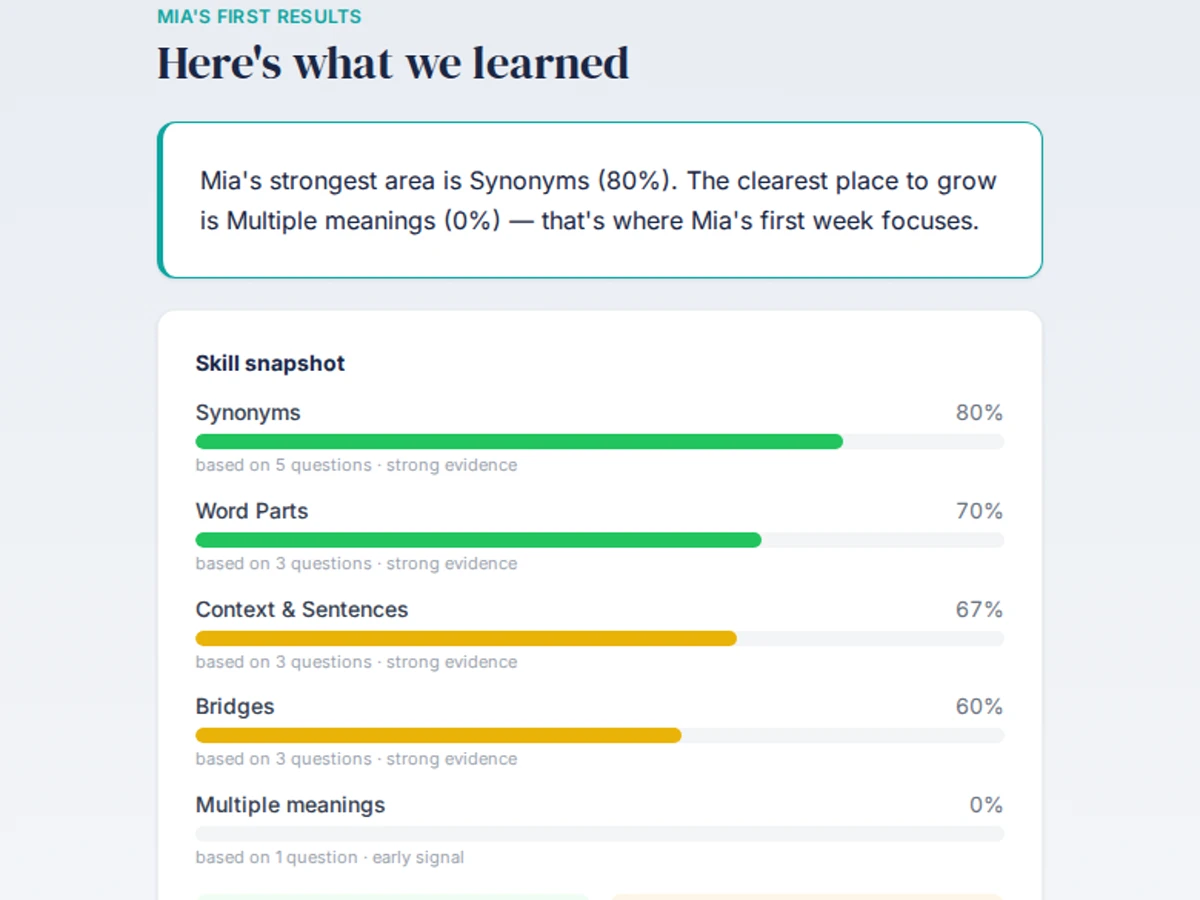
The check-up samples verbal skills and gives you an early strength, a growth area, and a first practice focus. It is not a full-length exam, an official SSAT or ISEE score, or an admissions prediction.
If you've just registered your child for the SSAT and pulled up the test date on your calendar, ninety days may feel like either too much time or not enough. Both feelings are worth taking seriously — because the families who get vocabulary prep right aren't necessarily the ones who work hardest. They're the ones who work consistently, and who structure those 90 days so each week builds on the last.
This is not a general "when to start" guide. It's a specific, week-by-week action plan. If your child has a test in roughly three months, this is the structure that gets vocabulary done — without burning out, without weekend marathon sessions, and without the low-grade anxiety that comes from not knowing whether you're on track.
The plan assumes 15 to 20 minutes of vocabulary work per day, five to six days per week. That's it.
You'll also find a note at each phase addressing the worry parents typically feel at that stage.
Before you begin, see When to Start SSAT Prep: The Complete Timeline for Every Grade .
Phase 1: Assessment (Weeks 1–2)
Goal: Know exactly where your child stands before spending a minute on instruction.
The single most common mistake families make at the start of test prep is starting to study before they know what to study.
What to do in Weeks 1–2
- Take a baseline diagnostic under timed conditions
- Score the verbal section separately (synonyms and analogies)
- List the words your child didn't know
- Assess current reading fluency
Checklist: Phase 1 Complete
- Baseline diagnostic taken under timed conditions
- Verbal raw score recorded (synonyms and analogies separately)
- Word list from missed questions compiled
- Rough gap estimate: small (under 20% missed), medium (20–40%), or large (over 40%)
- Study schedule established: which 5–6 days per week, what time of day
Parent worry: "The score is terrible. Are we already behind?"
A bad baseline score is information, not a verdict. The SSAT deliberately tests vocabulary that most children haven't encountered in natural reading. A low starting score tells you there's real room to grow. The families who struggle are the ones who find out vocabulary is the gap at week 11, not week 1. You found it early.
Phase 2: Foundation (Weeks 3–6)
Goal: Build the root-word infrastructure that everything else depends on.
This is the most important phase of the plan. Instead of learning individual word definitions, your child is going to learn the Latin and Greek roots that generate those definitions. A child who knows the root bene (good) can decode benevolent, benefactor, benediction, and beneficiary without having studied any individually.
There are 160 roots that cover a large share of SSAT/ISEE vocabulary. The goal this phase is the highest-frequency families.
What to do in Weeks 3–6
- Work through highest-frequency root families first: port (carry), dict (say/speak), spec (look/see), aud (hear), bene (good), mal (bad), voc/vox (voice/call), cred (believe). See 50 Latin Root Words
- Learn each root through its word family, not in isolation
- 15–20 minutes, 5–6 days per week
- Weekly check-in (15 minutes): test retention
Checklist: Phase 2 Complete
- 30–40 highest-frequency root families introduced
- Child can name root meaning and list 3–4 connected words from memory
- Spaced review is happening
- Child is showing signs of transfer: noticing root families in reading
Parent worry: "We're doing root words but not studying actual SSAT words. Is this the right approach?"
This is the right approach. Morphological instruction consistently outperforms definition memorization. See Root Words vs. Flashcards .
Phase 3: Deepening (Weeks 7–10)
Goal: Expand to advanced roots, practice analogies, and move vocabulary into active use.
Three tracks running in parallel.
Track 1: Advanced roots (daily sessions) — Continue with less common but high-value families: luc/lux (light), cis (cut), clam/claim (shout/declare), gress (step/walk), rupt (break), scrib/script (write), vers/vert (turn), viv (live/life).
Track 2: Analogy practice (2–3 sessions per week) — Introduce bridge types. The most common: function, type/category, degree, part-to-whole, worker-to-tool, location. Practice naming the bridge type before selecting an answer. See SSAT Analogy Practice .
Track 3: Contextual usage (weekly) — Sentence-writing, spot-testing roots in daily life.
Checklist: Phase 3 Complete
- 60–80 root families covered
- Child can identify bridge type for the 8 most common patterns
- Weekly sentence-writing practice underway
- Spaced review is still active
Parent worry: "We're seven weeks in and haven't taken a practice test. Are we falling behind?"
No. The first full practice test is two weeks away. Hold the line. See Spaced Repetition for Kids .
Phase 4: Practice (Weeks 11–12)
Goal: Bring vocabulary into full test conditions. Measure progress.
- Take a full timed practice test
- Break down verbal results by question type
- Timed section drills
- Daily vocabulary continues
- Identify the bottom 20% of vocabulary by accuracy
Checklist: Phase 4 Complete
- At least 2 full timed practice tests completed
- Verbal score improvement from baseline documented
- Weak areas identified and drilled
- Daily vocabulary review maintained
Parent worry: "The scores improved, but not as much as I hoped. Should we panic?"
First, measure the right thing: verbal percentile change. Second, vocabulary gains often show up inconsistently across practice tests before they stabilize. Third, ask whether daily study was consistent.
Phase 5: Review (Week 13)
Goal: Consolidate, build confidence, prepare logistics.
Vocabulary (daily, 10–15 minutes only): Light review. Don't introduce anything new.
Confidence-building: Go back through the baseline word list from Phase 1. The contrast is concrete evidence the work paid off.
Test-day logistics: Confirm location and travel time. Pack materials. Plan a normal evening and morning.
Checklist: Phase 5 Complete
- No new vocabulary introduced
- Daily light review completed
- Baseline comparison done
- Test-day logistics confirmed
- Early bedtime the night before
Parent worry: "Did we do enough?"
You prepared systematically for thirteen weeks. The work is done. Now let them show what they know.
A well-structured 90-day arc naturally sequences all five of the verbal domains the SSAT rewards. Roots are the on-ramp — they get vocabulary knowledge moving in Phase 2 — but the plan grows from there. Relational reasoning develops through analogy bridge-type work in Phase 3. Contextual inference deepens as your child practices sentence-writing and encounters words in varied settings. Test execution — pacing, elimination, guess discipline under the quarter-point penalty, and stamina across a full sitting — gets its turn in Phase 4 when timed practice begins in earnest. And metacognition, the self-monitoring habit that lets your child catch time-wasting and recalibrate mid-section, consolidates across Phases 4 and 5. LexiMap tracks all five domains on a parent dashboard, so you can see which areas are strengthening and which still need attention across the full 13-week window.
A Note on Tools
This plan works with any combination of quality materials. If you want the scheduling to happen automatically — spaced repetition that calculates exactly when each root should be reviewed — that's what LexiMap was built to do. The FSRS algorithm targets ~90% recall at each review.
But the structure above is the plan, regardless of what tools you use.
Key Takeaways
- Phase 1 (Weeks 1–2): Baseline diagnostic first
- Phase 2 (Weeks 3–6): Root families before word lists
- Phase 3 (Weeks 7–10): Add analogy bridge types and contextual usage
- Phase 4 (Weeks 11–12): Apply vocabulary under timed conditions
- Phase 5 (Week 13): Consolidate. No new learning.
- Daily consistency matters more than session length
Further Reading
- When to Start SSAT Prep
- Root Words vs. Flashcards
- SSAT Analogy Practice
- Spaced Repetition for Kids
- 50 Latin Root Words
Get the 90-day verbal prep checklist by email
Related Articles
When to Start SSAT Prep: The Complete Timeline for Every Grade
When should your child start preparing for the SSAT? Grade-by-grade timelines, daily study recommendations, and milestone checkpoints for Elementary, Middle, and Upper Level.
Last-Minute SSAT Prep: Your 30-Day Vocabulary Plan
Test in 30 days? Here's the prioritized week-by-week SSAT vocabulary plan — 20–30 min/day, roots first, proven strategies, no panic required.
SSAT Vocabulary Prep: The Complete Parent Guide
Everything parents need to know about SSAT vocabulary prep — what the verbal section tests, how scoring works, and the strategies that build lasting vocabulary mastery.
How to Improve Your Child's SSAT Verbal Score: A Parent's Guide
Evidence-based strategies to raise your child's SSAT verbal score. Root-based learning, spaced repetition, daily habits, and realistic improvement timelines.
Related Guides
The Parent's Complete Guide to SSAT & ISEE Prep
Everything parents need to know about SSAT and ISEE preparation. Test formats, timelines, study strategies, score interpretation, and how to support your child's verbal growth.
SSAT Vocabulary: The Complete Guide to Root-Based Learning
Master SSAT vocabulary through Latin and Greek roots. Learn how root-based learning, spaced repetition, and interactive practice build lasting verbal skills for grades 4-12.
SSAT® is a registered trademark of The Enrollment Management Association. ISEE® is a registered trademark of the Educational Records Bureau (ERB). LexiMap is not affiliated with or endorsed by these organizations.