5 SSAT Analogy Strategies That Actually Work on Test Day
Find your child’s vocabulary gaps
Start with a free, no-card vocabulary check-up and get a personalized parent report.
Find the vocabulary gaps — freeSee a sample parent report before starting
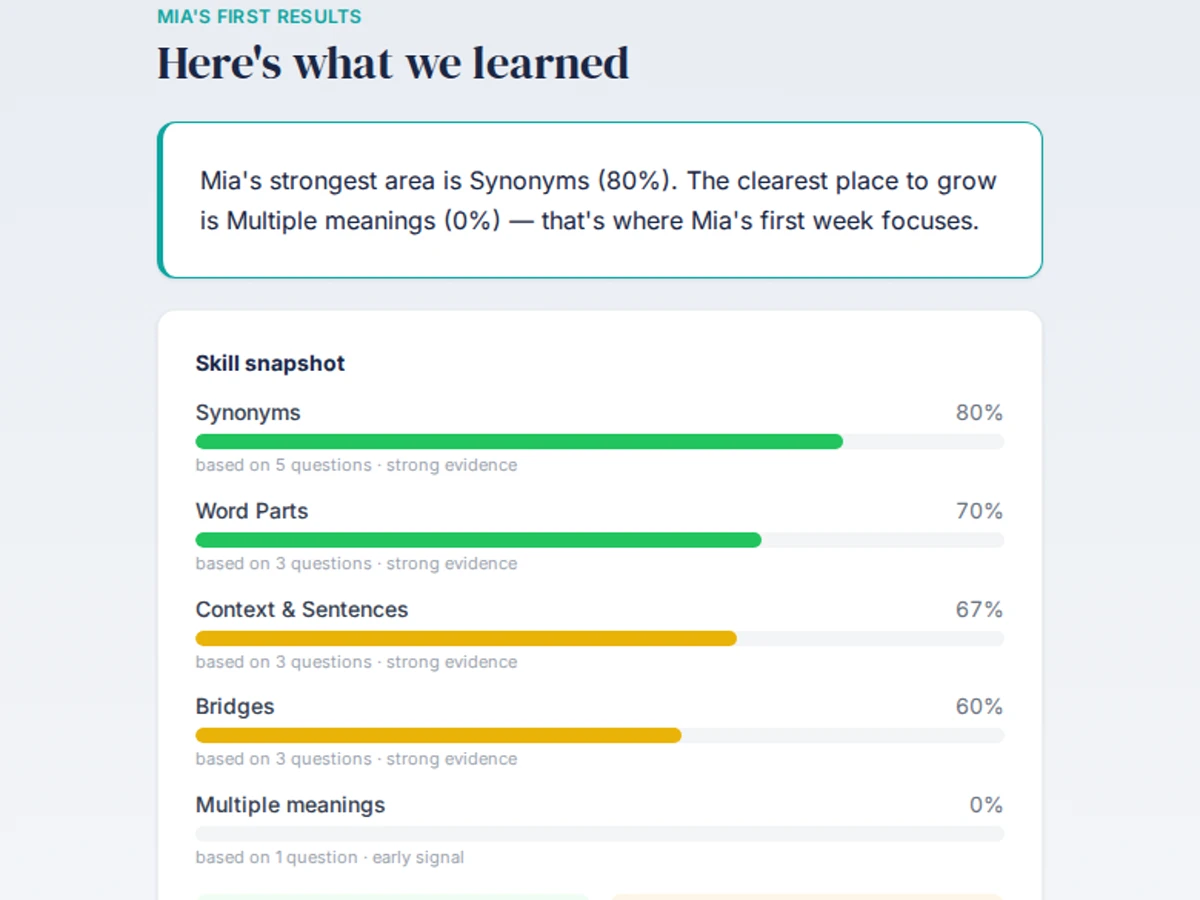
The check-up samples verbal skills and gives you an early strength, a growth area, and a first practice focus. It is not a full-length exam, an official SSAT or ISEE score, or an admissions prediction.
Analogies are the question type that separates strong SSAT verbal scores from great ones. Unlike synonyms, which test pure vocabulary knowledge, analogies require students to identify the relationship between two words and then find another pair with the same relationship. That extra layer of reasoning is what makes analogies feel harder — and it's also what makes them coachable.
Most students approach analogies by "feel" — reading the stem pair, glancing at the answer choices, and picking what seems right. That works for easy questions but breaks down on medium and hard ones, where multiple answers can look plausible without a systematic approach. The five strategies below give your child a repeatable process that works under time pressure.
If your child is also working on analogy relationship types, pair this article with our guide to SSAT analogy bridge types and practice questions.
Analogies are Domain 2 — Relational Reasoning — of the five verbal domains LexiMap trains; pairing them with Vocabulary Knowledge, Contextual Inference, and Test Execution is what lifts the whole score.
Strategy 1: The Bridge Sentence Method
The bridge sentence is the single most important analogy strategy. It works by creating a precise sentence that describes the relationship between the two stem words, then testing each answer choice by substituting its words into the same sentence.
Example:
SCULPTOR is to CHISEL as
- (A) painter is to canvas
- (B) writer is to pen
- (C) doctor is to patient
- (D) teacher is to classroom
- (E) chef is to restaurant
Step 1 — Build the bridge: "A SCULPTOR uses a CHISEL as their primary tool to create work."
Step 2 — Test each choice: "A painter uses a canvas as their primary tool to create work" — no, canvas is a surface, not a tool. "A writer uses a pen as their primary tool to create work" — yes. "A doctor uses a patient as their primary tool" — no. The answer is (B).
The key word is precise. A vague bridge like "a sculptor is related to a chisel" would make multiple answers look correct. The more specific your bridge sentence, the more clearly it distinguishes the right answer. Always include the nature of the relationship: is it a tool, a category, a part, an opposite, a characteristic?
Strategy 2: Root Word Analysis
When the stem pair contains an unfamiliar word, many students panic. Root word analysis turns that unfamiliar word into a solvable puzzle. By breaking a word into its prefix, root, and suffix — a skill grounded in morphological awareness research — students can determine enough of its meaning to identify the analogy relationship — even without knowing the precise definition.
Example:
MAGNANIMOUS is to PETTY as
- (A) generous is to wealthy
- (B) cautious is to reckless
- (C) angry is to furious
- (D) elegant is to refined
- (E) humble is to modest
Even if "magnanimous" feels unfamiliar, root analysis reveals its meaning. The root magn means "great" (as in magnificent, magnitude). The root anim means "spirit" or "mind" (as in animate, animal). So magnanimous literally means "great-spirited" — generous, noble, big-hearted. The opposite of great-spirited? Petty — small-minded and mean. This is an antonym pair.
Now scan the answers for another antonym pair: (B) cautious is to reckless — yes, these are opposites. Choices (C), (D), and (E) are synonym or degree pairs, not antonyms. Choice (A) is unrelated. The answer is (B).
Root analysis doesn't require knowing every root. Even partial recognition helps. If a student recognizes just magn = "great," that's enough to infer that MAGNANIMOUS and PETTY are opposites. For the essential roots that appear on the SSAT, see our 50 Latin roots that unlock SSAT words.
Strategy 3: Process of Elimination
Even when the bridge sentence feels uncertain, students can dramatically improve their odds by eliminating answer choices that have the wrong relationship type. This technique works because SSAT analogies test a limited set of relationship categories: synonyms, antonyms, part-to-whole, cause-to-effect, tool-to-user, degree, characteristic, and category membership.
How it works:
- Identify the relationship type in the stem pair (e.g., antonyms).
- Immediately eliminate every answer choice that uses a different relationship type.
- Among remaining choices, pick the one whose bridge sentence most precisely matches the stem's bridge.
If the stem pair is an antonym relationship, eliminate all synonym pairs, all part-to-whole pairs, and all degree pairs before you even consider which antonym pair is the best match. This often reduces five choices to two or three, turning a 20% guess into a 33–50% chance even in the worst case.
On the SSAT, where wrong answers carry a quarter-point penalty, this technique is especially valuable. Eliminating even one or two choices shifts the expected value of guessing from negative to positive, so students should always attempt elimination before considering whether to guess.
Strategy 4: Relationship Reversal Check
This strategy is a verification tool — use it after you've selected an answer to confirm it's correct. The principle is simple: if A is to B as C is to D, then B should relate to A the same way D relates to C. If the relationship doesn't hold in reverse, your answer may be wrong.
Example:
CHAPTER is to BOOK as
Candidate answer: ROOM is to BUILDING
Forward: A CHAPTER is a section of a BOOK. A ROOM is a section of a BUILDING. Matches.
Reversed: A BOOK contains CHAPTERS. A BUILDING contains ROOMS. Still matches.
Now consider a trap answer: CHAPTER is to BOOK as PAGE is to NEWSPAPER. Forward, it sounds plausible — a page is part of a newspaper. But reversed: a BOOK is composed entirely of chapters; a NEWSPAPER is not composed entirely of pages in the same structural sense (it's composed of articles and sections). The reversal reveals a subtle mismatch.
The reversal check takes only a few seconds and catches a surprising number of near-miss errors. Teach your child to use it as a final confirmation step whenever they feel uncertain between two plausible answers.
Strategy 5: Difficulty Calibration
The SSAT verbal section generally arranges questions from easier to harder within each question type. This sequencing is a strategic tool that most students ignore. Understanding difficulty calibration helps your child adjust their expectations and avoid common traps.
On easy questions (early in the set): The obvious answer is usually correct. Don't overthink. If the relationship between the stem words is immediately clear and one answer choice jumps out, trust that instinct and move on. Spending extra time second-guessing easy questions wastes time needed for harder ones.
On hard questions (later in the set): The "obvious" answer is often a trap. The test writers know which answer will feel right to students who are rushing or not applying systematic strategies. If you're on question 25 of 30 and the answer seems too easy, slow down and apply the bridge sentence method carefully. The trap answer usually has the right "vibe" but the wrong relationship type.
Difficulty calibration also helps with time management. Students who recognize that later questions deserve more time and earlier questions deserve less will allocate their 30 minutes more effectively than students who spend equal time on every question.
Practice Questions
Try these four analogy questions using the strategies above. Answers follow.
-
ARID is to DESERT as
-
(A) frozen is to glacier
-
(B) wet is to ocean
-
(C) tall is to mountain
-
(D) windy is to hurricane
-
(E) dark is to night
-
LUCID is to OBSCURE as
-
(A) bright is to luminous
-
(B) tranquil is to turbulent
-
(C) rapid is to quick
-
(D) fragile is to delicate
-
(E) ancient is to old
-
MELODY is to SYMPHONY as
-
(A) note is to scale
-
(B) chapter is to novel
-
(C) color is to rainbow
-
(D) ingredient is to recipe
-
(E) scene is to movie
-
PHILANTHROPIST is to GENEROSITY as
-
(A) optimist is to hope
-
(B) athlete is to strength
-
(C) teacher is to knowledge
-
(D) artist is to creativity
-
(E) scientist is to curiosity
Answers:
- (A) frozen is to glacier. Bridge sentence: "ARID is the defining characteristic of a DESERT." Frozen is the defining characteristic of a glacier. (Strategy: Bridge Sentence)
- (B) tranquil is to turbulent. Root analysis: luc means "light/clear" (as in elucidate). LUCID (clear) and OBSCURE (unclear) are antonyms. Tranquil and turbulent are antonyms. (Strategy: Root Word Analysis + Elimination)
- (B) chapter is to novel. Bridge: "A MELODY is a structural component of a SYMPHONY." A chapter is a structural component of a novel. While "scene is to movie" is tempting, a chapter is a more precisely parallel structural unit — both are self-contained sections of a larger composed work. (Strategy: Bridge Sentence + Reversal Check)
- (A) optimist is to hope. Root analysis: phil means "love" and anthrop means "human." A philanthropist is defined by their generosity. An optimist is defined by their hope. Both describe a person characterized by a specific quality. (Strategy: Root Word Analysis + Bridge Sentence)
Key Takeaways
- Always build a precise bridge sentence before looking at answer choices. Vague bridges lead to multiple "correct" answers.
- Use root word analysis to decode unfamiliar words. Even partial root recognition narrows the possibilities.
- Eliminate by relationship type first, then choose among remaining options. This shifts guessing odds in your favor.
- Use the reversal check to verify your answer: if the relationship doesn't hold backwards, reconsider.
- Calibrate to difficulty: trust your instincts on easy questions, be skeptical of "obvious" answers on hard ones. This kind of metacognitive awareness is what learning science research calls strategic self-regulation.
Get SSAT/ISEE vocabulary resources by email
Related Articles
SSAT Analogy Practice: Master All 10 Bridge Types with Examples
Practice SSAT analogies with all 10 bridge types explained and illustrated. Includes example questions, step-by-step solutions, and strategies for each bridge type.
Best SSAT Vocabulary Apps and Tools: A 2026 Comparison
Compare the best SSAT vocabulary prep tools — LexiMap, Quizlet, Anki, practice tests, and vocabulary apps. See which approach actually builds lasting verbal skills.
Best Vocabulary Apps for Private-School Admissions Tests (2026)
Compare vocabulary prep apps for private-school entrance exams — SSAT, ISEE, HSPT, and more. What to look for, honest tool comparisons, and how to choose for your child.
How to Improve Your Child's SSAT Verbal Score: A Parent's Guide
Evidence-based strategies to raise your child's SSAT verbal score. Root-based learning, spaced repetition, daily habits, and realistic improvement timelines.
Related Guides
SSAT Vocabulary List: 200+ Words Organized by Level and Root
Comprehensive SSAT vocabulary word lists organized by test level (Elementary, Middle, Upper) and root word family. Study the right words for your child's grade.
The Parent's Complete Guide to SSAT & ISEE Prep
Everything parents need to know about SSAT and ISEE preparation. Test formats, timelines, study strategies, score interpretation, and how to support your child's verbal growth.
SSAT® is a registered trademark of The Enrollment Management Association. ISEE® is a registered trademark of the Educational Records Bureau (ERB). LexiMap is not affiliated with or endorsed by these organizations.