The Invisible Curriculum: The Test-Execution Skills That Decide Verbal Scores
Find your child’s vocabulary gaps
Start with a free, no-card vocabulary check-up and get a personalized parent report.
Find the vocabulary gaps — freeSee a sample parent report before starting
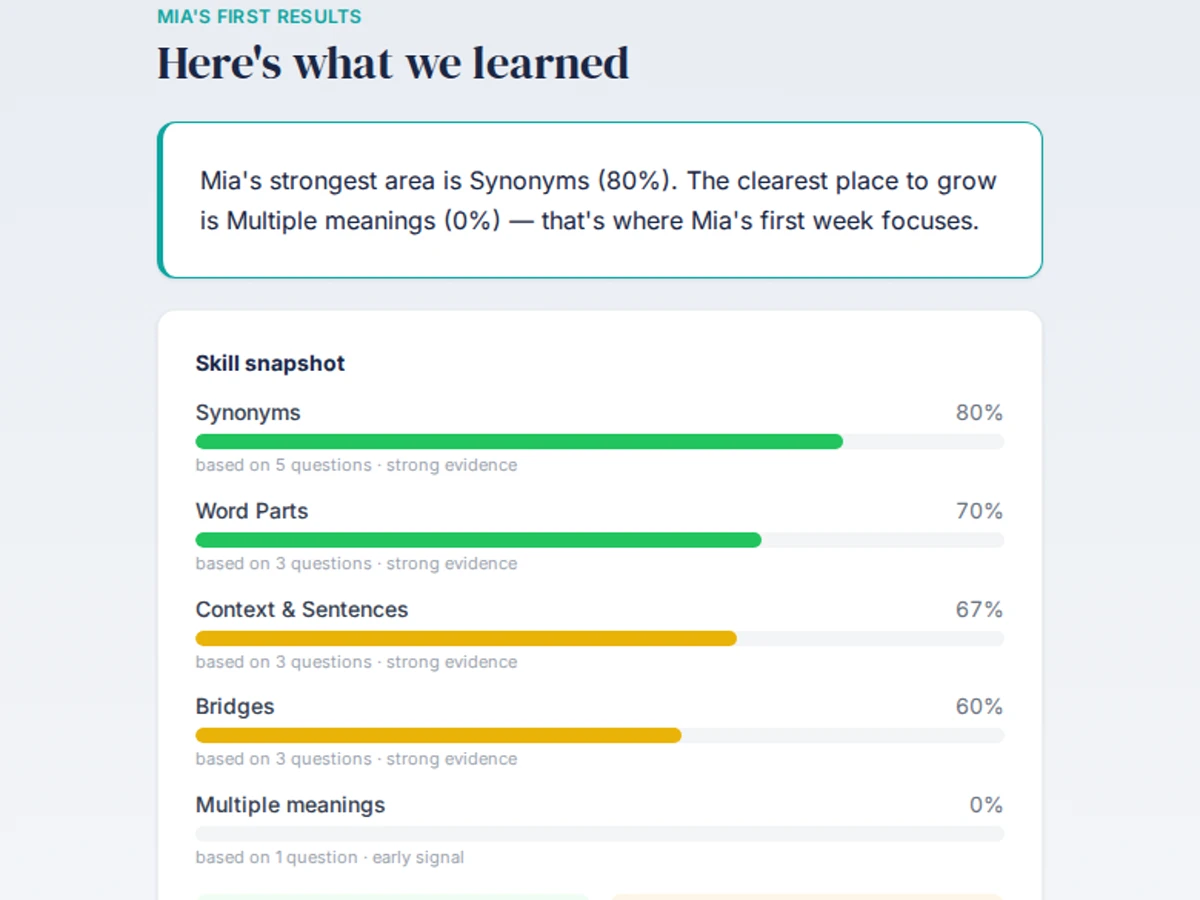
The check-up samples verbal skills and gives you an early strength, a growth area, and a first practice focus. It is not a full-length exam, an official SSAT or ISEE score, or an admissions prediction.
Your child has done the work. They know their roots, they recognize the hard words, they can define "ephemeral" and "obstinate" without hesitating. Then the score report comes back lower than the practice sessions promised, and you stare at it trying to make sense of the gap. The vocabulary clearly went in — so where did the points go?
They went somewhere most prep programs never talk about. Knowing the words is one thing. Spending those words correctly under a clock, with a penalty structure, against a fixed number of questions and a finite supply of attention, is something else entirely. That second skill set has a name even if nobody teaches it: the invisible curriculum — the execution skills that turn knowledge into a score. This post is about what it is, why it is separate from vocabulary, and how you can help your child build it and actually see it improve.
The gap between knowing the words and getting the score
Most test prep rests on a comfortable assumption: learn enough vocabulary and the score takes care of itself. It is half true. Word knowledge is necessary; it is just not sufficient.
A verbal section is not a vocabulary quiz in a quiet room with unlimited time. It is a performance, under constraints, with rules — a clock, a fixed number of questions, a scoring rule that (on the SSAT) punishes certain wrong answers, and your child's own attention, which degrades over a long sitting. Every one of those is a place where points leak, even from a child whose vocabulary is genuinely strong:
- A child spends ninety seconds on one stubborn analogy, then rushes the last six questions and misses three they actually knew.
- A child leaves eight questions blank because nobody told them whether guessing helps or hurts on their specific test.
- A child knows two choices are wrong but never crosses them out, so the remaining decision feels like a coin flip instead of a near-certain pick.
None of those is a vocabulary failure. Every one is an execution failure. Knowing the words puts the points on the table; execution decides how many your child collects. This is exactly why LexiMap is built around five co-equal verbal-skill domains rather than vocabulary alone — Vocabulary Knowledge is one, but Relational Reasoning, Contextual Inference, Test Execution, and Metacognition each carry their own weight on test day. This post lives in the fourth domain: the one that decides whether the other four ever show up on the score report.
What "test execution" means (the 5 invisible skills)
When prep programs do gesture at execution, they wave at it vaguely — "manage your time," "stay calm," "use strategy." That is a poster, not coaching. To build the skill, you break it into parts your child can practice one at a time. Test Execution decomposes into five trainable sub-skills:
- Pacing — distributing a fixed amount of time across a fixed number of questions so the clock never makes a decision for your child. The goal is not speed; it is not running out of room before the questions your child could have gotten.
- Elimination — actively ruling out wrong choices to shrink every question into a smaller, more winnable decision. This is the master skill, and it gets its own section.
- Guessing — knowing, for the specific test, whether to fill in every bubble or leave some blank, and how elimination changes that math. The right default is literally opposite on the SSAT and the ISEE.
- Triage — deciding in the moment which questions to answer now, which to flag and return to, and which to let go, so easy points are never sacrificed to hard ones.
- Stamina — sustaining accuracy across a long section so the back half scores as well as the front half.
Not one of these is about knowing more words. They are about spending word knowledge wisely under pressure — and every one is learnable. A child is not born a good pacer or a calm guesser; these are habits built through repetition with feedback, which is precisely why they belong in a curriculum, not a pep talk.
Pacing: why ~30 seconds per question changes how you study
On a verbal section, your child has roughly thirty seconds per question on average. That single number should reshape how you think about preparation, because it quietly redefines what "knowing a word" even means.
Thirty seconds is enough to recognize a word your child genuinely owns and to reason briefly through one they can decode. It is not enough to retrieve a half-remembered definition, second-guess it, and re-derive it from scratch. Under a clock, slow knowledge is functionally the same as no knowledge. That is why a child can "know" a word in calm review and still miss it on the test: the recall was real but too slow to survive thirty seconds of pressure.
So pacing is a lens you apply to everything else:
- Fluency matters as much as coverage. A word your child decodes instantly is worth more on test day than three they can decode eventually — which is why automatic recall, not just exposure, is the goal of good vocabulary work.
- A budget beats a stopwatch. Teach your child to think in an average, not a per-question countdown. If a question runs well past its share, that is the signal to decide — eliminate, guess, or flag and move — rather than keep grinding.
- The clock should never surprise you. A well-paced child reaches the final questions with time to spend; a poorly-paced child discovers in the last minute that six remain.
The most expensive pacing error compounds: over-investing early steals time from the back of the section, which is exactly where the hardest, highest-value questions tend to live. For a full treatment of how to structure the clock across a real section, see Verbal-Section Pacing & Time Management.
Process of elimination: turning a blank into a probable point
If you teach your child one execution skill, teach this one. Elimination is the master skill because it does double duty: it raises accuracy on questions your child can mostly reason through, and it transforms the math of guessing on questions they cannot.
A verbal multiple-choice question usually offers five answer choices, so a blind guess is one-in-five. But most wrong answers on a well-written test are wrong in recognizable ways — too extreme, off-topic, the opposite of what is asked, or a trap built from a word your child half-knows. Every choice your child can confidently cross off changes the odds:
- Eliminate one wrong choice, and a guess becomes one-in-four.
- Eliminate two, and it becomes one-in-three.
- Eliminate three, and your child chooses between two — a near coin flip that often resolves with one more second of thought.
"I have no idea" is almost never the true state of affairs. Your child rarely knows nothing; they usually know that some answers are clearly wrong. Elimination cashes in that partial knowledge instead of throwing it away.
The habit to build at home is physical and small: cross out wrong choices, every time, on every question. Marking eliminations commits the partial knowledge so your child stops re-evaluating dismissed options, and it makes the remaining decision visibly smaller. Five choices feel uncertain; two crossed out and three live ones feel — correctly — like closing in. Elimination is also the bridge to the next skill, because how many choices your child can eliminate decides whether a guess is smart or costly.
Guessing strategy: the SSAT −¼ penalty vs. the ISEE no-penalty rule
Here is where parents are most often given advice that is flatly wrong for their child's actual test — because the two major exams have opposite correct defaults. Get this backwards and your child either leaves easy points on the table or actively donates points away.
The SSAT: guess only after eliminating
The SSAT applies a guessing penalty: a wrong answer costs −¼ point, while a blank costs nothing. A purely blind guess on a five-choice question is, on average, a slightly losing bet — lucky hits do not quite cover the quarter-points lost on the misses. So the naive instruction "always fill in every bubble" is wrong for the SSAT.
But the penalty math flips the moment your child eliminates choices. Once two answers are crossed off, a guess among the remaining three becomes a positive-expected-value move: on average it gains more than the penalty costs. So the SSAT rule your child should internalize is:
If you can eliminate at least one or two choices, guess. If you truly cannot eliminate anything, it is defensible to skip.
That rule converts elimination from a nicety into a scoring engine — which is why the two skills must be taught together: on the SSAT, elimination is what earns your child the right to guess profitably.
The ISEE: never leave a blank
The ISEE has no guessing penalty. A wrong answer and a blank are scored identically — both earn no point. The logic inverts entirely: there is no downside to a guess and always some upside, so the correct default is absolute:
Answer every single question. Never leave a blank on the ISEE.
Even a blind one-in-five guess is free here, and an eliminated guess is better still. The trap on the ISEE is not over-guessing; it is running out of time with questions unanswered. So pacing and guessing interlock: your child should reserve the final seconds of each section to make sure every bubble is filled, even if some are educated guesses.
The uncomfortable takeaway resists a one-size-fits-all rule: the right guessing habit depends entirely on which test your child is sitting. An SSAT-drilled child who walks into an ISEE leaving blanks is throwing away points; an ISEE-trained "fill everything in" child who sits the SSAT and guesses blindly is bleeding quarter-points. If you are still deciding between the two, SSAT vs ISEE: A Comparison Guide lays out how their rules differ, and the SSAT Verbal Section Breakdown goes deeper on the SSAT's structure.
Question triage and stamina across a long section
The final two execution skills manage a sequence of questions and a supply of attention, not any single item.
Triage: protect the easy points
Your child's personal hard questions are scattered throughout the section. Triage is the habit of not letting one of them hijack the time that belongs to easier questions — a quick three-way sort made on the fly:
- Answer now — readable on sight; commit and move.
- Flag and return — probably gettable but needs more time; mark it, move on, circle back if time allows.
- Eliminate and guess — genuinely hard; apply what elimination is possible, take the best guess (subject to the test's penalty rule), and let it go.
The mindset to coach: every question is worth the same number of points. A hard analogy is worth no more than an easy synonym, so pouring three questions' worth of time into one hard item is a losing trade. Harvest every gettable point first, then spend leftover time on the stubborn ones — not the reverse.
Stamina: make the back half count
A verbal section is long enough that attention itself becomes a variable. Many children start sharp and fade, missing back-third questions because their focus is depleted — and the score report cannot tell "didn't know it" from "knew it but was running on empty." Stamina is trainable, but only if you train for it:
- Practice at section length, sometimes. Short daily sessions build knowledge, but your child also needs occasional full-length, timed reps so a complete section feels familiar.
- Build a tiny reset. A breath and a deliberate refocus between question clusters costs a second and recovers attention that careless errors would cost far more.
- Watch where errors cluster. If mistakes pile up in the back third, the problem is stamina, not vocabulary — and the fix is endurance practice, not more flashcards.
That last point is diagnostic: where errors fall tells you which execution skill to work on. Which raises the question every parent eventually asks — how do I actually see any of this?
Building execution at home — and seeing it on the dashboard
Execution skills have a frustrating property: they decide scores, yet they are nearly invisible to a parent. You can quiz your child on vocabulary at the kitchen table, but you cannot easily watch their pacing, count their unmarked eliminations, or notice that accuracy sags in the back third. That invisibility is why these skills get neglected — not because they do not matter, but because nobody could see them to coach them.
What you can do at home, even without instrumentation:
- Make elimination physical and mandatory. Insist on crossing out wrong choices on every practice question. It is the single habit with the highest return.
- Teach the right guessing default for the right test. Drill "eliminate, then guess (and skipping is okay)" for the SSAT, and "fill in every bubble, always" for the ISEE — and make sure your child knows which they are sitting.
- Do occasional full, timed sections. Build pacing and stamina under realistic conditions, then review where errors fell, not just how many.
But the real shift is being able to measure these habits rather than guess at them. This is where LexiMap is built differently from tools that report only how many words your child has seen. LexiMap's parent process-skills dashboard surfaces how your child is working, organized under a heading that maps directly to this post: Test Execution Skills, alongside Learning Skills and Behavioral Skills.
That Test Execution view is where the invisible becomes coachable. Pacing, elimination behavior, guess discipline, stamina, and triage stop being things you infer from a disappointing score and become a pattern you can watch over time. See that elimination is the gap, and you coach elimination; see that accuracy fades late, and you train stamina. The dashboard turns "I think the score should have been higher" into "here is the specific habit to work on this week." For the fuller picture across all of your child's process skills, see Metacognition & the Parent Process-Skills Dashboard, and for vocabulary-side gains, How to Improve Your Child's SSAT Verbal Score. If you would like your child's execution patterns surfaced this way, every plan starts with a 7-day free trial — enough time to run a few timed sessions and watch the Test Execution view fill in.
Key Takeaways
- Test execution is the "invisible curriculum" — five trainable skills vocabulary prep never touches.
- At ~30 seconds per question, pacing discipline protects the hard questions.
- Elimination is the master skill: it improves accuracy and guessing math.
- SSAT (−¼) and ISEE (no penalty) need opposite guessing defaults.
- Execution skill is measurable, not mystical — the dashboard makes it coachable.
Further reading:
- SSAT Verbal Section Breakdown
- SSAT vs ISEE: A Comparison Guide
- How to Improve Your Child's SSAT Verbal Score
- Metacognition & the Parent Process-Skills Dashboard
- Verbal-Section Pacing & Time Management
Get SSAT/ISEE vocabulary resources by email
Related Articles
Process of Elimination: The Verbal-Section Skill That Beats Guessing
Teach your child to eliminate wrong answers on SSAT/ISEE verbal questions — the technique that turns a blind guess into a high-probability point on test day.
Verbal-Section Pacing: Time Management and the Guessing-Penalty Math
How to pace your child through a timed verbal section — per-question budgets, when to skip, and how the SSAT penalty vs. ISEE no-penalty rule changes the plan.
50 Latin Root Words Every SSAT Student Should Know
Master the 50 most important Latin root words for the SSAT. Each root includes meaning, example words, and memory tips to build lasting vocabulary skills.
8 Ways a Strong Vocabulary Shapes Your Child's Future
Beyond test scores: the eight domains of adult life — from health and wealth to careers and emotional wellbeing — where research shows vocabulary makes a measurable difference.
Related Guides
SSAT Vocabulary: The Complete Guide to Root-Based Learning
Master SSAT vocabulary through Latin and Greek roots. Learn how root-based learning, spaced repetition, and interactive practice build lasting verbal skills for grades 4-12.
SSAT Vocabulary List: 200+ Words Organized by Level and Root
Comprehensive SSAT vocabulary word lists organized by test level (Elementary, Middle, Upper) and root word family. Study the right words for your child's grade.
SSAT® is a registered trademark of The Enrollment Management Association. ISEE® is a registered trademark of the Educational Records Bureau (ERB). LexiMap is not affiliated with or endorsed by these organizations.