SSAT vs ISEE: Complete Comparison Guide for Parents
Find your child’s vocabulary gaps
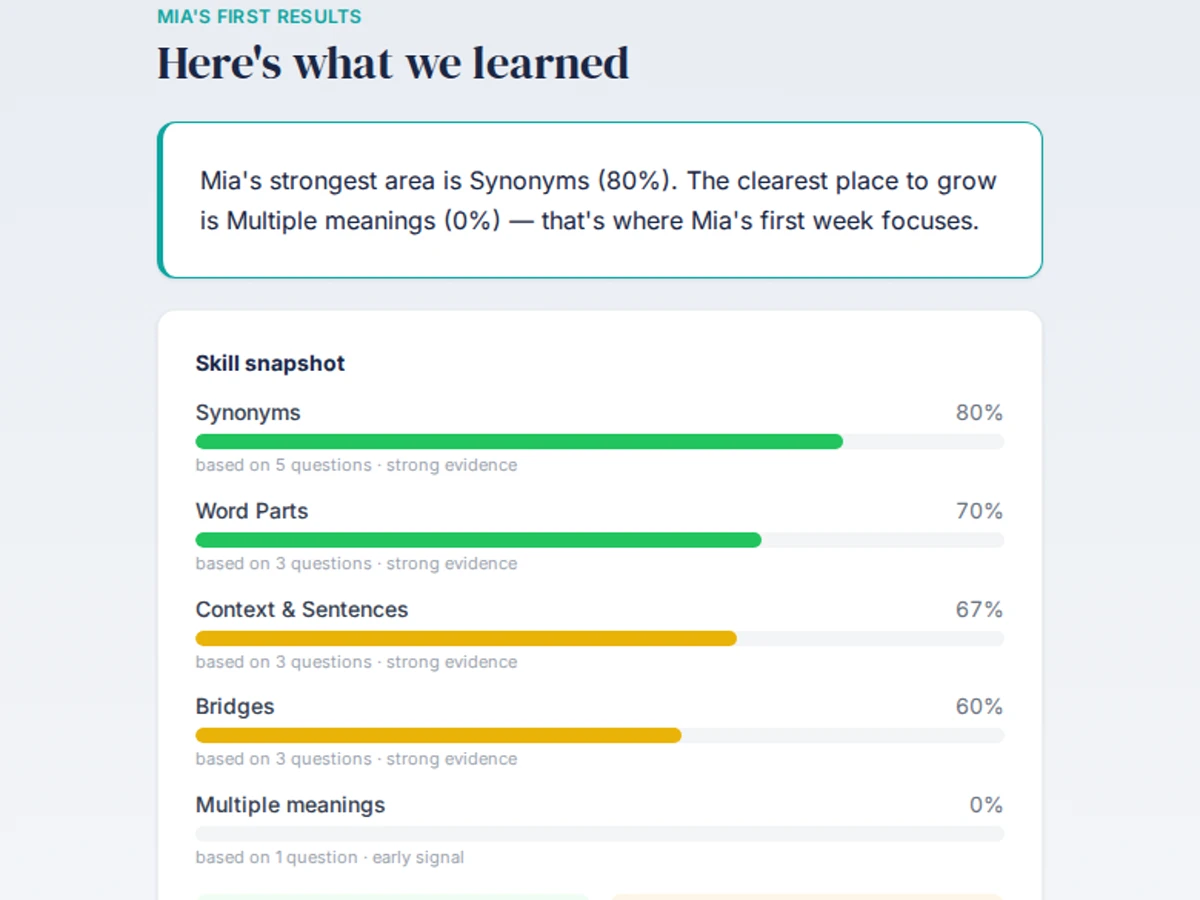
Start with a free, no-card vocabulary check-up and get a personalized parent report.
Find the vocabulary gaps — freeSee a sample parent report before starting
The check-up samples verbal skills and gives you an early strength, a growth area, and a first practice focus. It is not a full-length exam, an official SSAT or ISEE score, or an admissions prediction.
If your child is applying to independent schools, you have almost certainly encountered the SSAT vs. ISEE question. Both exams are accepted at most selective private schools, both test verbal skills, mathematics, and reading comprehension — and both can feel overwhelming to families encountering entrance exam prep for the first time.
This guide gives you a clear, side-by-side comparison of the two tests to help you decide which is the better fit for your child — or whether submitting scores from both makes sense.
Quick Comparison: SSAT vs. ISEE at a Glance
| Feature | SSAT | ISEE |
|---|---|---|
| Full name | Secondary School Admission Test | Independent School Entrance Exam |
| Publisher | The Enrollment Management Association | Educational Records Bureau (ERB) |
| Grade levels | 3 separate levels | 4 separate levels |
| Verbal section | Synonyms + analogies | Sentence completion + vocabulary |
| Verbal time | 30 min (synonyms) + 30 min (analogies) | 20 min verbal reasoning + 20 min reading |
| Wrong-answer penalty | Yes (−¼ point per wrong answer) | No wrong-answer penalty |
| Essay | Yes, unscored | Yes, unscored |
| How often you can take it | 8 times per testing year | 3 times per testing year |
| Score report delivery | ~2 weeks | ~2 weeks |
| Where accepted | Most independent schools | Most independent schools |
Test Levels: Which Level Does Your Child Take?
SSAT Levels
The SSAT has three levels:
- Elementary Level: Grades 3-4 (students applying to grades 4-5)
- Middle Level: Grades 5-7 (students applying to grades 6-8)
- Upper Level: Grades 8-11 (students applying to grades 9-12)
ISEE Levels
The ISEE has four levels:
- Primary Level: Grades 2-4 (students applying to grades 3-5)
- Lower Level: Grades 5-6 (students applying to grades 7-8)
- Middle Level: Grades 7-8 (students applying to grades 9-10)
- Upper Level: Grades 9-11 (students applying to grades 11-12)
The critical difference: the ISEE has a Primary Level that extends down to grade 2, while the SSAT begins at grade 3. Families applying to highly selective K-8 or K-12 independent schools for early grades should check whether their target schools require or prefer the ISEE Primary.
The Verbal Section: The Most Important Difference
The verbal section is where the SSAT and ISEE diverge most dramatically — and for verbal-focused families, this difference often determines which test to choose.
SSAT Verbal Section
The SSAT verbal section contains two distinct question types:
Synonyms (30 questions, 30 minutes): Given a single capitalized word, choose the answer closest in meaning. Example: AMBIVALENT — (A) uncertain (B) hostile (C) energetic (D) straightforward (E) cautious. Pure vocabulary depth; no sentence context is provided.
Analogies (30 questions, 30 minutes): Complete an A:B :: C:? relationship. Example: PAINTER : CANVAS :: (A) doctor : hospital (B) writer : paper (C) musician : melody (D) athlete : field (E) chef : kitchen. Tests word-relationship reasoning alongside vocabulary.
The SSAT verbal is considered vocabulary-heavy and specifically rewards students with broad lexical knowledge. A student who knows what ambivalent means can answer that question in 10 seconds. A student who does not know the word cannot easily use process of elimination or contextual reasoning.
ISEE Verbal Section
The ISEE verbal section also has two question types, but they are structured differently:
Synonyms/Sentence Completion (~17 questions): The ISEE begins its verbal section with single-word synonym questions similar to the SSAT, then shifts to sentence completion items that provide a sentence with a blank.
Reading Comprehension (separate section): The ISEE reading comprehension section is a full, separate section — it is not part of the "verbal reasoning" section. This is a meaningful structural difference from the SSAT, where reading comprehension is more integrated.
For students who struggle with pure vocabulary recall but reason well from context, the ISEE's sentence completion format can be more accessible. A student who doesn't know the precise definition of ambivalent might still infer the correct answer from a sentence like "Her ____ feelings about the move left her unable to decide whether to stay or go."
Scoring: The Wrong-Answer Penalty
This is the most practically significant difference between the two tests for many students.
SSAT scoring: Each correct answer earns +1 point. Each wrong answer deducts ¼ point. Omissions receive 0 points. This means random guessing slightly hurts your score; strategic guessing (when you can eliminate at least one answer) typically helps.
ISEE scoring: There is no wrong-answer penalty. Every question is worth the same regardless of whether you answer incorrectly or skip it. This means students should always answer every question on the ISEE.
Practical impact: Students who are anxious about guessing, or who tend to second-guess themselves and change correct answers to incorrect ones, often perform more comfortably on the ISEE. The cognitive load of managing a guessing strategy on the SSAT can affect performance for some students.
Conversely, students who are methodical and comfortable with strategic guessing can use the SSAT's penalty-based structure to their advantage — they can skip items where they have no useful information and spend more time on items where partial elimination is possible.
Frequency: How Often Can Your Child Take Each Test?
SSAT: Students may take the SSAT up to 8 times per testing year (September through August). Testing windows exist throughout the year, including flexible/independent testing options.
ISEE: Students may take the ISEE up to 3 times per testing year (once per season: fall, winter, spring). This significantly limits retake flexibility.
The SSAT's higher frequency limit benefits families who want to:
- Test early in the process to understand baseline scores
- Allow multiple attempts to reach a target score
- Reduce per-test anxiety by removing the "one shot" pressure
For families who prefer to test once and focus preparation energy on the first attempt, the ISEE's limit is less relevant.
Which Schools Accept Which Test?
The good news: the vast majority of independent schools that require a standardized entrance exam accept both the SSAT and ISEE. You should not choose a test based primarily on school acceptance — check your target schools' specific requirements, but in most cases either test is acceptable.
Exceptions to know:
- Some schools specify one test only. A small number of schools, particularly boarding schools with long-standing SSAT relationships, may state a preference for the SSAT. Always verify directly with each target school's admissions office.
- Catholic high schools using the HSPT do not typically use either the SSAT or ISEE. See our HSPT verbal section guide for Catholic high school admissions testing.
- NYC-area Catholic schools using TACHS and COOP exams have separate testing systems entirely.
Score Interpretation
SSAT Scaled Scores and Percentiles
SSAT scores are reported as scaled scores (ranging by level) and as percentile ranks compared to students who have taken the same level test over the past three years. This norm group is important: because it includes primarily students already applying to selective private schools, SSAT percentiles are lower than what families might expect from national norms.
A student who scores at the 60th percentile on the SSAT is performing at the 60th percentile among private school applicants — which translates to something like the 80th-85th percentile on national norms. This can initially surprise families who expect "above average" to mean 60th percentile or higher.
ISEE Scaled Scores and Stanines
The ISEE reports scaled scores and stanines (1-9 performance bands). Stanine 5 is average; stanines 7-9 represent above-average to high performance. The ISEE also reports percentile ranks.
A critical feature: the ISEE reports scores compared to all students at that grade level taking the test, but also separately compared to students applying to the same grade at the same school. Schools see both comparisons, giving them context for where your child falls among their specific applicant pool.
Verbal Prep Overlap: What Transfers Between Tests
Here is the practical good news for preparation: all the skills you develop for SSAT verbal prep transfer directly to ISEE verbal performance, and vice versa.
Both tests reward:
- Broad vocabulary with precise knowledge of word meanings
- Understanding of Latin and Greek roots and affixes
- Ability to reason about word relationships (analogies)
- Context-clue application (ISEE sentence completion)
A preparation approach based on root-word study, analogy practice, and vocabulary depth serves both tests simultaneously. If your child is applying to schools that accept both tests, you can prepare for one while remaining fully ready for the other.
Both tests reward the same five verbal domains — Vocabulary Knowledge, Relational Reasoning, Contextual Inference, Test Execution, and Metacognition — so a five-domain prep approach serves either test.
The main SSAT-specific skill worth additional attention: synonym recall under time pressure. The SSAT's synonym section rewards instant recall of word meanings without contextual support. Students preparing specifically for the SSAT should include timed synonym drills in their practice.
See our SSAT verbal study strategies guide for a structured 3-month preparation plan, and our ISEE verbal strategies by level guide for level-by-level preparation guidance.
Which Test Should Your Child Take?
There is no universally "easier" test — difficulty depends on the individual student. That said, here are the factors that tend to favor one test over the other:
SSAT might be a better fit if your child:
- Has broad, strong vocabulary (knows precise definitions without needing context)
- Is comfortable with strategic guessing under the wrong-answer penalty
- Wants to test multiple times with maximum flexibility
- Is applying primarily to schools where SSAT is traditionally preferred (many boarding schools)
- Has strong analogical reasoning skills
ISEE might be a better fit if your child:
- Reasons well from context (benefits from sentence completion format)
- Prefers not to manage a guessing strategy (no wrong-answer penalty)
- Is anxiety-prone and benefits from answer-all permission
- Is in the grades where the ISEE Primary level is the only test available (grades 2-4)
- Is applying to a school that specifically requires the ISEE
Consider taking both if:
- Your target schools accept both and have no preference
- Your child's scores on practice tests show significantly different performance between the two formats
- You have enough time in your test prep calendar to prepare for both (typically requires 4-5 months)
Frequently Asked Questions
Do schools see all SSAT scores or just the best one?
This depends on the school's policy and which score reporting option you choose. The SSAT's "Score Choice" option lets you select which scores to send; some schools require all scores. Always verify the specific policy with each target school.
Can we take both tests and submit whichever score is better?
Yes, in most cases. Since most schools accept both, you can submit your stronger performance. Some students take one test in fall and one in winter to compare. The cost of this approach is additional preparation time and test fees.
Is the SSAT harder than the ISEE?
Neither is categorically harder. The SSAT is widely considered more vocabulary-demanding because of its synonym-heavy format. The ISEE is sometimes considered more reasoning-oriented because of sentence completion and the lack of a guessing penalty. Student-by-student, the "harder" test varies.
What is a good score on the SSAT or ISEE?
"Good" is relative to your target schools and their applicant pools. For highly selective schools (Exeter, Andover, Hotchkiss, etc.), admitted students typically score above the 75th percentile on SSAT or in stanine 7+ on ISEE. Less selective schools may admit students across a wider score range. Contact each school's admissions office for specific expectations.
Key Takeaways
- Most independent schools accept both the SSAT and ISEE — choose based on your child's learning profile, not school acceptance.
- The SSAT is vocabulary-heavy with a guessing penalty; the ISEE uses sentence completion and has no wrong-answer deduction.
- Strong pure vocabulary recall favors the SSAT; contextual reasoning ability and guessing anxiety favor the ISEE.
- The SSAT allows up to 8 attempts per year; the ISEE allows only 3, so planning retakes requires earlier action.
- Root-based preparation transfers fully to both tests — the vocabulary pools overlap substantially.
Whether your child is preparing for the SSAT or ISEE, LexiMap's verbal training builds the root-word knowledge, analogy reasoning, and vocabulary depth both tests require. Explore our exam prep guides.
Get SSAT/ISEE vocabulary resources by email
Related Articles
Best Vocabulary Apps for Private-School Admissions Tests (2026)
Compare vocabulary prep apps for private-school entrance exams — SSAT, ISEE, HSPT, and more. What to look for, honest tool comparisons, and how to choose for your child.
LexiMap vs. Membean for SSAT and ISEE Vocabulary Prep
Compare LexiMap and Membean for grades 6–12 vocabulary learning and focused SSAT/ISEE verbal practice, including personal-plan access and where each tool fits.
SSAT vs ISEE: Which Test Does Your Child Need?
SSAT or ISEE? This honest comparison covers format, scoring, school preferences, and a clear decision framework to help you choose the right test for your child.
Best ISEE Vocabulary Apps and Tools: A 2026 Comparison
Compare the best ISEE vocabulary prep apps — LexiMap, Quizlet, general vocabulary platforms, and practice tests. What actually prepares kids for ISEE synonyms and sentence completions.
Related Guides
SSAT Vocabulary: The Complete Guide to Root-Based Learning
Master SSAT vocabulary through Latin and Greek roots. Learn how root-based learning, spaced repetition, and interactive practice build lasting verbal skills for grades 4-12.
Root Words for SSAT & ISEE: The Complete Study Guide
The definitive guide to Latin and Greek root words for SSAT and ISEE preparation. Curated root set, study strategies, grade-level timelines, and practice exercises for grades 4-12.
SSAT® is a registered trademark of The Enrollment Management Association. ISEE® is a registered trademark of the Educational Records Bureau (ERB). LexiMap is not affiliated with or endorsed by these organizations.