Verbal-Section Pacing: Time Management and the Guessing-Penalty Math
Find your child’s vocabulary gaps
Start with a free, no-card vocabulary check-up and get a personalized parent report.
Find the vocabulary gaps — freeSee a sample parent report before starting
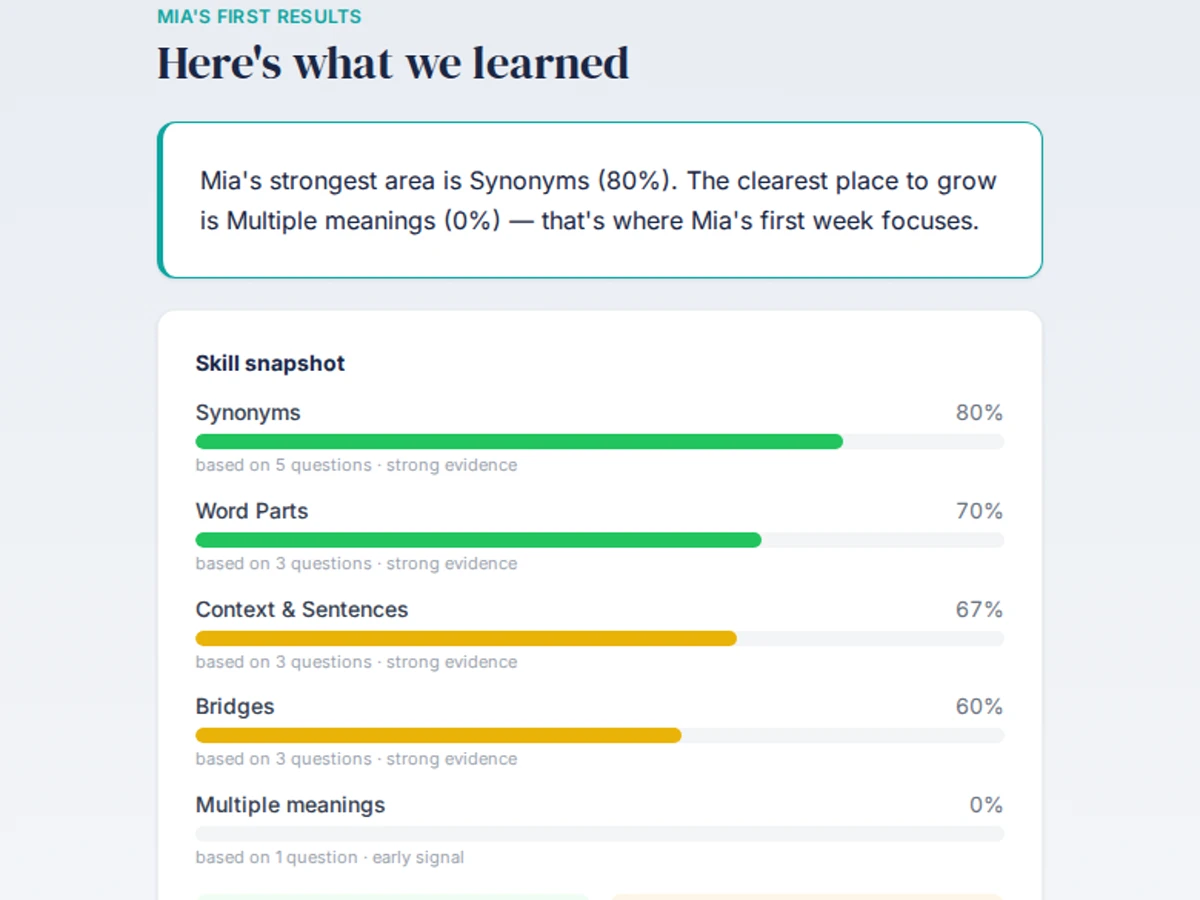
The check-up samples verbal skills and gives you an early strength, a growth area, and a first practice focus. It is not a full-length exam, an official SSAT or ISEE score, or an admissions prediction.
Your child finished the section. At least, that is what you assumed. Then you hear that they had eight questions still on the page when the proctor called time — and at least three of those were on words they absolutely knew. The vocabulary was there. The time was not.
Pacing is not a test-day emergency you fix with a pep talk in the car. It is a trainable skill with learnable mechanics: a per-question budget, a two-pass route, and a guessing rule that is literally opposite on the two major tests your child might sit. Most prep programs teach words and trust the clock will sort itself out. It does not. What follows is the parent-facing version of what LexiMap calls Test Execution — the fourth of five verbal domains, and the one that decides whether the vocabulary your child built ever shows up on the score report.
The real clock: roughly thirty seconds per question
At the SSAT Middle and Upper levels, and at the ISEE Middle and Upper levels, a verbal section gives your child approximately thirty seconds per question on average. That number is not a recommendation — it is an arithmetic reality derived from the section's time limit and question count. It is also the single most useful framing you can give your child before they sit down to prep.
Thirty seconds is enough time to recognize a word your child genuinely owns and to reason briefly through one they can partially decode. It is not enough to retrieve a half-remembered definition, second-guess it, argue internally between two choices, and re-derive the answer from scratch. Under a clock, slow knowledge is functionally the same as no knowledge — a child can legitimately own a word and still miss it on test day because the recall was real but too slow to survive a thirty-second window.
This is why fluency matters as much as coverage in vocabulary prep. A word your child can surface in two seconds is worth more on test day than five words they can surface in forty seconds each. Knowing the clock number also changes how your child behaves when a question turns hard: rather than grinding past the thirty-second mark and hoping it resolves, a practiced child recognizes the overrun as the signal to make a decision — eliminate, guess or skip, and move. The clock stops being a surprise and starts being a partner.
The two-pass method: bank the easy points first
A verbal section is not a locked maze where you must solve every room before the door to the next one opens. Your child can move freely, and the single most reliable thing they can do with that freedom is to complete the section in two passes.
First pass — the harvest. Move at a steady pace. Answer every question that is clearly readable on sight: the vocabulary synonym they know cold, the analogy whose relationship names itself immediately. Skip anything that requires real deliberation without marking an answer. The goal is to lock in every easy point before time can take it away.
Second pass — the investment. Return to the skipped questions. Now the easy points are safe and you can spend the remaining time on the hard ones with a clear conscience. If time runs short here, the loss is limited to the genuinely difficult items — not the easy ones buried under a question that ran long.
The key behavior to drill: mark skips clearly and keep moving. Many children instinctively grind at a hard question rather than move on, because stopping feels like giving up. Reframe it for them: skipping a hard question to protect an easy one is the disciplined choice, not the lazy one. Every question is worth exactly the same number of points; the only question is in what order to collect them.
When to skip and when to commit
The two-pass method requires a real-time decision at every hard question. Your child needs a clean rule, not a feeling. Here is the one to internalize:
- Commit if they can identify a definite answer or eliminate enough choices to make a good guess — even if they are not certain. Certainty is a luxury; confidence after elimination is enough.
- Skip if they have no traction at all after about ten seconds of initial reading. A question that gives nothing in the first scan is unlikely to give much in the next thirty seconds of staring. Flag it and move.
The discipline is in the skip. Children who have never been coached to skip will over-invest in hard questions because the sunk cost of ten seconds already spent makes moving on feel like waste. Teach them the opposite: the cost of staying is measured in the easy points being left unprotected at the end of the section. The moment a question crosses its time budget, the calculus has already resolved — skip, move, return.
Triage lives here too. Some skipped questions are worth returning to (probably gettable with another look); others are true coin flips to be guessed and released. Both are legitimate outcomes. The skill is sorting them efficiently rather than agonizing at each one.
The SSAT guessing penalty, explained for parents
This is where many families operate with the wrong information — and the wrong information costs real points. The SSAT applies a scoring rule that changes the guessing calculation entirely.
On the SSAT: a correct answer earns +1 point. A wrong answer costs −¼ point. A blank earns 0. There are five answer choices per question.
Run the expected value for a pure blind guess:
(1/5)(+1) + (4/5)(−¼) = +0.20 − 0.20 = 0.00
A blind guess on the SSAT is exactly break-even. On average, it neither gains nor loses points. That is why "always fill in every bubble" is wrong for the SSAT — it is not that guessing hurts, but that blind guessing does not help, so skipping a question your child cannot read at all is a defensible choice.
Now eliminate one wrong choice, leaving four options:
(1/4)(+1) + (3/4)(−¼) = +0.25 − 0.1875 = +0.0625
Positive expected value. Removing even a single choice tips the math in your child's favor. Eliminate two choices and it tips further; eliminate three and the guess is between two options, one of which your child often has a genuine reason to prefer.
The SSAT rule for your child to internalize: guess once you can eliminate at least one choice. Pure blind guessing only breaks even, so skipping a completely opaque question is fine — but the moment one answer is clearly eliminable, guessing is the correct move. This is why elimination and guessing must be taught as a pair on the SSAT: elimination is what earns the right to guess profitably.
The ISEE has no penalty — so the rule flips
The ISEE uses a different scoring model, and it changes everything about how your child should approach the last two minutes of a section.
On the ISEE, a wrong answer and a blank are scored identically: both earn zero points. There is no deduction for a wrong answer. The implication is absolute:
Answer every single question. Never leave a blank on the ISEE.
Even a pure blind guess among five choices is free on the ISEE. There is no downside to filling in a bubble and some upside — even one-in-five at random gains points on average. An eliminated guess is better still. The only guessing mistake on the ISEE is not guessing.
The trap here is the child who was drilled on SSAT caution and carries the "be careful about guessing" habit into an ISEE sitting. That habit actively costs points on the ISEE. The correct ISEE pacing strategy reserves the final moments of each section for a sweep: if any bubbles are empty, fill them — even randomly, because random is free. Pacing and guessing interlock directly on the ISEE: running out of time with unanswered questions is the worst outcome, not a wrong answer.
If your child is still deciding which test to sit, SSAT vs ISEE: A Comparison Guide walks through how their rules and formats differ. For a deeper look at the SSAT's specific structure, see SSAT Verbal Section Breakdown.
Building timing stamina without burning your child out
Pacing is not only a strategic skill; it is a physical one. Attention degrades across a long sitting, and many children who start a section sharp are running on fumes by the back third. That stamina gap is often invisible on the score report — the report says they missed those questions, but it does not say why. When errors cluster in the back third and not evenly across the section, the culprit is usually endurance, not vocabulary.
Stamina is trainable, but only if you practice at the right scale:
- Short daily practice builds knowledge. Fifteen to twenty minutes of word and root work each day is exactly right for vocabulary acquisition. It is not sufficient for stamina.
- Occasional full-length timed sections build endurance. Your child needs to have sat through a complete timed verbal section, more than once, before test day — so the experience is familiar rather than exhausting. Once every one to two weeks of prep is a reasonable cadence for full-section reps.
- Build a reset habit. A slow breath and a deliberate shift of focus between question clusters costs under a second and can recover meaningful attention. Teach it in practice so it becomes automatic under pressure.
- Watch where errors cluster. If accuracy falls off in the back third, more flashcards will not fix it. The fix is endurance practice — more full-length reps, not harder words.
The goal is for a complete timed section to feel mundane. Novelty plus fatigue is a combination test day does not need.
Practicing pace at home — and reading it on the dashboard
You can build solid pacing habits at home with a clock and a practice set, even without sophisticated instrumentation. The fundamentals are simple:
- Set a budget and say it aloud. Before a timed set, tell your child the per-question target (roughly thirty seconds) and remind them that going long on one question means going short on another.
- Make the two-pass route explicit. Walk through it once with a practice set before asking your child to apply it independently. Name the skip, explain the return, celebrate the harvest.
- Teach the right guessing default for the right test — and make sure your child knows which test they are preparing for. SSAT: eliminate one choice, then guess (blind is break-even so skipping is fine). ISEE: fill every bubble, always.
- Debrief on timing, not just accuracy. After a timed section, ask where time felt tight, not just which answers were wrong. Where it felt tight is often more diagnostic than what got marked incorrect.
LexiMap's parent process-skills dashboard goes further. Under the Test Execution Skills view — alongside Learning Skills and Behavioral Skills — you can watch pacing patterns, guess behavior, and elimination habits surface over time rather than inferring them from a single score. The invisible skill becomes a visible trend: see that accuracy sags late, and you add full-section reps; see that guessing is erratic, and you revisit the rule for the correct test. All plans start with a 7-day free trial, which is enough time to run a handful of timed sessions and see how the Test Execution view fills in.
For the full picture of the test-execution domain your child is building toward, see The Invisible Curriculum: Test-Execution Skills. For a study plan that builds pacing and vocabulary together, see The Last-Minute SSAT 30-Day Plan.
Key Takeaways
- A per-question budget and a two-pass route beat telling your child to "go faster."
- Bank every easy point before slowing down for the hard ones.
- On the SSAT, guess once you can eliminate at least one choice; a pure blind guess only breaks even.
- On the ISEE there is no penalty — answer every question.
- Pacing stamina is built with short, regular, full-length timed practice.
Further reading:
- SSAT Verbal Section Breakdown
- SSAT vs ISEE: A Comparison Guide
- The Last-Minute SSAT 30-Day Plan
- The Invisible Curriculum: Test-Execution Skills
Get SSAT/ISEE vocabulary resources by email
Related Articles
Best Vocabulary Apps for Private-School Admissions Tests (2026)
Compare vocabulary prep apps for private-school entrance exams — SSAT, ISEE, HSPT, and more. What to look for, honest tool comparisons, and how to choose for your child.
Entrance Exam Test Dates 2026-2027: Complete Calendar
Complete 2026-2027 test date calendar for SSAT, ISEE, HSPT, TACHS, COOP, and CogAT. Registration deadlines, testing windows, and score release dates in one place.
The Complete List of Latin and Greek Roots for SSAT Vocabulary
Learn 60+ Latin and Greek roots used in academic vocabulary for SSAT/ISEE preparation. Free root word tables, study strategies, and a test-question walkthrough for grades 4–12.
LexiMap vs. Membean for SSAT and ISEE Vocabulary Prep
Compare LexiMap and Membean for grades 6–12 vocabulary learning and focused SSAT/ISEE verbal practice, including personal-plan access and where each tool fits.
Related Guides
SSAT Vocabulary: The Complete Guide to Root-Based Learning
Master SSAT vocabulary through Latin and Greek roots. Learn how root-based learning, spaced repetition, and interactive practice build lasting verbal skills for grades 4-12.
Root Words for SSAT & ISEE: The Complete Study Guide
The definitive guide to Latin and Greek root words for SSAT and ISEE preparation. Curated root set, study strategies, grade-level timelines, and practice exercises for grades 4-12.
SSAT® is a registered trademark of The Enrollment Management Association. ISEE® is a registered trademark of the Educational Records Bureau (ERB). LexiMap is not affiliated with or endorsed by these organizations.