Process of Elimination: The Verbal-Section Skill That Beats Guessing
Find your child’s vocabulary gaps
Start with a free, no-card vocabulary check-up and get a personalized parent report.
Find the vocabulary gaps — freeSee a sample parent report before starting
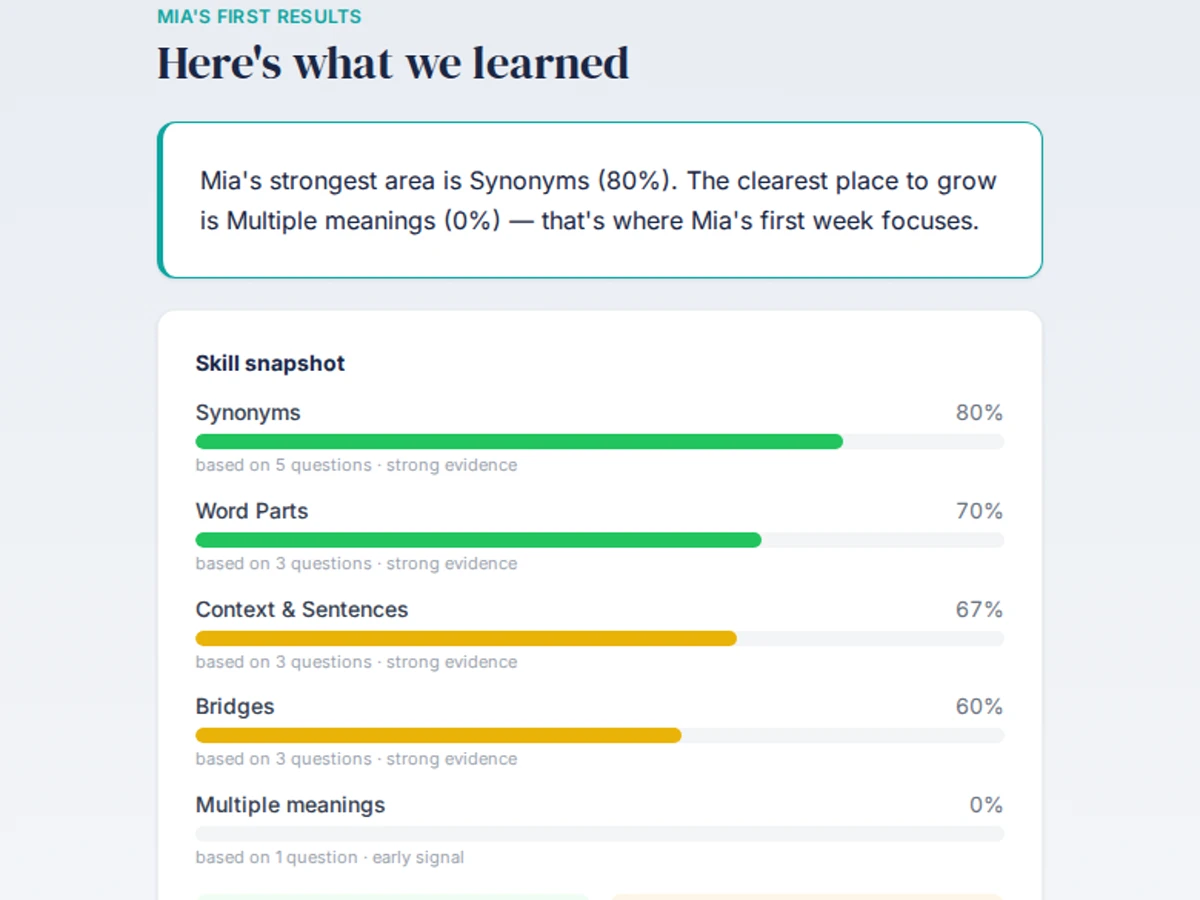
The check-up samples verbal skills and gives you an early strength, a growth area, and a first practice focus. It is not a full-length exam, an official SSAT or ISEE score, or an admissions prediction.
Most students treat multiple-choice as a selection problem: read the question, find the right answer, move on. That framing is subtly wrong — and it costs points. The right frame is a removal problem: read the question, discard everything that cannot be correct, then pick from what remains. That shift sounds small, but it changes the sequence of thinking, the time per question, and the expected value of every guess your child makes when the answer is not obvious.
Process of elimination is not a fallback when your child is stuck. It is the primary strategy, applied first, on every verbal question — because the structure of a well-designed test means that wrong answers are usually visibly wrong if you know where to look. Synonyms, analogies, and sentence completions each expose wrong choices through a different lens: word charge, bridge type, and signal words, respectively. Learning to read those lenses is what turns a verbal section from a vocabulary quiz into a winnable reasoning exercise.
This post gives your child a question-type-by-question-type elimination framework, then shows how the math of guessing changes the moment even one choice is removed.
Why elimination beats "picking the best answer"
When a student reads a verbal question and immediately scans for the right answer, they put themselves in a vulnerable position: every answer choice can seem plausible if you are not actively testing it against a specific criterion. The mind pattern-matches to familiarity, and test writers know this. Trap answers are designed to feel right — a word that sounds similar to the stem, a relationship that rhymes with the correct one, a word that fills the blank smoothly without fitting the logic.
Elimination inverts the vulnerability. Instead of asking "which of these could be right?" your child asks "why is each of these wrong?" Those are different cognitive tasks, and the second one is easier on hard questions because wrong answers fail a specific, testable rule. A synonym choice with the wrong charge fails on connotation. An analogy choice with the wrong bridge fails on relationship type. A sentence-completion choice that contradicts a signal word fails on logic direction. These failures are visible before you need to know the correct answer at all.
The practical habit to build is physical: cross out eliminated choices as you go. Marking a crossed-out choice removes it from the decision space permanently, so your child stops re-evaluating answers they have already dismissed. Five choices feel like uncertainty; two crossed out and three live ones feel, correctly, like a closing argument. The physical act of striking through a letter is the difference between elimination as an idea and elimination as a tool.
Eliminating on synonyms: charge, register, and obvious misfits
Synonyms test vocabulary knowledge most directly, but even a student who does not know the precise definition of the stem word can eliminate on charge and register before anything else.
Charge is the positive-or-negative valence of a word. A stem word that carries a clearly negative meaning — something like "berate" or "perfidious" — cannot have a positive-charge synonym. Any answer choice your child can identify as clearly positive (admirable, generous, kind) is gone immediately, before any deeper reasoning is needed.
Register is the formality and intensity level. A word meaning something mild or neutral cannot match an extreme synonym; a word meaning something intense cannot match a tepid one. If the stem word feels like a strong, high-intensity word and an answer choice is clearly mild, eliminate it.
Obvious misfits are choices your child genuinely recognizes as wrong — words they know whose meaning is unrelated, or clearly the opposite of what the stem means. Students sometimes hesitate to eliminate a word they recognize for fear of overconfidence. Teach them the opposite habit: if you know a word well enough to know it is wrong, cross it out without hesitation.
After charge, register, and misfits are removed, the remaining choices are the ones your child reasons through more carefully. Often the decision is now between two plausible options, not five uncertain ones.
Eliminating on analogies: rule out by bridge type first
Analogies have a structural feature that makes elimination powerful before vocabulary even enters the picture: every correct answer must share the same bridge type as the stem pair. That means every answer choice with the wrong relationship type is eliminated by logic, regardless of the words themselves.
The sequence is: identify the stem pair's bridge type (antonym, cause-to-effect, tool-to-user, part-to-whole, characteristic, degree, etc.), then scan answer choices and cross out any pair whose relationship is a different type. This usually removes two or three choices immediately and leaves a smaller field of plausible candidates among which the bridge sentence does the final work.
This section covers the principle; the full drill with relationship types and worked examples lives in SSAT Analogy Strategies, and the practice set organized by bridge type is at SSAT Analogy Practice: Bridge Types. Apply the principle here, then work through those posts for the complete technique.
Eliminating on sentence completions: let signal words cut choices
Sentence completions give your child explicit structural help that analogies and synonyms do not: the sentence itself contains signal words that constrain the direction of the blank. Teaching your child to read for signal words before reading the answer choices turns elimination into a one-pass process.
Contrast signals — words like although, however, despite, but, yet, while, on the other hand — indicate that the blank should go in the opposite direction from the rest of the sentence. If the sentence describes a situation that is positive, the blank should supply something negative, or vice versa. Any answer choice that points in the same direction as the surrounding sentence is eliminated immediately.
Continuation signals — words like and, also, because, since, therefore, as a result, furthermore — indicate that the blank should reinforce or extend what the rest of the sentence says. Any choice that contradicts or reverses the surrounding tone is eliminated immediately.
Definition signals — phrases like that is, in other words, known as, called, or an em-dash followed by an explanation — indicate that the blank is being defined directly by the sentence. The blank and the definition must match in meaning and charge.
After signal words identify the direction, your child narrows by charge (positive or negative), then by any vocabulary recognition among the remaining choices. Sentence completions are the question type where signal-word reading most reliably reduces five choices to two on the first pass.
The elimination-to-guessing bridge
This is the section where the math matters most, because parents and students frequently receive advice that is simply wrong for their child's specific test. The SSAT and ISEE have opposite correct defaults.
On the SSAT: wrong answers carry a penalty of −¼ point; blanks cost nothing. A purely blind guess across five choices is expected-value neutral — the probability of being right and the penalty for being wrong cancel out almost exactly, making blind guessing a wash, not a loss. The key word is blind: the moment your child eliminates even one choice, the math tilts positive. With four choices instead of five, the expected value of guessing becomes slightly positive. With three remaining, it becomes meaningfully positive. The rule to internalize: on the SSAT, guess once you can eliminate at least one choice. A blank is only defensible when your child genuinely cannot eliminate anything at all.
On the ISEE: there is no guessing penalty whatsoever. A wrong answer and a blank score identically — zero points. The implication is absolute: on the ISEE, never leave a blank. Even a blind one-in-five guess is free, and an eliminated guess is better still. The mistake ISEE students make is running out of time before filling in every bubble; that is a pacing problem that leaves guaranteed chances for points unclaimed.
The uncomfortable reality is that these two defaults are exact opposites, and a child who has drilled one exam's habit and then sits the other will actively hurt their score. Make sure your child knows which test they are sitting and has practiced the correct guessing default under timed conditions.
The SSAT and ISEE differ in other important ways — structure, score reporting, score banking — covered in SSAT vs ISEE: A Comparison Guide.
Drilling elimination at home — and the dashboard's Test Execution Skills view
Elimination is a habit, not an insight. Your child can understand the idea in five minutes; what takes time is making it the automatic first move on every question, including the ones they are confident about. These drills build that automaticity.
The forced-elimination drill: On any practice set, require your child to cross out at least one answer choice on every question before committing to an answer. On questions they find easy, this feels redundant — that feeling is the point. Elimination on easy questions cements the habit so it is available on hard ones.
The wrong-answer autopsy: After any timed practice set, go back through missed questions and ask not "what is the right answer?" but "which answer choices should you have been able to eliminate, and why didn't you?" Wrong answers are usually wrong in a specific, identifiable way. Pattern-recognizing those ways is the actual learning.
The charge-only pass: On a set of synonym questions, have your child go through every choice and label each one positive, negative, or neutral before doing any other reasoning. Then cross out every choice whose charge is incompatible with the stem's charge. No dictionary, no vocabulary needed — just charge reading. This single pass often removes one or two choices per question.
Signal-word scavenger hunt: On sentence-completion practice, have your child read each sentence and mark the signal word(s) before reading any answer choices. Then predict the direction of the blank — contrast or continuation — before engaging with the choices at all.
On the assessment side, LexiMap surfaces how well your child is applying elimination during practice sessions. The parent process-skills dashboard organizes performance under three headings — Test Execution Skills, Learning Skills, and Behavioral Skills — and the Test Execution view shows elimination behavior as a trackable pattern rather than a number you infer after the fact. When elimination is the gap, you see it; you coach it; it moves. That feedback loop is what separates execution training from execution advice. For the full picture of what the Test Execution domain covers alongside Metacognition and the other three verbal domains, see The Invisible Curriculum: Test-Execution Skills. All plans start with a 7-day free trial — enough time to run a few timed sessions and watch the Test Execution Skills view fill in.
Key Takeaways
- Elimination is a removal skill, not a selection skill.
- Synonyms eliminate on connotation and charge; analogies on the wrong bridge type; completions on signal-word direction.
- On the SSAT, eliminating even one choice makes a guess positive-expected-value.
- On the ISEE there is no penalty — never leave a blank.
- Elimination and guessing must be taught together, not separately.
Further reading:
- SSAT Analogy Strategies
- SSAT Analogy Practice: Bridge Types
- SSAT vs ISEE: A Comparison Guide
- The Invisible Curriculum: Test-Execution Skills
Get SSAT/ISEE vocabulary resources by email
Related Articles
Best Vocabulary Apps for Private-School Admissions Tests (2026)
Compare vocabulary prep apps for private-school entrance exams — SSAT, ISEE, HSPT, and more. What to look for, honest tool comparisons, and how to choose for your child.
Entrance Exam Test Dates 2026-2027: Complete Calendar
Complete 2026-2027 test date calendar for SSAT, ISEE, HSPT, TACHS, COOP, and CogAT. Registration deadlines, testing windows, and score release dates in one place.
The Invisible Curriculum: The Test-Execution Skills That Decide Verbal Scores
Vocabulary gets your child ready; test execution gets the score. The pacing, elimination, guessing, and triage skills most prep ignores — and how to build them.
The Complete List of Latin and Greek Roots for SSAT Vocabulary
Learn 60+ Latin and Greek roots used in academic vocabulary for SSAT/ISEE preparation. Free root word tables, study strategies, and a test-question walkthrough for grades 4–12.
Related Guides
SSAT Vocabulary: The Complete Guide to Root-Based Learning
Master SSAT vocabulary through Latin and Greek roots. Learn how root-based learning, spaced repetition, and interactive practice build lasting verbal skills for grades 4-12.
Root Words for SSAT & ISEE: The Complete Study Guide
The definitive guide to Latin and Greek root words for SSAT and ISEE preparation. Curated root set, study strategies, grade-level timelines, and practice exercises for grades 4-12.
SSAT® is a registered trademark of The Enrollment Management Association. ISEE® is a registered trademark of the Educational Records Bureau (ERB). LexiMap is not affiliated with or endorsed by these organizations.