From Error Log to Score Gains: The Habit That Compounds Verbal Practice
Find your child’s vocabulary gaps
Start with a free, no-card vocabulary check-up and get a personalized parent report.
Find the vocabulary gaps — freeSee a sample parent report before starting
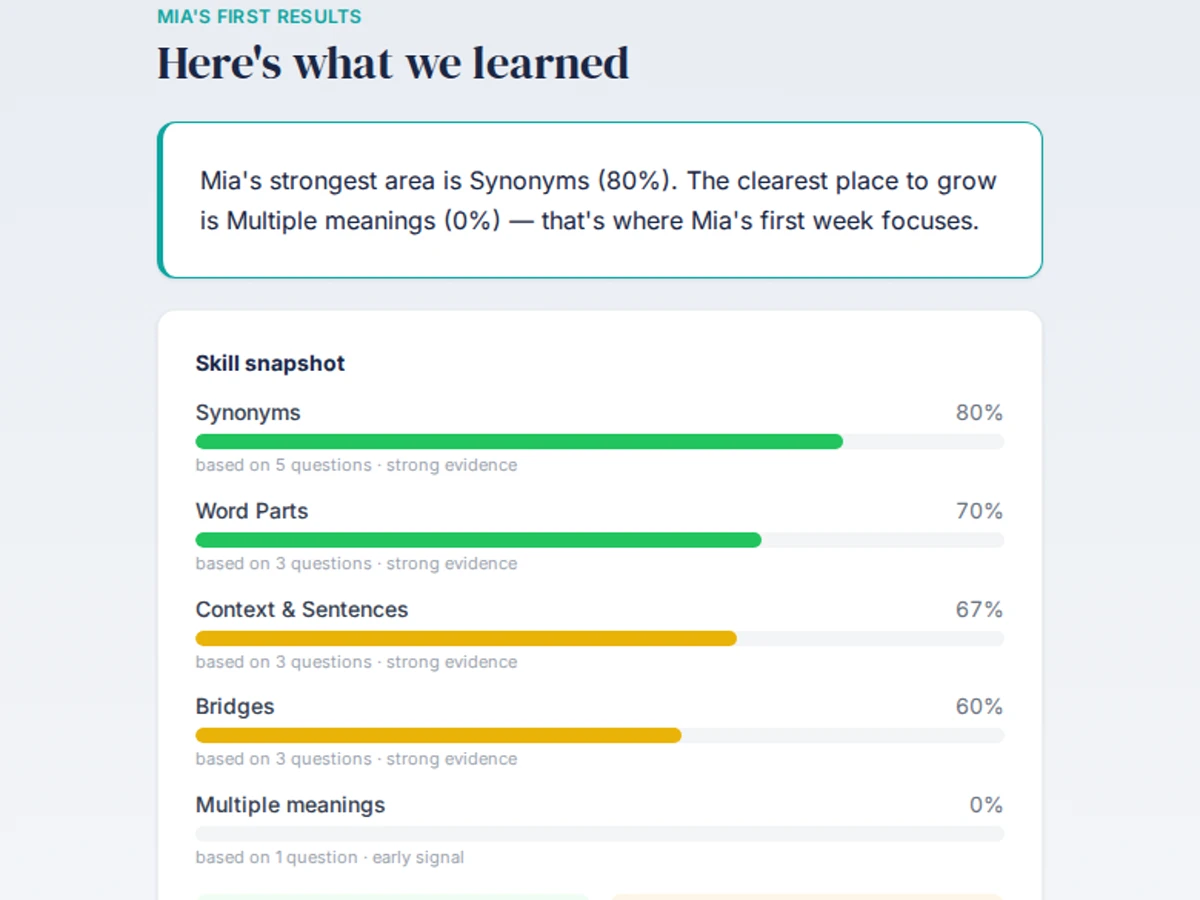
The check-up samples verbal skills and gives you an early strength, a growth area, and a first practice focus. It is not a full-length exam, an official SSAT or ISEE score, or an admissions prediction.
Your child finished a practice test. You circled the wrong answers, noted the score, and moved on to the next set of questions. That is the version of review most families do — and it is also the version that leaves most of the improvement on the table.
A score tells you how many questions your child missed. It does not tell you which kind of mistake each one was, whether those mistakes share a pattern, or which category of practice would close the gap fastest. Without that information, more practice mostly means more of the same — the same word lists, the same question formats, the same errors made again and less visibly. The session that actually earns points is the review session: the hour you spend categorizing misses rather than just tallying them.
This post is the parent's practical guide to that review habit. We will walk through why re-doing tests rarely raises scores by itself, name the five specific verbal error types your child is most likely making, show you how to build an error log your child will actually maintain, and explain how the Learning Skills view in LexiMap's dashboard automates the entire habit.
Why re-doing practice tests doesn't raise scores
Most families use practice tests as a measure: take the test, get a number, repeat. The implicit hope is that the act of doing more tests will move the score upward on its own. Sometimes it does — in the early weeks of prep, when your child is raw and the simple exposure to test-format questions teaches them something new each time. But that learning curve flattens quickly. After the first few tests, doing another practice test without structured review mostly confirms the existing error patterns rather than fixing them.
The research on learning is clear on why: retrieval is strengthened by corrective feedback, not just by more retrieval attempts. Your child does not improve on near-synonym errors by missing more near-synonym questions under timed conditions; they improve by understanding exactly how a near-synonym trap is built, recognizing the pattern in the questions they missed, and then practicing specifically against that error type. That corrective loop cannot happen without a review step that identifies which type of error occurred.
There is a second cost to review-free repetition that is less obvious: it teaches your child to accept errors as random, not diagnostic. A child who goes through a practice test, checks the answers, and circles the wrong ones without analyzing them learns — over time, implicitly — that mistakes are just things that happen, not data that means something. That framing works against the metacognitive habit this post is about. The reframe you want to install instead is: every wrong answer is a question with an answer. The question is, which type of mistake caused this? And once your child can ask that question fluently, the practice test stops being a verdict and starts being a planning tool.
The five error types in verbal
Verbal errors are not random. They cluster into a small number of named types, and each type has a different cause and a different fix. Lumping them all as "missed it" misses the point. Here are the five types to teach your child:
-
Unknown word. The word was genuinely outside your child's knowledge — not decodable from any root or affix they own, and not inferrable from context. The fix is content: more root study, more reading exposure, more vocabulary work in that word's semantic neighborhood.
-
Near-synonym slip. Your child knew the correct word but chose a tempting answer that was close but not quite right — a word that overlaps in meaning but misses on register, connotation, or degree. These errors are especially common on synonym questions where several choices seem plausible. The fix is precision practice: drilling the distinction between words that feel similar, and slowing down to test each candidate rather than taking the first one that feels comfortable.
-
Wrong analogy bridge. Your child knew both words in an analogy pair but named the relationship between them incorrectly — or named a relationship that was partially right but not precise enough to pick the correct parallel pair. The fix is relational-reasoning practice: writing out the bridge in a full sentence before scanning the answer choices. A is to B as what, exactly? One specific sentence, not a feeling.
-
Misread signal word. Your child ignored or misread a hinge word in a sentence-completion or context-clues question — words like "although," "despite," "because," "however," or "therefore" that steer the meaning of the surrounding sentence. Missing a signal word can flip the direction of the answer entirely. The fix is contextual-inference work: practicing the habit of circling signal words before reading the answer choices, so the sentence structure is locked in before the options introduce confusion.
-
Time-pressure or careless error. Your child knew the answer or could have reasoned to it, but rushed, mis-read the question stem, or lost focus at the end of a section. These errors are identifiable because your child can often identify the correct answer immediately in calm review. The fix is not vocabulary — it is pacing and stamina practice, building the habit of slowing slightly on the read-the-question step even when time feels short.
The diagnostic value of these five categories is that the fix for each one is genuinely different. Unknown-word errors call for content coverage. Near-synonym errors call for precision drills. Bridge errors call for analogy structure practice. Signal-word errors call for contextual inference work. Time-pressure errors call for pacing and stamina training. A child who thinks all their errors are vocabulary gaps will keep studying words when they should be working on bridge sentences. Naming the type is the first step toward pointing effort in the right direction.
Building a simple error log your child will actually use
The principle is simple: after every practice test or practice session, sort each wrong answer into one of the five categories and record it. The implementation question is what format your child will actually sustain, because a perfect system nobody uses is worse than a simple system used consistently.
Here is the lightest version that still captures the essential information:
A single notebook page or a shared document with four columns: date, question type (synonym, analogy, context clues, sentence completion), error type (from the five above), and what to do differently. That last column is the most important one. It is not "study more vocabulary" — it is a concrete, specific note like "circle signal word before reading choices" or "write the bridge as a full sentence before scanning answers." Concrete actions stick better than general reminders.
For younger children, a simpler two-column version works fine: what went wrong and what to do next time. The goal is the habit of categorizing, not the sophistication of the record.
A few practical notes on sustainability:
- Keep it short. Ten minutes after a practice session is enough. If review consistently takes longer, it will get skipped.
- Do it together the first few times. Sit with your child and model the categorization out loud. "This one — you knew the word benevolent, but you picked the near-synonym gentle instead of charitable. That is a near-synonym slip, not a vocabulary gap." After a few sessions together, your child can do it independently.
- Do not aim for perfection. A log that captures 80 percent of errors consistently is more valuable than a comprehensive log attempted once and then abandoned. Habits beat systems.
- Review the log, not just the test. Once a week, look at the log together. Which category shows up most? That is next week's practice focus. The log is only useful if someone reads it.
Reading the patterns: one log page tells you what to fix
After two to four weeks of consistent logging, a page of your child's error log becomes a diagnostic tool. The category that appears most often is not bad news — it is a specific, actionable signal about where to aim practice next.
A child whose log is dominated by unknown-word entries needs more root and vocabulary coverage. One dominated by near-synonym slips needs precision work — slowing down, testing word choice more carefully, building intuition for register and degree. One full of bridge errors is a relational-reasoning problem, not a vocabulary problem; more flashcards will not fix it. One full of signal-word misreads needs contextual-inference drills with the hinge-word circling habit. One full of time-pressure errors needs timed practice at section length, building the stamina and pacing habits that protect accuracy late in a section.
The pattern is worth more than any individual entry. One near-synonym slip might be noise; four in a week is a signal. Two bridge errors might be coincidence; eight across three sessions is a curriculum gap. The log converts impressionistic concern ("she seems to struggle on analogies") into a countable, consistent pattern ("seven of her last nine errors were wrong bridge type on analogies"). Countable patterns point to countable remedies.
One useful reframe for your child when reviewing the log: categories are not character judgments. A child who keeps missing signal words is not bad at reading — they have a specific habit that has not been installed yet. The log makes the habit visible, which is the first condition for changing it. This is metacognition in its most practical form: error-pattern awareness turns vague struggle into named targets.
Closing the loop: from pattern to targeted practice
A pattern in the log is only useful if it changes what your child practices next. The loop has four steps:
Log — categorize each error after every session. Read — once a week, identify the dominant category for the week. Target — choose one category to focus on in the next cycle of practice sessions. Verify — the following week, check whether errors in that category went down.
That verification step is the one most families skip, and it is the most motivating part. When a child does focused bridge-sentence practice for a week and then sees their analogy errors drop from six to two in the next session, the log is no longer an administrative chore — it is a feedback loop they can feel. Visible cause and effect is the fastest path to owning the habit.
For SSAT verbal study strategies, the general principle is the same: the highest-leverage study time is not the time spent going over content your child already knows, but the time spent on the specific skill category that is currently costing the most points. The error log makes that targeting automatic.
A word on spaced repetition: if your child is using LexiMap's spaced repetition system, the error log and the SRS system are not redundant — they are complementary. The SRS manages when to review individual words and roots to maximize retention. The error log manages which skill category to emphasize in your practice sessions. Both run simultaneously, and each does something the other cannot.
How the dashboard automates the error log
The manual error log described above is valuable and teachable for any family, with any prep program. But the reason it is hard to sustain over months is that it requires consistent discipline from both parent and child: remember to log, categorize correctly, read the pattern, act on it. Any one of those steps, missed enough times, breaks the loop.
LexiMap's parent process-skills dashboard automates the loop. As your child completes sessions, the dashboard builds a real-time picture of their error patterns across the five verbal domains — Vocabulary Knowledge, Relational Reasoning, Contextual Inference, Test Execution, and Metacognition — without requiring a separate notebook or a weekly review ritual.
The Learning Skills view in the dashboard is the metacognition window. This is where the dashboard surfaces error-pattern awareness as a trackable signal: which question types are generating errors, whether those errors cluster in ways that point to a specific skill gap, and whether targeted practice is moving the needle. You do not need to sit with a notebook and count categories; the system counts them for you and surfaces the trend.
That visibility changes what you can do as a parent. Instead of asking "how did practice go?" and getting a vague answer, you can open the dashboard and ask "the Learning Skills view shows you have been making bridge-type errors — want to spend this week on analogy sentence practice?" The question is concrete, the data is shared, and the conversation is about skills rather than effort or character. All plans start with a 7-day free trial, which is enough time to run several sessions and see the Learning Skills view populate with your child's actual pattern.
The dashboard does not replace the metacognitive habit of error-pattern awareness — it accelerates it. The goal is for your child to internalize the categorizing instinct so thoroughly that they begin to notice their own error type in the moment: "I got this wrong because I didn't circle the signal word, not because I didn't know the vocabulary." That internal voice is what the error log is training toward, and what the verbal pacing and time management habits reinforce in parallel. The dashboard just makes the pattern visible faster, so the feedback loop runs tighter and the habit forms earlier.
Key Takeaways
- Review beats redo: gains come from analyzing misses, not more reps.
- Verbal errors fall into five named types, each with a distinct remedy.
- A lightweight log your child will use beats a perfect one they won't.
- A logged pattern converts directly into targeted practice.
- LexiMap's dashboard turns manual logging into an automatic signal.
Further reading:
- SSAT Verbal Study Strategies
- Spaced Repetition for Kids
- Metacognition & the Parent Process-Skills Dashboard
- Verbal-Section Pacing & Time Management
Get SSAT/ISEE vocabulary resources by email
Related Articles
Beyond the Score: Metacognition and the Parent Process-Skills Dashboard
The strongest test-takers manage how they think. How to build your child's confidence calibration, error awareness, and strategy selection — and track it as a parent.
Roots Aren't Enough: Why Knowing Word-Parts Doesn't Equal Test-Day Points
Your child memorized the roots but still misses questions. The transfer gap — and how to turn root knowledge into the applied reasoning the verbal section rewards.
50 Latin Root Words Every SSAT Student Should Know
Master the 50 most important Latin root words for the SSAT. Each root includes meaning, example words, and memory tips to build lasting vocabulary skills.
8 Ways a Strong Vocabulary Shapes Your Child's Future
Beyond test scores: the eight domains of adult life — from health and wealth to careers and emotional wellbeing — where research shows vocabulary makes a measurable difference.
Related Guides
SSAT Vocabulary: The Complete Guide to Root-Based Learning
Master SSAT vocabulary through Latin and Greek roots. Learn how root-based learning, spaced repetition, and interactive practice build lasting verbal skills for grades 4-12.
SSAT Vocabulary List: 200+ Words Organized by Level and Root
Comprehensive SSAT vocabulary word lists organized by test level (Elementary, Middle, Upper) and root word family. Study the right words for your child's grade.
SSAT® is a registered trademark of The Enrollment Management Association. ISEE® is a registered trademark of the Educational Records Bureau (ERB). LexiMap is not affiliated with or endorsed by these organizations.