SSAT Verbal Study Strategies: Your 3-Month Plan
Find your child's SSAT vocabulary gaps
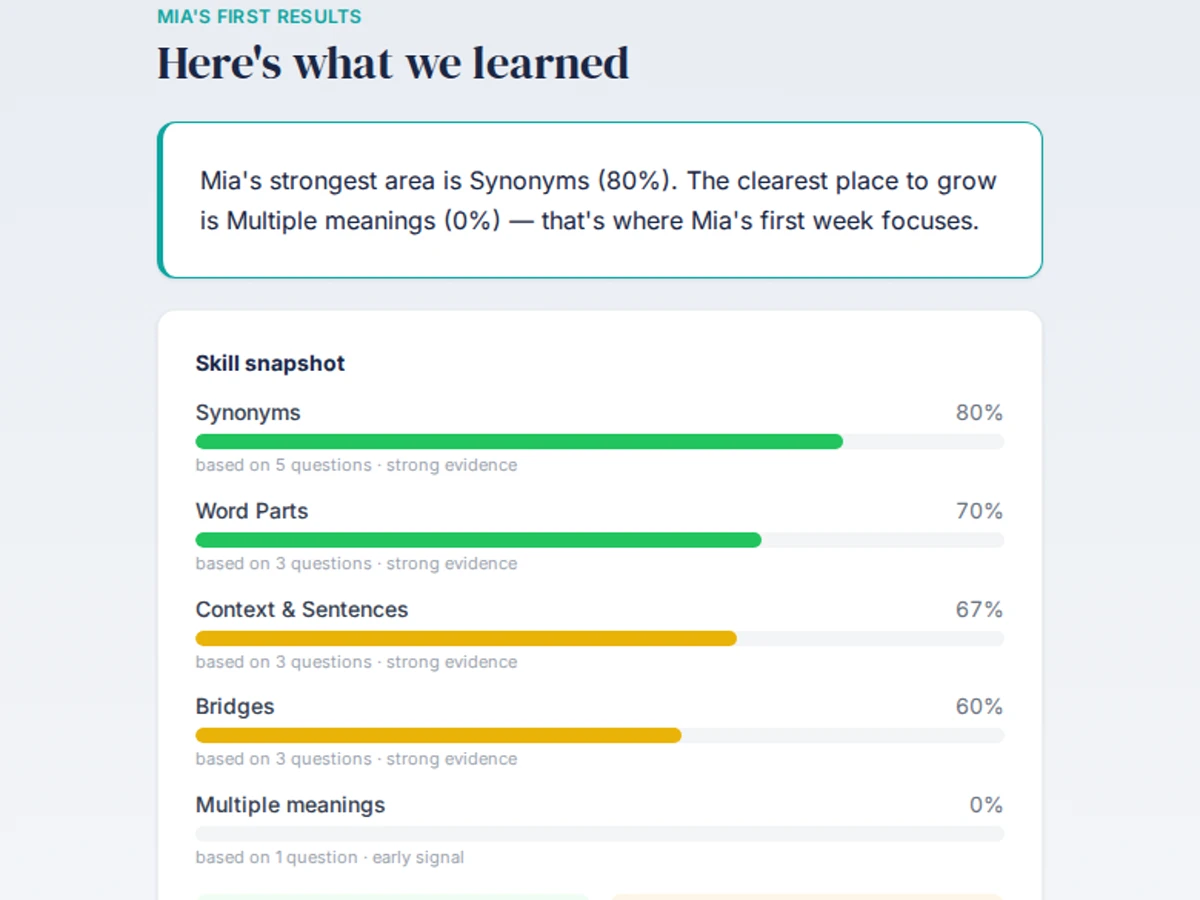
Start with a free, no-card SSAT check-up — 30 questions with a personalized parent report.
Find the SSAT vocabulary gaps — freeSee a sample parent report before starting
The check-up samples verbal skills and gives you an early strength, a growth area, and a first practice focus. It is not a full-length exam, an official SSAT or ISEE score, or an admissions prediction.
Three months is the ideal preparation window for most SSAT verbal students — long enough to build genuine vocabulary depth, short enough to stay motivated. This guide gives you a week-by-week structure to help your child in the 12 weeks before their test date, plus the strategies behind each phase.
Before diving in: this plan is built around the insight that SSAT verbal success comes from vocabulary ownership, not vocabulary exposure. The difference matters. Exposure means your child has seen a word before. Ownership means your child can recall the word's precise meaning under time pressure, distinguish it from similar words, and recognize it in a synonym context without surrounding sentence support. The SSAT's synonym section — one-third of the verbal battery — tests ownership, not exposure. That changes how your child needs to study.
Understanding the SSAT Verbal Section
The SSAT verbal section contains 60 questions in 30 minutes for the Upper Level, or 60 questions in 30 minutes for the Middle Level. Questions are divided into:
- 30 synonym questions: One capitalized word, five answer choices. Choose the word closest in meaning. No sentence context is provided.
- 30 analogy questions: A:B :: C:? format. Choose the word that completes the relationship.
What this means for your child's prep: The 60/30 ratio means approximately 30 seconds per question, including reading time. This is fast. Students who pause to think hard about each synonym lose time on later questions. The goal of preparation is to make most vocabulary items instantly recognizable — saving harder decision-making for the genuinely unfamiliar questions.
The Three Verbal Skills SSAT Rewards
Effective preparation builds three distinct skills:
1. Precise vocabulary depth: Knowing what ambivalent means is not enough. Your child needs to know that it means holding two contradictory feelings simultaneously — so that when they see it next to decisive (which means strongly and clearly inclined), they recognize that ambivalent and irresolute are closer synonyms than ambivalent and uncertain (which lacks the "two-sided" nuance). This depth comes from learning words in families and studying their precise semantic territory.
2. Root-word decoding: Many SSAT synonyms are words students have never directly studied. Root knowledge is the safety net. A student who knows -ous means "having the quality of" and anim means "life, spirit, mind" can infer that animosity means "having the quality of [hostile] spirit" — and choose hostility over energy on a synonym question. This inference is faster than helpless guessing.
3. Bridge-type fluency: Analogy questions are faster to answer when students have internalized the standard bridge types. A student who instantly recognizes "this is a worker-to-creation relationship" answers the question in 15 seconds. A student who reads and re-reads the word pair trying to figure out the connection uses 45 seconds. At 30 seconds per question, that difference is catastrophic for timing.
Those three skills — vocabulary depth, root-word decoding, and bridge-type fluency — cover vocabulary knowledge and relational reasoning well. But your child's performance on the SSAT is also shaped by three more domains that this plan builds implicitly and deserve explicit attention: contextual inference (reading meaning from surrounding cues, which sharpens synonym precision), test execution (pacing, elimination, guess discipline under the quarter-point penalty, and stamina across a full sitting), and metacognition (the self-monitoring habit that helps your child notice when they have over-spent time and recalibrate). LexiMap trains all five domains across its game modes and surfaces each — vocabulary knowledge, relational reasoning, contextual inference, test execution, and metacognition — on a parent dashboard so you can see where your child is strongest and where more practice is still needed.
The 3-Month Plan (12 Weeks)
Phase 1: Foundation (Weeks 1-4)
Goal: Build the root-word and vocabulary foundation
Week 1-2: Core Latin roots (roots 1-15)
Begin with the 15 highest-frequency Latin roots for SSAT vocabulary. Focus on roots that produce the most commonly tested words.
Starting roots (with key examples):
- duc/duct (to lead): conduct, deduce, introduce, educate, aqueduct
- spec/spect (to look): inspect, perspective, retrospect, suspect, spectacle
- port (to carry): transport, export, import, portable, deportation
- pos/pon (to place): compose, depose, propose, postpone, impose
- vert/vers (to turn): convert, diverse, revert, invert, controversy
How to study roots: For each root, learn the meaning, then generate 5+ example words (don't just look them up — try to come up with them first). Note the shared semantic thread: vert/vers words all involve some kind of turning. Then practice using each word in a sentence. Spend 20-30 minutes on roots per day; use remaining time for synonym practice.
Week 3-4: Core Latin roots (roots 16-30) + introduce Greek roots
Add 15 more Latin roots and begin 10 core Greek roots. The Greek roots that matter most for SSAT:
- log/logy (word, study of): logic, dialogue, analogy, biology, prologue
- phil/philo (love): philosophy, philanthropist, bibliophile, philharmonic
- graph/gram (to write): biography, telegram, photograph, paragraph
- anthrop (human): anthropology, misanthrope, philanthropy
- chron (time): chronological, anachronism, synchronize, chronic
Daily schedule weeks 1-4:
- 15 minutes: new roots (2-3 per day)
- 10 minutes: synonym practice (10-15 questions from previously studied vocabulary)
- 5 minutes: bridge-type identification practice (5 analogy questions, name the bridge before guessing)
Phase 2: Development (Weeks 5-8)
Goal: Expand vocabulary and develop test-taking strategies
Week 5-6: Affixes + word family expansion
Shift from new root acquisition to vocabulary family expansion. For each root your child has learned, branch out to more obscure derived words. If they studied spec/spect, they have already learned inspect and retrospect — now add circumspect, perspicacious, specious.
Also begin systematic prefix and suffix study:
Key prefixes for SSAT:
- bene- (good): benevolent, benefactor, beneficent, benign, benediction
- mal- (bad): malevolent, malicious, malign, malady, malcontent
- inter- (between): intercede, intermittent, interlude, interpolate
- circum- (around): circumspect, circumvent, circumscribe, circumference
- per- (through, thoroughly): persistent, permeate, pervade, perfidious
Key suffixes that change meaning:
- -ous (having the quality of): audacious, nefarious, obstreperous, verbose
- -ious (characterized by): gregarious, imperious, dubious, ostentatious
- -ent/-ant (having the quality of): ambivalent, eloquent, vacillant, resonant
Week 7-8: Context and nuance — synonym precision
The SSAT often uses near-synonyms as answer choices. The wrong answers are not random — they are words that share a general category with the correct answer but differ in nuance. This week's focus: precision.
Practice distinguishing synonym clusters:
Sad: melancholy (reflective sadness), despondent (hopeless sadness), mournful (grief-tinged sadness), disconsolate (inconsolably sad), doleful (pitiful sadness)
Enthusiastic: ardent (passionate intensity), fervent (intense, often moral), zealous (eager dedication), ebullient (enthusiastic energy), effusive (over-expressive enthusiasm)
Calm: placid (undisturbed surface calm), equanimous (balanced inner calm), imperturbable (unshakeable calm), sanguine (optimistic calm), tranquil (peaceful calm)
Knowing these clusters lets your child answer synonym questions with precision. When they see FERVENT, they know the correct synonym is closer to passionate than to cheerful.
Daily schedule weeks 5-8:
- 10 minutes: word family expansion (review roots, extend to new derived words)
- 10 minutes: synonym cluster practice (precision work, near-synonym distinctions)
- 10 minutes: analogy practice (25+ questions per week, all bridge types)
Phase 3: Test-Ready (Weeks 9-12)
Goal: Build test-speed and mixed-format performance
Week 9-10: Timed synonym sets
Introduce consistent timing to synonym practice. Set a timer for 5 minutes and complete 10 synonym questions. Review not just what was wrong but why — was it an unknown word, a near-synonym confusion, or a time-pressure mistake?
For unknown words, apply root-based decoding: can your child identify any recognizable part? MENDACIOUS — no known root at first glance, but -ious means "having the quality of" and mend suggests "fault" (via Old French). The answer is probably "faulty, dishonest, or deceptive." (Mendacious means lying or untruthful.)
Week 11-12: Full verbal section practice under real conditions
Complete a full 60-question, 30-minute verbal section each week. Simulate test conditions: no interruptions, no checking answers mid-test, no skipping the timer.
After each full practice section:
- Score synonyms and analogies separately (they show different skill gaps)
- Review all wrong answers with bridge/root analysis
- Note patterns: are errors clustered in specific analogy bridge types? In words from particular root families? In near-synonym precision?
The goal in weeks 11-12 is not to learn new material — it is to solidify performance, manage timing, and reduce test-day anxiety through familiarity.
Daily schedule weeks 9-12:
- 15 minutes: timed synonym practice (10 questions, 5-minute target)
- 10 minutes: analogy practice (identify bridge first, then answer)
- 5 minutes: review and root/bridge analysis
- Once per week: full 60-question timed verbal section
Analogy Strategy: Name the Bridge First
Analogy questions are faster to answer correctly when your child follows a consistent 3-step process:
Step 1: Read the stem pair and name the bridge explicitly. AUTHOR : NOVEL — "an author creates a novel" (worker-to-creation relationship)
Step 2: Create a sentence using the bridge. "An author CREATES a novel as a ____ CREATES a ____"
Step 3: Apply the sentence to the answer choices. "A sculptor CREATES a statue" ✓ "A doctor TREATS a hospital" ✗ (wrong relationship) "A musician PLAYS a melody" ✗ (close, but melody is not a created product in the same sense)
The 3-step process takes slightly longer per question initially, but becomes faster with practice. More importantly, it is far more accurate than intuitive pattern-matching, which fails on unfamiliar vocabulary.
Common Bridge Types to Memorize
Internalizing these relationship types makes analogy questions dramatically faster:
| Bridge Type | Example |
|---|---|
| Synonym | SERENE : TRANQUIL |
| Antonym | TURBULENT : CALM |
| Worker to creation | SCULPTOR : STATUE |
| Worker to tool | SURGEON : SCALPEL |
| Part to whole | PETAL : FLOWER |
| Whole to part | ORCHESTRA : VIOLIN |
| Degree/intensity | WARM : SCALDING |
| Category member | OAK : TREE |
| Function | COMPASS : NAVIGATE |
| Cause and effect | NEGLIGENCE : ACCIDENT |
| Characteristic feature | MISER : FRUGAL |
| Without/lacks | PAUPER : WEALTH |
What to Do About Unknown Words
Your child will encounter words they don't know on the SSAT verbal section. Here is the protocol:
For synonyms with an unknown word:
- Have your child look for root elements they recognize
- Eliminate choices that cannot possibly be right based on the word's sound/feel (this is imprecise but better than random guessing)
- If your child can eliminate at least 2 of 5 choices, guess (the SSAT has a -¼ penalty, but eliminating 2 choices makes guessing statistically favorable)
- If your child recognizes nothing and cannot eliminate any choice, skip it (the -¼ penalty makes random guessing slightly harmful)
For analogies with an unknown word:
- Your child should apply root-decoding to the unknown word
- If they can determine the stem bridge from the words they do know, test answer choices using the bridge
- If they genuinely cannot determine the stem bridge, skip and return if time allows
Week-by-Week Schedule Summary
| Weeks | Phase | Daily Focus | Weekly Extra |
|---|---|---|---|
| 1-2 | Foundation | Roots 1-15 + 10 synonym questions | — |
| 3-4 | Foundation | Roots 16-30, Greek roots + synonyms | Review all roots weeks 1-4 |
| 5-6 | Development | Affixes + word family expansion | Bridge-type study session |
| 7-8 | Development | Near-synonym precision clusters | — |
| 9-10 | Test-Ready | Timed synonym sets + analogy review | — |
| 11-12 | Test-Ready | Mixed review + timed sessions | Full 60-question test each week |
See our SSAT word list organized by root families for a complete root study reference. For the comparison between SSAT and ISEE formats, see our SSAT vs. ISEE guide.
Key Takeaways
- SSAT verbal success comes from vocabulary ownership (recall under pressure), not mere exposure.
- Three months of spaced, daily practice outperforms last-minute cramming for verbal depth.
- The synonym section rewards precise meaning — train near-synonym discrimination.
- For analogies, name the relationship ("bridge") before scanning answer choices.
- Decode unknown words from Latin/Greek roots rather than guessing.
LexiMap's SSAT verbal mode delivers adaptive practice in synonyms, analogies, and vocabulary — with spaced repetition built in so your child retains what they study. Explore SSAT prep.
Get SSAT/ISEE vocabulary resources by email
Related Articles
ISEE Analogy Practice: How Relationship Thinking Helps with Synonyms & Sentence Completions
The ISEE doesn't test analogies — but analogy thinking is the key to ISEE synonyms and sentence completions. Learn bridge types, practice questions, and root word strategies.
Last-Minute SSAT Prep: Your 30-Day Vocabulary Plan
Test in 30 days? Here's the prioritized week-by-week SSAT vocabulary plan — 20–30 min/day, roots first, proven strategies, no panic required.
The 90-Day SSAT Vocabulary Prep Plan for Parents
A week-by-week SSAT study schedule parents can actually follow — 15 minutes a day, five phases, from baseline diagnostic to test-day confidence.
50 Latin Root Words Every SSAT Student Should Know
Master the 50 most important Latin root words for the SSAT. Each root includes meaning, example words, and memory tips to build lasting vocabulary skills.
Related Guides
SSAT Vocabulary: The Complete Guide to Root-Based Learning
Master SSAT vocabulary through Latin and Greek roots. Learn how root-based learning, spaced repetition, and interactive practice build lasting verbal skills for grades 4-12.
Root Words for SSAT & ISEE: The Complete Study Guide
The definitive guide to Latin and Greek root words for SSAT and ISEE preparation. Curated root set, study strategies, grade-level timelines, and practice exercises for grades 4-12.
SSAT® is a registered trademark of The Enrollment Management Association. ISEE® is a registered trademark of the Educational Records Bureau (ERB). LexiMap is not affiliated with or endorsed by these organizations.