Why Flashcards Don't Work for Verbal Test Prep (And What to Do Instead)
Find your child’s vocabulary gaps
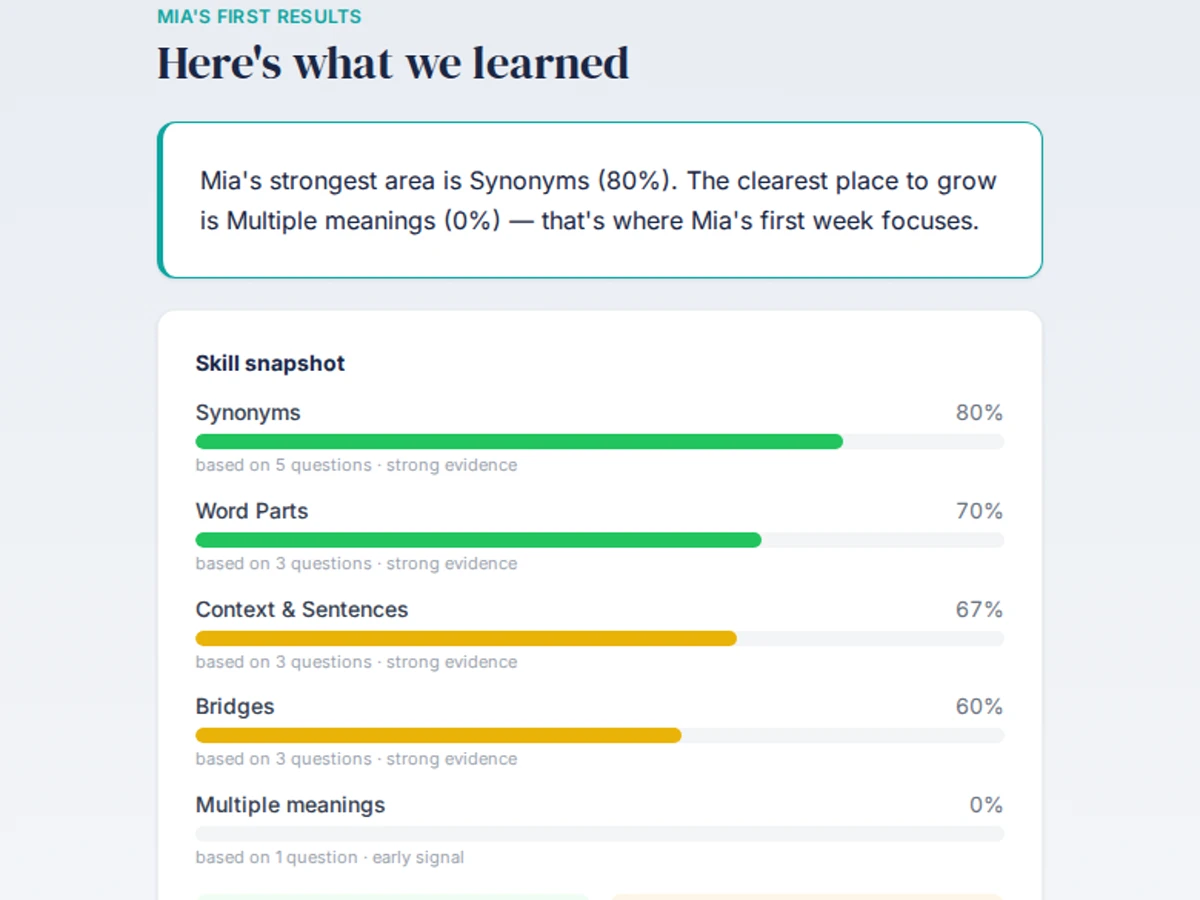
Start with a free, no-card vocabulary check-up and get a personalized parent report.
Find the vocabulary gaps — freeSee a sample parent report before starting
The check-up samples verbal skills and gives you an early strength, a growth area, and a first practice focus. It is not a full-length exam, an official SSAT or ISEE score, or an admissions prediction.
Every year, thousands of families preparing for the SSAT, ISEE, and HSPT buy vocabulary flashcard decks, digital flashcard apps, or download word lists — and then experience the same frustrating result: their child can recognize most of the words by test week, but on the actual test, the words simply do not come back.
This is not a motivation problem. It is not a memory problem. It is a method problem. Flashcards, as most students use them, are almost perfectly designed to produce the one kind of vocabulary knowledge that entrance exams do not test.
Here is what is happening, and what to do instead.
The Fluency Illusion
The most damaging property of standard flashcard study is a cognitive phenomenon researchers call the fluency illusion (Kornell & Bjork, 2008).
Here is how it works: You study 30 vocabulary flashcards on Monday night. The first pass through the deck is slow — some words you know, many you do not. By the third pass, the deck feels more familiar. By the fifth pass, most cards feel easy. You go to bed feeling like you have learned 30 words.
But what actually happened? Through repeated exposure to the same physical cards in the same order, your brain learned to recognize the cards. Recognition and retrieval are completely different memory processes:
- Recognition: "I've seen this before; I know this." Triggered by the presence of the word.
- Retrieval: "I can recall the meaning of this word when I encounter it in isolation, under pressure, without the physical cue of the card."
Entrance exam synonym questions are pure retrieval. The word TENACIOUS appears on the page, alone, with no physical card context, no order cues, no recent repetition. The student must retrieve the meaning from long-term memory, right now, under time pressure.
Recognition training (repeated flashcard review) does not produce retrieval. In fact, Kornell and Bjork's experiments showed that students who practiced until items "felt learned" were substantially overconfident about their actual retrieval ability. The fluency of recognition created false confidence about the state of their long-term memory.
The Decay Problem
Even if a student genuinely learns vocabulary through flashcards, the standard flashcard approach fails to address the forgetting curve.
Ebbinghaus (1885) documented that memory naturally decays over time — and that the rate of decay is predictable. Without review at the right intervals, most new vocabulary fades significantly within 2-4 weeks.
The typical flashcard behavior: study a deck intensively for two weeks, feel confident, stop reviewing. Three weeks later — which is exactly when the test arrives — the words have faded substantially. The student who felt prepared finds that the vocabulary that seemed solid is no longer accessible.
The solution is not more flashcard study. The solution is study with optimal spaced intervals — the property that is missing from typical flashcard use.
The Isolation Problem
The third and most fundamental problem: flashcards study words in isolation, without relationships to other words or to shared structures.
When you learn benevolent as an isolated flashcard (front: BENEVOLENT / back: kind and generous), you gain one memory: the word-to-definition link. Now you encounter malevolent on the test. You have never studied this specific card. The one memory you have does not help.
This isolation means that the return on every hour of flashcard study is limited to the specific words on the specific cards. There is no transfer. There is no growth of a vocabulary system.
Contrast this with root-based learning: when you learn the root bene (good) and the root mal (bad), you gain a framework. Benevolent is easy: bene (good) + vol (to wish) + -ent (having the quality of) — "having the quality of wishing good." Malevolent is immediately accessible: mal (bad) + same structure = "having the quality of wishing bad (evil)."
More importantly, you can now decode benefactor, beneficent, benign, malicious, malign, malady, malcontent — none of which you studied specifically — because you understand the structural pattern.
This transfer effect is exactly what entrance exams test when they include words you have never directly studied (which every entrance exam does deliberately).
What the Research Shows Actually Works
Root-Based Morphological Learning
A meta-analysis by Bowers, Kirby, and Deacon (2010) examined studies of morphological instruction — explicitly teaching roots, prefixes, and suffixes — and found statistically significant gains in vocabulary, reading comprehension, and spelling across multiple studies, with the comprehension benefits strongest for less-able readers. A separate meta-analysis by Goodwin and Ahn (2013) confirmed significant gains in vocabulary and decoding for school-age learners, and an earlier meta-analysis by Goodwin and Ahn (2010) found reading-comprehension gains specifically for children who struggle with literacy.
The key finding: morphological instruction produces transfer to novel words — words students have never directly studied. This is the exact transfer that entrance exam preparation requires, because test makers deliberately include unfamiliar words.
A student who learns 30 root families does not just acquire the 240+ words in those families. They acquire a decoding tool that works on thousands of words — including words they encounter for the first time on test day.
Spaced Repetition (The Right Kind of Flashcards)
This is the important nuance: the problem is not flashcards per se — it is flashcards used with massed, repetitive review. What actually works is flashcards used with optimal spaced intervals calibrated to each student's forgetting curve.
Spaced repetition systems (SRS) — which automatically schedule each card for review at the interval just before it would be forgotten — produce substantially better retention than any other review method. Cepeda et al.'s (2006) meta-analysis found robust spacing effects across learning types; research specifically on vocabulary shows 2-3× better retention from spaced practice compared to massed practice.
The FSRS (Free Spaced Repetition Scheduler) algorithm calculates optimal review intervals for each individual word based on your historical performance. Words you know well get longer intervals; words you struggle with get shorter intervals. After 10 weeks, every studied word has been reviewed multiple times at its individual optimal moment — not reviewed uniformly in batches.
The result: vocabulary that is retrievable on test day, not just familiar the night before.
What the Combination Looks Like
The evidence-based vocabulary approach for entrance exams combines both methods:
-
Root-based acquisition: Learn vocabulary in root families, not isolation. Each root provides the structural scaffold for 8-12 words. 25-30 root families over 8-10 weeks covers the core academic vocabulary range for SSAT/ISEE/HSPT.
-
Spaced repetition review: Every word learned through root study enters a spaced review queue. Reviews happen at intervals calibrated to each word's individual retention rate. No cramming, no repetitive reviewing of words already firmly learned.
-
Retrieval practice: Every review session requires active retrieval — producing the meaning from memory — not passive recognition (seeing the word and its definition together). The difficulty of retrieval is what builds durable memory.
How to Transition If You Have Already Started Flashcards
If your child is already in a flashcard routine, here is how to shift:
Do not throw out the word list. The vocabulary target is still valid. The issue is the study method, not the word selection.
Reorganize by root family. Group the flashcard words by their root. If you have benevolent, malevolent, benefactor, malefactor, benign, put them together under the bene/mal root family. This reorganization itself produces better encoding — the words are now understood as related, not isolated.
Switch to retrieval practice, not recognition practice. Cover the definition and try to produce it from memory before turning the card over. The effort of effortful retrieval (even when you fail) is more beneficial for long-term retention than reading the front-and-back repeatedly.
Use a spacing schedule. If your tool does not automatically space intervals, use a simple manual schedule:
- New word: review the next day
- If recalled correctly: review 4 days later
- If recalled correctly again: review 10 days later
- If recalled correctly again: review 21 days later
Words you miss get pushed back to shorter intervals.
The Quizlet Problem Specifically
Quizlet is the most widely used vocabulary tool for entrance exam prep. It is popular for good reasons — it is easy, visually appealing, and game-like. But in its default modes, it exemplifies the fluency illusion problem perfectly.
Quizlet's "Learn" mode adapts to your performance — this is spaced repetition done reasonably well. Use this mode.
Quizlet's "Flashcard" mode (the classic mode) shows you the card repeatedly until the deck is complete. This mode produces fluency illusion. Do not use it for vocabulary acquisition.
Quizlet's "Test" mode creates a quiz from your studied words. This is good retrieval practice. Use it — but do not practice from the test and then feel prepared; use it as genuine retrieval practice with honest tracking of what you actually recall.
The deeper issue with Quizlet is that it does not organize vocabulary by root family — it presents words in whatever order you enter them. You can manually create root-family card sets, which improves the tool significantly.
The vocabulary failure that flashcards produce runs deeper than word knowledge alone. Entrance exams challenge students across five verbal domains: vocabulary knowledge (where roots are the on-ramp), relational reasoning (analogies and word relationships), contextual inference (reading a sentence for meaning), test execution (pacing and strategy under time pressure), and metacognition (knowing which strategies to deploy and when). Flashcards address only the first of these, and even there they fall short. LexiMap is designed around all five domains and reports progress across each one on a parent dashboard — because closing the gap on vocabulary alone rarely moves the full verbal score.
Key Takeaways
- Flashcards are not inherently bad — the problem is massed recognition drilling, which produces familiarity without the retrieval the SSAT and ISEE actually test.
- Entrance exams test retrieval, not recognition: your child must produce a word's meaning under time pressure with no card context or repetition cue.
- Grouping words by root family gives your child a decoding system — they can reason through words they have never directly studied, which every entrance exam includes by design.
- Reviewing on a spaced schedule (not in one cram session) is what makes vocabulary survive to test day; 15 minutes of daily spaced-interval root practice outperforms an hour of flashcard review.
- The students who perform best on SSAT, ISEE, and HSPT verbal are not those who studied the most flashcards — they are the ones who own their vocabulary and can decode words they have never seen.
For the full science of vocabulary building for entrance exams, see our vocabulary building methods guide. For a root-organized SSAT word list, see our SSAT word list by root families.
Get SSAT/ISEE vocabulary resources by email
Related Articles
Root Words vs. Flashcards: Which SSAT Study Method Actually Works?
Compare root-based vocabulary learning with traditional flashcard memorization for SSAT and ISEE prep. Research-backed analysis of which method produces lasting results.
The LexiMap Method: Roots, Spaced Repetition, and a 5-Domain Verbal Model
How LexiMap combines morphological roots, FSRS spaced repetition, and a 5-domain verbal model — vocabulary, relational reasoning, contextual inference, test execution, and metacognition — into one trainer for the SSAT and ISEE.
SSAT Vocabulary Prep: The Complete Parent Guide
Everything parents need to know about SSAT vocabulary prep — what the verbal section tests, how scoring works, and the strategies that build lasting vocabulary mastery.
SSAT Vocabulary Words: Why a List Won't Save Your Child on Test Day
Your child memorized hundreds of SSAT vocabulary words. So why didn't the score move? The structural flaw in word lists — and what actually works instead.
Related Guides
Vocabulary Study Methods: A Research-Based Guide for SSAT & ISEE Prep
Compare proven vocabulary study methods — root-based learning, flashcards, reading programs, spaced repetition, and contextual learning. Find the most effective approach for your child.
SSAT Vocabulary: The Complete Guide to Root-Based Learning
Master SSAT vocabulary through Latin and Greek roots. Learn how root-based learning, spaced repetition, and interactive practice build lasting verbal skills for grades 4-12.
SSAT® is a registered trademark of The Enrollment Management Association. ISEE® is a registered trademark of the Educational Records Bureau (ERB). LexiMap is not affiliated with or endorsed by these organizations.