SSAT Word List Organized by Root Word Families
Find the SSAT vocabulary gaps before test day
Show all 12 roots
Sample SSAT roots we teach
- cred— believe
- bene— good, well
- mal— bad
- dict— say, speak
- spec / spect— look, see
- struct— build
- port— carry
- voc / vok— call, voice
- vid / vis— see
- tract— pull, drag
- magn— great
- ver— truth
Sample SSAT roots we teach
- cred— believe
- bene— good, well
- mal— bad
- dict— say, speak
- spec / spect— look, see
- struct— build
- port— carry
- voc / vok— call, voice
- vid / vis— see
- tract— pull, drag
- magn— great
- ver— truth
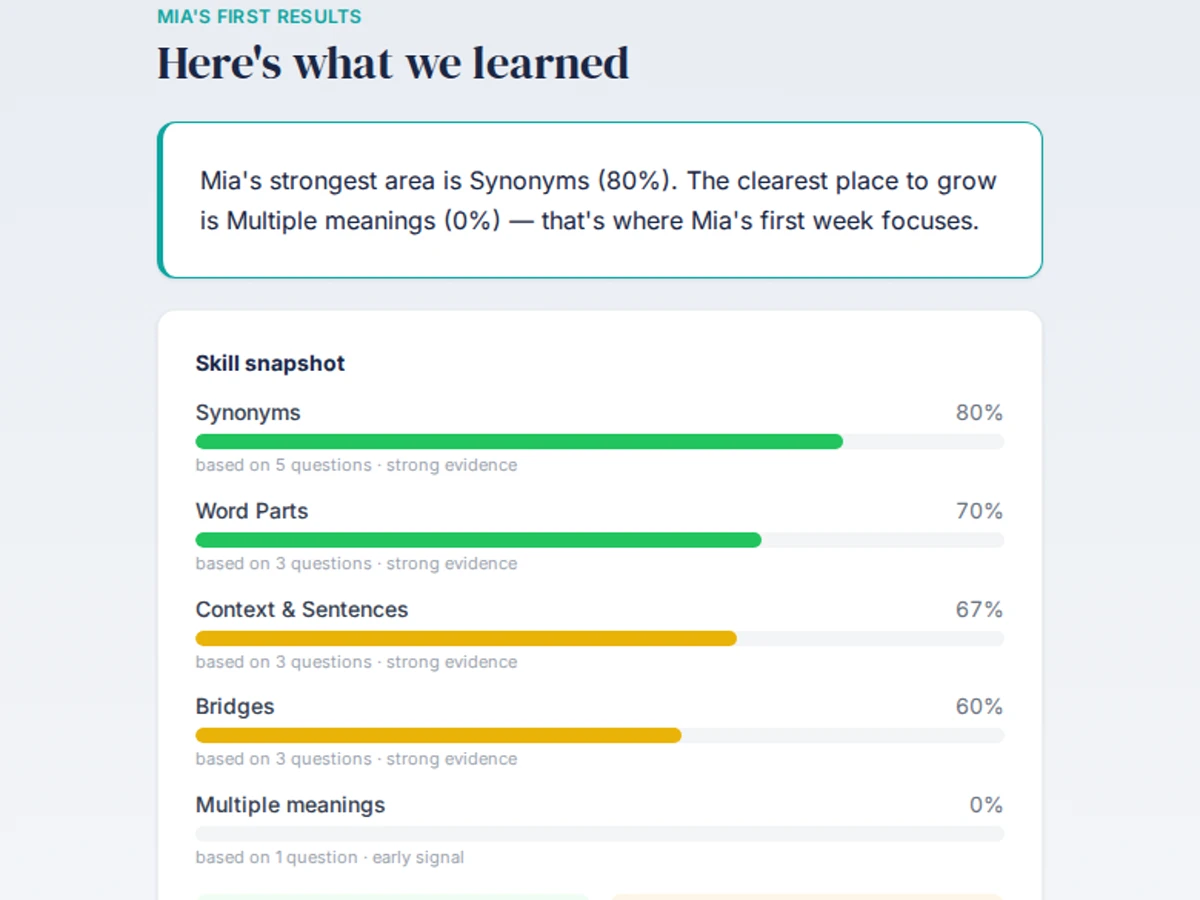
A free SSAT verbal check-up samples 30 questions and gives you an early strength, a growth area, and a first practice focus. No card required.
Start the free check-upSee a sample parent report before starting
The check-up samples verbal skills and gives you an early strength, a growth area, and a first practice focus. It is not a full-length exam, an official SSAT or ISEE score, or an admissions prediction.
Most SSAT word lists are organized alphabetically. That is the wrong organization for learning — alphabetical order puts abhor next to abolish for no vocabulary reason whatsoever, guaranteeing that students study words with no reinforcing connections between them.
This word list is organized differently: by root families. Each section gives your child a Latin or Greek root, its meaning, and 8-10 words commonly tested on the SSAT Middle and Upper levels. Learning words by root is more efficient because:
- Each root provides a memory peg — a concrete meaning anchor shared by every word in the family
- Your child acquires 8-10 words at the cost of learning one root pattern
- The root knowledge transfers to words not on this list when they encounter them on test day
Before the list: roots are not magic. They give a strong inference, not a guaranteed definition. The word notorious comes from nosc/not (to know) — literally "known for," which is accurate, but knowing it is "known for" only helps if your child also knows it carries a negative connotation. Use roots to decode and anchor, then verify precise meanings through full word study.
Root Family 1: VOC/VOK (to call, voice)
Latin root meaning "to call" or "voice." SSAT words from this family appear frequently in both synonym and analogy questions.
| Word | Definition | SSAT context |
|---|---|---|
| evoke | to call forth; to bring to mind | synonym: conjure, elicit |
| provoke | to call forth strong feelings, especially anger | synonym: incite, aggravate |
| invoke | to call upon (a higher power or principle) | synonym: appeal to, cite |
| revoke | to call back; to cancel officially | synonym: rescind, annul |
| vociferous | calling out loudly; clamorous | synonym: boisterous, clamorous |
| equivocal | having two possible meanings; ambiguous | synonym: ambiguous, evasive, noncommittal |
| advocate | one who calls in support of; to argue for | synonym: champion, proponent |
| vociferate | to cry out loudly and insistently | synonym: clamor, bellow |
Analogy note: A SSAT analogy might test EQUIVOCAL : CLEAR (antonym bridge) or ADVOCATE : OPPOSE (antonym bridge by function).
Root Family 2: SENT/SENS (to feel, to perceive)
Latin root meaning "to feel" or "to perceive through the senses."
| Word | Definition | SSAT context |
|---|---|---|
| sensitive | easily affected by external conditions | synonym: perceptive, responsive |
| sensory | relating to the senses | synonym: perceptual |
| sentiment | a feeling or opinion; a tender feeling | synonym: feeling, opinion |
| sentimental | appealing excessively to tender feelings | synonym: maudlin, mawkish |
| consent | to feel with; to agree | synonym: acquiesce, assent |
| dissent | to feel differently; to disagree | synonym: disagree, object |
| resent | to feel again; to feel anger about a past wrong | synonym: begrudge, bear a grudge |
| sentient | capable of feeling or perception | synonym: conscious, aware |
| insensible | without feeling; unconscious or imperceptive | synonym: unresponsive, oblivious |
Analogy note: CONSENT : DISSENT is a classic antonym bridge pair from this family.
Root Family 3: LOQUI/LOCUT (to speak)
Latin root for speaking. Words from this family describe how people speak, making them excellent SSAT synonym targets.
| Word | Definition | SSAT context |
|---|---|---|
| eloquent | speaking fluently and persuasively | synonym: articulate, fluent |
| loquacious | tending to talk a great deal | synonym: garrulous, verbose, talkative |
| colloquial | relating to informal conversation | synonym: informal, conversational |
| elocution | the skill of clear and expressive speaking | synonym: diction, articulation |
| ventriloquist | one who throws their voice | (vocabulary context) |
| soliloquy | a speech made by oneself, alone | synonym: monologue |
| circumlocution | using many words to say something; talking around a point | synonym: verbosity, roundabout expression |
| grandiloquent | pompous or inflated in language | synonym: pompous, bombastic |
SSAT connection: LOQUACIOUS and GARRULOUS are commonly tested as synonym pairs.
Root Family 4: VERD/VER (truth)
Latin root meaning "truth." These words appear in both synonyms and analogies on the SSAT.
| Word | Definition | SSAT context |
|---|---|---|
| verify | to establish the truth of | synonym: confirm, validate |
| verdict | a decision about truth; a judgment | synonym: judgment, decision |
| veracious | truthful; habitually speaking truth | synonym: truthful, honest |
| verity | the quality of being true; a fundamental truth | synonym: truth, actuality |
| veritable | genuine; actual (used for emphasis) | synonym: genuine, authentic |
| verisimilitude | the appearance of being true | synonym: plausibility, realism |
| aver | to state confidently and firmly as fact | synonym: assert, affirm, declare |
| mendacious | not telling the truth; lying | antonym bridge: veracious:mendacious |
Antonym pair: VERACIOUS : MENDACIOUS — truth-telling vs. lying — frequently appears as an analogy or antonym question.
Root Family 5: CRED (to believe, trust)
Latin root meaning "to believe" or "trust."
| Word | Definition | SSAT context |
|---|---|---|
| credible | believable; trustworthy | antonym: incredible, implausible |
| credulous | too ready to believe; gullible | antonym: incredulous, skeptical |
| incredulous | unwilling to believe; skeptical | synonym: skeptical, disbelieving |
| credence | belief; acceptance as true | synonym: belief, trust |
| discredit | to cause distrust in; to harm reputation | synonym: undermine, impugn |
| credentials | evidence of one's qualifications | (vocabulary context) |
| accredit | to give official recognition to | synonym: certify, authorize |
| credulity | tendency to believe too readily | synonym: gullibility, naivety |
SSAT analogy: CREDULOUS : SKEPTICAL — classic antonym bridge (the credulous person believes too easily; the skeptical person disbelieves).
Root Family 6: BENE/BONA (good, well)
Latin root meaning "good" or "well." Pairs naturally with MAL- (bad) for antonym question practice.
| Word | Definition | SSAT context |
|---|---|---|
| benevolent | wishing well to others; generous | antonym: malevolent |
| benefactor | one who does good; a patron | antonym: malefactor |
| beneficent | actively doing good; charitable | synonym: generous, philanthropic |
| benign | gentle and kind; not harmful | antonym: malign, malignant |
| benediction | a blessing; words of good wishes | antonym: malediction (a curse) |
| benevolence | the quality of being kind and generous | synonym: generosity, goodwill |
| boon | a blessing; a benefit; a welcome gift | synonym: blessing, benefit, windfall |
| bonafide | in good faith; genuine | synonym: genuine, authentic, legitimate |
Root Family 7: MAL (bad, evil, wrong)
The natural antonym of bene-. Learning these two families together makes both stick.
| Word | Definition | SSAT context |
|---|---|---|
| malevolent | having evil intentions | antonym: benevolent |
| malicious | intending harm; spiteful | synonym: spiteful, vindictive |
| malign | to speak evil of; harmful in nature | synonym: slander, defame; also: harmful |
| malady | an illness; a disorder | synonym: ailment, affliction |
| malcontent | a discontented or rebellious person | synonym: complainer, dissatisfied person |
| malfeasance | wrongdoing by a public official | synonym: wrongdoing, misconduct |
| malefactor | a person who commits a crime | antonym: benefactor |
| malice | desire to cause harm | synonym: spite, ill will, venom |
| malodorous | having an unpleasant smell | synonym: fetid, pungent, rank |
Root Family 8: FORT/FORC (strong)
Latin root meaning "strong" or "strength."
| Word | Definition | SSAT context |
|---|---|---|
| fortify | to make stronger; to strengthen | synonym: reinforce, strengthen |
| fortitude | courage in pain or adversity | synonym: courage, endurance, resilience |
| forte | one's strong suit; an area of strength | synonym: strength, specialty |
| fortress | a fortified building; a stronghold | (vocabulary context) |
| enforce | to compel or force compliance | synonym: compel, impose |
| reinforce | to strengthen by adding to | synonym: support, strengthen |
| effort | exertion of force toward a goal | (vocabulary context) |
| forceful | powerful; having great effect | synonym: potent, compelling, powerful |
| infortitude | lack of mental or moral strength | antonym: fortitude |
Root Family 9: GRAT (thankful, pleasing)
Latin root meaning "thankful" or "pleasing."
| Word | Definition | SSAT context |
|---|---|---|
| gratitude | thankfulness; appreciation | antonym: ingratitude |
| grateful | thankful; appreciative | antonym: ungrateful |
| ingrate | an ungrateful person | synonym: ungrateful person |
| gratuitous | uncalled for; excessive; free of charge | synonym: unnecessary, unwarranted |
| gratify | to please or satisfy | synonym: satisfy, please, delight |
| gracious | kind and pleasant; showing grace | synonym: courteous, benevolent |
| congratulate | to express pleasure at another's good fortune | synonym: commend, praise |
| ingratiate | to work to gain favor with someone | synonym: flatter, curry favor |
SSAT note: GRATUITOUS is commonly tested because students confuse its meaning (unjustified, unnecessary) with simply meaning "free of charge."
Root Family 10: GREG (flock, herd, group)
Latin root meaning "flock" or "group."
| Word | Definition | SSAT context |
|---|---|---|
| gregarious | fond of company; sociable | antonym: solitary, hermetic |
| congregate | to gather together into a group | synonym: assemble, convene |
| aggregate | a whole formed from many parts | synonym: total, sum, composite |
| segregate | to separate from a group | antonym: integrate |
| egregious | outstandingly bad; shocking | synonym: flagrant, glaring, outrageous |
SSAT favorite: GREGARIOUS (loves groups) and its antonym solitary or hermetic (prefers isolation) appear regularly. EGREGIOUS looks positive (e-greg-ious = "standing out from the group") but means shockingly bad — a common trap.
Root Family 11: PATH/PASS (feeling, suffering)
Greek root meaning "feeling" or "suffering."
| Word | Definition | SSAT context |
|---|---|---|
| empathy | understanding another's feelings | antonym: apathy |
| apathy | lack of feeling or interest | antonym: empathy, enthusiasm |
| sympathy | feeling together with; compassion | synonym: compassion, commiseration |
| antipathy | strong dislike; aversion | synonym: aversion, hostility, animosity |
| pathetic | arousing pity; miserably inadequate | synonym: pitiful, pitiable |
| impassive | not showing feeling; expressionless | synonym: stoic, dispassionate, imperturbable |
| passionate | having strong feelings; fervent | synonym: ardent, fervent, zealous |
| dispassionate | not influenced by emotion; objective | synonym: impartial, detached, objective |
Root Family 12: CHRON (time)
Greek root meaning "time."
| Word | Definition | SSAT context |
|---|---|---|
| chronological | arranged in order of time | (vocabulary context) |
| anachronism | something out of its time period | synonym: temporal incongruity |
| synchronize | to occur at the same time | synonym: coordinate, align temporally |
| chronic | persisting for a long time | synonym: persistent, prolonged |
| chronicle | a record of events in order of time | synonym: record, account, annals |
| chronometer | an instrument for measuring time accurately | (vocabulary context) |
Root Family 13: RUPT (to break)
Latin root meaning "to break."
| Word | Definition | SSAT context |
|---|---|---|
| abrupt | sudden; unexpected; curt | synonym: sudden, brusque, curt |
| corrupt | broken in morals; dishonest | synonym: dishonest, unscrupulous, depraved |
| disrupt | to break apart; to interrupt the normal flow | synonym: interrupt, disturb |
| erupt | to break out suddenly and violently | synonym: explode, burst forth |
| interrupt | to break into; to stop temporarily | synonym: intrude, interject |
| bankrupt | financially broken; unable to pay debts | synonym: insolvent, penniless |
| rupture | a break or tear; to break open | synonym: breach, fracture, tear |
| irrupt | to break in forcibly | synonym: intrude, invade |
Root Family 14: SCRIB/SCRIPT (to write)
Latin root meaning "to write."
| Word | Definition | SSAT context |
|---|---|---|
| prescribe | to write instructions for; to order | synonym: mandate, specify |
| describe | to write about; to give a verbal picture | synonym: depict, portray, characterize |
| inscribe | to write on a surface; to enroll formally | synonym: engrave, carve |
| conscript | one written into service; a draftee | synonym: draftee, enlisted person |
| transcribe | to write across; to copy or record | synonym: copy, record, document |
| proscribe | to write against; to forbid or ban | synonym: forbid, ban, prohibit |
| circumscribe | to write around; to limit or restrict | synonym: restrict, confine, delimit |
| ascribe | to write to; to attribute to a cause | synonym: attribute, assign, credit |
Root Family 15: TERR (earth, land)
Latin root meaning "earth" or "land."
| Word | Definition | SSAT context |
|---|---|---|
| terrestrial | relating to earth or land | antonym: celestial, extraterrestrial |
| subterranean | underground; beneath the earth's surface | synonym: underground, subsurface |
| terrain | a stretch of land with particular features | synonym: landscape, topography |
| territory | an area of land under control | synonym: region, domain, jurisdiction |
| terrace | a flat area of land | (vocabulary context) |
| inter | to bury in the earth | synonym: bury, entomb |
| exhume | to dig up from the earth | antonym: inter |
| Mediterranean | "middle of the earth" (sea) | (etymological context) |
Using This Word List Effectively
Work through one root family per day. Do not attempt to cram multiple families in one session.
Have your child generate before looking. Before reading the word list for a new root, ask your child to name 3-5 words from the root meaning. This retrieval attempt — even when it fails — dramatically improves subsequent learning.
Learn antonym pairs together. When your child encounters benevolent, immediately associate it with malevolent. The SSAT tests both directions.
Spot roots in everyday reading. When your child encounters an unfamiliar word while reading or studying, look for recognizable root elements before checking a dictionary. This practice builds the root-decoding skill that transfers to unknown words on test day.
Revisit with spaced intervals. After learning a root family, return to it 2 days later, then 5 days later, then 12 days later. Each return requires your child to recall from memory rather than re-read — the retrieval is what builds durable retention.
Key Takeaways
- Alphabetical word lists are inefficient; root-family organization lets your child acquire 8–10 words per root learned and builds a decoding system for words they have never studied.
- The highest-value root pairs to study together are antonym families: bene/mal, verd/mendac, credulous/incredulous — the SSAT tests both directions.
- Roots give a strong inference, not a guaranteed definition; your child should use root knowledge to decode and anchor, then confirm precise meaning through full word study.
- Spaced review — returning to each family at 2, 5, and 12 days — builds far more durable retention than re-reading words in a single session.
- The transfer effect is the real value: a child who knows 15 roots can reason through hundreds of unfamiliar SSAT words, not just the ones on this list.
For a structured 3-month SSAT verbal study plan organized around root-based vocabulary, see our SSAT verbal study strategies guide. For the science behind why root-based learning outperforms flashcards, see our vocabulary building methods guide.
These root families give your child a powerful foundation in Vocabulary Knowledge — the first of five verbal domains the tests actually score. See how LexiMap trains all five domains so your child's preparation covers the full picture.
Get SSAT/ISEE vocabulary resources by email
Related Articles
50 Latin Root Words Every SSAT Student Should Know
Master the 50 most important Latin root words for the SSAT. Each root includes meaning, example words, and memory tips to build lasting vocabulary skills.
The Complete List of Latin and Greek Roots for SSAT Vocabulary
Learn 60+ Latin and Greek roots used in academic vocabulary for SSAT/ISEE preparation. Free root word tables, study strategies, and a test-question walkthrough for grades 4–12.
SSAT Vocabulary Prep: The Complete Parent Guide
Everything parents need to know about SSAT vocabulary prep — what the verbal section tests, how scoring works, and the strategies that build lasting vocabulary mastery.
Last-Minute SSAT Prep: Your 30-Day Vocabulary Plan
Test in 30 days? Here's the prioritized week-by-week SSAT vocabulary plan — 20–30 min/day, roots first, proven strategies, no panic required.
Related Guides
Root Words for SSAT & ISEE: The Complete Study Guide
The definitive guide to Latin and Greek root words for SSAT and ISEE preparation. Curated root set, study strategies, grade-level timelines, and practice exercises for grades 4-12.
SSAT Vocabulary: The Complete Guide to Root-Based Learning
Master SSAT vocabulary through Latin and Greek roots. Learn how root-based learning, spaced repetition, and interactive practice build lasting verbal skills for grades 4-12.
SSAT® is a registered trademark of The Enrollment Management Association. ISEE® is a registered trademark of the Educational Records Bureau (ERB). LexiMap is not affiliated with or endorsed by these organizations.