SSAT Vocabulary Words: Why a List Won't Save Your Child on Test Day
Find the SSAT vocabulary gaps before test day
Show all 12 roots
Sample SSAT roots we teach
- cred— believe
- bene— good, well
- mal— bad
- dict— say, speak
- spec / spect— look, see
- struct— build
- port— carry
- voc / vok— call, voice
- vid / vis— see
- tract— pull, drag
- magn— great
- ver— truth
Sample SSAT roots we teach
- cred— believe
- bene— good, well
- mal— bad
- dict— say, speak
- spec / spect— look, see
- struct— build
- port— carry
- voc / vok— call, voice
- vid / vis— see
- tract— pull, drag
- magn— great
- ver— truth
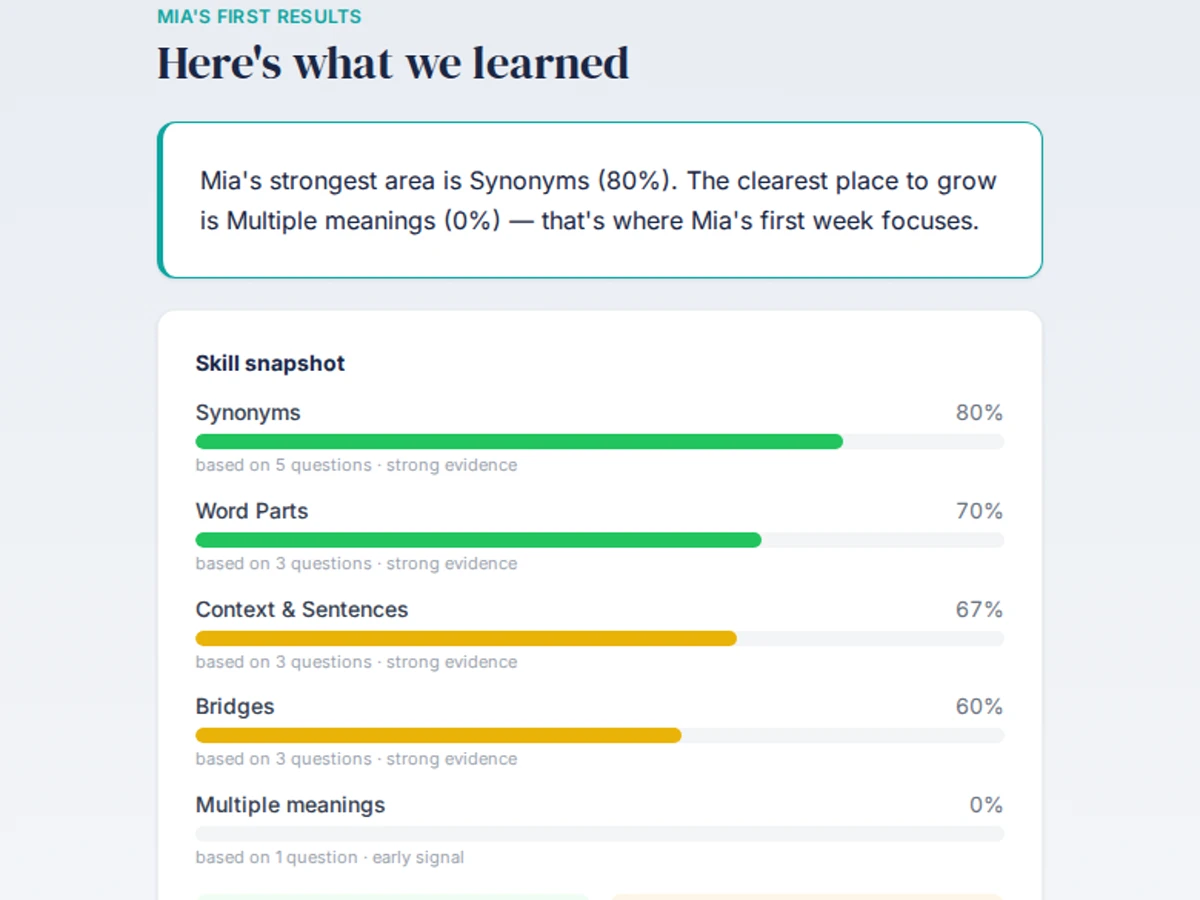
A free SSAT verbal check-up samples 30 questions and gives you an early strength, a growth area, and a first practice focus. No card required.
Start the free check-upSee a sample parent report before starting
The check-up samples verbal skills and gives you an early strength, a growth area, and a first practice focus. It is not a full-length exam, an official SSAT or ISEE score, or an admissions prediction.
You did everything right.
You found a "Top 500 SSAT Vocabulary Words" list — probably from a test prep site or a Quizlet deck someone shared in a Facebook group. Your child spent four, six, maybe eight weeks drilling through it. Flash through the cards. Check the definition. Flip again. By the week before the test, they could rattle off that loquacious means talkative, that intrepid means fearless, and that pernicious means harmful.
Then came the practice test.
The verbal score barely moved.
If this sounds familiar, you are not alone — and you did not do anything wrong. Word lists are the obvious choice. They're free, they're everywhere, and the logic seems sound. The issue isn't your effort or your child's. It's that rote word lists have a structural flaw that makes them a poor match for how the SSAT actually tests vocabulary.
Here's why — and what works instead.
The SSAT Doesn't Test Whether Your Child Can Recall a Definition
This is the core mismatch. When your child memorizes a word list, they train for: see word, produce definition. That works on a simple matching quiz. It does not work on the SSAT.
The SSAT tests vocabulary in two ways. Synonyms ask your child to choose the closest meaning from four alternatives that include near-synonyms, partial synonyms, and deliberate traps. Analogies ask them to identify the relationship between word pairs: SCULPTOR : CHISEL :: __ : __. To answer correctly, they need to understand not just what words mean but how they relate.
Neither task is well-served by memorizing "loquacious = talkative." On a synonym question, if the choices include garrulous, voluble, chatty, and articulate, they need to know which lives closest in meaning. On an analogy, knowing "intrepid means fearless" tells them nothing about the relationship between INTREPID and COWARD.
Application is the skill. Recall is not.
Word Lists Are Disconnected — Which Is Why They Don't Compound
There is a second problem with standard vocabulary lists: the words sit next to each other with no relationship between them.
Pernicious. Nascent. Truculent. Ephemeral. Obsequious.
Why would a child remember these as a group? There's no organizing principle. Every word is a fresh effort. Every word exists in isolation.
Compare that to learning that the Latin root bene means "good." That single piece of knowledge opens up beneficial, benevolent, benign, benediction, and benefactor simultaneously. One root, decoded correctly, gives you a family of words and a decoding strategy that transfers to new words on test day.
Lists can't do this. By definition, they're a sequence of disconnected items. There's nothing to compound.
The Forgetting Curve Will Defeat Weeks of Cramming
In 1885, Hermann Ebbinghaus documented what happens to memorized information without review: it drops off fast. Without reinforcement, most people forget roughly 70% of new material within 24 hours.
A child who grinds through 500 words over six weeks, then stops reviewing because the test is next weekend, will have forgotten most of what they learned. Cramming produces a spike of short-term recall useful if the test is tomorrow. For four to twelve weeks of prep, it's the wrong model. You need spaced repetition — revisiting each word at the moment memory begins to fade, moving it into long-term storage. Rote list memorization doesn't do this.
The SSAT Draws From a Word Pool No One Can Fully Memorize
No one knows exactly which words will appear on your child's specific test. The SSAT draws from a large pool. Prep lists are retrospective, not predictive. If you memorize 500 words perfectly (unlikely due to forgetting), and the test draws from several thousand, you've covered a fraction.
A child who has internalized 160 Latin and Greek roots can walk into any SSAT test with a rational strategy for unfamiliar words. They look for the root, make a structural inference, and have a fighting chance. That 160 roots covers a large share of the academic vocabulary on the SSAT and ISEE. The Complete List of Latin and Greek Roots for SSAT Vocabulary.
What Morphological Awareness Actually Does for Test Scores
Research consistently shows children who learn vocabulary through morphological instruction show stronger growth and higher retention than rote memorization, with Goodwin and Ahn (2013) documenting significant gains in vocabulary and decoding. Carlisle (2010) and Bowers et al. (2010) link the same instruction to better reading comprehension — especially for students who struggle with literacy.
The mechanism: when your child knows port means "carry," they don't just know portable — they understand it. That understanding makes it harder to forget, easier to apply in context, and transferable: transport, import, export, deportation, deportment. Each root multiplies their reach.
Root-based learning vs. flashcards isn't a comparison between two equal methods. They're structurally different. Flashcards build a list. Roots build a system. See Root Words vs. Flashcards.
What to Do Instead: The Practical Pivot
If you've been using word lists and the score hasn't moved, here's the shift:
Start with high-frequency roots, not high-frequency words. A list of 50 Latin roots will unlock more SSAT vocabulary, more durably, than 500 individual words. See 50 Latin Root Words Every SSAT Student Should Know.
Work through the complete root system systematically. See The Complete List of Latin and Greek Roots for SSAT Vocabulary.
Add spaced repetition, not more cramming. The FSRS algorithm achieves an ~90% recall target by timing reviews to each child's forgetting curve. See Spaced Repetition for Kids.
Practice application, not recall. Practice using words in synonym discrimination and analogy reasoning contexts.
The Honest Bottom Line
Word lists are a reasonable first instinct. They're just insufficient. The SSAT tests vocabulary in ways that require more than recall: discrimination between near-synonyms, reasoning about relationships, decoding unfamiliar words under time pressure.
The alternative isn't harder — it's organized differently. A shorter list of roots that builds a system. Spaced review that makes knowledge stick. A decoding strategy that works on unseen words.
That's the difference between memorizing vocabulary and actually owning it.
Key Takeaways
- The SSAT tests vocabulary through application (synonym discrimination, analogies), not definition recall — word lists train the wrong skill
- Disconnected word lists don't compound: each word is a separate effort
- The forgetting curve means cramming produces temporary recall that fades without spaced review
- The SSAT word pool is too large to memorize — the better strategy is learning to decode unfamiliar words
- 160 Latin and Greek roots cover a large share of SSAT/ISEE vocabulary and transfer to unseen words
- Spaced repetition (not cramming) is how vocabulary moves from short-term to long-term memory
A word list, even a well-chosen one, feeds only the first of five verbal domains the SSAT actually tests: vocabulary knowledge. The other four — relational reasoning, contextual inference, test execution, and metacognition — each require their own dedicated practice. Thinking of the word list as Domain 1 input, rather than the whole preparation plan, clarifies why score gains often stall: the other domains are untouched. LexiMap trains all five and surfaces each one on a parent dashboard, so you can see exactly where your child stands across the full verbal skill set — not just how many words they've memorized.
LexiMap is a vocabulary mastery app built specifically for SSAT and ISEE preparation. It teaches 160 Latin and Greek roots through spaced repetition and gamified quests — so your child can decode words they've never seen, not just recall ones they've memorized. Try it free at leximap.ai.
Questions parents ask
How many vocabulary words does my child need for the SSAT?
There's no fixed number — the SSAT draws from a large academic pool, which is why memorizing a finite list underperforms. Learning high-frequency Latin and Greek roots lets your child decode unfamiliar words structurally; each root unlocks a whole word family.
Are word lists useless, then?
No — they're a reasonable starting point. They fall short as the primary method because the SSAT draws from a large pool that no finite list can cover; roots plus spaced review provide a decoding strategy that works on unseen words.
Get SSAT/ISEE vocabulary resources by email
Related Articles
Root Words vs. Flashcards: Which SSAT Study Method Actually Works?
Compare root-based vocabulary learning with traditional flashcard memorization for SSAT and ISEE prep. Research-backed analysis of which method produces lasting results.
Why Flashcards Don't Work for Verbal Test Prep (And What to Do Instead)
Why flashcard vocabulary study fails on the SSAT, ISEE, and HSPT — and what cognitive science shows actually works: root-based learning and spaced repetition.
50 Latin Root Words Every SSAT Student Should Know
Master the 50 most important Latin root words for the SSAT. Each root includes meaning, example words, and memory tips to build lasting vocabulary skills.
Last-Minute SSAT Prep: Your 30-Day Vocabulary Plan
Test in 30 days? Here's the prioritized week-by-week SSAT vocabulary plan — 20–30 min/day, roots first, proven strategies, no panic required.
Related Guides
Vocabulary Study Methods: A Research-Based Guide for SSAT & ISEE Prep
Compare proven vocabulary study methods — root-based learning, flashcards, reading programs, spaced repetition, and contextual learning. Find the most effective approach for your child.
SSAT Vocabulary: The Complete Guide to Root-Based Learning
Master SSAT vocabulary through Latin and Greek roots. Learn how root-based learning, spaced repetition, and interactive practice build lasting verbal skills for grades 4-12.
SSAT® is a registered trademark of The Enrollment Management Association. ISEE® is a registered trademark of the Educational Records Bureau (ERB). LexiMap is not affiliated with or endorsed by these organizations.