Vocabulary Study Methods: A Research-Based Guide for SSAT & ISEE Prep
Find your child’s vocabulary gaps
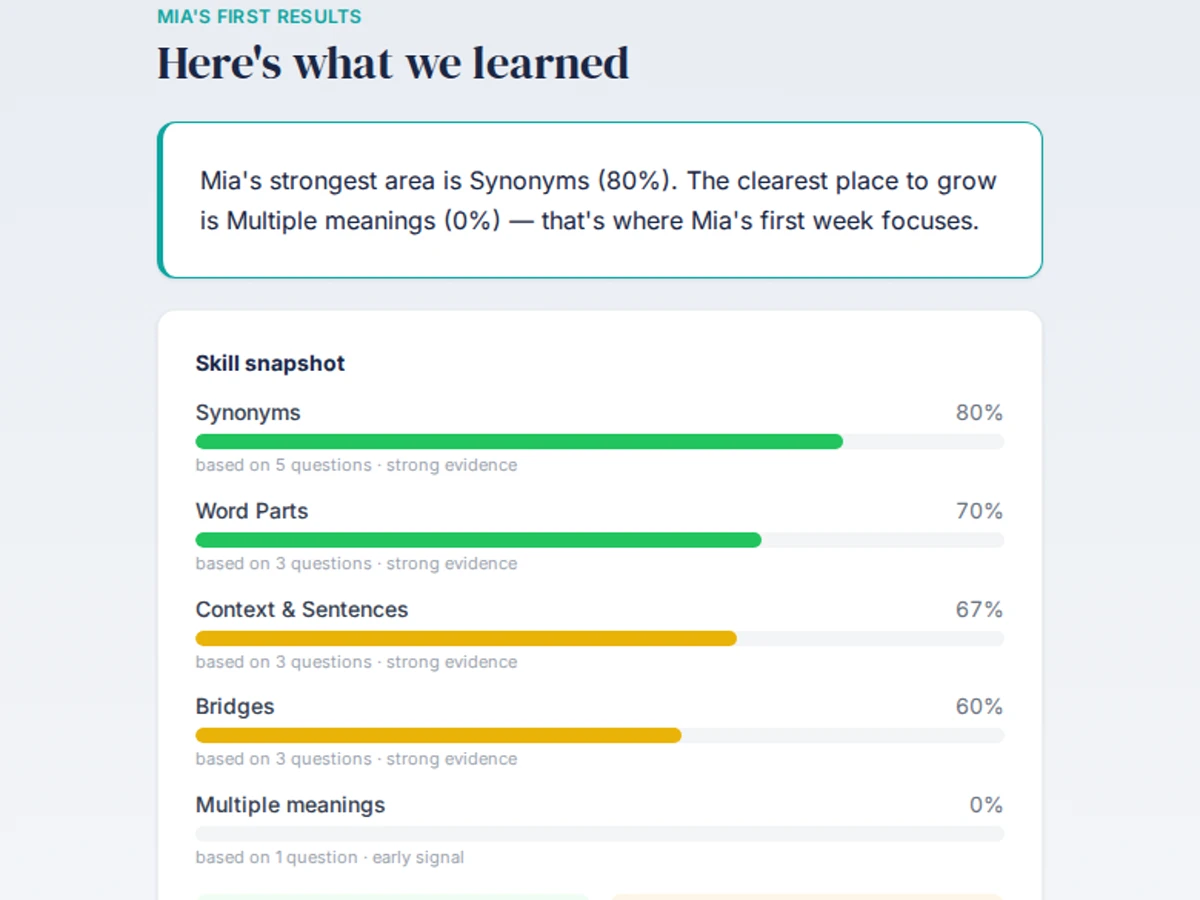
Start with a free, no-card vocabulary check-up and get a personalized parent report.
Find the vocabulary gaps — freeSee a sample parent report before starting
The check-up samples verbal skills and gives you an early strength, a growth area, and a first practice focus. It is not a full-length exam, an official SSAT or ISEE score, or an admissions prediction.
If your child is preparing for the SSAT or ISEE, you've probably encountered a bewildering range of vocabulary study advice. Flash cards. Word-list apps. Speed-reading programs. Root word charts. Vocabulary workbooks. Each promises to build the verbal skills your child needs — but not all approaches are created equal, and the differences matter enormously when test day arrives.
The challenge isn't finding a study method — it's finding the right combination of methods backed by evidence. A 2023 study on vocabulary instruction across K–12 settings found that students who used multiple complementary approaches outperformed those who relied on a single technique, but only when the methods were chosen to reinforce each other rather than duplicate the same type of practice.
This guide evaluates six major vocabulary study methods against the criteria that matter most for standardized test preparation: transfer to unknown words, long-term retention, time efficiency, student engagement, cost, and strength of supporting research. By the end, you'll know exactly which methods to prioritize and how to combine them for maximum impact.
Method 1: Root-Based Learning
How It Works
Root-based learning, also called morphological analysis, teaches students to break words into their structural components: prefixes, roots, and suffixes. Instead of memorizing the definition of "benevolent" as an isolated fact, a student learns that bene means "good" and vol means "wish" — so benevolent literally means "wishing good." That same bene root then unlocks benefit, benediction, benefactor, and benign without additional memorization.
What the Research Says
A systematic review by Bowers, Kirby, and Deacon (2010) synthesized 22 studies on morphological instruction and found that it improved vocabulary knowledge, decoding, and spelling, with broader literacy benefits especially for less-able readers. The effect was particularly strong for students who received explicit, systematic instruction in root meanings rather than incidental exposure.
Over 60% of English words have Greek or Latin roots, and up to 90% of academic vocabulary is Latin/Greek-derived (Rasinski et al., 2008). Our focused set of 182 Latin and Greek root families targets the academic vocabulary most heavily tested across SSAT and ISEE verbal sections. That concentration makes root-based study remarkably efficient: a student who masters these roots has structural access to many word families.
Strengths and Weaknesses
- Transfers to unknown words: The defining advantage. Students can decode words they've never seen before by recognizing familiar roots.
- Scales efficiently: One root unlocks an entire word family, so learning a focused set of roots provides access to thousands of words.
- Builds deep understanding: Students learn why words mean what they mean, not just that they mean it.
- Requires structured curriculum: Root-based learning works best when roots are taught in a deliberate sequence with varied practice. Self-directed study from a list is less effective.
- Takes time to build: The full benefit emerges over 3+ months of consistent study as root knowledge compounds.
Best for: Systematic preparation over 3 or more months. Students who want lasting vocabulary growth, not just test-day recall. For a deep dive, see our complete guide to root words for SSAT and ISEE.
Method 2: Flashcard Memorization
How It Works
Traditional flashcard study pairs individual words with their definitions. The student reviews cards repeatedly, attempting to recall the definition when shown the word (or vice versa). Digital tools like Quizlet have modernized the format, but the core mechanism remains the same: associative memorization of word-definition pairs.
What the Research Says
The testing effect — the finding that retrieving information from memory strengthens that memory — is one of the most robust findings in cognitive psychology. Flashcards leverage this effect directly. However, research also shows that the testing effect is strongest when retrieval is effortful and when the material is meaningful. Rote word-definition pairs often produce shallow encoding that doesn't transfer well to novel contexts.
Strengths and Weaknesses
- Simple and accessible: No special curriculum needed. Students can start immediately with any word list.
- Leverages the testing effect: Active recall is more effective than passive re-reading.
- Doesn't transfer: Memorizing "veracious = truthful" doesn't help a student decode "veritable" or "aver." Each word must be learned independently.
- Fragile under pressure: Rote associations are more likely to fail under test-day stress than structural understanding.
- Doesn't scale: SSAT vocabulary spans thousands of words. Memorizing each one individually is impractical within typical preparation timelines.
Best for: Last-minute review of specific high-frequency words, or as a supplementary tool alongside structural methods. See our analysis in root words vs. flashcards.
Method 3: Spaced Repetition
How It Works
Spaced repetition is an evidence-based scheduling technique that determines when to review material for optimal retention. Instead of reviewing everything equally, the algorithm identifies which items are about to be forgotten and surfaces those for review at the ideal moment. Items you know well are shown less frequently; items you struggle with appear more often.
Modern implementations use algorithms like FSRS (Free Spaced Repetition Scheduler), which was presented at KDD 2023 and demonstrated significantly better retention prediction than older algorithms like SM-2. FSRS models individual learning patterns and adapts review intervals accordingly.
What the Research Says
The spacing effect has been documented since Ebbinghaus's foundational memory research in the 1880s. Hundreds of subsequent studies have confirmed that distributed practice dramatically outperforms massed practice (cramming) for long-term retention. The FSRS algorithm, developed through machine learning analysis of millions of review records, can target specific retention rates — typically 85–95% — with remarkable accuracy.
Strengths and Weaknesses
- Optimizes retention: Students remember more of what they study with less total review time.
- Adapts to the learner: FSRS adjusts to individual memory patterns rather than using one-size-fits-all intervals.
- Requires daily commitment: Spaced repetition only works when reviews are completed consistently. Skipping days undermines the algorithm's effectiveness.
- It's a HOW, not a WHAT: Spaced repetition determines when to review, but the quality of retention depends on what is being reviewed. Spacing flashcards is better than cramming flashcards, but spacing root-based practice is better still.
Best for: Any vocabulary method — spaced repetition improves retention regardless of what's being studied. The key is pairing it with high-quality content. Learn more about how children respond to spaced repetition in our article on spaced repetition for kids, or explore our methodology.
Root-based learning + spaced repetition, built for kids
LexiMap combines the two strongest methods in one platform: root-based learning taught through 18 game modes with FSRS spaced repetition. Start with a free, no-card check-up.
Take a real timed section — freeMethod 4: Wide Reading
How It Works
Wide reading — also called extensive reading or free voluntary reading — builds vocabulary through incidental acquisition. As children read books, articles, and other texts, they encounter new words in natural contexts. Over time, repeated exposure across different contexts deepens word knowledge without explicit study.
What the Research Says
Stephen Krashen's extensive research on free voluntary reading shows strong correlations between reading volume and vocabulary size. Students who read widely consistently outperform non-readers on vocabulary measures. However, the research also shows that incidental acquisition is slow and unpredictable: a student must encounter a word 6–12 times in meaningful context before it's reliably learned, and there's no way to control which words are encountered.
Strengths and Weaknesses
- Builds context understanding: Words learned through reading come with rich associations — tone, register, collocations — that isolated study can't replicate.
- Intrinsically engaging: For children who enjoy reading, this doesn't feel like "studying."
- Too slow for targeted prep: A child preparing for the SSAT in 3–6 months can't rely on reading alone to cover specific test vocabulary.
- Uncontrollable coverage: There's no guarantee that reading will expose a student to the specific words and roots tested on the SSAT or ISEE.
Best for: Long-term vocabulary growth alongside targeted preparation. Wide reading is an excellent complement to root-based study — it provides the natural contexts where root knowledge becomes practical — but it should not be the primary preparation method for a timed standardized test.
Method 5: Contextual / Sentence-Based Learning
How It Works
Contextual learning presents new words within sentences or short passages rather than in isolation. Students read the word in context, infer its meaning, then confirm with a definition. More sophisticated programs ask students to use new words in their own sentences, identify context clues, or match words to appropriate contexts.
What the Research Says
Research consistently shows that words learned in context are retained better than words learned in isolation. A study by Webb (2007) found that encountering a word in multiple sentence contexts produced deeper vocabulary knowledge than repeated exposure to the same word-definition pair. However, contextual learning is relatively slow — each word requires multiple exposures in varied contexts — and coverage is limited by the number of contexts that can be meaningfully constructed.
Strengths and Weaknesses
- Stronger retention than isolated memorization: Contextual encoding creates richer memory traces.
- Builds usage knowledge: Students learn not just what a word means but how it's used, which helps with sentence completion questions on the ISEE.
- Slow coverage: Constructing meaningful contexts for thousands of words is time-intensive.
- Limited transfer: Contextual learning of "magnanimous" doesn't automatically help with "magnificent" the way knowing the root magn (great) does.
Best for: Complementing root-based study. After learning that magn means "great," encountering magnanimous, magnitude, and magnificent in sentences reinforces both the root knowledge and the contextual nuance.
Method 6: Vocabulary Workbooks
How It Works
Vocabulary workbooks present words in structured chapters, typically organized by theme, difficulty level, or word list. Each chapter introduces 10–20 words, followed by exercises: fill-in-the-blank, matching, multiple choice, and sentence writing. Popular series for test prep include Kaplan's SSAT/ISEE prep books and various "1100 Words You Need to Know" formats.
Strengths and Weaknesses
- Structured and progressive: Chapters provide a clear study path with built-in exercises.
- Familiar format: Many students and parents feel comfortable with workbooks as a study format.
- Passive learning risk: Fill-in-the-blank exercises can be completed through process of elimination rather than genuine word knowledge. Students may feel productive without actually retaining material.
- No spaced repetition: Words from Chapter 1 are rarely reviewed after Chapter 2 begins. Without built-in review scheduling, earlier material fades.
- Often word-list based: Most workbooks teach individual words rather than root families, which limits transfer to unknown words.
Best for: Supplementary practice alongside a primary method. Workbooks can provide useful written practice, but they should not be the sole study approach. If your child uses a workbook, supplement it with active recall practice and spaced review of earlier chapters.
Head-to-Head Comparison
The table below rates each method across six criteria that matter most for standardized test preparation. "Transfer" measures how well the method helps with words not directly studied. "Retention" measures durability over weeks and months. "Efficiency" measures vocabulary coverage per hour of study time. "Engagement" measures how well the method holds student attention. "Cost" measures financial accessibility. "Evidence" measures the strength of supporting research.
| Method | Transfer | Retention | Efficiency | Engagement | Cost | Evidence |
|---|---|---|---|---|---|---|
| Root-Based Learning | Strong | Strong | Strong | Moderate | Low-Med | Strong |
| Flashcard Memorization | Weak | Moderate | Moderate | Low | Low | Moderate |
| Spaced Repetition | N/A (method) | Strong | Strong | Moderate | Low | Strong |
| Wide Reading | Strong | Strong | Weak | Strong | Low | Strong |
| Contextual / Sentence | Moderate | Moderate | Weak | Moderate | Low | Moderate |
| Vocabulary Workbooks | Weak | Weak | Moderate | Low | Low | Weak |
Two patterns stand out immediately. First, root-based learning and spaced repetition are the only methods that rate "Strong" on both transfer and efficiency — the two criteria most critical for standardized test preparation, where students encounter unfamiliar words under time pressure. Second, no single method rates "Strong" across every dimension, which is why the optimal approach combines complementary methods.
Note that spaced repetition appears as "N/A" for transfer because it's a scheduling technique, not a content method. It amplifies whatever material it's applied to. Spaced repetition applied to flashcards produces better flashcard retention; spaced repetition applied to root-based practice produces better root retention — with all the transfer benefits that root knowledge provides.
The Optimal Combination
Based on the evidence, the highest-impact combination for SSAT and ISEE vocabulary preparation is:
- Root-based learning as the foundation — providing the structural knowledge that transfers to unknown words and scales efficiently across thousands of vocabulary items.
- Spaced repetition as the delivery mechanism — ensuring that root knowledge, word families, and practiced items are retained durably over the full preparation timeline.
- Wide reading as the enrichment layer — providing the natural contexts where root knowledge becomes intuitive and where students encounter words in the registers and sentence structures that standardized tests mimic.
This combination outperforms any single method because each component addresses a different aspect of vocabulary knowledge. Root-based learning provides structural decoding ability. Spaced repetition provides durable retention. Wide reading provides contextual fluency. Together, they produce students who can decode unfamiliar words, recall studied words reliably, and understand how words function in real sentences — all skills tested directly on the SSAT and ISEE.
For a complete preparation framework built on this combination, see our SSAT vocabulary study guide.
Key Takeaways
- Root-based learning is the only method that reliably transfers to unknown words — the defining challenge of standardized vocabulary tests.
- Spaced repetition is a scheduling technique, not a content method. It amplifies whatever approach it's paired with, but the best results come from pairing it with root-based content.
- Flashcards and workbooks are useful supplements but poor primary methods because they don't build transfer skills.
- Wide reading builds deep vocabulary over time but is too slow and uncontrollable for targeted test preparation on its own.
- The optimal combination is root-based learning + spaced repetition + wide reading — structural knowledge, durable retention, and contextual fluency working together.
SSAT® is a registered trademark of The Enrollment Management Association. ISEE® is a registered trademark of ERB. LexiMap is not affiliated with or endorsed by these organizations.
Related Guides
SSAT Vocabulary: The Complete Guide to Root-Based Learning
Master SSAT vocabulary through Latin and Greek roots. Learn how root-based learning, spaced repetition, and interactive practice build lasting verbal skills for grades 4-12.
Root Words for SSAT & ISEE: The Complete Study Guide
The definitive guide to Latin and Greek root words for SSAT and ISEE preparation. Curated root set, study strategies, grade-level timelines, and practice exercises for grades 4-12.
ISEE Vocabulary: The Complete Guide to Root-Based Learning
Prepare for Lower, Middle, and Upper Level ISEE verbal reasoning with word roots, sentence-completion strategies, official exam-format sources, and a practical study plan.
Related Articles
Root Words vs. Flashcards: Which SSAT Study Method Actually Works?
Compare root-based vocabulary learning with traditional flashcard memorization for SSAT and ISEE prep. Research-backed analysis of which method produces lasting results.
The Complete List of Latin and Greek Roots for SSAT Vocabulary
Learn 60+ Latin and Greek roots used in academic vocabulary for SSAT/ISEE preparation. Free root word tables, study strategies, and a test-question walkthrough for grades 4–12.
The LexiMap Method: Roots, Spaced Repetition, and a 5-Domain Verbal Model
How LexiMap combines morphological roots, FSRS spaced repetition, and a 5-domain verbal model — vocabulary, relational reasoning, contextual inference, test execution, and metacognition — into one trainer for the SSAT and ISEE.
SSAT® is a registered trademark of The Enrollment Management Association. ISEE® is a registered trademark of the Educational Records Bureau (ERB). LexiMap is not affiliated with or endorsed by these organizations.