From SSAT to SAT to Career: Why Vocabulary Is the Gift That Keeps Giving
Find your child’s vocabulary gaps
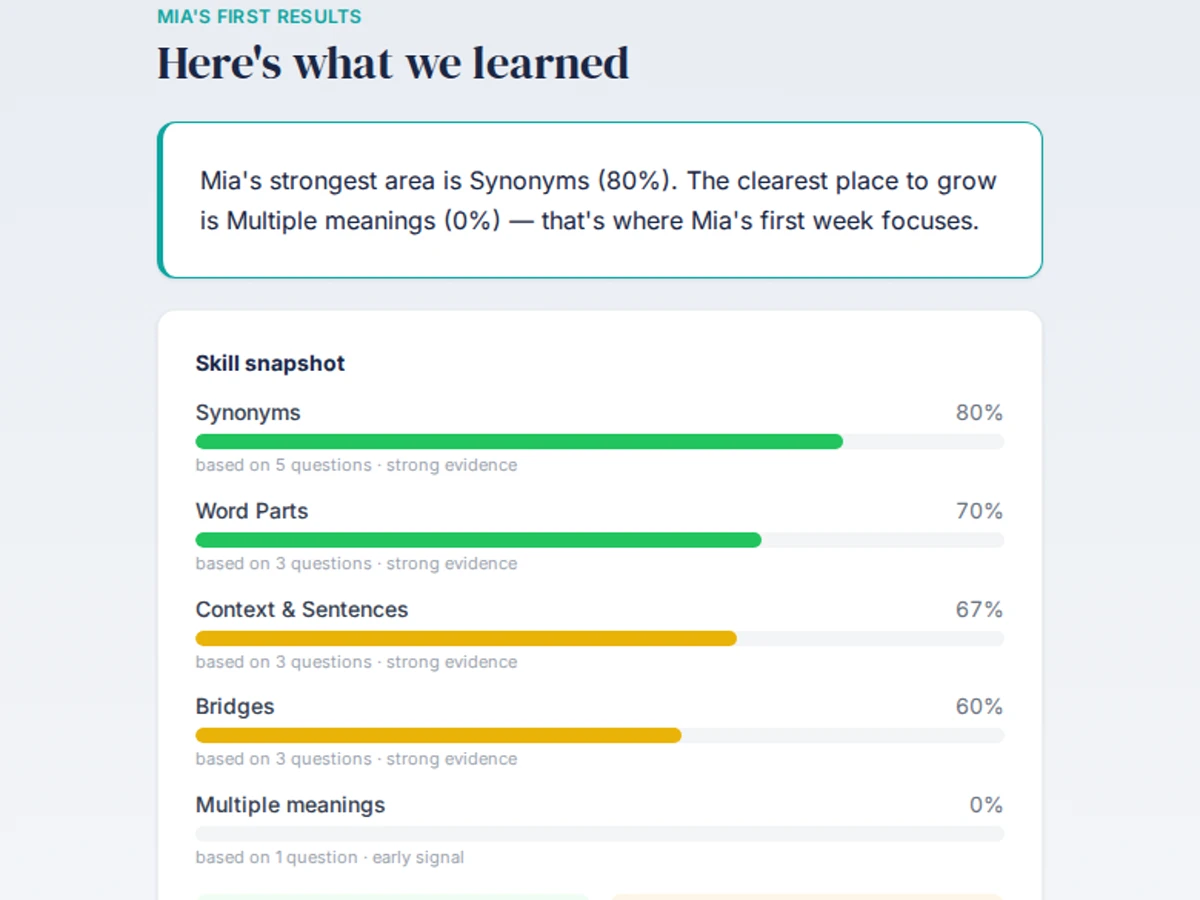
Start with a free, no-card vocabulary check-up and get a personalized parent report.
Find the vocabulary gaps — freeSee a sample parent report before starting
The check-up samples verbal skills and gives you an early strength, a growth area, and a first practice focus. It is not a full-length exam, an official SSAT or ISEE score, or an admissions prediction.
Most parents approach the SSAT the way they approach a dental cleaning: necessary, mildly unpleasant, and best forgotten once it is over. Vocabulary prep fits neatly into that frame — a finite list of words to grind through, a test to sit, a score to collect.
That framing is understandable. It is also a significant miscalculation.
The vocabulary your child is building right now is not a disposable set of flashcards. It is the first deposit into an account that will keep compounding for decades. The same mental muscle that helps an eighth-grader crack an unfamiliar SSAT analogy is the same one that, fifteen years later, helps them parse a contract clause, read a prospectus, or understand a diagnosis without nodding along in ignorance. The investment thesis is simple: vocabulary is one of the very few things you can teach a child in middle school that will still be actively working for them in their forties.
Understanding why makes it much easier to stay the course during the unglamorous months of prep work.
The same muscle, fifteen years later
Think about what an SSAT analogy question actually demands. Your child encounters two unfamiliar words, works out the relationship between them, and extends that relationship to a third pair — often under time pressure. It is not a memory test. It is a reasoning test that happens to require words as its raw material.
That is precisely why the skill transfers. A teenager who has learned to decode an unfamiliar word from its Latin roots — who can look at malediction and reconstruct "bad-saying" even without having studied it — is developing an analytical habit, not a parlor trick. That habit does not switch off after the SSAT. It gets applied, again and again, to every new domain they encounter.
By the time a child who built that vocabulary in middle school reaches early adulthood, they are reading contracts and noticing what an arbitration clause actually does. They are listening to a financial advisor explain a prospectus and following the argument rather than nodding politely. They are in a doctor's appointment and asking a second question because they understood the first answer. Each of those moments is a compounded return on the same foundational investment.
The continuity here is not metaphorical — it is structural. The decoding frameworks for academic language, professional language, and test language are substantially the same. Building one is building all three.
What employers actually pay for
When employers describe what they want from new hires, the list almost always starts in the same place. Communication skills top the chart year after year: in survey data from the National Association of Colleges and Employers (NACE), 73.4% of employers name communication as the #1 skill they seek. Not technical knowledge. Not a specific degree. Communication — which, at its core, is vocabulary deployed with precision and purpose.
The wage data reinforces this. English-language proficiency is associated with salary premiums of up to 80% in some global analyses (Pearson). That is not a small rounding error. It reflects the reality that the ability to read, write, and speak with precision is treated by labor markets as a genuinely scarce and valuable input.
The effect is particularly striking in negotiation contexts. Research by Galinsky, Ku, and Mussweiler (2009) found that first offers explain 50 to 85% of negotiation outcomes. The implication is uncomfortable but clear: the person who can name what they want, frame it persuasively, and respond to counteroffers with precision is not just a better communicator — they are capturing meaningfully more value in every negotiation they enter, from job offers to vendor contracts to salary reviews. Negotiation vocabulary is not a soft skill. It is an economic one.
The academic backbone
Behind almost all of these professional benefits sits a specific piece of academic infrastructure: the Academic Word List, developed by researcher Averil Coxhead in 2000. The AWL is a collection of approximately 570 word families — words like accumulate, inherent, parameter, perspective, retain — that appear consistently across academic and professional texts in fields ranging from law to science to business.
These are not esoteric specialist terms, and they are not everyday conversational words. They occupy the tier in between: the vocabulary of educated discourse, the language through which institutions describe themselves and their rules.
The scale of the coverage is striking. The AWL's roughly 570 word families account for approximately 10% of the words in academic and professional text. In other words, a child who owns the AWL enters every college classroom, every legal document, and every professional email thread with a built-in comprehension advantage that touches roughly one word in ten. Research suggests that AWL knowledge predicts 16 to 25% of GPA variance — a substantial portion of academic performance explained by a teachable and finite vocabulary set.
Put more plainly: the AWL is not a memorization burden. It is a master key. Once a child owns it, the adult world becomes considerably more legible.
The good news is that a serious SSAT/ISEE verbal preparation program, properly executed, delivers a substantial portion of the AWL as a side effect. The high-register, Latinate vocabulary of standardized tests and the academic vocabulary of college and career overlap heavily. The prep work and the long-term investment are not in tension — they are the same thing.
Investing early beats cramming late
Vocabulary is unusual among academic skills in one important respect: it does not respond well to urgency. You cannot cram your way to a large vocabulary the way you can cram your way through a history chapter or a set of geometry formulas. Word knowledge is built through repeated, spaced encounters over time — through seeing a word in one context, then another, then recognizing it in a third, until it settles into permanent memory as a tool rather than a temporary fact.
This is why timing matters so much. A child who begins building vocabulary in fifth or sixth grade is not just giving themselves more time to study. They are giving the compounding process more room to run. Every root mastered in middle school is a lens through which hundreds of words in high school become immediately more intelligible. Every AWL word absorbed before the SAT is a word that does not need to be relearned in college. The investments layer on each other.
The flip side is equally true. A student who attempts to build vocabulary in the six weeks before an SSAT can make real progress, but they are fighting the biology of memory. The knowledge is fragile. The compounding has barely begun.
For a fuller look at why the calendar matters and how to use it well, when to start verbal test prep walks through the research on timing, and why vocabulary matters lays out the broader case for treating vocabulary as a lifelong investment rather than a test-prep variable. LexiMap is built around exactly this logic — spaced repetition and root-based learning designed to make vocabulary stick across years, not days. Vocabulary Knowledge is Domain 1 of the five verbal domains your child builds in LexiMap; the compounding career advantage described above draws on all five — Relational Reasoning, Contextual Inference, Test Execution, and Metacognition alongside it.
The underlying principle is simple: start early, build on roots, review systematically, and let time do its work. The effort required per week is modest. The return, measured over fifteen years, is not.
Key Takeaways
- The vocabulary built for the SSAT is not test-specific — the same decoding skill pays dividends through the SAT, college coursework, and decades of professional life.
- Communication is the #1 employer-desired skill (73.4% of employers, NACE), and English-language proficiency is linked to salary premiums of up to 80% in some global analyses (Pearson).
- Negotiation vocabulary has direct economic consequences: first offers explain 50 to 85% of negotiation outcomes (Galinsky, Ku & Mussweiler, 2009).
- The Academic Word List — roughly 570 word families — covers approximately 10% of academic and professional text and predicts 16 to 25% of GPA variance; owning it makes the adult world more legible.
- Vocabulary compounds with time — starting in middle school gives the investment years to layer, making early, systematic effort far more efficient than late cramming.
Further reading:
Get SSAT/ISEE vocabulary resources by email
Related Articles
8 Ways a Strong Vocabulary Shapes Your Child's Future
Beyond test scores: the eight domains of adult life — from health and wealth to careers and emotional wellbeing — where research shows vocabulary makes a measurable difference.
Does Vocabulary Affect Test Scores? What the Research Actually Shows
A clear-eyed look at the evidence linking vocabulary to academic achievement, reading comprehension, and beyond — what's well-supported, what's overstated, and why it matters for test prep.
The Vocabulary Gap: Why Words Are Your Child's Greatest Equalizer
Vocabulary quietly opens — or closes — doors to schools, professions, and institutions. Why the word gap is one of the few advantages families can actually close, and how to start.
Why Vocabulary Matters: The Research Case for Investing in Your Child's Words
Vocabulary isn't just a test-score booster — research links it causally to health, wealth, careers, and emotional wellbeing. Why word knowledge is one of the highest-return investments a parent can make.
Related Guides
SSAT Vocabulary: The Complete Guide to Root-Based Learning
Master SSAT vocabulary through Latin and Greek roots. Learn how root-based learning, spaced repetition, and interactive practice build lasting verbal skills for grades 4-12.
Root Words for SSAT & ISEE: The Complete Study Guide
The definitive guide to Latin and Greek root words for SSAT and ISEE preparation. Curated root set, study strategies, grade-level timelines, and practice exercises for grades 4-12.
SSAT® is a registered trademark of The Enrollment Management Association. ISEE® is a registered trademark of the Educational Records Bureau (ERB). LexiMap is not affiliated with or endorsed by these organizations.