Vocabulary Depth: Connotation, Register, and Words With More Than One Meaning
Find your child’s vocabulary gaps
Start with a free, no-card vocabulary check-up and get a personalized parent report.
Find the vocabulary gaps — freeSee a sample parent report before starting
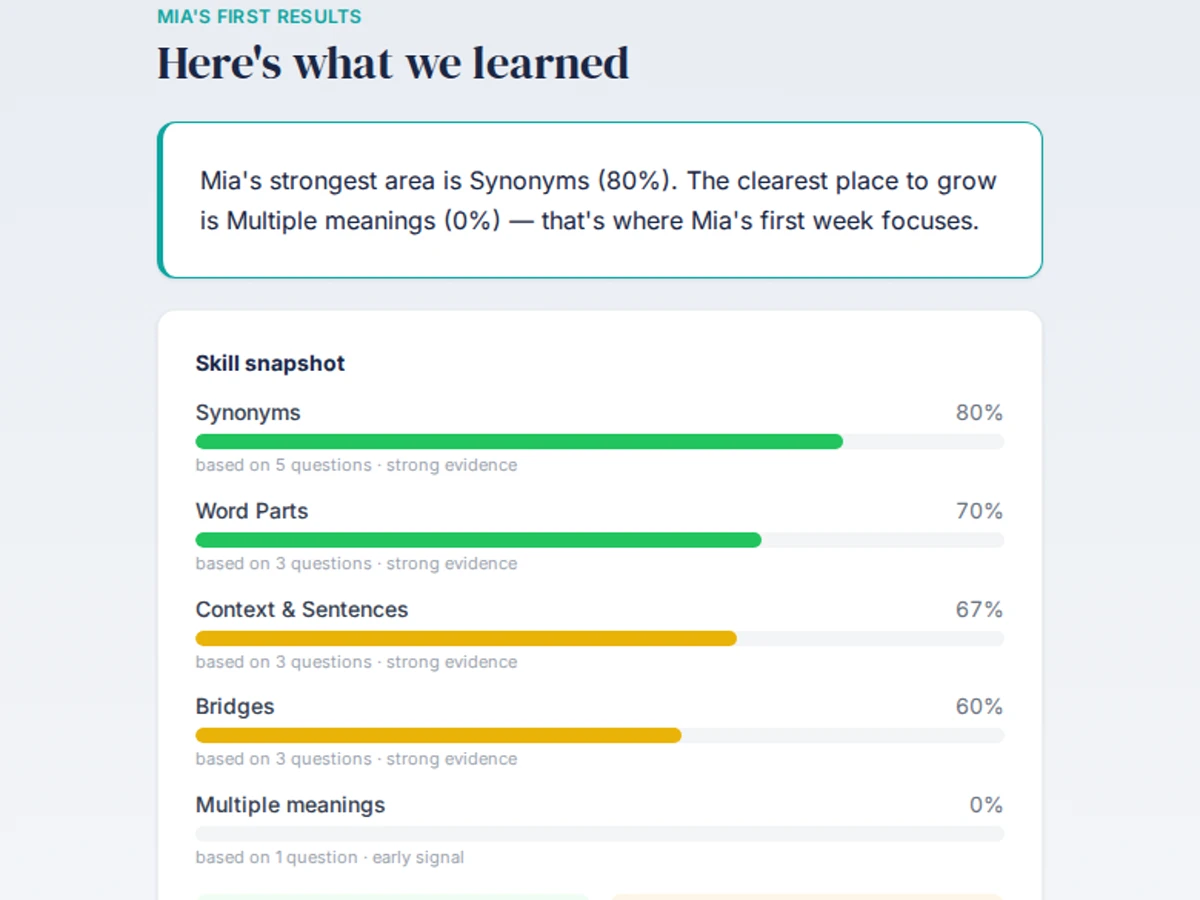
The check-up samples verbal skills and gives you an early strength, a growth area, and a first practice focus. It is not a full-length exam, an official SSAT or ISEE score, or an admissions prediction.
When your child studies vocabulary for the SSAT or ISEE, they are building two very different things at once — and most study methods only build one of them. The first thing is breadth: the raw number of words in their working vocabulary. The second thing is depth: how well they actually know each word. Breadth gets your child to the word. Depth gets them the right answer.
The distinction matters because the verbal section's hardest synonym questions are not hard because the words are obscure. They are hard because four of the five answer choices are real synonyms — all of them plausibly correct, all of them pointing in roughly the same direction — and only one is the right synonym. Eliminating the others requires knowing not just what the words mean, but how they feel, what register they belong to, and whether the word in question is actually the same word the test-maker had in mind. That is vocabulary depth, and it is something roots alone do not build.
This post goes inside the mechanisms: connotation, word charge, register, and polysemy. Other posts in this cluster touch on near-synonym discrimination as a concept — SSAT Vocabulary Prep: A Parent's Guide names it as one of the five vocabulary skills, and SSAT Verbal Study Strategies treats it as a study target. What you will find here is the explanation underneath: why near-synonyms feel different, what produces the difference, and how your child can learn to read it.
The Trap of "I Know That Word"
There is a specific kind of wrong answer that frustrates students who have prepared conscientiously. They see the target word, they recognize it, and they feel a flash of confidence — I know that word — and then they pick the answer that shares a definition with it. The result is wrong, and it feels unfair, because they were not guessing. They knew the word.
What happened is that recognition is not depth. Knowing a word means knowing its definition. Knowing it deeply means knowing its connotation (the feeling it carries), its register (the context where it sounds natural), and its full range of meanings (not just the one sense the student memorized). The SSAT exploits every gap between these levels. Wrong answer choices on hard synonym questions are designed to activate the "I know that word" feeling while being subtly off on one of the deeper dimensions.
Consider thrifty versus frugal versus stingy. All three are about being careful with money. All three might feel like synonyms when your child sees them on a word list. But on a synonym question where the target is thrifty, only frugal is correct — because stingy carries a negative charge that thrifty does not. Your child is not wrong that the words are related. They are caught in the gap between recognition and depth.
This is the trap. And the way out of it is not more definitions — it is an understanding of the mechanics that make words feel different from each other even when they mean similar things.
Denotation vs. Connotation: The Feeling a Word Carries
Every word has a denotation — its dictionary meaning, the factual content it conveys. And every word also has a connotation — the emotional association, the evaluative charge, the unspoken attitude it brings into a sentence.
Denotation is the shared territory. Connotation is the private territory. Thin, slender, and scrawny all denote a person who lacks excess body weight. But thin is neutral, slender carries approval and elegance, and scrawny carries criticism and even contempt. If you describe someone as slender, you are complimenting them. If you describe them as scrawny, you are insulting them. The factual content is nearly identical; the connotation is opposite.
This matters for your child on every synonym question where the choices cluster in the same semantic neighborhood. The test-writer is not asking which word is in the same ballpark. They are asking which word has the same feel. A target word with a neutral or positive connotation cannot be matched to an answer choice with a negative connotation, even if the dictionary definitions overlap substantially.
Connotation is also culturally and historically embedded in ways that pure definition study cannot capture. Your child learns notorious and hears that it means "famous" — and that is technically true. But notorious has a connotation of fame-for-bad-reasons. The correct synonym is not celebrated or renowned (both positive) but infamous (same negative charge). A student who learned the definition "famous" picks the wrong answer. A student who absorbed the full word — including the feeling of notorious — picks correctly.
Word Charge: Positive, Negative, Neutral (and Why the SSAT Exploits It)
Connotation has a direction. Linguists call it valence or, more simply, charge: words have a positive charge, a negative charge, or they are relatively neutral. This charge is one of the most reliable tools for eliminating wrong answers on synonym questions, because the SSAT systematically places near-synonyms of the wrong charge in the answer choices.
A few examples of how charge works across word families:
- Curiosity family: curious (neutral-positive), inquisitive (positive, intellectual), nosy (negative, intrusive), prying (negative, unwelcome)
- Spending family: frugal (neutral-positive), thrifty (positive, virtuous), stingy (negative, selfish), miserly (strongly negative, cold)
- Confidence family: confident (neutral-positive), assured (positive, polished), arrogant (negative, excessive), smug (negative, self-satisfied)
The SSAT pairs these deliberately. On a hard synonym question, if the target is confident, the wrong answers include arrogant and smug — words that share a territory but cross the charge boundary. A student matching by territory alone gets caught. A student who reads charge eliminates them immediately: the target is neutral-positive, so the correct synonym must also be neutral-positive.
Teach your child a simple habit: before picking an answer, read the charge of the target word. Then read the charge of each answer choice. Eliminate any that do not match. This alone eliminates two or three wrong answers on the hardest synonym questions without requiring perfect vocabulary recall.
Register: Formal, Neutral, Casual — Same Meaning, Different Fit
Register is the level of formality a word carries. Every word lives somewhere on a spectrum from highly formal (legal or literary English) through neutral to casual or colloquial. Words that mean the same thing at different points on this spectrum are not interchangeable, and the SSAT uses register mismatches to construct wrong answers.
Consider words for asking: inquire, ask, and query all mean roughly the same thing. But inquire is formal (you inquire at the reception desk of a hotel), ask is neutral (you ask a friend a question), and query is technical-formal (you query a database or send a query letter). If a synonym question targets inquire, the answer ask is wrong not because it means something different, but because it belongs to a different register. On the SSAT, both words appear as choices, and students who have not internalized register pick ask confidently.
The same dynamic runs through dozens of word pairs. Commence and start both mean to begin, but commence is formal and start is neutral. Consume and eat both mean to take in food, but consume is formal or clinical. Reside and live both mean to inhabit a place, but reside is legal-formal. These differences are invisible in a definition. They are only learned through exposure — encountering words in real contexts, noticing where they appear and where they do not.
For parents, the most useful way to build register awareness at home is to discuss where a word sounds right. When your child encounters an unfamiliar word, ask: does this sound like something you would read in a textbook, a legal document, a novel, or a text message? That placement question builds a register instinct that no flashcard can produce.
Polysemy: Words That Mean Several Things (and Context Decides)
Polysemy is the technical term for a familiar fact: most words mean more than one thing. Bank means a financial institution and the edge of a river. Light means something that illuminates and something that is not heavy. Run has over forty distinct senses in the dictionary. This is not a curiosity — it is a systematic feature of language, and the SSAT uses it to construct a specific kind of trap.
The trap works as follows. A student memorizes one meaning of a word — the primary meaning, the one that appeared in the word list — and when the test uses the same word in a synonym question, the student matches against the memorized meaning. But the test might be testing a different sense of the word entirely. The wrong answer — the one keyed to sense 1 — is right there as a choice. The correct answer — keyed to sense 2 — looks unexpected.
Here are concrete examples of how polysemy appears on verbal tests:
Grave: Most students learn grave as the place where someone is buried (noun). But grave is also an adjective meaning serious or solemn — as in a grave mistake or a grave expression. A synonym question targeting the adjective sense places the noun-related words in the wrong-answer column and expects your child to recognize solemn or serious as the correct match.
Sanguine: Students who learn sanguine from its root sanguin- (blood) might recall a vague sense of bloodiness or redness. But on the SSAT, sanguine almost always appears in its common figurative sense: optimistic, cheerful, confident about outcomes. The root-derived meaning misleads here; the conventional sense is what the question tests.
Temper: As a noun, temper means the tendency to become angry (she has a bad temper). As a verb, temper means to moderate or soften (to temper one's response). These are not the same meaning. A synonym question on temper as a verb expects moderate or soften — not anger or mood.
The fix is to learn words with multiple senses explicitly flagged. When your child encounters a word that has more than one distinct meaning, both meanings should be part of what they learn — because the test can probe either one. Context decides which sense is active, and reading the sentence or question stem carefully is the skill that unlocks the right sense.
How Depth Defeats Near-Synonym Distractors
All three mechanisms — connotation, register, polysemy — converge on the same problem: the near-synonym distractor. Understanding them separately is valuable; applying them together in sequence is what actually raises a score.
Here is what the process looks like when your child faces a hard synonym question:
Step 1: Read the target for charge. Is the target word positively charged, negative, or neutral? Mark it.
Step 2: Read the target for register. Is it formal, neutral, or casual? Mark that too.
Step 3: Check for multiple senses. Is this a word that means more than one thing? If so, which sense is active here — the most common sense, or a secondary one?
Step 4: Apply all three to the answer choices. Eliminate any answer choice that fails on charge, register, or sense. What remains is a much smaller set — often just one or two options — and the decision is now much more tractable.
This process changes the question from "which of these five words means the same as the target?" (impossible to answer precisely when all five are near-synonyms) to "which of these words matches the target on charge, register, and sense?" That is a question your child can actually answer.
The relational reasoning post in this cluster explains the related skill of mapping words within semantic fields — understanding where a word sits among its neighbors. Depth is the vertical slice of that work: not how many neighbors your child knows, but how precisely they understand the target word itself. The two skills are complementary: breadth maps the field, depth locates the position.
Building Depth: Beyond the Definition (and the Dashboard's Vocabulary Signal)
Depth is not something your child can build from a word list. It is built through exposure: encountering words in context, noticing the charge a writer intended, observing which register a text is written in, and finding the same word used in a different sense and being surprised by it.
Here are a few practical habits that build depth without drilling:
Ask what a word is doing, not what it means. When your child reads notorious in a sentence, ask: is the writer treating this as a good thing or a bad thing? That question directly builds connotation awareness.
Compare synonyms side by side. If your child is studying frugal, spend a moment on thrifty and stingy in the same sitting — not to add three words to a list, but to place all three in relation to each other. Which one would you use as a compliment? Which one sounds critical? That comparison installs both words and the difference between them.
Notice register in real reading. When your child encounters a formal word in a book or article, ask: could you say the same thing in a more casual way? What would change? That exercise surfaces register as a real dimension rather than an abstract category.
Flag polysemous words explicitly. When your child learns a word with more than one meaning, mark it. Keep a separate list of "double-duty words" — words that mean two different things and could be tested on either sense.
LexiMap's Vocabulary Knowledge signal in the parent dashboard tracks progress across all four dimensions of the domain: breadth (how many words your child has built toward mastery), morphology (root and affix knowledge), depth (connotation, register, and polysemy), and connotation/register discrimination specifically. The signal lets you see whether depth is keeping pace with breadth — because a child who has broad vocabulary but shallow knowledge of each word will hit a ceiling on hard synonym questions. All plans start with a 7-day free trial, so you can check where your child's depth signal sits before the hard questions start costing points.
The goal is not a larger word list. The goal is words that your child actually owns: words they can charge-check, register-sort, and disambiguate under time pressure. That is the vocabulary knowledge that wins the verbal section.
Key Takeaways
- Recognition is not depth — knowing a definition isn't knowing a word.
- Connotation and charge separate near-synonyms.
- Register governs which synonym fits a given context.
- Polysemy means context, not memory, decides a word's meaning.
- Depth is the antidote to the SSAT's near-synonym traps.
Further reading:
- SSAT Vocabulary Prep: A Parent's Guide
- SSAT Verbal Study Strategies
- Why Flashcards Don't Work
- Relational Reasoning Across the Verbal Section
Get SSAT/ISEE vocabulary resources by email
Related Articles
ISEE Analogy Practice: How Relationship Thinking Helps with Synonyms & Sentence Completions
The ISEE doesn't test analogies — but analogy thinking is the key to ISEE synonyms and sentence completions. Learn bridge types, practice questions, and root word strategies.
Beyond Analogies: Relational Reasoning Across the Whole Verbal Section
Analogies, synonyms, antonyms, and word families all test one skill: relational reasoning. How to develop the relationship-thinking that lifts your child's whole verbal score.
SSAT Verbal Study Strategies: Your 3-Month Plan
A research-backed 3-month SSAT verbal study plan covering synonyms, analogies, and vocabulary. Week-by-week schedule for Middle and Upper Level students.
50 Latin Root Words Every SSAT Student Should Know
Master the 50 most important Latin root words for the SSAT. Each root includes meaning, example words, and memory tips to build lasting vocabulary skills.
Related Guides
SSAT Vocabulary: The Complete Guide to Root-Based Learning
Master SSAT vocabulary through Latin and Greek roots. Learn how root-based learning, spaced repetition, and interactive practice build lasting verbal skills for grades 4-12.
SSAT Vocabulary List: 200+ Words Organized by Level and Root
Comprehensive SSAT vocabulary word lists organized by test level (Elementary, Middle, Upper) and root word family. Study the right words for your child's grade.
SSAT® is a registered trademark of The Enrollment Management Association. ISEE® is a registered trademark of the Educational Records Bureau (ERB). LexiMap is not affiliated with or endorsed by these organizations.