ISEE Analogy Practice: How Relationship Thinking Helps with Synonyms & Sentence Completions
Find your child’s vocabulary gaps
Start with a free, no-card vocabulary check-up and get a personalized parent report.
Find the vocabulary gaps — freeSee a sample parent report before starting
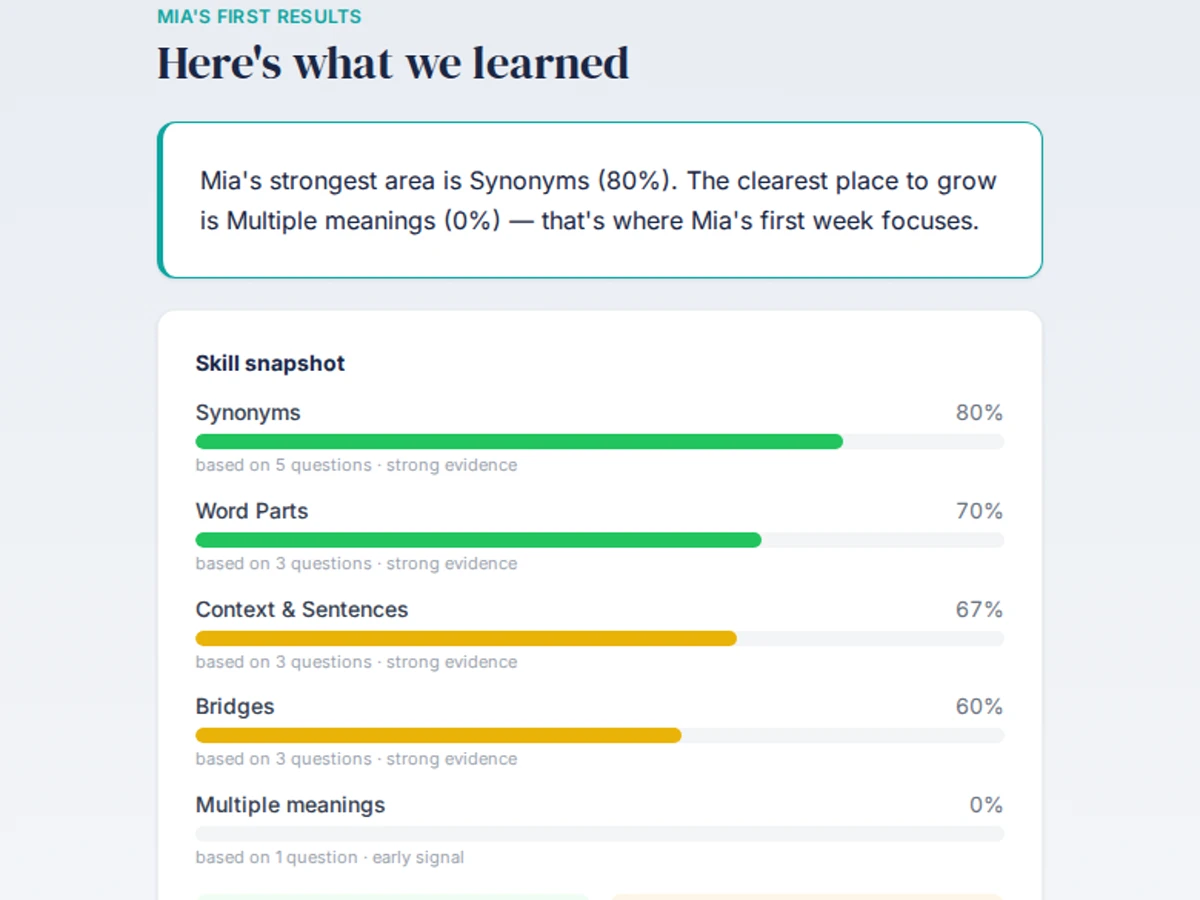
The check-up samples verbal skills and gives you an early strength, a growth area, and a first practice focus. It is not a full-length exam, an official SSAT or ISEE score, or an admissions prediction.
If you searched for "ISEE analogy questions," here's the surprising truth: the ISEE doesn't have an analogy section. Not at any level — Primary, Lower, Middle, or Upper. The ISEE verbal reasoning section tests synonyms and sentence completions exclusively. Analogies are an SSAT question type, not an ISEE one.
But here's the less obvious truth: the thinking skills behind analogies are exactly what your child needs for ISEE success. Analogy reasoning — what test-prep specialists call "bridge-type thinking" — is the foundation for recognizing synonym relationships, interpreting sentence completion context clues, and eliminating wrong answers systematically. Students who understand how words relate to each other outperform students who simply memorize definitions.
This guide explains how analogy thinking applies to every ISEE verbal question type, provides practice questions in the actual ISEE format, and shows how to build the relational reasoning skills that raise scores. For a detailed overview of ISEE vocabulary preparation, see our complete ISEE vocabulary guide.
What the ISEE Actually Tests
The ISEE verbal reasoning section appears at every test level, but the format stays consistent: synonyms and sentence completions. No analogies, no antonym sections, no vocabulary-in-context passages. Here's the breakdown by level:
| Level | Grades Entering | Questions | Time | Guessing Penalty |
|---|---|---|---|---|
| Primary (2–4) | Grades 2–4 | Varies by subtest | Varies | None |
| Lower Level | Grades 5–6 | 34 (~17 synonyms + ~17 sentence completions) | 20 minutes | None |
| Middle Level | Grades 7–8 | 40 (20 synonyms + 20 sentence completions) | 20 minutes | None |
| Upper Level | Grades 9–12 | 40 (20 synonyms + 20 sentence completions) | 20 minutes | None |
Synonym questions present a word and ask students to choose the answer choice closest in meaning. There are four answer choices (not five, as on the SSAT). The challenge is that the ISEE often tests secondary definitions and Tier 2 academic vocabulary — words like acute (meaning "sharp" or "keen," not just an angle type) or novel (meaning "new," not just a book).
Sentence completions present a sentence with one blank and four answer choices. The sentence contains context clues — signal words like "although," "because," "despite," and "therefore" — that indicate what kind of word belongs in the blank. Success requires reading comprehension and vocabulary knowledge working together.
Crucially, the ISEE has no penalty for wrong answers. Students should answer every question, even when guessing. This is different from the SSAT Middle and Upper levels, which deduct a quarter point for incorrect responses.
Why Analogy Thinking Still Matters for the ISEE
Analogy reasoning is fundamentally about understanding relationships between words. On the SSAT, that relationship is made explicit: "WARM is to SCORCHING as annoyed is to _____." On the ISEE, the same relational thinking operates beneath the surface of every question — it's just not labeled as an "analogy."
Consider what actually happens when a student solves an ISEE synonym question. They see a word like benevolent and four answer choices. To find the synonym, they need to recognize that benevolent and kind share a relationship of similar meaning. That's a synonym bridge — the same relationship type that appears in SSAT analogies.
Now consider sentence completions. A sentence like "Although the weather was _______, the team decided to play outdoors" requires the student to recognize a contrast relationship (signaled by "although") and choose a word that fits that pattern. This is cause-and-effect and contrast reasoning — the same cognitive skills tested by analogy bridge types.
The research supports this connection. A meta-analysis of morphological instruction found that students who learn to analyze word structures — roots, prefixes, suffixes, and the relationships between word forms — show significant vocabulary gains across grade levels. Relational reasoning is the thread connecting all verbal skills.
Bridge Types Applied to ISEE Synonyms
On the SSAT, students learn to classify word relationships using "bridge types" — synonym, antonym, degree, part-to-whole, cause-and-effect, and so on. (For the full list of 10 bridge types with examples, see our SSAT analogy bridge types guide.) Several of these bridge types map directly to ISEE synonym skills.
1. Synonym/Definition Bridge → Direct Synonym Questions
The most straightforward bridge type maps directly to ISEE synonyms. Two words mean the same thing. On the SSAT, this appears as "KIND : GENEROUS." On the ISEE, it becomes: "Which word means the same as generous?"
The skill transfer is immediate: students who can identify synonym bridges in analogies can identify correct answers on ISEE synonym questions. The bridge sentence "A means the same as B" is exactly what they're looking for.
Practice: ELOQUENT most nearly means
- (A) quiet
- (B) articulate
- (C) loud
- (D) complicated
Show answer
(B) articulate — Synonym bridge. Eloquent and articulate both mean "expressing ideas clearly and persuasively." Root clue: loqu (speak) tells you eloquent relates to speaking well.
Practice: BENEVOLENT most nearly means
- (A) wealthy
- (B) intelligent
- (C) kind
- (D) cautious
Show answer
(C) kind — Synonym bridge. bene (good) + vol (wish) = "wishing good," which means kind or generous. On an SSAT analogy, this might appear as BENEVOLENT : KIND :: malevolent : cruel.
2. Degree/Intensity Bridge → Distinguishing Close Synonyms
On the SSAT, degree bridges test whether students can recognize that two words describe the same quality at different intensities: WARM : SCORCHING. On the ISEE, this skill surfaces when multiple answer choices are in the same "meaning neighborhood" and the student must pick the one closest in degree to the target word.
For example, if the question asks for a synonym of annoyed, a student might see both irritated and furious among the choices. Understanding degree bridges helps them recognize that irritated matches the mild intensity of annoyed, while furious is far too strong.
Practice: CONTENT most nearly means
- (A) ecstatic
- (B) satisfied
- (C) indifferent
- (D) cheerful
Show answer
(B) satisfied — Degree awareness matters here. Content means quietly pleased — a mild positive. Ecstatic is the extreme end of happiness (too intense). Cheerful is a related but different quality (outward vs. inward). Indifferent is neutral. Satisfied matches the quiet, moderate intensity of content.
Practice: IRATE most nearly means
- (A) annoyed
- (B) furious
- (C) disappointed
- (D) nervous
Show answer
(B) furious — Irate means extremely angry, not mildly annoyed. Students who understand the degree bridge know to match intensity levels: irate sits at the high end of the anger spectrum, alongside furious. Annoyed is too mild.
3. Part-to-Whole Bridge → Structural Vocabulary Relationships
Part-to-whole reasoning helps with synonym questions that involve structural or compositional vocabulary. When a student encounters a word like component and understands its part-to-whole relationship with systems and structures, they can more accurately match it to synonyms like element or ingredient rather than confusing it with related but non-synonymous words like combination.
Practice: FRAGMENT most nearly means
- (A) whole
- (B) piece
- (C) collection
- (D) boundary
Show answer
(B) piece — Part-to-whole reasoning clarifies this instantly. A fragment is a part broken off from a whole. Root clue: frag/fract (break) tells you this word means "something broken" — a piece. Students who confuse fragment with collection (a whole made of parts) are reversing the part-whole relationship.
4. Cause-and-Effect Bridge → Sentence Completion Context Clues
Cause-and-effect is arguably the most important bridge type for ISEE sentence completions. Half the ISEE verbal section consists of sentence completions, and many of those sentences are built on causal logic: "Because X happened, the result was _____." Students who can identify cause-and-effect relationships between words can decode these sentences systematically.
Practice: PROVOKE most nearly means
- (A) prevent
- (B) calm
- (C) incite
- (D) observe
Show answer
(C) incite — Cause-and-effect reasoning: to provoke is to cause a reaction; to incite is to cause action or feeling. Both words describe causing something to happen. Root clue: voc/vok (call) hints at "calling forth" a response. Students who think in causal bridges immediately see the match.
5. Antonym Bridge → Eliminating Wrong Answers
The ISEE doesn't test antonyms directly, but antonym awareness is one of the most powerful elimination tools. When a student recognizes that an answer choice means the opposite of the target word, they can eliminate it instantly — even if they're unsure which of the remaining choices is correct. This is especially valuable on the ISEE, where there is no guessing penalty.
Practice: DIMINISH most nearly means
- (A) increase
- (B) reduce
- (C) maintain
- (D) create
Show answer
(B) reduce — Antonym bridge thinking helps with elimination: increase is the opposite of diminish, so eliminate (A) immediately. Create and maintain are unrelated. Root clue: min (small, less) tells you diminish means "to make smaller" — which matches reduce.
Bridge Types Applied to Sentence Completions
Sentence completions are where bridge-type thinking really pays off. Every sentence completion contains context clues — signal words and logical patterns that reveal what kind of word belongs in the blank. These context clue types map neatly to analogy bridge types:
| Context Clue Type | Signal Words | Bridge Type |
|---|---|---|
| Definition/Restatement | "which means," "in other words," "that is" | Synonym bridge |
| Contrast/Opposition | "although," "but," "however," "despite" | Antonym bridge |
| Cause and Effect | "because," "therefore," "as a result," "since" | Cause-and-effect bridge |
| Example/Illustration | "such as," "for example," "including" | Category/type bridge |
Understanding these mappings transforms sentence completions from a guessing game into a systematic process. Here are practice questions for each type.
-
Although the novel's plot was _______, the author's vivid characters kept readers engaged throughout.
-
(A) captivating
-
(B) predictable
-
(C) original
-
(D) suspenseful
Show answer
(B) predictable — Contrast clue. "Although" signals that the blank must contrast with "kept readers engaged." If readers stayed engaged despite something, that something must be negative. Predictable is the negative quality; the vivid characters compensated for it. Antonym bridge thinking: the blank is the opposite of what you'd expect to keep readers engaged.
-
Because the scientist's findings were _______, the research committee immediately approved additional funding.
-
(A) inconclusive
-
(B) controversial
-
(C) compelling
-
(D) redundant
Show answer
(C) compelling — Cause-and-effect clue. "Because" tells you the blank caused the committee to approve funding. What kind of findings cause approval? Strong, convincing ones. Compelling means "powerfully convincing." Root clue: pel/puls (drive, push) — compelling findings "drive" people to act.
-
The diplomat was known for being _______; that is, she could navigate disagreements without offending either side.
-
(A) aggressive
-
(B) indifferent
-
(C) tactful
-
(D) stubborn
Show answer
(C) tactful — Definition/restatement clue. The phrase "that is" signals a restatement: the blank is defined by "navigate disagreements without offending either side." That's the definition of tactful. Synonym bridge thinking: the blank and the restatement mean the same thing.
-
The region is home to many _______ species, including wolves, bears, and mountain lions.
-
(A) aquatic
-
(B) predatory
-
(C) extinct
-
(D) domestic
Show answer
(B) predatory — Example/illustration clue. "Including" introduces examples that define the category in the blank. Wolves, bears, and mountain lions are all predators. Category bridge thinking: the examples are types of the blank word. These animals are types of predatory species.
The Root Word Advantage
Root-word knowledge is the bridge between analogy thinking and actual ISEE performance. When students learn that bene means "good" and mal means "bad," they're not just memorizing definitions — they're building a relational framework. Every word containing bene sits in a synonym network with other "good" words, and in an antonym relationship with every mal word. This is bridge-type thinking applied to morphology.
Here are four root families that demonstrate the connection between relational reasoning and ISEE vocabulary:
spec/spect (look, see)
Inspect (look into), spectacle (something to see), perspective (way of looking at), retrospect (looking back). On the ISEE, if a student sees circumspect and recognizes circum (around) + spect (look), they decode it as "looking around carefully" = cautious. That's a synonym bridge to careful or prudent.
cred (believe)
Credible (believable), incredible (not believable), credential (proof of belief/trust), credulous (too willing to believe). The antonym bridge between credible and incredible is built into the prefix in- (not). One root, one prefix, and the student understands both the word and its opposite.
duc/duct (lead)
Conduct (lead together), deduce (lead from evidence), introduce (lead into), produce (lead forward). These words share a root but play different roles in sentences. Understanding the word-form bridge — how prefixes change the root's direction — helps students decode unfamiliar members of the family, like induct or abduct.
vor/vour (eat, devour)
Voracious (eating eagerly), devour (eat up completely), carnivore (meat-eater), herbivore (plant-eater). This root family demonstrates both category bridges (carnivore is a type of animal) and degree bridges (voracious is an intense form of hungry). On the ISEE, recognizing vor in voracious immediately connects it to "eager" or "insatiable."
For a comprehensive list of the roots that appear most frequently on the ISEE and SSAT, see our roots vs. flashcards comparison and our guide to spaced repetition for kids.
Root knowledge is a powerful on-ramp — but analogy thinking itself belongs to a broader skill category the ISEE is really measuring. The test scores five verbal domains: Vocabulary Knowledge (where roots live), Relational Reasoning (the bridge-type thinking at the core of this guide), Contextual Inference (reading context clues in sentence completions), Test Execution (pacing, guessing rules, format awareness), and Metacognition (knowing which strategy to reach for and when). LexiMap trains all five and surfaces each one on a parent dashboard, so you can see at a glance where your child is strongest and where the next gains are coming from.
ISEE vs. SSAT: How Verbal Questions Differ
If your child is deciding between the SSAT and ISEE — or taking both — understanding the structural differences helps you plan preparation efficiently. The vocabulary knowledge transfers between tests, but the question formats require different skills.
| Feature | SSAT | ISEE |
|---|---|---|
| Analogies | Yes — 30 questions (Middle/Upper) | No |
| Synonyms | Yes — 30 questions (Middle/Upper) | Yes — 17–20 questions |
| Sentence Completions | No | Yes — 17–20 questions |
| Total Verbal Questions | 60 (Middle/Upper) | 34–40 |
| Time | 30 minutes | 20 minutes |
| Answer Choices | 5 per question | 4 per question |
| Guessing Penalty | -0.25 points (Middle/Upper) | None — answer every question |
| Key Cognitive Skill | Relational reasoning (analogies) | Contextual reasoning (sentence completions) |
| Root Knowledge Value | Decodes unfamiliar words + reveals bridge types | Decodes unfamiliar words + confirms context clues |
The key takeaway: the SSAT tests relational reasoning explicitly through analogies, while the ISEE tests the same reasoning implicitly through synonym and sentence completion questions. Students who learn bridge types for the SSAT will find that the same skills make them faster and more accurate on the ISEE — and vice versa.
For more on how the SSAT verbal section works, see our guide to SSAT analogy strategies.
Practice Strategy: Using Analogy Thinking for ISEE Prep
Here's a four-step method for incorporating bridge-type reasoning into your child's ISEE preparation:
- Learn the bridge types. Even though the ISEE doesn't test analogies directly, understanding the 10 bridge types gives students a vocabulary for thinking about word relationships. Our SSAT analogy bridge types guide covers all 10 with examples. Spend one week learning them, even if your child is only taking the ISEE.
- Apply bridge thinking to synonym practice. For every synonym question, have your child name the relationship: "This is a synonym bridge — the words mean the same thing" or "I'm eliminating this choice because it's an antonym bridge." Naming the relationship makes the reasoning explicit and repeatable.
- Map context clues to bridge types on sentence completions. When your child sees "although," they should think "contrast = antonym bridge." When they see "because," they should think "cause-and-effect bridge." This turns signal-word recognition from an abstract reading skill into a concrete classification task.
- Build root word knowledge systematically. Roots are the connective tissue between bridge-type reasoning and actual word knowledge. Learning root families (not just individual words) reinforces the relational framework. See our ISEE vocabulary builder guide for tool recommendations and our roots vs. flashcards analysis for the research behind this approach.
How LexiMap Supports ISEE Verbal Preparation
LexiMap was built on the premise that understanding word relationships matters more than memorizing definitions. Its root-based curriculum teaches the same structural thinking that underlies bridge-type reasoning:
- Root families, not word lists. Students learn root families (e.g., bene → benefit, benevolent, benediction) rather than isolated definitions. This builds the relational networks that power synonym recognition and answer elimination.
- FSRS spaced repetition. The FSRS algorithm schedules review at optimal intervals, targeting 85%+ retention. Ten minutes a day produces better results than hour-long weekend sessions. Learn more about our FSRS methodology.
- ISEE-appropriate difficulty levels. Content is calibrated to Lower, Middle, and Upper Level ISEE vocabulary, so students practice with words they'll actually encounter on test day.
- Morphological awareness. Every word is connected to its root, prefix, and suffix components — building the decoding skills that research shows are strongly correlated with vocabulary knowledge (observed r = 0.40–0.70 across studies) in grade 4 and beyond.
Frequently Asked Questions
Does the ISEE have analogy questions?
No. The ISEE does not include analogy questions at any level (Primary, Lower, Middle, or Upper). The ISEE verbal reasoning section tests synonyms and sentence completions only. Analogies are exclusive to the SSAT, where they make up 30 of 60 verbal questions at the Middle and Upper levels. However, the relational reasoning skills behind analogies — understanding how words connect through synonym, antonym, degree, and cause-and-effect relationships — directly support ISEE synonym and sentence completion performance.
How is the ISEE verbal section different from the SSAT?
The SSAT verbal section tests synonyms (30 questions) and analogies (30 questions) in 30 minutes. The ISEE verbal section tests synonyms (17–20 questions) and sentence completions (17–20 questions) in 20 minutes. The SSAT has 5 answer choices per question and penalizes wrong answers (-0.25 points at Middle/Upper levels). The ISEE has 4 answer choices and no guessing penalty. The underlying vocabulary overlaps significantly, but the SSAT emphasizes abstract relational reasoning (analogies) while the ISEE emphasizes contextual reasoning (sentence completions).
What's the best way to study for ISEE synonyms?
The most effective approach combines root-based learning with spaced repetition. Instead of memorizing individual word definitions, learn root families: understanding that bene means "good" unlocks benefit, benevolent, benediction, benefactor, and benign — five words from one root. Pair this with daily spaced repetition practice (10–15 minutes) and periodic practice tests in ISEE format. For detailed tool recommendations, see our ISEE vocabulary builder guide.
Should I practice SSAT analogies if I'm only taking the ISEE?
Yes, with a caveat. Practicing SSAT-style analogies is a highly effective way to build the relational reasoning skills that improve ISEE synonym and sentence completion performance. Learning bridge types trains students to think about how words relate, not just what they mean. However, don't spend the majority of your prep time on analogies. Dedicate one to two weeks to learning bridge types and practicing SSAT analogies, then shift focus to ISEE-format synonym and sentence completion questions. The analogy skills will transfer automatically.
Key Takeaways
- The ISEE has no analogy section, but bridge-type thinking — the relational reasoning behind analogies — is the foundation for ISEE synonyms and sentence completions.
- Five bridge types map directly to ISEE verbal skills: synonym, degree, part-to-whole, cause-and-effect, and antonym bridges each support a specific test strategy.
- Context clue signal words ("although," "because," "that is," "including") map to bridge types; naming the pattern turns sentence completion from guessing into a systematic process.
- Root-word knowledge is the connective tissue between bridge reasoning and actual test performance: roots build synonym networks and reveal cause-and-effect relationships structurally.
- A one-to-two week bridge-type study block pays lasting dividends on ISEE performance even for students who will never see an analogy question on test day.
Get SSAT/ISEE vocabulary resources by email
Related Articles
ISEE Verbal Section: The Parent's Complete Guide
Everything parents need to know about the ISEE verbal reasoning section — question types, scoring, levels, and what vocabulary prep actually works for your child.
ISEE Reading Comprehension: How Vocabulary Knowledge Determines Your Child's Score
Learn how vocabulary knowledge affects your child's ISEE reading comprehension score — and which prep strategies transfer beyond the Verbal Reasoning section.
ISEE Verbal Reasoning Strategies by Level: Primary Through Upper
Level-by-level ISEE verbal strategies for Primary through Upper Level. Vocabulary, sentence completion, and reading comprehension prep tailored to each grade band.
ISEE Vocabulary Builder: Best Tools and Strategies for 2026
Compare the best ISEE vocabulary building tools and strategies. Learn how root-based learning, spaced repetition, and targeted practice prepare students for ISEE verbal reasoning.
Related Guides
The Parent's Complete Guide to SSAT & ISEE Prep
Everything parents need to know about SSAT and ISEE preparation. Test formats, timelines, study strategies, score interpretation, and how to support your child's verbal growth.
SSAT Vocabulary: The Complete Guide to Root-Based Learning
Master SSAT vocabulary through Latin and Greek roots. Learn how root-based learning, spaced repetition, and interactive practice build lasting verbal skills for grades 4-12.
SSAT® is a registered trademark of The Enrollment Management Association. ISEE® is a registered trademark of the Educational Records Bureau (ERB). LexiMap is not affiliated with or endorsed by these organizations.