Beyond Analogies: Relational Reasoning Across the Whole Verbal Section
Find your child’s vocabulary gaps
Start with a free, no-card vocabulary check-up and get a personalized parent report.
Find the vocabulary gaps — freeSee a sample parent report before starting
The check-up samples verbal skills and gives you an early strength, a growth area, and a first practice focus. It is not a full-length exam, an official SSAT or ISEE score, or an admissions prediction.
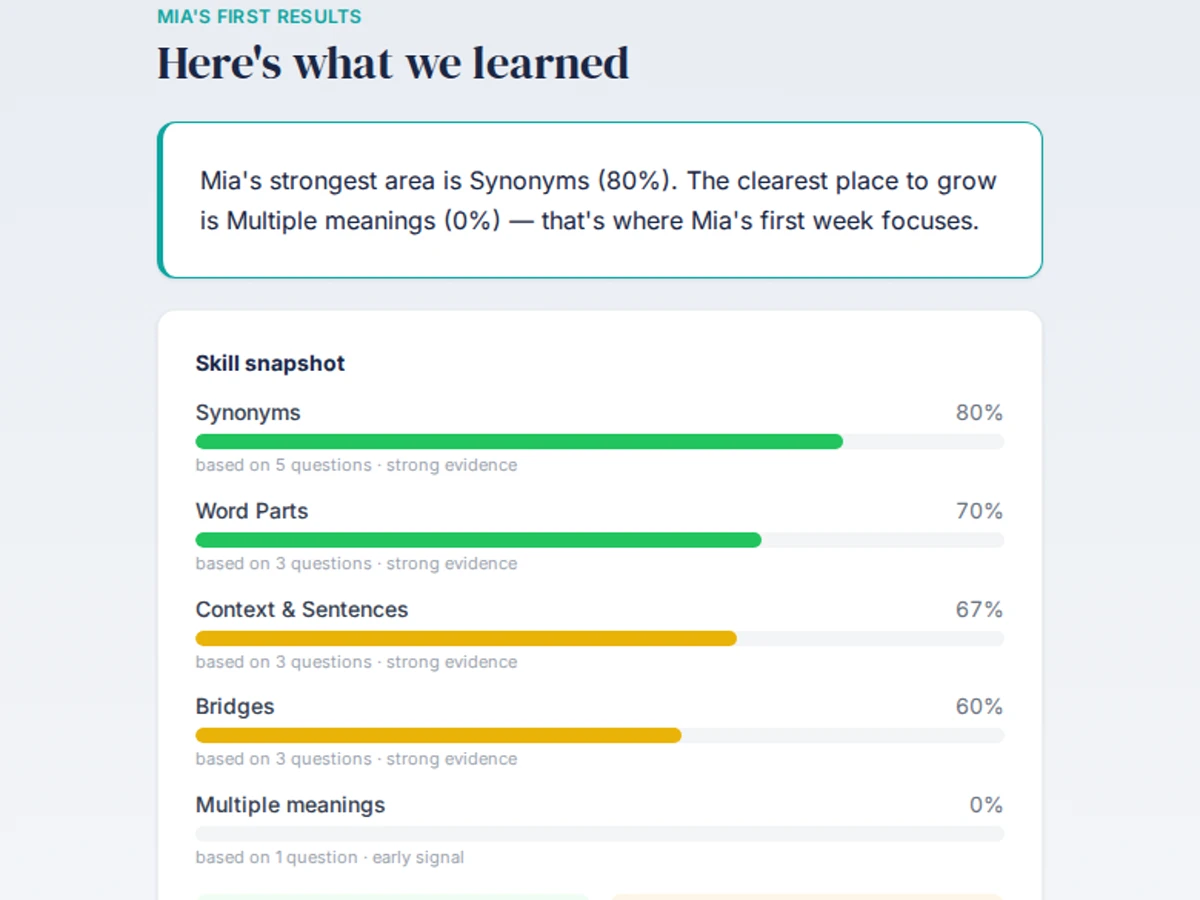
When parents read a verbal score report, they tend to see a list of unrelated question types: analogies here, synonyms there, sentence completions somewhere else. The instinct is to treat each as its own subject to drill. But a hidden thread runs through most of the verbal section, and once you can see it, the whole thing starts to make sense.
That thread is relational reasoning — the ability to perceive how two words relate, not just what each one means alone. Analogies test it most obviously, but near-synonym questions, antonym questions, and the quiet sorting your child does while reading all lean on the same skill. A child who can name relationships precisely answers faster, guesses smarter, and reads with sharper comprehension. This post is the hub for that skill: analogies get a short treatment because we cover them in depth elsewhere, and the real work below is on the under-taught slices — near-synonym discrimination, antonym recognition, and the semantic fields that hold word families together.
The Hidden Thread: One Skill Behind Several Question Types
Picture three questions your child might meet on the SSAT or ISEE: complete an analogy, pick the word closest in meaning to a target, find a word's opposite. On the surface these look like three skills, and most prep treats them that way — separate drills, separate decks, separate tips.
But watch what the brain actually does. In all three, your child holds two words side by side and asks one question: how do these relate? For the analogy, the relationship is the point. For the synonym, they test whether it is "same meaning, same direction." For the antonym, "opposite direction." The vocabulary is raw material; the relationship is what gets graded. And that changes how you help: if these are three subjects, you drill three things and hope; if they are three expressions of one skill, strengthening that skill lifts all three at once, and the habit a child builds on analogies carries straight into the synonym section.
LexiMap treats this as a first-class domain rather than a scatter of question types. It is one of five verbal domains the platform trains — Vocabulary Knowledge, Relational Reasoning, Contextual Inference, Test Execution, and Metacognition — and the parent dashboard reports on it as a distinct signal, so you can see whether relationship-thinking is developing independently of how many words your child has memorized.
What Relational Reasoning Is (and Why It Predicts Verbal Scores)
Relational reasoning is the skill of identifying, comparing, and applying relationships between concepts. It is not about how many words your child knows; it is about what they can do with the words they know. Two children can have identical vocabularies and very different scores, and the gap is almost always relational reasoning.
In plain terms: vocabulary answers "what does frugal mean?" Relational reasoning answers "how does frugal relate to thrifty, to wasteful, to stingy?" The first is a lookup; the second is a judgment — and judgments are what hard verbal questions are built from. A test-writer cannot make a question difficult just by using a rarer word; the dictionary is the same for everyone. They make it hard by demanding finer relational distinctions: not "happy versus sad," but "content versus elated," where both point the same way and only the degree differs.
That is why relational reasoning predicts overall verbal performance. Easy questions reward vocabulary; the questions that separate a good score from a great one reward the ability to say these words are close, but not identical, and here is exactly how they differ. And it is trainable: vocabulary grows slowly, word by word, but relationship-thinking is a habit, and habits install in weeks. The habit is simple to state — before deciding, name the relationship.
Analogies: Relationship Thinking Made Explicit
Analogies are relational reasoning with the disguise removed. Every other question type asks your child to think about relationships implicitly; the analogy puts the relationship on the table as the whole task. PAINTER is to CANVAS as a writer is to — what? Your child cannot answer without first deciding what kind of relationship binds painter and canvas. It is the purest form of the skill this post is about. Because analogies are central, we cover them in depth elsewhere, and this hub deliberately does not repeat that material:
- The complete relationship taxonomy — synonym, antonym, part-to-whole, degree, function, and the rest — lives in our SSAT analogy bridge-types guide.
- The test-day technique for applying those categories under time pressure — building a precise relationship sentence, eliminating by type, calibrating to difficulty — is in SSAT analogy strategies.
- For ISEE families, ISEE analogy practice covers the format and worked examples specific to that test.
The one idea to carry forward is this: naming the relationship before answering is not an analogy trick. It is the core move of relational reasoning, and it works just as well on the question types below — where the relationship is hidden rather than handed to you.
Synonym Discrimination: Near-Synonyms Are a Relationship Problem
Synonym questions look like vocabulary questions, and parents file them that way. On easy items they are. But the synonym questions that actually move a score are relationship questions, and the relationship being tested is "same meaning, same direction, same intensity, same register" — all at once.
Take a target like frugal with choices thrifty, stingy, economical, and cheap. Every one lives in the same neighborhood. A child relying on raw recall — "frugal means careful with money, and all four are about money" — has no way to choose. Discrimination requires relational reasoning: frugal and thrifty share not just a meaning but a connotation (both mildly approving), while stingy points the same direction but carries a negative judgment the target does not. The right answer matches on every relational dimension, not just the dictionary gloss.
That is why near-synonym discrimination deserves its own attention rather than being lumped under "build vocabulary." The skill is judging fine differences along several axes:
- Connotation — approving, neutral, or critical? Thrifty praises; stingy criticizes; frugal sits near neutral-positive.
- Intensity — warm and scorching both describe heat, but the question wants the match at the same strength, not a stronger cousin.
- Register — purchase and buy mean the same thing, but one is formal and one plain; the best match shares the target's register.
Teach your child to treat a synonym question as a same-direction relationship judgment: not "which word means roughly this?" but "which word is a true twin — same direction, same temperature, same tone?" That reframing alone eliminates trap answers that share a definition but differ in feel. We go deeper on connotation, register, and shades of meaning in our companion post on vocabulary depth.
Antonym Recognition: Opposites, Gradation, and the Roots That Flag Them
Antonyms are the mirror image of synonyms, and they test relational reasoning just as directly — the relationship is "opposite direction." But "opposite" is less simple than it sounds, and the better questions exploit that.
The first complication is gradation. Many words are not binary opposites but points on a scale. The opposite of frigid might be scorching, but it might also be warm — and the test wants the true opposite, the far end of the same scale. A child who thinks of antonyms as on/off switches picks a word that is somewhat opposite and misses the one that is exactly opposite. Relational reasoning is what asks: are these on the same scale, and at opposite ends of it?
The second complication is near-opposite distractors — words that contrast loosely but do not actually reverse the target. The defense is the same habit: name the relationship precisely. If the target is candid (open, frank), the opposite is secretive or evasive — not merely quiet or shy, which contrast in mood but not in openness. Naming the dimension being reversed separates the right answer from the plausible one.
This is where roots earn their double advantage most visibly. A large share of opposites in English are signaled by morphology, and a child who knows the code spots the opposition before fully retrieving the definition:
- bene (good) versus mal (bad): benevolent and malevolent are opposites the instant your child decodes the prefixes.
- pro (forward, for) versus anti/contra (against): protagonist and antagonist.
- eu (good, well) versus dys (bad, faulty): euphony and dysphony.
- Reversing directional prefixes: ex (out) versus in/im (in), as in exhale and inhale, export and import.
When your child recognizes an opposite-signaling root, antonym recognition stops being a memory test and becomes a decoding move. They are not recalling that malevolent opposes benevolent; they are reading the opposition straight out of the prefixes. That is relational reasoning and morphology working as one system.
Semantic Fields: Mapping Words That Cluster Together
Behind both synonym and antonym work sits a quieter idea: words do not live alone. They cluster into semantic fields — groups that share a domain of meaning. Thrifty, frugal, stingy, miserly, economical, and prodigal form one field (attitudes toward spending). Whisper, murmur, shout, bellow, and yell form another (volume of speech). The field is the territory; the words are positions within it.
Why does this matter for a score? Because every fine relational judgment — is this a true synonym? the exact opposite? — is really a question about position within a field. You cannot judge that frugal sits closer to thrifty than to stingy without a mental map of the spending field with all three placed on it. A child who treats vocabulary as a flat list has no such map, so every discrimination is a coin flip; a child who thinks in fields can see where a word sits among its neighbors, and the judgments become almost visual.
This is where breadth pays off in a way memorization does not. Knowing more words in a field does not just add facts; it sharpens the map. The more positions your child has plotted in the "volume of speech" field, the more precisely they can locate a new word — and distinguish murmur from mutter. Semantic-field mapping is how vocabulary breadth converts into relational precision, and it is why a child with a well-organized vocabulary outperforms one with a merely large one.
Practically, build fields by grouping rather than listing. Instead of learning frugal as one card, your child learns it as a position: more positive than stingy, less extreme than miserly, the near-twin of thrifty, the opposite of prodigal. Each new word gets placed, not just stored — and that placement is the habit that makes relational reasoning automatic.
How Roots Power Relational Reasoning (The Double Advantage)
Roots are usually sold to parents as a vocabulary tool — learn the building blocks, decode more words. True, and it is the on-ramp. But roots do something subtler and, for relational reasoning, more valuable: they often encode the relationship itself, not just one word's meaning. That is the double advantage. Roots decode the words — if your child does not know benevolent, no reasoning can save them, and a recognized bene unlocks it. But the same roots that decode meaning also flag relationships: when your child sees bene in one word and mal in another, the relationship is handed to them — opposite — with no retrieval and no guessing.
Across the question types the pattern holds:
- On antonyms, opposite-signaling roots (bene/mal, pro/anti, eu/dys, ex/in) turn an opposition into something readable straight off the prefixes.
- On synonyms, a shared root often confirms a same-direction relationship — words built on the same root usually sit in the same semantic field.
- On analogies, roots reveal the bridge: scope (look) or meter (measure) expose a tool-to-purpose relationship; -ist flags a "person who"; -tion flags a grammatical relationship.
- On semantic fields, roots are the natural organizing principle — words sharing loqu/loc (speak) cluster into a speech field.
This is why LexiMap starts with roots but does not stop there. Roots are the most efficient on-ramp to vocabulary, and they are also the hidden infrastructure of relational reasoning — so a child building roots is, without being told, building the relationship-detection system the harder questions reward. For the full inventory, see our complete list of Latin and Greek roots.
Building Relationship Thinking at Home (and the Dashboard's Relational Reasoning Signal)
The most useful thing you can do at home costs nothing and takes seconds: whenever a word comes up — in reading, conversation, or homework — ask not "what does it mean?" but "how does it relate to a word you already know?" Is it a synonym, an opposite, a stronger version, a member of the same family? You are not quizzing vocabulary; you are installing the habit of naming relationships. A few low-effort routines compound it:
- Play "name the relationship." Give two words — thrifty and stingy, candid and evasive — and have your child say the relationship in a precise sentence: "almost the same, but one is approving and one critical." That sentence is relational reasoning.
- Build small fields, not long lists. When a new word appears, ask for two neighbors and one opposite. Three placements beat ten isolated definitions.
- Decode opposites from roots. Hit a recognizable prefix, then ask what its opposite prefix would be. If bene means good, what would a mal- word feel like?
Where this gets hard alone is measurement. You can sense that your child knows more words, but not whether their relationship-thinking is improving — and that is the skill that moves the hard questions. This is the gap LexiMap's parent dashboard closes. Relational Reasoning is tracked as its own signal, separate from raw vocabulary, so you can see whether your child is getting better at the judgments that matter — distinguishing near-synonyms, recognizing true opposites, mapping fields. The dashboard's process-skills view sits alongside Test Execution and Learning Skills signals, so you see how your child is thinking, not only what they have memorized. The freeing part is that you do not have to drill four question types and hope they all improve — they are one skill in four costumes, and a child gets visibly better at it when it is named, practiced, and measured. All plans start with a 7-day free trial, so you can watch the Relational Reasoning signal move before committing.
Key Takeaways
- Relational reasoning is the connective tissue of the verbal section.
- Analogies are its most explicit form — but synonyms and antonyms test it too.
- Synonym discrimination is a same-direction relationship judgment.
- Antonym recognition leans on opposite-signaling roots.
- Semantic-field mapping builds the breadth that relationships need.
Further reading:
- SSAT Analogy Practice: Bridge Types
- SSAT Analogy Strategies
- ISEE Analogy Practice
- Vocabulary Depth: Connotation, Register & Multiple Meanings
- The Complete List of Latin and Greek Roots
Get SSAT/ISEE vocabulary resources by email
Related Articles
ISEE Analogy Practice: How Relationship Thinking Helps with Synonyms & Sentence Completions
The ISEE doesn't test analogies — but analogy thinking is the key to ISEE synonyms and sentence completions. Learn bridge types, practice questions, and root word strategies.
SSAT Analogy Practice: Master All 10 Bridge Types with Examples
Practice SSAT analogies with all 10 bridge types explained and illustrated. Includes example questions, step-by-step solutions, and strategies for each bridge type.
5 SSAT Analogy Strategies That Actually Work on Test Day
Master SSAT analogies with 5 proven strategies: bridge sentences, root word analysis, elimination technique, relationship reversal, and difficulty calibration.
SSAT Verbal Study Strategies: Your 3-Month Plan
A research-backed 3-month SSAT verbal study plan covering synonyms, analogies, and vocabulary. Week-by-week schedule for Middle and Upper Level students.
Related Guides
SSAT Vocabulary: The Complete Guide to Root-Based Learning
Master SSAT vocabulary through Latin and Greek roots. Learn how root-based learning, spaced repetition, and interactive practice build lasting verbal skills for grades 4-12.
SSAT Vocabulary List: 200+ Words Organized by Level and Root
Comprehensive SSAT vocabulary word lists organized by test level (Elementary, Middle, Upper) and root word family. Study the right words for your child's grade.
SSAT® is a registered trademark of The Enrollment Management Association. ISEE® is a registered trademark of the Educational Records Bureau (ERB). LexiMap is not affiliated with or endorsed by these organizations.