SSAT vs ISEE: Which Test Does Your Child Need?
Find your child’s vocabulary gaps
Start with a free, no-card vocabulary check-up and get a personalized parent report.
Find the vocabulary gaps — freeSee a sample parent report before starting
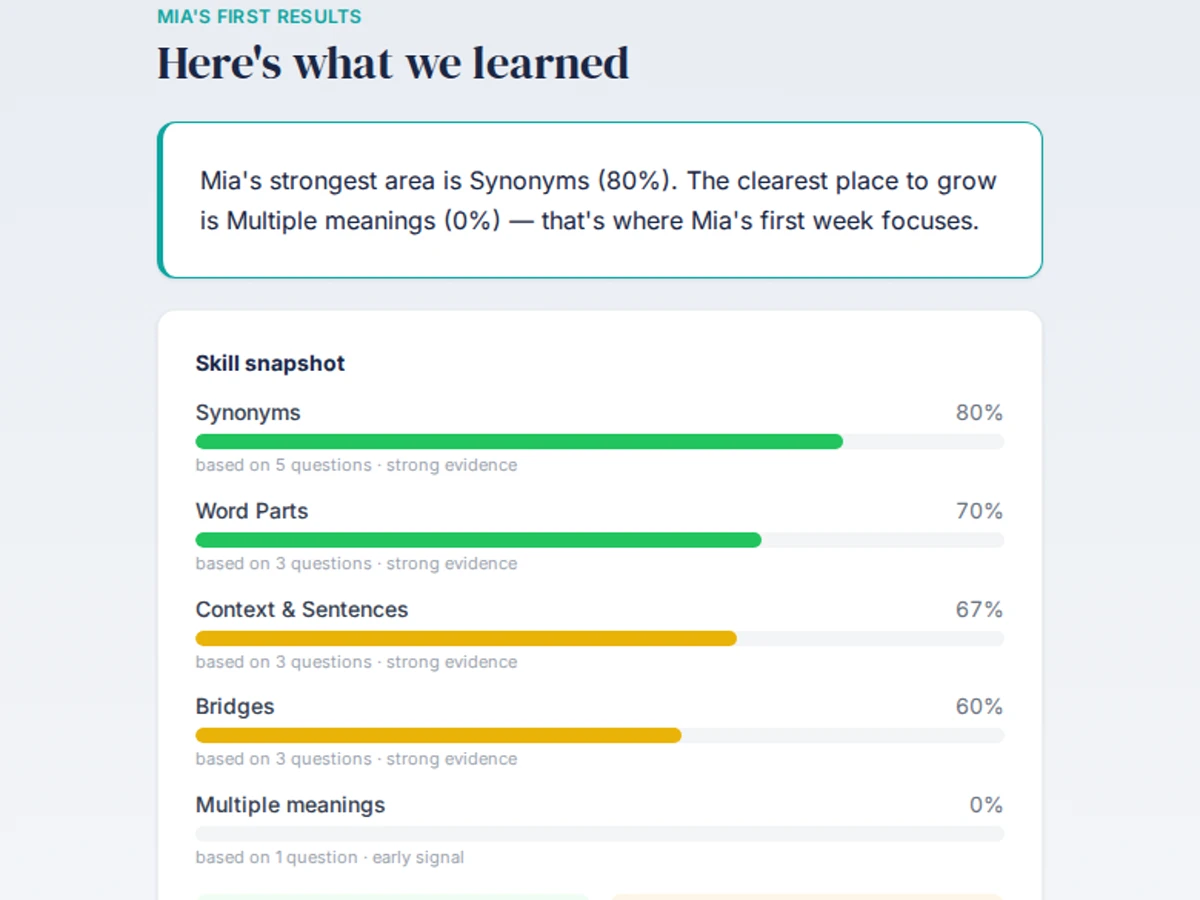
The check-up samples verbal skills and gives you an early strength, a growth area, and a first practice focus. It is not a full-length exam, an official SSAT or ISEE score, or an admissions prediction.
One of the first questions parents face when preparing for independent school admissions is one nobody warned them about: before you can start prepping, you have to figure out which test your child is actually taking.
The SSAT and the ISEE are both admissions tests used by private and independent schools. They measure similar things — verbal reasoning, quantitative ability, reading comprehension — and they're taken by kids in overlapping grade ranges. Many schools accept both. And yet the two tests are meaningfully different in format, scoring, difficulty distribution, and what they reward.
Choosing the wrong one is a low-stakes mistake — you can switch. But choosing thoughtfully, based on your child's specific strengths and your target schools' preferences, gives you a cleaner preparation path and a better starting point.
This guide covers everything you need to make a confident decision.
What Are the SSAT and ISEE?
The SSAT (Secondary School Admission Test)
The SSAT is administered by the Enrollment Management Association (EMA). Accepted at more than 2,600 schools worldwide.
Three levels:
- Elementary Level — grades 3–4 (applying to grades 4–5)
- Middle Level — grades 5–7 (applying to grades 6–8)
- Upper Level — grades 8–11 (applying to grades 9–12)
Test dates are fixed Saturdays throughout the year.
The ISEE (Independent School Entrance Exam)
Administered by the Educational Records Bureau (ERB). Accepted at more than 1,200 independent schools.
Four levels:
- Primary Level — applying to grades 2–4
- Lower Level — grades 4–5 (applying to grades 5–6)
- Middle Level — grades 6–7 (applying to grades 7–8)
- Upper Level — grades 8–11 (applying to grades 9–12)
Format Differences
SSAT Format
| Section | Content | Questions | Time |
|---|---|---|---|
| Writing Sample | Persuasive or creative prompt (unscored) | 1 prompt | 25 min |
| Verbal | Synonyms + analogies | 60 questions | 30 min |
| Quantitative 1 | Math (no calculator) | 25 questions | 30 min |
| Reading Comprehension | Short passages | 40 questions | 40 min |
| Quantitative 2 | Math (no calculator) | 25 questions | 30 min |
| Experimental | Unscored trial questions | 16 questions | 15 min |
Total: ~3 hours 5 minutes.
Key notes:
- Verbal section: only synonyms and analogies. No sentence completions.
- Two separate quantitative sections.
- Experimental section doesn't count. Students don't know which questions are experimental.
- Writing sample goes to schools but receives no score.
ISEE Format
| Section | Content | Questions | Time |
|---|---|---|---|
| Verbal Reasoning | Synonyms + sentence completions | 40 questions | 20 min |
| Quantitative Reasoning | Math reasoning (no calculator) | 37 questions | 35 min |
| Reading Comprehension | Passages with questions | 36 questions | 35 min |
| Mathematics Achievement | Curriculum-based math | 47 questions | 40 min |
| Essay | Writing prompt (unscored) | 1 prompt | 30 min |
Total: ~2 hours 40 minutes.
Key notes:
- Verbal section: sentence completions alongside synonyms. No analogies.
- Separates quantitative reasoning from mathematics achievement.
- Essay goes to schools unscored.
Scoring Differences
SSAT Scoring
Scaled score ranges: Elementary 300–600, Middle 440–710, Upper 500–800. Percentile rank vs. prior 3-year test-takers. Wrong-answer penalty: −1/4 point per wrong answer.
ISEE Scoring
Stanine scale (1–9). No wrong-answer penalty.
Head-to-Head Comparison Table
| Feature | SSAT | ISEE |
|---|---|---|
| Administering organization | EMA | ERB |
| Levels available | Elementary, Middle, Upper | Primary, Lower, Middle, Upper |
| Grade range | Grades 3–11 | Ages 5–11 (Primary); Grades 4–11 |
| Schools accepted | 2,600+ worldwide | 1,200+ primarily US |
| Verbal question types | Synonyms + analogies | Synonyms + sentence completions |
| Verbal section length | 60 questions / 30 min | 40 questions / 20 min |
| Math sections | 2 quantitative sections | Quant Reasoning + Math Achievement |
| Reading section | 40 questions / 40 min | 36 questions / 35 min |
| Writing/essay | Unscored writing sample (25 min) | Unscored essay (30 min) |
| Experimental section | Yes (16 questions, unscored) | No |
| Total testing time | ~3 hours 5 min | ~2 hours 40 min |
| Score scale | 300–600 / 440–710 / 500–800 | Stanines 1–9 |
| Percentile reporting | Yes | Yes |
| Wrong-answer penalty | Yes (−1/4 point) | No |
| Guessing strategy | Avoid random guesses | Always answer every question |
| Calculator permitted | No | No |
| Typical test dates | Monthly Saturdays | Flexible scheduling |
| Registration fee | ~$165 | ~$110–$250 |
Which Schools Prefer Which Test?
- SSAT-dominant: East Coast boarding schools (Exeter, Andover, Hotchkiss, etc.)
- ISEE-dominant: NYC day schools (Collegiate, Spence, Trinity, etc.) and Bay Area/Boston schools
- Both accepted: Now the majority of schools
Which Test Is Harder?
- SSAT verbal tends harder for students with weak root knowledge
- ISEE verbal tends harder for students who struggle with context
- SSAT's wrong-answer penalty raises stakes on guessing
- Best approach: take a practice test for each
Decision Framework: How to Choose
- Do your target schools require or prefer one test?
- Does your child's verbal profile suggest a preference?
- Take a timed practice test for each
- Consider logistics (dates, costs, centers)
- Consider penalty structure and your child's temperament
Should You Prep for Both?
For most families: no. Pick one test, prepare well.
One area where preparation transfers between both: vocabulary roots. Both tests' verbal sections are dominated by vocabulary. Root-based vocabulary preparation works for both. LexiMap's 160 roots and 60 affixes cover a large share of SSAT/ISEE vocabulary.
Whichever test your child sits, the same five verbal domains drive performance — Vocabulary Knowledge, Relational Reasoning, Contextual Inference, Test Execution, and Metacognition — so a five-domain prep approach carries over completely.
For a deeper look at the SSAT verbal format, see our SSAT Verbal Section Breakdown. For ISEE-specific vocabulary tools, check out ISEE Vocabulary Builder: Best Tools.
Frequently Asked Questions
Can my child take both?
Yes. There is no rule against taking both the SSAT and the ISEE.
What if a school requires only one?
Then the choice is made. Check your target schools' admissions pages for their specific requirements.
What grade should my child be in for each test?
Both tests are designed for students applying above their current grade level. The test level is determined by the grade your child is currently in, not the grade they're applying to.
How many times can my child take each?
SSAT: once per test date. ISEE: once per testing season (roughly every 6 months).
What's the cost difference?
SSAT is approximately $165. ISEE ranges from approximately $110 to $250, depending on testing format and location.
Key Takeaways
- The SSAT and ISEE differ in verbal question types (analogies vs. sentence completions), scoring (scaled vs. stanines), and wrong-answer penalties (yes vs. no)
- Most schools now accept both. Start by checking your target schools
- The "harder" test depends on your child
- For most families: take one practice test for each early, then commit to one
- Vocabulary preparation transfers between both tests. Root-based learning builds the underlying word knowledge needed for ISEE analogy practice and SSAT analogy practice alike
- If timing allows only one prep cycle, choose the test that aligns with target schools first, then your child's verbal strengths. See our guide on when to start SSAT prep for timeline guidance
LexiMap is a vocabulary mastery platform for SSAT and ISEE prep. The 160 roots and 60 affixes in LexiMap's curriculum cover a large share of vocabulary across both tests — all levels, no content gating. Start with a 7-day free trial at leximap.ai.
Questions parents ask
Which is easier, the SSAT or the ISEE?
Neither is uniformly easier — they test the same academic vocabulary in different formats. The SSAT's analogies reward relational thinking; the ISEE's sentence completions reward context-clue skill. Most students find one format more natural, which is worth discovering with a sample section of each.
Do private schools prefer one test?
Many schools accept either — but requirements vary by school and year, so check each target school's admissions page before choosing. Some schools and regions do specify one test.
Does prep for one test transfer to the other?
Vocabulary prep transfers almost entirely — the word pools overlap heavily and the same Latin/Greek roots drive both. Format practice is test-specific: analogies for the SSAT, sentence completions for the ISEE.
Get SSAT/ISEE vocabulary resources by email
Related Articles
Best Vocabulary Apps for Private-School Admissions Tests (2026)
Compare vocabulary prep apps for private-school entrance exams — SSAT, ISEE, HSPT, and more. What to look for, honest tool comparisons, and how to choose for your child.
ISEE Verbal Section: The Parent's Complete Guide
Everything parents need to know about the ISEE verbal reasoning section — question types, scoring, levels, and what vocabulary prep actually works for your child.
Best ISEE Vocabulary Apps and Tools: A 2026 Comparison
Compare the best ISEE vocabulary prep apps — LexiMap, Quizlet, general vocabulary platforms, and practice tests. What actually prepares kids for ISEE synonyms and sentence completions.
Best SSAT Vocabulary Apps and Tools: A 2026 Comparison
Compare the best SSAT vocabulary prep tools — LexiMap, Quizlet, Anki, practice tests, and vocabulary apps. See which approach actually builds lasting verbal skills.
Related Guides
The Parent's Complete Guide to SSAT & ISEE Prep
Everything parents need to know about SSAT and ISEE preparation. Test formats, timelines, study strategies, score interpretation, and how to support your child's verbal growth.
SSAT Vocabulary: The Complete Guide to Root-Based Learning
Master SSAT vocabulary through Latin and Greek roots. Learn how root-based learning, spaced repetition, and interactive practice build lasting verbal skills for grades 4-12.
SSAT® is a registered trademark of The Enrollment Management Association. ISEE® is a registered trademark of the Educational Records Bureau (ERB). LexiMap is not affiliated with or endorsed by these organizations.