ISEE Vocabulary Builder: Best Tools and Strategies for 2026
Find your child's ISEE vocabulary gaps
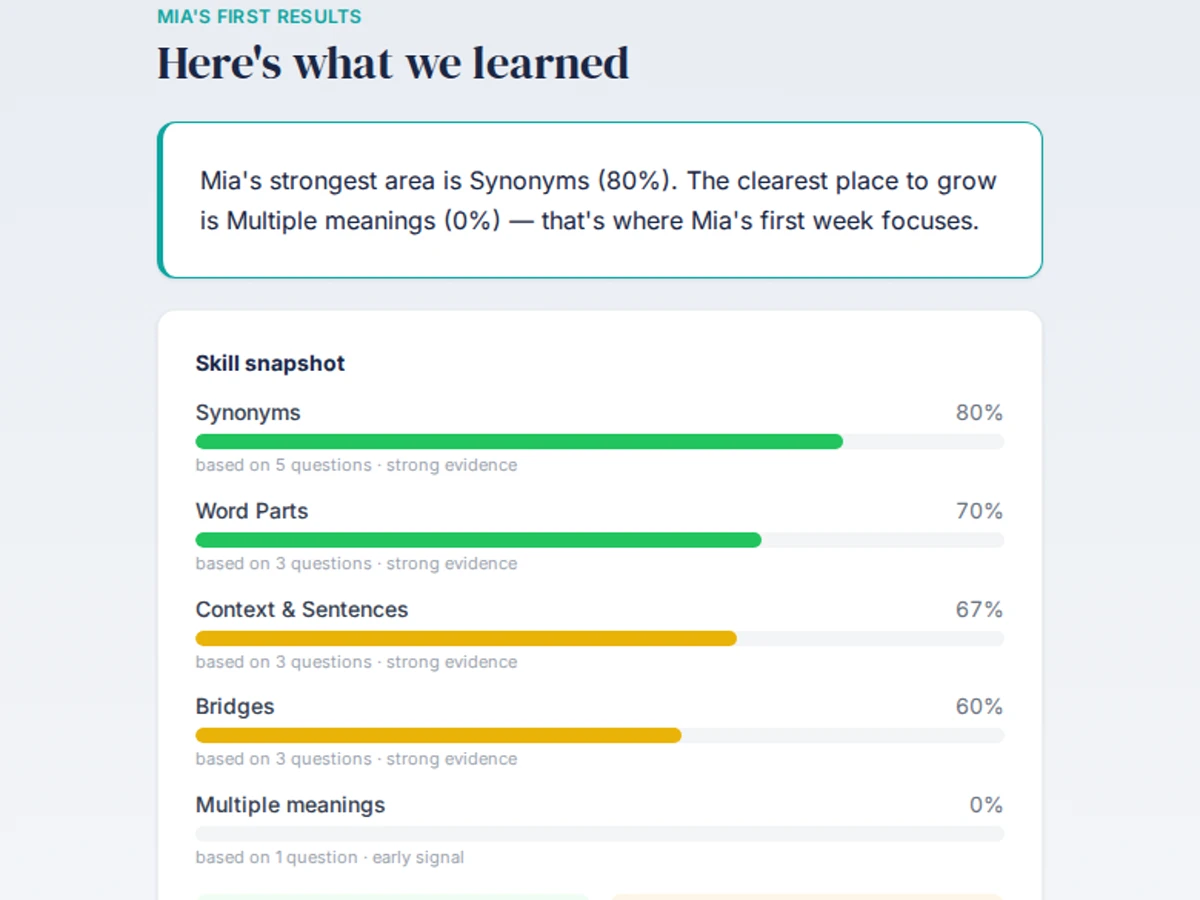
Start with a free, no-card ISEE check-up — 16–20 questions with a personalized parent report.
Find the ISEE vocabulary gaps — freeSee a sample parent report before starting
The check-up samples verbal skills and gives you an early strength, a growth area, and a first practice focus. It is not a full-length exam, an official SSAT or ISEE score, or an admissions prediction.
The ISEE verbal reasoning section is one of the most consequential exams in independent school admissions — and one of the hardest to prepare for through memorization alone. Unlike the SSAT, which includes analogies, the ISEE tests vocabulary through two question types: synonyms and sentence completions. Both reward students who can decode word meaning structurally rather than recall definitions from a list.
The good news is that the same Latin and Greek roots underlying SSAT vocabulary also drive the ISEE. The question formats differ, but the word pool overlaps significantly. That means the right preparation strategy — root-based learning paired with targeted practice — works for both tests.
This guide covers how the ISEE verbal section works, why root-based learning is especially effective for sentence completions, and how the major preparation tools compare. If your child is preparing for the SSAT as well, see our SSAT verbal section breakdown for a side-by-side comparison of the two tests.
How the ISEE Verbal Section Works
The ISEE is administered at four levels, each corresponding to the grade the student is entering. The verbal reasoning section appears at every level, but its length and timing vary:
| Level | Grades | Questions | Time |
|---|---|---|---|
| Primary (2–4) | Entering 2–4 | Varies by subtest | Varies |
| Lower Level | Entering 5–6 | 34 questions | 20 minutes |
| Middle Level | Entering 7–8 | 40 questions | 20 minutes |
| Upper Level | Entering 9–12 | 40 questions | 20 minutes |
At the Middle and Upper levels, the 40 questions split roughly evenly between synonyms and sentence completions. Unlike the SSAT, the ISEE does not include analogies. There is no penalty for wrong answers on the ISEE, so students should answer every question.
Scoring uses a scaled score (760–940) and a stanine ranking (1–9) that compares students to the same-grade norm group. ERB, the organization that administers the ISEE, recalculates norms every three years. Schools typically look for stanine scores of 5 or above, with competitive programs expecting 7–9.
The time pressure is real: at Middle and Upper levels, students have 30 seconds per question on average. This is where root knowledge becomes a decisive advantage — students who can decode unfamiliar words structurally spend less time deliberating and more time confirming answers.
Why Root-Based Learning Works for the ISEE
The Latin and Greek roots that underpin English academic vocabulary are the same regardless of which test your child takes. Based on our content mapping analysis, a focused set of 182 root families (291 word parts) targets the academic vocabulary most heavily tested across SSAT and ISEE test levels. Over 60% of English words have Latin or Greek roots, and up to 90% of academic vocabulary is Latin/Greek-derived (Rasinski et al., 2008). The roots don't change — only the question format does.
Sentence completions, which make up half of the ISEE verbal section, are where root-based learning shines brightest. These questions present a sentence with one or two blanks and ask students to choose the word that best completes the meaning. Success requires two overlapping skills: understanding the context clues in the sentence and decoding the vocabulary in the answer choices.
Root knowledge addresses the second skill directly. When a student encounters an unfamiliar word in the answer choices — say, magnanimous — recognizing magn (great) and anim (spirit, mind) reveals its meaning ("great-spirited," or generous) without prior memorization. Combined with context clues from the sentence stem, this gives students a reliable two-step decoding process.
For synonyms, root knowledge works the same way it does on the SSAT: identify the root, connect it to known words, and match the meaning to the answer choices. The research supporting this approach is robust — a meta-analysis of morphological instruction found significant vocabulary gains across all grade levels when students were explicitly taught roots, prefixes, and suffixes.
Root-based learning is also more efficient than word-list memorization. Instead of studying thousands of individual words, students learn the building blocks that compose them. One root unlocks an entire word family: cred (believe) connects credible, incredible, credential, credulous, creed, and discredit — six words from a single root.
Tool Comparison: What Works for ISEE Vocabulary Prep
Not all vocabulary tools are created equal. The table below compares the major categories of ISEE prep tools across five dimensions that matter most for lasting vocabulary growth.
| Approach | Vocab Depth | Retention | Cost/mo | Time | ISEE-Specific |
|---|---|---|---|---|---|
| Root-based apps (LexiMap) | High — teaches transferable patterns | High (spaced repetition) | $10–25 | 10–15 min/day | Yes — SSAT/ISEE word pool |
| Flashcard apps (Quizlet, Anki) | Medium — individual words | Medium (depends on usage) | $0–10 | 15–20 min/day | Partial — user-created decks |
| Practice test platforms (Test Innovators, ERB Praxis) | Low — tests existing knowledge | Low (exposure only) | $20–50 | 1–3 hrs/session | High — real test format |
| Private tutoring | Variable — depends on tutor | Variable | $300–800 | 1–2 hrs/week | High — if specialized |
The most effective approach combines tools from different categories. Root-based learning builds the underlying vocabulary knowledge; practice tests develop test-taking skills and format familiarity; tutoring addresses individual weaknesses. As a starting point, root-based learning offers a strong ratio of time invested to vocabulary gained — especially for the sentence completion questions that make up half the ISEE verbal section. But vocabulary knowledge is only the first domain the ISEE draws on; relational reasoning, contextual inference, test execution, and metacognition each require their own deliberate practice. LexiMap's parent dashboard surfaces all five domains so you can see where your child is strong and where to focus next.
For a deeper comparison of individual apps and tools, see our 2026 comparison of SSAT/ISEE vocabulary apps. The vocabulary overlap between SSAT and ISEE means tools built for one test work well for both.
Effective ISEE Study Strategies
The right tools matter, but how your child uses them matters more. Four strategies consistently produce the best results for ISEE verbal preparation.
1. Study Root Families, Not Isolated Words
Instead of memorizing "benevolent = kind," study the root family: bene (good) connects benefit, benefactor, benediction, benevolent, and benign. When your child encounters any of these words on test day — or a new word built from the same root — they can decode it structurally. This is the core advantage of root-based learning over word-list memorization.
2. Use Spaced Repetition Daily
Cramming produces short-term recall that fades within days. Spaced repetition — reviewing roots at increasing intervals based on how well they're retained — builds durable long-term memory. The FSRS algorithm used by modern learning tools targets retention rates above 85%. See how our methodology applies FSRS to root-based learning. Practically, this means 10–15 minutes of daily practice is far more effective than one-hour weekend sessions.
3. Practice Context-Based Decoding
Sentence completions test two skills simultaneously: reading context clues and understanding vocabulary. Students should practice combining both skills: read the sentence for logical clues (contrast words like "although," cause-effect signals like "because"), then use root knowledge to decode unfamiliar answer choices. This two-step process — context first, then roots — mirrors how the strongest test-takers actually work through questions.
4. Build a Daily Practice Schedule
Consistency beats intensity. A practical daily schedule might look like: 10 minutes of root review (spaced repetition), 5 minutes of sentence completion practice, and 5 minutes of synonym drills. That's 20 minutes total — short enough to sustain over months, long enough to produce real gains. On weekends, add one full-length practice section to build stamina and timing awareness.
Sentence Completion Strategy: A Step-by-Step Walkthrough
Sentence completions are where root knowledge and context reading combine. Here's a step-by-step approach applied to a sample question:
Although the speaker's argument was _______, the audience remained unconvinced by its logic.
- (A) ambiguous
- (B) cogent
- (C) laconic
- (D) frivolous
Step 1 — Read for context clues. The word "although" signals contrast: the blank describes something positive about the argument (since the audience was unconvinced despite it). The answer must mean something like "strong" or "persuasive."
Step 2 — Eliminate using roots. Scan the answer choices:
- ambi (both) → ambiguous means "unclear, having two meanings" — that's negative, not positive. Eliminate.
- cog (related to cogn, to know/think) → cogent means "clear and compelling." This fits the positive meaning we need.
- lacon (brief, from Laconia/Sparta) → laconic means "using few words." Doesn't match "persuasive." Eliminate.
- Frivolous means "not serious" — negative. Eliminate.
Step 3 — Confirm. "Although the speaker's argument was cogent, the audience remained unconvinced." The contrast works: strong argument, but still unconvinced. Answer: (B).
This three-step process — context first, root-based elimination, then confirmation — gives students a repeatable system for sentence completions. It transforms guessing into structured reasoning.
Key Takeaways
- The ISEE verbal section tests synonyms and sentence completions — no analogies. At Middle and Upper levels, students face 40 questions in 20 minutes.
- The same 166 Latin and Greek roots that target the most-tested SSAT academic vocabulary also underpin ISEE test words. Preparation for one test transfers directly to the other.
- Sentence completions are where root knowledge is most powerful — students can decode unfamiliar answer choices and combine that knowledge with context clues for a reliable two-step strategy.
- Root-based apps offer the best ratio of time invested to vocabulary gained, especially when combined with spaced repetition for durable retention.
- Daily practice (10–20 minutes) produces far better results than infrequent, longer study sessions.
Next Steps
If your child is preparing for the ISEE, start with the fundamentals: learn the root families, build a daily practice habit, and layer in practice tests as test day approaches. These resources can help:
- ISEE Vocabulary: The Complete Guide — Our comprehensive ISEE vocabulary guide covering all 4 test levels, sentence completion strategies, and a 50-root reference table.
- Parent's Guide to SSAT/ISEE Prep — A comprehensive planning resource covering timelines, strategies, and common mistakes.
- 50 Latin Roots That Unlock 500+ SSAT/ISEE Words — A focused starter set of the most high-value roots with example words and test connections.
- The Complete List of Latin and Greek Roots — Our full reference with 60+ roots, prefixes, suffixes, and question walkthroughs.
Questions parents ask
How is ISEE verbal different from SSAT verbal?
The ISEE tests synonyms and sentence completions; the SSAT tests synonyms and analogies. The underlying word pool overlaps significantly, so the same root-based vocabulary work serves both — what changes is the format practice layered on top.
What's the best way to build ISEE vocabulary?
A daily 20-minute habit: about 10 minutes of spaced root review plus 10 minutes of sentence-completion practice. Root-based tools transfer to words your child has never studied, which is exactly what ISEE synonyms and sentence completions reward; weekend cram sessions fade before test day.
Does SSAT prep transfer to the ISEE?
Largely yes. The same Latin and Greek roots drive both tests' vocabulary, so root study transfers directly. Add ISEE-specific sentence-completion practice for format familiarity, since the ISEE does not include the SSAT's analogy questions.
Get SSAT/ISEE vocabulary resources by email
Related Articles
ISEE Verbal Reasoning Strategies by Level: Primary Through Upper
Level-by-level ISEE verbal strategies for Primary through Upper Level. Vocabulary, sentence completion, and reading comprehension prep tailored to each grade band.
ISEE Analogy Practice: How Relationship Thinking Helps with Synonyms & Sentence Completions
The ISEE doesn't test analogies — but analogy thinking is the key to ISEE synonyms and sentence completions. Learn bridge types, practice questions, and root word strategies.
ISEE Reading Comprehension: How Vocabulary Knowledge Determines Your Child's Score
Learn how vocabulary knowledge affects your child's ISEE reading comprehension score — and which prep strategies transfer beyond the Verbal Reasoning section.
ISEE Verbal Section: The Parent's Complete Guide
Everything parents need to know about the ISEE verbal reasoning section — question types, scoring, levels, and what vocabulary prep actually works for your child.
Related Guides
The Parent's Complete Guide to SSAT & ISEE Prep
Everything parents need to know about SSAT and ISEE preparation. Test formats, timelines, study strategies, score interpretation, and how to support your child's verbal growth.
SSAT Vocabulary: The Complete Guide to Root-Based Learning
Master SSAT vocabulary through Latin and Greek roots. Learn how root-based learning, spaced repetition, and interactive practice build lasting verbal skills for grades 4-12.
SSAT® is a registered trademark of The Enrollment Management Association. ISEE® is a registered trademark of the Educational Records Bureau (ERB). LexiMap is not affiliated with or endorsed by these organizations.