ISEE Verbal Reasoning Strategies by Level: Primary Through Upper
Find your child's ISEE vocabulary gaps
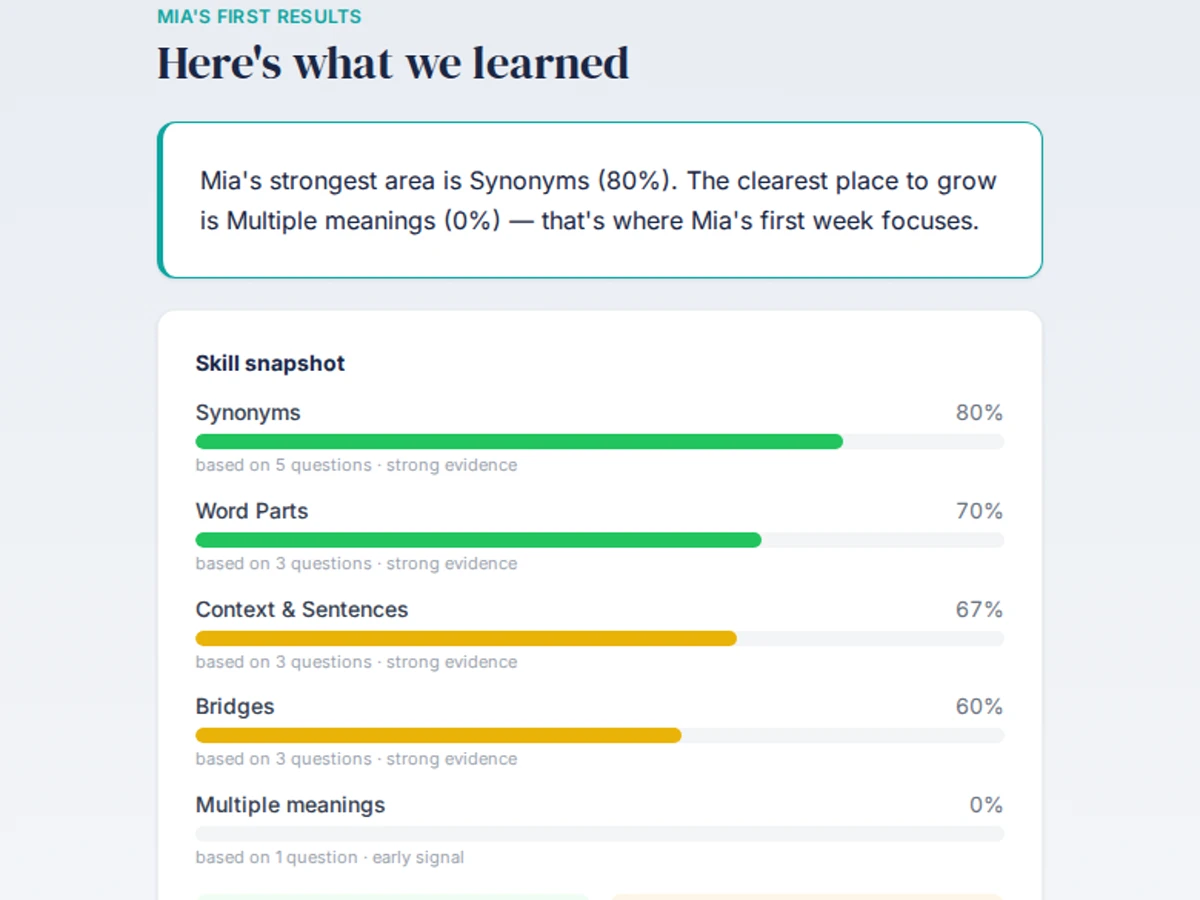
Start with a free, no-card ISEE check-up — 16–20 questions with a personalized parent report.
Find the ISEE vocabulary gaps — freeSee a sample parent report before starting
The check-up samples verbal skills and gives you an early strength, a growth area, and a first practice focus. It is not a full-length exam, an official SSAT or ISEE score, or an admissions prediction.
The ISEE is four tests, not one. Primary Level students in second grade face fundamentally different content than Upper Level students in ninth grade — and preparation strategies that work brilliantly for one level can be entirely mismatched for another.
This guide breaks down ISEE verbal preparation by level: what each level tests, what the hardest questions look like, and the most effective strategies for each grade band. Read the section that applies to your child's level, then cross-reference the common strategies at the end.
ISEE Overview: How the Levels Work
The four ISEE levels are:
| Level | Applies To | Students Applying To |
|---|---|---|
| Primary | Current grades 2, 3, and 4 | Grades 3, 4, and 5 |
| Lower | Current grades 5-6 | Grades 7-8 |
| Middle | Current grades 7-8 | Grades 9-10 |
| Upper | Current grades 9-11 | Grades 11-12 |
Key difference from SSAT: The ISEE has four levels (vs. SSAT's three), and the Primary Level extends to current grade 2 students — two years earlier than the SSAT begins. If your child is applying to a selective K-12 school for early grades, the ISEE Primary Level is often the only option.
No wrong-answer penalty: Unlike the SSAT, the ISEE does not penalize wrong answers. Students should always answer every question — leaving blanks is worse than guessing.
ISEE Verbal Section: The Two Question Types
Across all four levels, the ISEE verbal reasoning section contains two types of questions:
Synonyms (~17 questions): One word is presented; choose the answer closest in meaning. Identical format to SSAT synonyms. No sentence context is provided.
Sentence Completion (~17 questions): A sentence with one or two blanks; choose the best word(s) to complete it. Unlike the SSAT, the ISEE's sentence completion items are longer, more context-rich, and specifically reward context-clue reading.
The verbal section has 34 total questions and runs approximately 20 minutes — about 35 seconds per question.
Additionally, the ISEE has a separate Reading Comprehension section (36 questions, 35 minutes) that is scored separately from verbal reasoning. This guide focuses primarily on the verbal reasoning section, with notes on reading comprehension strategy as relevant.
Primary Level (Grades 2-4): Building Foundational Verbal Skills
What the Primary Level Tests
The ISEE Primary Level is designed for students in grades 2-4. The verbal content at this level tests:
- Vocabulary breadth: Words at a grade-appropriate level, but the upper end of that level
- Sentence comprehension: Understanding complete sentences and choosing words that fit semantically and grammatically
- Context-clue use: Early sentence completion items that reward reading for meaning
Primary Level verbal questions use vocabulary your child may have encountered in school or through reading but might not have directly studied. The words are not obscure adult vocabulary — but they are chosen to differentiate students who have had rich language exposure from those who have not.
Primary Level Strategies
Priority 1: Rich oral language environment
The single most powerful preparation for Primary Level verbal is not test prep workbooks — it is a language-rich home environment. Students who are read to regularly (including books above their independent reading level), who engage in extended conversations, and who encounter varied vocabulary in context score substantially higher on Primary Level verbal than students with similar intelligence but limited language exposure.
Priority 2: Category vocabulary
Sentence completion at the Primary Level often tests whether students know the precise word for a category. "The apple and the orange were both ____" — the answer is fruit. Practice naming precise categories for familiar objects, animals, and concepts.
Priority 3: Age-appropriate vocabulary books
For grades 3-4 specifically, dedicate 10-15 minutes per day in the 6-8 weeks before the test to reading from a grade-appropriate vocabulary builder. The goal is not to memorize definitions but to encounter words in context multiple times.
Priority 4: Context clue awareness
Practice "what word would fit here?" games during read-aloud sessions. Point to a word in a text, cover it, and ask what word would make sense in the sentence. Celebrate reasoning ("I can tell it would be a big, scary word because the sentence says the character was terrified") more than getting the exact word right.
Primary Level Score Context
Primary Level scores range from 900-1000 in each section. Selective schools using the Primary Level for grade 3-5 admissions typically look for combined verbal+reading scores in the upper quartile relative to their specific applicant pool. Contact each school for their context.
Lower Level (Grades 5-6): Where Vocabulary Work Begins
What the Lower Level Tests
The Lower Level tests students in grades 5-6 applying to grade 7-8 programs — often first-time independent school applicants. The vocabulary jumps significantly from Primary Level, and sentence completion items begin to require real inferential reasoning.
Lower Level synonym vocabulary typically includes:
- Academic words students may have encountered in school (hypothesis, perceive, demonstrate)
- Formal vocabulary appearing in grade-appropriate books (apprehensive, reluctant, persistent)
- Words with recognizable Latin/Greek roots (beneficial, portable, predict)
Sentence completion items at this level include 1-2 blank sentences of moderate length. The context clues are relatively clear; the vocabulary in the answer choices is the primary difficulty.
Lower Level Strategies
Priority 1: Root study as vocabulary on-ramp
For grade 5-6 students, this is an effective time to begin explicit Latin and Greek root instruction. Roots are a strong on-ramp to vocabulary breadth — starting with 20-25 high-frequency roots in the 8-10 weeks before the test builds both synonym knowledge and context-clue application — but they work best alongside the other priorities below, not as a standalone gate before everything else.
High-value roots for Lower Level ISEE preparation:
- bene/mal (good/bad): benevolent, beneficial, malicious, malign
- port (to carry): transport, portable, import, report
- vis/vid (to see): visible, vision, evident, video
- scrib/script (to write): describe, inscribe, prescribe, manuscript
- duc/duct (to lead): conduct, introduce, deduce, educate
Priority 2: Sentence completion context-clue practice
At this level, the 3-step sentence completion strategy is explicitly teachable:
- Read the whole sentence before looking at answer choices
- Identify signal words: contrast (but, however, although, despite), similarity (similarly, just as, also), and cause-effect (because, therefore, as a result)
- Predict the missing word before looking at options, then match
Practice this process until it is automatic. Students who skip step 3 (predicting before looking) are vulnerable to trap answers that "sound right" but contradict the sentence's logic.
Priority 3: Expand reading above grade level
Lower Level students benefit significantly from reading one to two books above their grade level in the months before testing. The vocabulary exposure accelerates naturally without requiring separate vocabulary study.
Middle Level (Grades 7-8): Sophistication and Nuance
What the Middle Level Tests
Middle Level is where ISEE verbal becomes genuinely sophisticated. Students in grades 7-8 face vocabulary that:
- Includes words with subtle nuance differences between choices
- Draws heavily from the academic vocabulary register that college-preparatory programs use
- Includes some words that require root-based decoding to infer meaning
Middle Level sentence completion items often use contrast and concession structures — constructions like "Although she appeared ____, her underlying motivation was ____" — which require understanding both blanks in relation to each other.
Middle Level Strategies
Priority 1: Precision synonym study
At the Middle Level, wrong answers are often near-synonyms, not random distractors. The answer for TENACIOUS is not among random positive words — it is among stubborn, persistent, unyielding, determined. A student who only knows "tenacious = stubborn" cannot distinguish between the choices. A student who knows tenacious specifically means "holding firmly to a goal despite obstacles" can identify persistent as a better synonym than stubborn (which has a more negative connotation).
This precision requires studying synonym clusters with attention to connotation and degree. For each major vocabulary word, learn:
- The core meaning
- Which synonyms are closer vs. more distant
- Whether the word has positive, negative, or neutral connotation
- Whether it implies intensity (fierce vs. strong; loathe vs. dislike)
Priority 2: Two-blank sentence completion
Middle Level introduces two-blank sentence completion items where the blanks interact. The strategy adds a step:
- Read the sentence
- Identify which direction each blank must go (positive/negative, more/less, same as/opposite to)
- Identify the relationship between the two blanks (are they both positive? opposing? one causes the other?)
- Predict both blanks
- Test answer choice pairs against both predictions
The interaction between blanks eliminates many choices quickly — if the sentence requires the first blank to be positive and the second to be negative, any choice pair where both words are positive is immediately wrong.
Priority 3: Root-based decoding for unfamiliar words
At Middle Level, encountering an unknown word on the synonym section is inevitable. Root-based decoding is the primary recovery strategy. When facing an unknown word:
- Look for recognizable root elements
- Identify any prefix that modifies the meaning (un-, in-, dis-, mal-, bene-)
- Note any suffix that indicates part of speech or quality (-ous, -ent, -tion, -ify)
- Assemble an inference: "This word probably means ____"
- Test the inference against the answer choices
This process is not perfect, but it produces correct inferences significantly more often than random guessing — and with no wrong-answer penalty, even probabilistic inferences should result in an answer.
Upper Level (Grades 9-11): Mastery of Academic Vocabulary
What the Upper Level Tests
The ISEE Upper Level is among the most vocabulary-demanding secondary school entrance tests. Students face:
- Vocabulary at the college-preparatory and early-college level
- Words where even the near-synonym distractors require careful precision
- Complex sentence completion items with sophisticated logical structures
Upper Level vocabulary includes words that most adults would need to look up: perspicacious, recondite, obsequious, tendentious, laconic. These are not obscure for the sake of difficulty — they are words that appear in the academic texts, literary works, and professional writing that the most rigorous high school programs use.
Upper Level Strategies
Priority 1: Broad vocabulary curriculum anchored in roots
At Upper Level, there is no shortcut to vocabulary breadth. Roots are the most efficient entry point — they let students decode unfamiliar words under pressure — but the preparation window should cover the full range of skills the test demands:
- 30+ root families (Latin and Greek), each with 8-10+ derived words
- Prefix and suffix study alongside roots
- Explicit study of near-synonym distinctions (the "precision cluster" approach)
- Spaced repetition over 10-12 weeks for durable retention
The most efficient approach: begin with root families covering the highest-frequency academic vocabulary, then extend to less common roots. Study words in families, not isolation. Review with spaced intervals.
Priority 2: Connotation and tone
Upper Level sentence completion items frequently depend on connotation. A sentence might require a negative word — but the answer is not just any negative word. It is a word with the specific type of negativity the sentence implies: disparaging (belittling) vs. malevolent (evil-intentioned) vs. capricious (unpredictably changeable) are all in some sense "negative" but describe completely different things.
Practice identifying the emotional tone and direction of sentences before looking at answer choices. Is the sentence describing something that is unexpected? contradictory? regrettable? insufficient? This pre-reading narrows the answer space dramatically.
Priority 3: Reading comprehension as vocabulary reinforcement
For Upper Level students, the reading comprehension section is an extension of the verbal section — both reward vocabulary breadth and inferential reasoning. Vocabulary-in-context questions on the reading section require the same skills as sentence completion: understanding a word from the surrounding passage.
Reading widely in challenging nonfiction (essays, literary criticism, science writing, history) builds the contextual vocabulary knowledge that supports both sections simultaneously.
Strategies Common to All Levels
Always Answer Every Question
The ISEE has no wrong-answer penalty. Leaving a question blank gives you zero points and zero chance of points. Guessing (even randomly) gives you a 20-25% chance of a correct answer on every question. Always provide an answer, even when you have no idea.
Use the Sentence Before Looking at Answers
For sentence completion, reading the sentence fully and noting signal words before looking at answer choices prevents the "this sounds right" trap, where an answer choice's familiarity pulls you away from the sentence's logical requirements.
Eliminate Before Guessing
For synonym questions where you do not know the word, look at the answer choices and eliminate options you are confident are wrong. Reducing from 5 choices to 3 or 2 before guessing significantly improves your expected score on unknown items.
Practice Under Time Conditions
The verbal section is 34 questions in 20 minutes — approximately 35 seconds per question. Students who practice without time awareness often find test-day time pressure disorienting. From about 4 weeks before the test, time your practice sessions to build comfort with the pacing.
Vocabulary and roots are the most visible part of ISEE verbal prep, but they're the on-ramp, not the full picture. The ISEE actually measures five verbal domains: Vocabulary Knowledge (the words themselves), Relational Reasoning (understanding how words connect), Contextual Inference (decoding sentence completion clues), Test Execution (the pacing, guessing, and format decisions covered in this guide), and Metacognition (knowing which strategy to use and catching errors in real time). LexiMap is built around all five domains and displays each in a parent dashboard — so you can track not just whether your child is learning words, but whether they're developing the full suite of skills that move the needle at every ISEE level.
Key Takeaways
- The ISEE's four levels (Primary through Upper) require meaningfully different preparation strategies; vocabulary depth, sentence completion complexity, and time pressure all escalate from level to level.
- Across all levels, the ISEE has no wrong-answer penalty — students should answer every question and use root-based elimination to improve guessing odds on unknowns.
- For Primary and Lower Level students, rich language environment and context-clue awareness matter more than formal vocabulary drilling; root study becomes the priority from Lower Level onward.
- Middle and Upper Level preparation requires precision synonym study (synonym clusters with connotation and degree distinctions) and two-blank sentence completion strategy on top of the root foundation.
- Four strategies apply at every level: always answer every question, read the sentence before answer choices, eliminate before guessing, and practice under timed conditions from about four weeks out.
For the science of vocabulary acquisition that underlies all of these strategies, see our vocabulary building methods guide. For SSAT verbal preparation (the companion exam to ISEE), see our SSAT verbal study strategies guide. For exam comparisons, see SSAT vs. ISEE.
Get SSAT/ISEE vocabulary resources by email
Related Articles
ISEE Vocabulary Builder: Best Tools and Strategies for 2026
Compare the best ISEE vocabulary building tools and strategies. Learn how root-based learning, spaced repetition, and targeted practice prepare students for ISEE verbal reasoning.
ISEE Analogy Practice: How Relationship Thinking Helps with Synonyms & Sentence Completions
The ISEE doesn't test analogies — but analogy thinking is the key to ISEE synonyms and sentence completions. Learn bridge types, practice questions, and root word strategies.
ISEE Reading Comprehension: How Vocabulary Knowledge Determines Your Child's Score
Learn how vocabulary knowledge affects your child's ISEE reading comprehension score — and which prep strategies transfer beyond the Verbal Reasoning section.
ISEE Verbal Section: The Parent's Complete Guide
Everything parents need to know about the ISEE verbal reasoning section — question types, scoring, levels, and what vocabulary prep actually works for your child.
Related Guides
The Parent's Complete Guide to SSAT & ISEE Prep
Everything parents need to know about SSAT and ISEE preparation. Test formats, timelines, study strategies, score interpretation, and how to support your child's verbal growth.
ISEE Vocabulary: The Complete Guide to Root-Based Learning
Prepare for Lower, Middle, and Upper Level ISEE verbal reasoning with word roots, sentence-completion strategies, official exam-format sources, and a practical study plan.
SSAT® is a registered trademark of The Enrollment Management Association. ISEE® is a registered trademark of the Educational Records Bureau (ERB). LexiMap is not affiliated with or endorsed by these organizations.