CogAT Verbal Prep: The Complete Parent Guide
Find your child’s vocabulary gaps
Start with a free, no-card vocabulary check-up and get a personalized parent report.
Find the vocabulary gaps — freeSee a sample parent report before starting
The check-up samples verbal skills and gives you an early strength, a growth area, and a first practice focus. It is not a full-length exam, an official SSAT or ISEE score, or an admissions prediction.
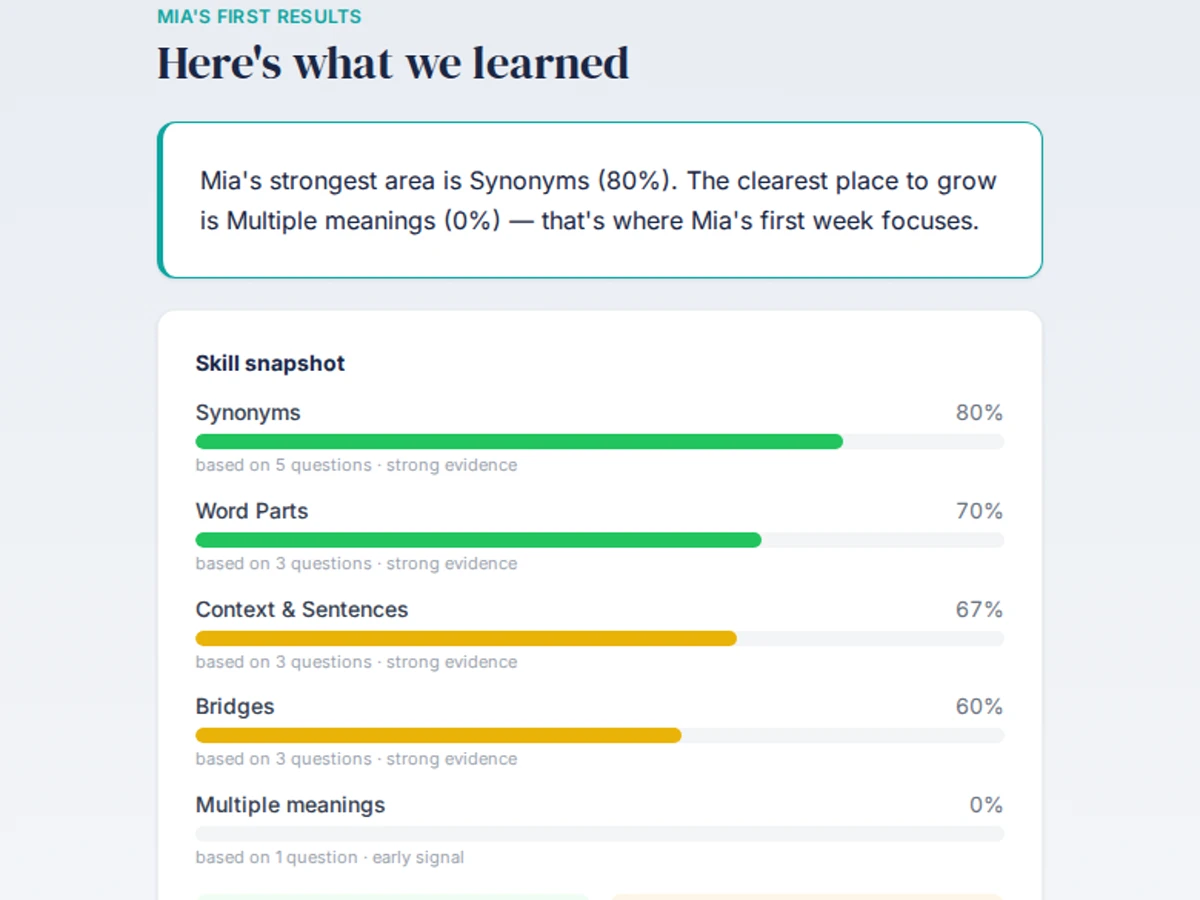
Every year, roughly 2 to 3 million students take the Cognitive Abilities Test — one of the most widely used school ability assessments in the United States. If your child has been nominated for gifted and talented testing or your district requires the CogAT for advanced-program placement, you are probably wondering what the verbal battery actually tests and what, if anything, you can do to help your child prepare.
The short answer: the CogAT verbal battery is entirely preparable, and you do not need to hire a tutor or buy expensive workbooks to do it. This guide walks you through each verbal subtest, explains what it measures, and gives you practical strategies organized by grade level.
What Is the CogAT Verbal Battery?
The CogAT verbal battery is one of three batteries on the Cognitive Abilities Test, alongside the quantitative battery and the nonverbal battery. The verbal battery consists of three subtests — verbal analogies, verbal classification, and sentence completion — and contributes one-third of the composite CogAT score.
Each subtest contains approximately 20 questions and runs 10 minutes for most grade levels. The entire verbal battery takes about 30 minutes to complete. Scores are reported as age-based standard scores (mean 100, standard deviation 16), national percentile ranks, and stanines.
Critically, the CogAT measures reasoning ability rather than memorized knowledge. A child who has learned to think carefully about word relationships, identify category membership, and use sentence context to select the best word will score higher than a child who has simply memorized dictionary definitions.
Three Subtests, One Verbal Score
| Subtest | What It Tests | Question Format |
|---|---|---|
| Verbal Analogies | Word-relationship reasoning (A:B :: C:?) | Choose the word that completes the analogy |
| Verbal Classification | Category recognition and semantic grouping | Choose the word that belongs with a given group |
| Sentence Completion | Context-clue application and vocabulary breadth | Choose the best word to fill a sentence blank |
The three subtest scores combine into a single Verbal Standard Age Score. Most gifted programs use a composite score that weighs all three batteries, but some programs — particularly those focused on verbal enrichment — give extra weight to the verbal battery.
How Schools Use CogAT Verbal Scores
School districts use CogAT verbal scores in several ways:
- Gifted and talented identification: Many districts require a verbal score above the 93rd or 95th percentile for gifted program eligibility
- Advanced English or reading placement: Some schools use verbal scores to recommend honors or accelerated reading groups
- Instructional planning: Teachers receive score reports to identify areas where individual students need enrichment or support
- Magnet school admissions: Selective magnet programs may use CogAT verbal scores as part of a holistic application
Testing timing varies by district. Some districts test all students in a grade cohort; others test only nominated students. See our CogAT prep page for district-specific testing windows.
Verbal Analogies: Building Word-Relationship Reasoning
The verbal analogies subtest asks students to complete a four-term analogy in the form A:B :: C:?. The student must identify the relationship between the first two terms and then choose the word that has the same relationship to the third term.
What CogAT Verbal Analogies Look Like
At the kindergarten through second-grade levels (CogAT Levels 5/6), analogies use pictures rather than words. A child might see images representing puppy:dog and then choose from pictures to complete kitten:?. From third grade onward (Levels 7 and above), all three batteries shift to written words.
Common relationship types you will see on CogAT verbal analogies include:
- Synonyms and antonyms: happy:joyful :: sad:? (answer: melancholy)
- Part-to-whole: petal:flower :: spoke:? (answer: wheel)
- Category membership: salmon:fish :: eagle:? (answer: bird)
- Function or use: scissors:cut :: hammer:? (answer: pound)
- Degree of intensity: warm:hot :: cool:? (answer: freezing)
- Worker and product: author:novel :: sculptor:? (answer: statue)
Children who struggle with analogies typically have one of two underlying gaps: a vocabulary gap (they do not know what one of the words means) or a relational-reasoning gap (they cannot identify what relationship connects the pair). Both gaps are addressable with practice.
As research shows, analogical reasoning is a trainable skill. Regular exposure to structured word-pair practice — even 10 minutes a day — meaningfully develops the pattern-recognition skills this subtest measures.
How to Practice Verbal Analogies at Home
The Word Pair Game: At dinner or in the car, present two related words and ask your child to explain the connection. Start simple: hot:cold (they are opposites). Work up to more abstract pairs: paintbrush:artist :: scalpel:? Practice identifying the bridge — the name of the relationship — before guessing the answer.
Root word exploration: Many analogy relationships become clearer when children know the word parts. A child who knows that bene- means "good" and mal- means "bad" will recognize that benevolent:malevolent is an antonym pair even if they have never seen those words. This is why root-based vocabulary learning transfers so directly to analogy performance.
21 bridge types: LexiMap's verbal training covers all 21 standard analogy bridge types — from simple synonyms to complex cause-effect relationships. Working through a variety of bridge types builds the flexible relational reasoning that CogAT analogies require.
Verbal Classification: Recognizing Categories and Patterns
The verbal classification subtest presents three words that share a common category or feature. The student must identify what connects the three words and then choose a fourth word that belongs to the same group.
What CogAT Verbal Classification Tests
Classification questions test the ability to:
- Identify semantic categories: rose, daisy, tulip — all are flowers; the answer might be orchid
- Recognize abstract features: happy, elated, cheerful — all mean very pleased; the answer might be joyful
- Group by function: hammer, wrench, screwdriver — all are tools; the answer might be pliers
- Identify grammatical or structural patterns at higher difficulty levels
The trap in classification questions is a word that is partially related but does not share the precise category. If the group is oak, maple, birch (deciduous trees), an answer like pine is a tree but not a deciduous tree — it belongs to a different sub-category. Children who think in loose categories will miss these distinctions; children who think in precise categories will catch them.
Practice Strategies for Verbal Classification
Odd One Out: Give your child four words and ask which one does not belong, and why the other three do belong. This exact exercise trains the precision that classification questions require. Increase difficulty by choosing groups where the "odd one out" is initially plausible.
Root word sorting: Root families are natural classification frameworks. Words built from the root aud (to hear) — auditorium, audience, audio, audible, audition — form a category. Understanding why they belong together (shared Latin root, shared semantic thread) trains the classification thinking the subtest measures.
Vocabulary notebooks with categories: Encourage your child to group new words by category rather than listing them alphabetically. Creating their own classification scheme builds the same cognitive muscle the CogAT tests.
Sentence Completion: Using Context Clues to Find Missing Words
The sentence completion subtest provides a sentence with one or more words missing and asks the student to choose the best word from four or five options.
How CogAT Sentence Completion Works
Sentence completion questions test two things simultaneously: vocabulary breadth and the ability to use surrounding context to determine meaning. A student might encounter:
"The scientist's theory was considered ____ by her peers because it contradicted decades of established research."
Answer choices: conventional, controversial, obsolete, trivial, acclaimed
A student who does not know the word controversial can still arrive at the right answer by reading context clues: the theory "contradicted decades of established research," which tells us her peers probably viewed it with skepticism or disagreement — pointing to controversial.
This context-clue strategy is explicitly teachable. Students who learn to annotate sentences before looking at answer choices — identifying tone words, contrast signals (words like "but," "although," "despite"), and cause-effect markers — dramatically improve their sentence completion accuracy.
Building Context-Clue Skills at Home
Read-aloud cloze exercises: When reading together, occasionally pause before a word and ask "What word do you think comes next? What made you guess that?" This trains real-time context-clue use rather than guessing.
Signal word awareness: Teach your child to recognize contrast signals (however, but, despite, although, yet) and similarity signals (similarly, also, just as, likewise). These sentence-level signals are the fastest shortcut to sentence completion success.
Wide reading: There is no substitute for volume of reading when it comes to sentence completion. Students who read broadly encounter vocabulary in authentic contexts — which is exactly what the sentence completion subtest tests. See our guide on root words and spaced repetition for vocabulary building for structured approaches to vocabulary expansion.
CogAT Verbal Prep by Grade Level
The CogAT is designed to be grade-normed, meaning the questions your child will see are calibrated to their current age. Preparation strategies should be similarly calibrated.
Grades K-2 (CogAT Levels 5/6): Picture-Based and Emergent
At this level, the verbal battery uses picture-based analogies alongside some words. Preparation priorities:
- Oral language development: Read aloud daily. Talk through what is happening in books. Discuss why characters do things (cause-effect language). Name animals, plants, and objects by category rather than individual instance.
- Category games: Play sorting games with physical objects — sort toys by color, then by size, then by material. This builds the classification thinking the test measures.
- Vocabulary exposure: Introduce one or two interesting words per week through natural conversation. "This soup is simmering — it is almost boiling but not quite. What do you think the difference is between simmering and boiling?"
- Avoid drilling: At this age, test familiarity matters more than test preparation. Keep activities playful.
Grades 3-5 (CogAT Levels 7/8): Building Analogical Reasoning
At this stage, all questions are word-based and the difficulty begins to climb significantly. Preparation priorities:
- Root word study: Begin explicit root instruction. Focus on the 30 most common Latin and Greek roots (see our SSAT word list organized by root families for a transferable list). Root knowledge pays dividends across all three verbal subtests.
- Analogy practice sets: Work through structured analogy sets 3-4 times per week. Identify the bridge relationship before looking at answer choices.
- Reading at or above grade level: Students reading above grade level naturally encounter more sophisticated vocabulary in context.
- Verbal discussions about books: Ask comprehension questions that require using academic vocabulary: "How would you describe the protagonist's dilemma?"
Grades 6-8 (CogAT Level 9+): Advanced Vocabulary and Abstract Relationships
By middle school, CogAT questions test genuinely sophisticated vocabulary and abstract reasoning. Preparation priorities:
- Systematic vocabulary study: Students at this level benefit from structured vocabulary learning using spaced repetition. 15-20 minutes per day yields better long-term retention than infrequent marathon sessions.
- Advanced root and affix study: Add prefixes and suffixes to the root-word base. Understanding that -ous means "having the quality of" transforms courageous, joyous, hazardous, audacious from isolated words into a family.
- Practice with abstract analogies: At Level 9+, analogies may involve abstract concepts, figurative meanings, or multiple possible relationships. Practice explaining why a particular bridge applies before checking answers.
- Timed practice: Begin timing practice sessions about 6 weeks before the test to build comfort with the pacing. CogAT verbal is not a speed test, but students unused to any time pressure can experience anxiety that affects performance.
Daily Practice: Why 10 Minutes a Day Beats Weekend Cram Sessions
Cognitive science is unambiguous on this point: spaced repetition beats massed practice for vocabulary acquisition and reasoning skill development. A child who practices verbal reasoning for 10 minutes every day for six weeks will outperform a child who does a two-hour cram session the weekend before the test.
The mechanism is straightforward. Each time you retrieve and use a word or reasoning skill, you strengthen the neural pathways associated with it. The key is retrieval — actively using the word, not passively reading it — and spacing — allowing some forgetting to occur between practice sessions so that retrieval requires genuine effort.
What does 10 minutes per day look like in practice?
- Monday: 10 analogy questions (identify the bridge relationship first)
- Tuesday: 10 classification questions (explain why the three words belong together)
- Wednesday: vocabulary review (5 new root words with 3 derived words each)
- Thursday: sentence completion practice (annotate context clues before answering)
- Friday: mixed review (5 questions from each subtest)
- Weekends: read something interesting for 20-30 minutes
This schedule is consistent with the preparation structure in LexiMap's CogAT verbal mode sequences, which deliver short adaptive sessions that maximize retention per minute of practice.
CogAT Verbal Prep vs. Workbooks: What Parents Need to Know
Workbooks and printed practice test booklets have been the standard CogAT prep tool for decades. They are not bad — any practice is better than no practice — but they have structural limitations:
Workbooks do not adapt. A child who has mastered synonym analogies will work through 30 more synonym analogy questions, while the analogy type they actually struggle with (say, part-to-whole) receives the same one-page treatment as every other type.
Workbooks do not track spacing. The most common workbook mistake is working through 20 vocabulary words in one sitting, then not returning to them for two weeks. The words that felt solid during the session will have faded significantly by then.
Workbooks provide no feedback on reasoning. A child can mark an answer correct or incorrect, but a workbook cannot explain why the relationship between "petal" and "flower" is part-to-whole rather than category membership, or why that distinction matters.
Adaptive digital practice — designed around spaced repetition and the specific CogAT subtest formats — addresses all three limitations. It delivers more practice on the subtests where the child is weakest, spaces review sessions to the optimal intervals for retention, and provides explanations that build reasoning skills rather than just answer-checking.
Frequently Asked Questions About CogAT Verbal Prep
How early should I start CogAT verbal prep?
For young children (grades K-2), the most valuable preparation is ongoing: read aloud regularly, play word games, talk about books, and build general vocabulary through conversations. Targeted test preparation is not developmentally appropriate for kindergartners.
For grades 3-5, starting 8-12 weeks before the test date allows enough time to build meaningful root-word knowledge and practice all three verbal subtest formats.
For grades 6-8, 10-12 weeks of structured daily practice allows for systematic vocabulary study plus full coverage of all verbal subtest types.
Does knowing the test format help?
Yes, significantly. Students who encounter the A:B :: C:? analogy format for the first time on test day spend cognitive effort figuring out the format rather than demonstrating what they know. Brief exposure to the format — understanding what the question is asking — removes that barrier.
Is the CogAT verbal battery fair to English language learners?
The CogAT includes a nonverbal battery specifically to provide a language-reduced ability measure for ELL students. The verbal battery inherently requires English vocabulary knowledge. Many districts take this into account when interpreting verbal battery scores for ELL students.
Can the CogAT verbal score go up with practice?
Yes. The research on this is clear — see our detailed post on whether you can prep for CogAT. Students who develop genuine vocabulary and reasoning skills through practice earn higher scores because they have actually developed the abilities the test measures. The goal of CogAT prep is not to game the test; it is to help children develop skills they will use far beyond any single test.
What score do I need for gifted testing?
This varies by district and program. Many programs use a composite score cutoff (commonly the 93rd percentile or above), but some use verbal battery specifically. Contact your district's gifted education coordinator for the specific criteria that apply to your child.
Root-word knowledge is a powerful on-ramp to CogAT preparation, but your child's verbal score reflects far more than vocabulary. Because the CogAT is fundamentally a reasoning test, the skills that most move the needle are relational reasoning (analogies and classification) and contextual inference (sentence completion) — and those sit alongside vocabulary knowledge, test execution habits, and metacognitive self-monitoring as distinct skill areas. LexiMap builds all five domains and surfaces each one on a parent dashboard, so you can see exactly where your child is growing across the full range of what the CogAT measures.
Key Takeaways
- The CogAT verbal battery has three subtests — verbal analogies, verbal classification, and sentence completion — each requiring a distinct reasoning skill, all of which are trainable.
- Root-word study is a strong on-ramp for grades 3–8: knowing 30 Latin and Greek roots gives your child structural decoding ability across all three verbal subtests, alongside the relational reasoning and contextual inference skills the test most rewards.
- 10 minutes of daily practice beats any cram session — spaced retrieval is what builds the durable memory that holds up on test day, not massed repetition the night before.
- Adaptive digital practice outperforms workbooks because it focuses effort on your child's actual weak spots, spaces reviews optimally, and explains the reasoning behind correct answers.
- Grade-level calibration matters — K-2 prep is oral language and category play; grades 3-5 introduce written root study; grades 6-8 add systematic spaced repetition and timed practice.
- Gifted program score thresholds vary by district; contact your coordinator early so preparation targets the right benchmark.
Ready to start? LexiMap's CogAT verbal training adapts to your child's specific gaps across all three verbal subtests, with daily 10-minute sessions designed for busy families. Visit our CogAT prep page to learn more.
Get SSAT/ISEE vocabulary resources by email
Related Articles
Entrance Exam Test Dates 2026-2027: Complete Calendar
Complete 2026-2027 test date calendar for SSAT, ISEE, HSPT, TACHS, COOP, and CogAT. Registration deadlines, testing windows, and score release dates in one place.
SSAT Verbal Study Strategies: Your 3-Month Plan
A research-backed 3-month SSAT verbal study plan covering synonyms, analogies, and vocabulary. Week-by-week schedule for Middle and Upper Level students.
When to Start Verbal Test Prep: Month-by-Month Timelines by Exam
When to start test prep for SSAT, ISEE, HSPT, TACHS, COOP, and CogAT verbal. Month-by-month timelines so your child peaks on test day — not weeks before or after.
50 Latin Root Words Every SSAT Student Should Know
Master the 50 most important Latin root words for the SSAT. Each root includes meaning, example words, and memory tips to build lasting vocabulary skills.
Related Guides
SSAT Vocabulary: The Complete Guide to Root-Based Learning
Master SSAT vocabulary through Latin and Greek roots. Learn how root-based learning, spaced repetition, and interactive practice build lasting verbal skills for grades 4-12.
SSAT Vocabulary List: 200+ Words Organized by Level and Root
Comprehensive SSAT vocabulary word lists organized by test level (Elementary, Middle, Upper) and root word family. Study the right words for your child's grade.
SSAT® is a registered trademark of The Enrollment Management Association. ISEE® is a registered trademark of the Educational Records Bureau (ERB). LexiMap is not affiliated with or endorsed by these organizations.