Can You Prep for CogAT? A Research-Backed Answer
Find your child’s vocabulary gaps
Start with a free, no-card vocabulary check-up and get a personalized parent report.
Find the vocabulary gaps — freeSee a sample parent report before starting
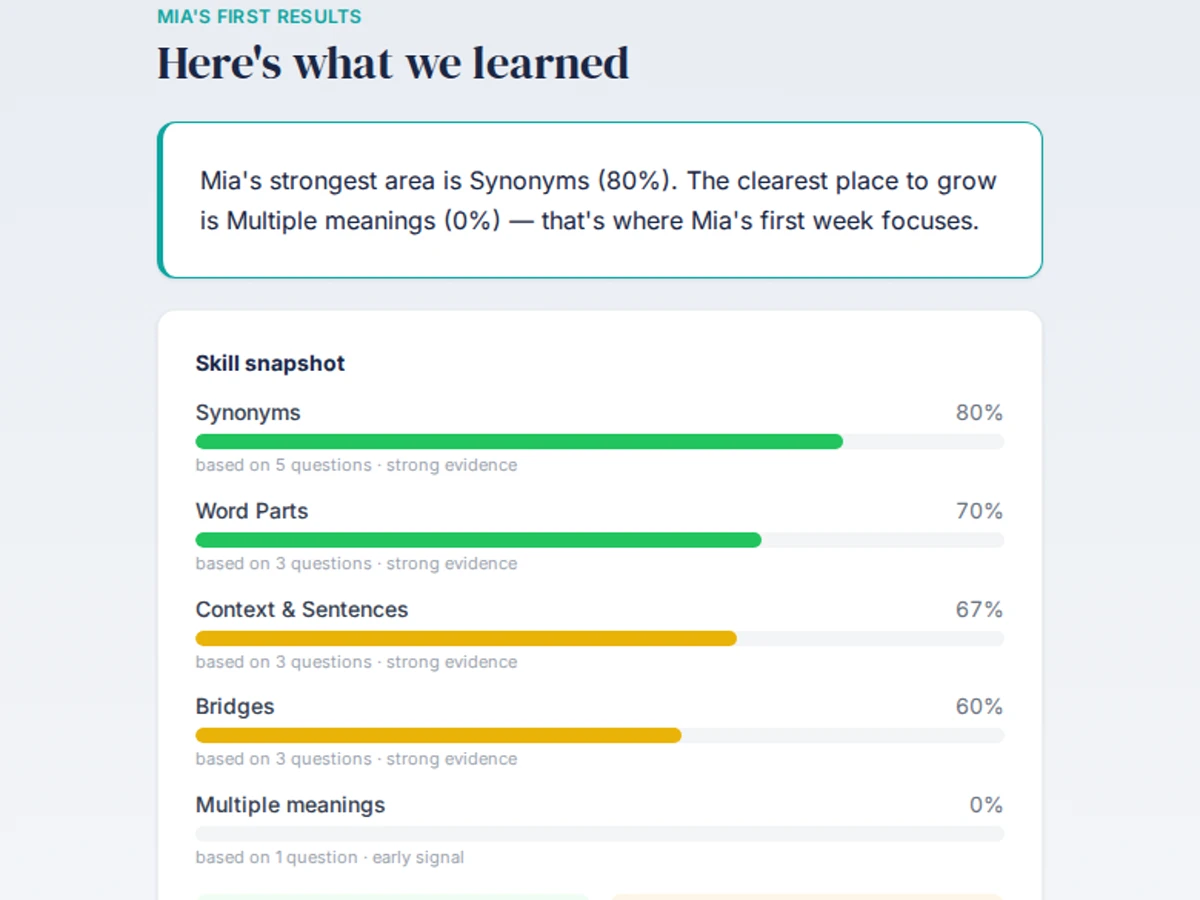
The check-up samples verbal skills and gives you an early strength, a growth area, and a first practice focus. It is not a full-length exam, an official SSAT or ISEE score, or an admissions prediction.
"Can you even prep for the CogAT?" is the first question many parents ask when their child is scheduled for gifted and talented testing. It is a fair question, and you will find confidently stated opposing answers on parent forums, school websites, and test prep company blogs.
The honest, research-backed answer is: yes, meaningful preparation is possible and beneficial — particularly for the verbal battery. But the kind of preparation that works looks different from cramming vocabulary definitions or drilling practice questions. Here is what the cognitive science actually says.
Why the "You Can't Prep for CogAT" Myth Persists
The myth has a legitimate origin. The CogAT is published by Riverside Insights and was designed to measure cognitive abilities rather than acquired knowledge. Unlike an achievement test (which asks "what have you learned?"), the CogAT asks "how well can you reason?" The publisher's position is that the test is not coached; many educators repeat this.
The myth is also strategically convenient for school districts. If the test cannot be prepared for, there is no equity concern about wealthy families gaining an advantage through expensive tutoring. The test is positioned as a fair, level-playing-field measure of innate potential.
Here is the problem: the premise that reasoning ability is fixed and untrainable is contradicted by decades of cognitive science research.
What the Research Actually Shows
Analogical Reasoning Is Trainable
Verbal analogies — the A:B :: C:? format — make up one-third of the CogAT verbal battery. The ability to identify word relationships and apply them to new pairs is not a fixed trait; it is a learnable cognitive strategy.
Research on analogical reasoning development (Goswami, 2012; Gentner, 2003) shows that children's analogical reasoning improves substantially with explicit instruction in relational categories. Children who are taught to identify the type of relationship (not just the specific pair) transfer that knowledge to novel analogies — exactly the transfer that CogAT analogies require.
A landmark study by Klauer, Willmes, and Phye (2002) found that training in inductive reasoning — the same logical-pattern recognition the CogAT verbal battery tests — produced effect sizes of d = 0.56 on trained tasks and d = 0.33 on transfer tasks. The training was not just "teaching the test"; the gains transferred to novel reasoning challenges.
Vocabulary Knowledge Directly Predicts CogAT Verbal Performance
Sentence completion and verbal classification both require vocabulary breadth. A child who does not know what benevolent means cannot determine whether benevolent:malevolent is an antonym pair or not. A child who has never encountered obstinate cannot classify it with stubborn, unyielding, pig-headed.
Morphological awareness — specifically, knowing Latin and Greek roots and affixes — is one of the most research-supported approaches to vocabulary growth. A meta-analysis by Bowers, Kirby, and Deacon (2010) found statistically significant gains in vocabulary from morphological instruction across multiple studies. Students who learn that bene- means "good" can decode benevolent, benefactor, beneficial, benign, and dozens of other words — all at once.
This is not gaming the test. It is genuinely developing the word knowledge the test was designed to measure.
Working Memory and Attention Can Improve
The CogAT is partly a test of working memory — holding word relationships in mind while scanning answer choices. Research on cognitive training (Schwaighofer, Fischer, & Bühner, 2015) finds that working memory capacity improves with practice, particularly in children. Students who practice analogies and classification questions regularly develop facility with the cognitive load these items impose.
What Kind of Preparation Works
Not all preparation is equally effective. Here is a breakdown of what the evidence supports and what it does not.
What Works: Relational Reasoning and Contextual Inference Practice
Because CogAT's verbal battery is primarily a reasoning test — not a vocabulary quiz — the highest-leverage preparation targets the skills the three subtests are actually measuring:
- Verbal Analogies reward recognizing and applying bridge relationships between word pairs (part-to-whole, degree, cause-effect, synonym, antonym). A child who learns to name the relationship type — not just guess — transfers that skill to novel analogy pairs they have never seen.
- Verbal Classification rewards grouping words by a shared concept or feature. Practice should focus on explaining why a set of words belongs together, not just selecting the answer.
- Sentence Completion rewards reading for context clues — signal words like although, therefore, because — and choosing the word that fits the sentence's logic.
These skills are distinct from vocabulary knowledge and require deliberate practice in their own right. Explicit instruction in analogy bridge types and context-clue signals produces the transferable reasoning gains the research documents.
What Works: Root-Based Vocabulary as the On-Ramp
Vocabulary knowledge is the foundation the three reasoning subtests rest on. A child who does not know what benevolent means cannot evaluate whether benevolent:malevolent is an antonym pair; a child unfamiliar with obstinate cannot classify it with stubborn, unyielding, pig-headed. Getting the words in place is a real prerequisite.
Learning words through their roots builds durable, generalizable vocabulary — when a child learns the root vis/vid (to see), they gain access to visible, vision, visualize, evidence, video, visor, visage and more. Each new root adds a family of words, not just a single definition, and that breadth pays off across all three verbal subtests.
But root knowledge is the on-ramp, not the destination. Once vocabulary is no longer the bottleneck, the child's ceiling is set by how well they reason with words — which is what the deliberate reasoning practice above develops.
See our complete parent guide to CogAT verbal prep for a root-and-reasoning preparation schedule by grade level.
What Works: Spaced Repetition Practice
Massed practice — spending two hours the day before the test reviewing vocabulary — has poor retention. Spaced practice — returning to the same material at increasing intervals over weeks — produces far better long-term retention.
The spacing effect is one of the most replicated findings in cognitive psychology (Ebbinghaus, 1885; Cepeda et al., 2006). For CogAT verbal prep, this means a student practicing 10 minutes per day for six weeks will retain more and perform better than one who practices 2 hours per day for three days before the test.
What Works: Deliberate Practice of Subtest Formats
Exposure to the specific question formats used on the CogAT verbal battery matters — not because it "teaches the test" but because cognitive overhead for format unfamiliarity should not be competing with cognitive effort for reasoning. A student who has never seen an A:B :: C:? analogy question format will spend mental energy decoding the question structure on test day.
Brief, deliberate practice with each of the three verbal subtest formats (analogies, classification, sentence completion) allows the format to become automatic so the child's reasoning capacity is fully available for the actual task.
What Works: Wide Reading
No preparation strategy replaces the broad vocabulary exposure that comes from reading widely. Students who read at or above grade level — particularly in non-fiction and literary fiction — develop contextual vocabulary knowledge that directly benefits all three verbal subtests.
The mechanism is not memorization; it is multiple encounters with words in varied contexts, which is exactly what robust vocabulary knowledge looks like.
What Does Not Work: Last-Minute Cramming
Trying to memorize 200 vocabulary words in the week before the test is among the least effective preparation strategies. The words feel learned during the study session (recognition is easy) but are not retrievable under test conditions (recall is hard).
The "illusion of knowing" from massed vocabulary study is well-documented (Kornell & Bjork, 2008). Students who cram feel prepared but underperform. The solution is not more cramming — it is earlier, more spaced practice.
What Does Not Work: Timed Drilling Without Understanding
Having a child rush through practice question banks to maximize volume produces diminishing returns. Understanding why an analogy bridge is "degree of intensity" rather than "synonyms" builds transferable reasoning; marking answers correct or incorrect without reviewing the reasoning does not.
The Ethics Question: Is Prepping "Fair"?
Some parents worry that prepping for a cognitive abilities test feels like cheating — like trying to make their child appear smarter than they are.
This concern deserves a direct response: developing your child's verbal reasoning and vocabulary skills is not deception. It is education. If practice genuinely develops word-relationship reasoning, vocabulary breadth, and context-clue application, then a higher CogAT verbal score accurately reflects those developed abilities.
The equity concern cuts the other way, actually. Affluent families have always had an advantage on the CogAT: access to richer vocabulary environments, more books, more conversation with adults who use formal academic language, and the kind of word-rich upbringing that correlates strongly with CogAT verbal scores.
Intentional preparation — particularly root-based vocabulary work — is a way for any family to provide the kind of word-rich environment that supports CogAT verbal performance.
What Preparation Cannot Do
Honest preparation should be honest about its limits too.
You cannot meaningfully prep in a weekend. Cognitive skill development requires time and repetition. A six-to-twelve-week preparation schedule yields real gains; a two-day cram does not.
You cannot guarantee a specific score. Preparation improves the probability of a strong performance, but test-day variables (sleep, anxiety, the child's mood) matter too.
You should not pressure your child. The research on test anxiety is clear: stress impairs cognitive performance, particularly on tasks requiring working memory. Preparation that creates anxiety is counterproductive. Keep the practice low-stakes and frame it as a skill-building adventure rather than a high-pressure countdown.
The goal is skill, not the test. Children who develop genuine vocabulary and reasoning skills through CogAT prep gain abilities they will use throughout school: reading complex texts, making inferences, evaluating word choices in their own writing. The CogAT is one measurement occasion; the skills are durable.
A Practical Preparation Protocol
Based on the cognitive science, here is a realistic preparation approach for parents:
8-12 weeks before testing:
- Begin 10 minutes of daily verbal reasoning practice (analogies, classification, sentence completion)
- Start explicit root word instruction: 2-3 roots per week with derived word families
- Increase read-aloud time or independent reading time
4-7 weeks before testing:
- Continue daily practice with spaced review of previously learned roots
- Introduce all three CogAT verbal subtest formats deliberately
- Practice identifying bridge relationships in analogies before guessing
1-3 weeks before testing:
- Shift to mixed review across all three subtests
- Ensure your child is comfortable with the question format (not drilling for specific answers)
- Prioritize sleep and reduce stress
Test week:
- No last-minute cramming; this raises anxiety and does not improve performance
- Ensure your child sleeps well and eats a good breakfast on test day
- Frame the test as "showing what you know" rather than "passing or failing"
More Than Roots: The Five-Domain Verbal Trainer
Roots are where your child starts, not where LexiMap stops. CogAT's verbal battery doesn't just test whether your child knows a word — its analogy, classification, and sentence-completion subtests reward five distinct verbal domains, and LexiMap trains all five:
- Vocabulary Knowledge — roots, word families, and connotation (the on-ramp).
- Relational Reasoning — analogy bridge types and synonym discrimination.
- Contextual Inference — sentence completions, signal words, and meaning from context.
- Test Execution — pacing, answer elimination, and guess discipline under time pressure.
- Metacognition — strategy selection, error awareness, and knowing when to skip.
Each domain shows up on the parent dashboard, so you can see exactly where your child is strong and where to focus — something a word list or flashcard deck can't give you.
Key Takeaways
- Meaningful CogAT verbal preparation is possible — research shows analogical reasoning, vocabulary, and working memory all improve with targeted practice over weeks.
- Root-based vocabulary learning builds generalizable word knowledge, not test-specific memorization — a student who learns vis/vid (to see) gains access to an entire word family rather than a single definition.
- Spaced repetition practice (10 minutes a day for six to eight weeks) produces dramatically better retention than last-minute cramming, which creates an "illusion of knowing" that fails under test conditions.
- The ethical concern cuts in favor of preparation — wealthy families have always provided richer vocabulary environments; intentional practice is how any family closes that gap.
- Preparation has real limits: you cannot meaningfully prep in a weekend, cannot guarantee a specific score, and should not create anxiety through pressure.
- The goal is skill development, not test gaming — children who build genuine reasoning and vocabulary ability through CogAT prep carry those skills into every year of school that follows.
Start CogAT verbal prep with daily adaptive sessions designed around the cognitive science of vocabulary acquisition and reasoning skill development.
Get SSAT/ISEE vocabulary resources by email
Related Articles
ISEE Verbal Reasoning Strategies by Level: Primary Through Upper
Level-by-level ISEE verbal strategies for Primary through Upper Level. Vocabulary, sentence completion, and reading comprehension prep tailored to each grade band.
ISEE Vocabulary Builder: Best Tools and Strategies for 2026
Compare the best ISEE vocabulary building tools and strategies. Learn how root-based learning, spaced repetition, and targeted practice prepare students for ISEE verbal reasoning.
5 SSAT Analogy Strategies That Actually Work on Test Day
Master SSAT analogies with 5 proven strategies: bridge sentences, root word analysis, elimination technique, relationship reversal, and difficulty calibration.
Best ISEE Vocabulary Apps and Tools: A 2026 Comparison
Compare the best ISEE vocabulary prep apps — LexiMap, Quizlet, general vocabulary platforms, and practice tests. What actually prepares kids for ISEE synonyms and sentence completions.
Related Guides
SSAT Vocabulary List: 200+ Words Organized by Level and Root
Comprehensive SSAT vocabulary word lists organized by test level (Elementary, Middle, Upper) and root word family. Study the right words for your child's grade.
The Parent's Complete Guide to SSAT & ISEE Prep
Everything parents need to know about SSAT and ISEE preparation. Test formats, timelines, study strategies, score interpretation, and how to support your child's verbal growth.
SSAT® is a registered trademark of The Enrollment Management Association. ISEE® is a registered trademark of the Educational Records Bureau (ERB). LexiMap is not affiliated with or endorsed by these organizations.