TACHS and COOP Exams: NYC and NJ Catholic School Parent Guide
Find your child’s vocabulary gaps
Start with a free, no-card vocabulary check-up and get a personalized parent report.
Find the vocabulary gaps — freeSee a sample parent report before starting
The check-up samples verbal skills and gives you an early strength, a growth area, and a first practice focus. It is not a full-length exam, an official SSAT or ISEE score, or an admissions prediction.
If you are a parent in the New York City area or New Jersey researching Catholic high school admissions, you have probably run into two names that do not get the same national attention as the HSPT: the TACHS and the COOP. Both serve the same function as the HSPT — selecting students for Catholic high schools. The TACHS is its own region-specific exam. The COOP is an admissions program that, as of 2026, administers the HSPT® as its test instrument (the legacy COOP exam format was replaced).
This guide is specifically for families in the NYC metro area navigating these tests.
2026 update — the COOP program now uses the HSPT®. The Cooperative Admissions Examination Program (COOP) is active, but as of 2026 it administers the HSPT® (njcoopexam.org). The legacy CTB/McGraw-Hill COOP exam format is no longer used. If your child is applying to COOP-program schools in New Jersey, prepare for the HSPT — see our HSPT verbal section guide.
What Is the TACHS?
The Test for Admission into Catholic High Schools (TACHS) is the entrance exam used by Catholic high schools in the Archdiocese of New York and the Dioceses of Brooklyn and Queens. It is the primary Catholic high school entrance exam for most of New York City.
The TACHS is distinctive in several ways:
- It is administered on a single date across all participating schools — usually the first Friday of November
- Students register once for the TACHS; scores are automatically shared with all NYC Catholic high schools through a unified scoring system
- Students can apply to as many participating NYC Catholic high schools as they like using a single TACHS score
TACHS Structure
The TACHS has four sections:
| Section | Description | Questions | Time |
|---|---|---|---|
| Reading | Vocabulary and reading comprehension | 50 questions | 25 minutes |
| Written Expression | Grammar, usage, and mechanics | 50 questions | 25 minutes |
| Mathematics | Arithmetic, algebra, geometry | 50 questions | 25 minutes |
| Ability | Logical and spatial reasoning patterns | 50 questions | 25 minutes |
Reading section breakdown: The TACHS reading section has two components:
- Vocabulary (25 questions): A word is presented; choose the synonym. Identical in format to SSAT and HSPT synonym questions.
- Reading Comprehension (25 questions): Short passages followed by comprehension and vocabulary-in-context questions.
TACHS Registration
Registration for the TACHS is managed through the Catholic schools of the Archdiocese of New York. Key registration details:
- Registration typically opens in September for the November test date
- Students register at catholicschoolsny.com
- Registration is online; students select which schools to apply to during registration
- One registration covers all NYC Catholic high schools
Important: The TACHS is a one-shot test. Unlike the SSAT (which can be taken up to 8 times per year) or the ISEE (up to 3 times per year), there is typically no retake opportunity for the TACHS. The November test is the test.
This single-test structure makes preparation especially important — you cannot rely on retaking to improve a disappointing score.
TACHS Score Interpretation
TACHS scores are reported as scaled scores and percentile ranks. Schools use these scores as part of a holistic admissions decision alongside:
- Middle school grades (especially 7th and 8th grade)
- Teacher and/or pastor recommendations
- Some schools conduct interviews
Selective NYC Catholic high schools — Regis High School (which is entirely scholarship-funded and free), Archbishop Molloy, Fordham Prep, Convent of the Sacred Heart — see highly competitive TACHS applicant pools. For these schools, top-percentile scores are typical among admitted students.
Less selective Catholic high schools use TACHS scores as one of several admissions factors and admit students across a broader score range.
What Is the COOP? (Now Administered as the HSPT)
The Cooperative Admissions Examination Program (COOP) is the Catholic high school admissions program used primarily in New Jersey — the Archdiocese of Newark and the Diocese of Paterson. The program is active, but as of 2026 it administers the HSPT® (High School Placement Test) as its test instrument. The legacy CTB/McGraw-Hill COOP exam format was replaced (njcoopexam.org: "the COOP will be using the HSPT® for the 2026 administration").
So if your child is applying to COOP-program schools, the test they will sit is the HSPT. Prepare for the HSPT — not the retired legacy COOP format.
What the COOP Program Now Tests (HSPT Structure)
Because the COOP program administers the HSPT, the structure your child faces is the HSPT's. The verbal section LexiMap trains is Verbal Skills:
| HSPT Section | Content |
|---|---|
| Verbal Skills | Synonyms, antonyms, analogies, verbal classification, logic |
| Reading | Comprehension and vocabulary |
| Language | Grammar, usage, mechanics |
| Mathematics | Concepts and problem-solving |
| Quantitative | Number relationships and reasoning |
HSPT Verbal Skills — the COOP-program verbal surface: synonyms, antonyms, analogies, verbal classification (odd-one-out), and verbal logic. Unlike the legacy COOP, the HSPT does include synonym and antonym questions. For the full breakdown, see the HSPT verbal section guide.
On the legacy COOP format. The old CTB/McGraw-Hill COOP (Sequences, picture Analogies, Verbal Reasoning, etc.) is no longer administered. Preparation aimed at that format is outdated — prepare for the HSPT.
COOP Program Registration (2026)
The COOP program registers families through the program at njcoopexam.org. For the 2026 administration:
- Online registration opens September 1, 2026
- Primary test date: Friday, November 6, 2026 (make-up: Saturday, November 14, 2026)
- Confirm specific requirements with each NJ Catholic high school you are applying to
Because the test is the HSPT, prepare for the HSPT Verbal Skills section — not the retired COOP format. Verify dates directly at njcoopexam.org and with each school.
TACHS vs. the HSPT (Used Nationally and by the COOP Program): Key Differences
Because the COOP program now administers the HSPT, the meaningful comparison for NYC/NJ families is TACHS vs. HSPT.
| Feature | TACHS (NYC) | HSPT (national + NJ COOP program) |
|---|---|---|
| Geography | NYC (Archdiocese of NY, Brooklyn/Queens dioceses) | Most other Catholic high schools; NJ COOP-program schools |
| Verbal question types | Vocabulary synonyms + reading comprehension | Synonyms, antonyms, analogies, verbal logic, classification |
| Synonym section | Yes (25 questions) | Yes (~15 questions) |
| Antonym section | No | Yes (~15 questions) |
| Analogy section | No | Yes (~12 questions) |
| Classification/odd-one-out | No | Yes (~10 questions) |
| Ability/non-verbal | Yes (50 questions) | No |
| Number of test dates | 1 (first Friday of November) | Varies; COOP program: Friday, November 6, 2026 |
| Retake option | None typically | Yes (separate administrations) |
| Registration | Centralized (catholicschoolsny.com) | School/program (COOP program: njcoopexam.org) |
Can Students Take Both TACHS and HSPT?
Students applying to Catholic high schools that span multiple dioceses sometimes need to take multiple exams. For NYC metro families, the most common multi-test scenario is:
NYC Catholic high schools + Catholic boarding schools: Students interested in both NYC Catholic high schools (TACHS) and out-of-state Catholic boarding schools (HSPT or SSAT) will need to prepare for multiple tests.
NJ Catholic high schools + NYC Catholic high schools: Some families near the NYC/NJ border apply to schools in both areas. They would take the HSPT (NJ COOP-program schools) and the TACHS (NYC schools).
Catholic high schools that accept HSPT instead of TACHS/COOP: A small number of Catholic high schools in the NYC metro area use the HSPT rather than the regional exam. Verify with each school which test they require.
Verbal Preparation: What Transfers and What Is Test-Specific
If you are preparing for the TACHS or the HSPT (the COOP program's test), here is the good news: the core verbal skills — vocabulary breadth, analogy reasoning, category classification — transfer directly from one to the other.
Skills That Transfer to the TACHS and the HSPT (COOP Program)
Vocabulary depth: Whether tested through synonyms (TACHS, HSPT) or analogies (HSPT), vocabulary knowledge is foundational. Root-based vocabulary study builds the vocabulary needed for both.
Analogy bridge fluency: The HSPT tests analogies directly; the TACHS reading section tests contextual vocabulary. Both reward students who can reason about word relationships quickly and accurately.
Category precision: HSPT verbal classification rewards precise category identification. "Odd one out" questions require identifying which word fails to belong to the precise sub-category the other three share.
TACHS-Specific Preparation
Synonym speed: The TACHS vocabulary section is 25 questions in approximately 12 minutes — even faster than the HSPT. Vocabulary ownership (instant recall) is more important than vocabulary familiarity (slow recognition). Practice timed synonym sets starting 4 weeks before the test.
Reading comprehension and vocabulary-in-context: The TACHS reading comprehension section includes vocabulary-in-context questions where you choose the best replacement for an underlined word. This requires understanding contextual meaning — not just dictionary definition. Practice sentence completion and context-clue exercises.
The Ability section: The TACHS Ability section tests non-verbal reasoning through pattern completion, analogical reasoning with shapes and sequences, and logical puzzles. This section is less directly preparable through verbal practice, but students can benefit from 2-3 weeks of dedicated pattern-recognition practice.
Preparing for the COOP Program (the HSPT)
Because COOP-program schools now use the HSPT, prepare for the HSPT Verbal Skills section:
Synonyms and antonyms: unlike the legacy COOP, the HSPT has both. Build synonym precision and antonym-versus-synonym discrimination.
Analogies: practice bridge types and relationship reasoning — HSPT analogy items reward naming the exact relationship and applying it fast.
Verbal classification (odd-one-out): train category precision — which word does not belong to the exact sub-category the others share.
Timed fluency: the Verbal Skills section rewards quick, confident recognition. See the HSPT verbal section guide for the full plan.
A Practical Preparation Calendar (TACHS, Fall Test)
Because the TACHS is administered on a single date in early November, the preparation calendar has a fixed endpoint. Here is a practical schedule:
August: Research and apply to target Catholic high schools. Confirm TACHS registration requirements and dates. Begin reading (30+ min/day) and vocabulary enrichment.
Early September: Complete TACHS registration. Begin structured verbal preparation:
- Root word study: 2-3 roots per day (5 per week)
- Synonym practice: 10 questions per day
- Reading comprehension passages: 2-3 per week with vocabulary-in-context focus
September–October: Core preparation phase:
- Continue root word study through week 6
- Add timed synonym practice (5-minute sets)
- Introduce ability/pattern practice (3x/week, 15 minutes)
- Take a full-length TACHS practice test at week 5
Late October: Test-ready phase:
- Shift to mixed review (all section types)
- Second full-length practice test
- Focus on weak areas identified from practice tests
- Begin winding down intensity; prioritize sleep
Test week (early November): No new material. Normal routines. Early bedtimes. Good breakfast on test day.
Score Reporting and What Comes Next
TACHS results: TACHS scores are typically released in December or January. Schools receive scores electronically and make admissions and scholarship decisions over the winter.
COOP-program (HSPT) results: released through the COOP program; confirm the timeline at njcoopexam.org and with each school.
Catholic high school admissions decisions: Most NYC and NJ Catholic high schools send admissions decisions in January or February, with some schools extending to March.
Scholarship notifications: Scholarship awards are typically announced alongside or shortly after admissions decisions.
If your child applies to multiple schools, admissions decisions may arrive at different times. Some schools offer rolling admissions; others release all decisions on the same date. Confirm each school's timeline.
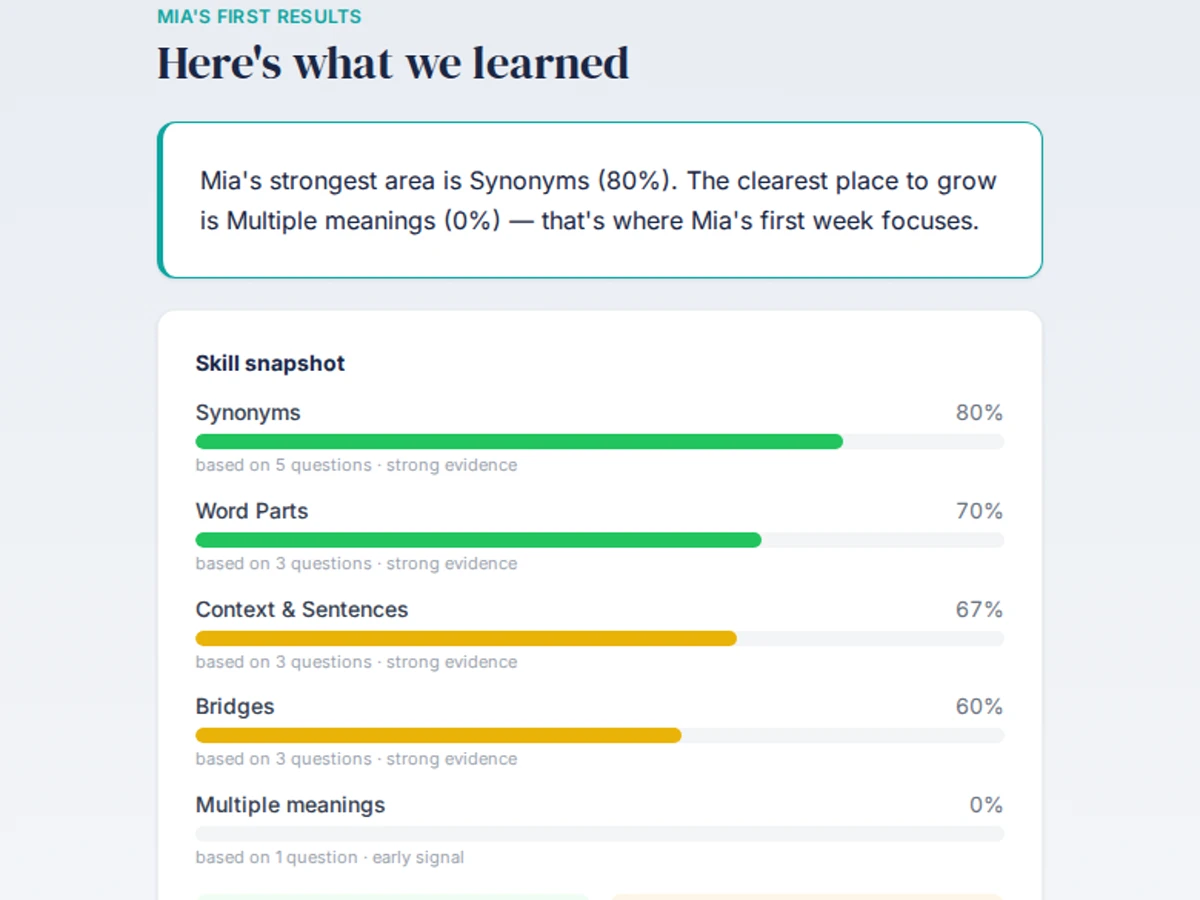
Root-based vocabulary study is the on-ramp that makes the rest of verbal prep faster — it is not the whole destination. Whether your child is sitting the TACHS or the HSPT (via the COOP program), what produces top-quartile performance is the full set of five verbal domains: vocabulary knowledge, relational reasoning (analogy bridge recognition), contextual inference (reading comprehension and vocabulary-in-context), test execution (pacing, skip strategy, no-retake composure), and metacognition (knowing which question types to commit to quickly). LexiMap builds all five and reports each one in a parent dashboard, giving you an honest view of where your child stands before the single November test date arrives.
Key Takeaways
- The TACHS is a single-date, no-retake exam — register in September and treat preparation as a one-shot window, not a trial run.
- The TACHS tests vocabulary synonyms and reading comprehension. The COOP program now administers the HSPT, whose Verbal Skills section tests synonyms, antonyms, analogies, and verbal classification.
- Root-based vocabulary study transfers across both, but your child needs TACHS-specific synonym speed practice and HSPT Verbal Skills practice for COOP-program schools.
- Start preparation by August 15 – September 1 to reach the November test date with 10–11 weeks of structured work.
- Admissions decisions follow in January or February — confirm each school's individual timeline rather than assuming a single announcement date.
For a complete guide to HSPT verbal prep (for Catholic high schools outside NYC/NJ), see our HSPT verbal section guide. For scholarship score targets at Catholic high schools, see our HSPT scholarship scores guide.
Get SSAT/ISEE vocabulary resources by email
Related Articles
SSAT vs ISEE: Complete Comparison Guide for Parents
SSAT vs ISEE: understand the key differences in format, scoring, verbal sections, difficulty, and which test is accepted where to make the best choice for your child.
50 Latin Root Words Every SSAT Student Should Know
Master the 50 most important Latin root words for the SSAT. Each root includes meaning, example words, and memory tips to build lasting vocabulary skills.
8 Ways a Strong Vocabulary Shapes Your Child's Future
Beyond test scores: the eight domains of adult life — from health and wealth to careers and emotional wellbeing — where research shows vocabulary makes a measurable difference.
Best ISEE Vocabulary Apps and Tools: A 2026 Comparison
Compare the best ISEE vocabulary prep apps — LexiMap, Quizlet, general vocabulary platforms, and practice tests. What actually prepares kids for ISEE synonyms and sentence completions.
Related Guides
SSAT Vocabulary: The Complete Guide to Root-Based Learning
Master SSAT vocabulary through Latin and Greek roots. Learn how root-based learning, spaced repetition, and interactive practice build lasting verbal skills for grades 4-12.
SSAT Vocabulary List: 200+ Words Organized by Level and Root
Comprehensive SSAT vocabulary word lists organized by test level (Elementary, Middle, Upper) and root word family. Study the right words for your child's grade.
SSAT® is a registered trademark of The Enrollment Management Association. ISEE® is a registered trademark of the Educational Records Bureau (ERB). LexiMap is not affiliated with or endorsed by these organizations.